A: No training agency sanctions solo diving with a rebreather. All training is done with an emphasis on buddy teams. You are taught to brief open circuit buddies on rescue procedures specific to rebreather divers.
That said, you are responsible for yourself. Accident avoidance is the best strategy. As I said before most accidents can be traced back to events or actions of a rebreather diver on the surface. Buddies should be there for random chance events such as a shark biting your leg not for your failure set your unit up correctly and monitoring during the dive. Units setup properly simply work as designed 99.999% of the time. Paying attention during the dive allows one to recognize problems and take action before an accident occurs.
As a note, to break the chain of events leading to an accident due to unit or diver failure, you simply bailout to open circuit and abort the dive. All rebreather divers carry bailout bottles and are trained to use them.
Q: Why use a rebreather?
A: Rebreathers by there nature do two things very well. First is gas logistics. With a rebreather you can stay down 5 plus hours with two 20cf2 bottles at any depth. The second and much more important to fish people is no bubbles. Your interaction with the critters of the sea is much different. With a rebreather you are one of them now. Not some big noisy thing to be avoided. That is why photographers are beginning to use them. I have sat a cleaning station and had my hand cleaned by little shrimp. Swam in a school of marlin having to push them out of the way. Way cool and at 40 feet of less.
A rebreather is a tool that is used in order to accomplish a result. Just like your regulators. Think of it as such.
Archives for February 2011
Changes at Oceanic Ventures
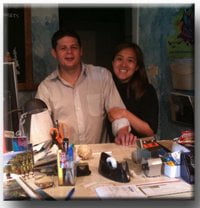
The world keeps changing and Oceanic Ventures is not immune. After graduating from the University of Houston, Ashton, our Retail Manager, has decided to change things up a bit and move to Boston. He is a part of our family and a part of the Oceanic Ventures family. He is moving to Boston to be closer to Joyce, who moved up to Boston a year ago.
Ashton will still be involved with the Company as a consultant and would like to lead a few of the really cold water trips (there are not many of our staff who love ice diving); he has also agreed to help us with some other projects.
Before leaving, Ashton tried to perform a Vulcan Mind Meld with Alex and transfer much of his knowledge and experience to him. Alex is a long-time client who has come on-board to take over some of Ashton’s duties and to keep Ann and me on-track. Please wish him well in that task!
You will also find some other new staff working part-time in the store along with some other old friends. Please come by and meet Alex and check on Dive Mom. You can reach Alex by email or phone just as you can reach Ann or me via our personal email accounts and through the store’s main account at divesafe@oceanicventures.net.
Things are changing but one thing remains the same, our commitment to being your door to adventure!TM We have a lot of exciting things happening this year including some cool travel opportunities, Club Aquarius meetings, and our all new DiverXY group. You really have no excuse not to make scuba diving a lifetime pastime.
Preplanning a Scuba Diving Silhouette Photograph

Penetration
© Eric V. Keibler
Here is a natural light photograph taken in a cargo hold in Truk Lagoon. While the shot may look completely natural, it was set-up prior to getting in the water. Todd Emons and I decided to go in the water together to take some photographs of one another in various locations on the ship.
Todd works on the Odyssey so he is very familiar with the wrecks and had some ideas of what shots might look good in this wreck. This type of local knowledge helps you to capture photographs that you might otherwise miss. Of course, you still have to do everything to take the image but setting up the shot can make things easier. You need to discuss the general sight and then make a plan with your dive buddy. It is easier to discuss what you want to do on the surface rather than underwater. Working with a model can be quite challenging underwater and having a plan before you go in makes it much simplier.
To take this shot, I swam to the lower portion of the cargo hold. While getting in position, it was important not to kick up the bottom or dislodge too much debris from the ceiling because the debris would ruin the shot. I set the camera on manual and set the camera to properly capture the blue light throwing everything else into shadows. After everything was set, I signaled Todd who was perched at the lip of the hold and he began to swim toward the camera being careful not to shine his light in the direction of the camera. You can see just a small beam coming from the light but because the hold was so large, and the backlight so strong, his light had little effect in the final image.
Also notice that while Todd is the subject of the shot, he is not in the center of the image but rather is in the top third of the picture. In general, it is more pleasing to the eye if the subject is not centered but rather offset into another quadrant. We call this division the rule of thirds which is a compositional tool. Look for a better discussion of this “Rule” in another post on composition.
Remember, when taking silhouette shots, it is important to make sure that you keep the meter reading set for the backlight and not let the camera adjust to the target swimming towards you.
Camera Specifications: Canon 5D, fitted with a 17mm-40mm lens at 20mm, f4.0 at 1/25 sec, ISO 640
Striped Marlin, Scuba Diving – an Underwater Photography Expedition

In the Company of Striped Marlin – an Underwater Expedition
The first year I led my Striped Marlin Expedition to Todos Santos in Mexico, it was splendid. Last year was almost a bust because we hardly saw any Striped Marlin. The reason for that was the water temperature rose to over 81 degrees, and that meant there were not many plankton and the sardines had nothing to feed on. The marlin somehow figured that out and almost totally avoided the normal pattern.
This year with support and reports from the University in La Paz and the local fisherman, I have understood that the marlin will show up, but later than last year. What you see below are images from the first two days here. The sea is placid, the wind very calm and water temperature is between 76 – 78 – just right for the plankton bloom, the sardine are feeding and … the marlin are here. Take a look:


 My Team of Guests
Chris and Jerry were with me last year – they understood very well what was happening with the water temperature and feeding patterns. We did all that was humanly possible to show them a good time and we succeeded to a limited level. Both were so impressed by the effort they have joined me again and they are here with us and they are so happy that they counted on my research. I am so proud to be able to deliver to such loyal guests, pictured above.
Every day we leave at 6:30 am along the western cost of Baja (on the Pacific side) and stay out till 5pm – watching the Frigate birds feeding action and formation. It’s the birds who actually give us information about the marlin. When a formation of two dozen or more Frigates is tight and close over the water I know the birds are feeding on sardines below – and the marlin are in pursuit.
All day we jump in and out of the water. The encounters last from just one minute up to sometimes 20 minutes. It’s a dance among the birds and fish. The “bait ball” of sardines, the Striped Marlin below, and the birds above all work in opposite directions from each other. The sardines run for their life but they are not much of a match for the quantity and skills of the birds up above and the marlin under the water. Both the flying and swimming predators are relentless and work the bait ball till it is consumed. It’s dramatic and exciting, especially when visibility ranges from 80 to 150 feet plus … next year we will come back in December. There will be room for only four people to join in the adventure, to be in the company of the ocean giants like the Striped Marlin.
Eric Keibler is putting together one of these trips with me. Remember, there are only 4 spaces so you need to call him quickly!
Between Scuba Dives – Tips for Flower Photography
 Start early in the day – Before the sun heats up the land there is usually far less wind, causing blur. Also, there is often dew on the flowers (or frost in winter), which can add another dimension to your pictures.
Photographs in the Sun – Flowers look great in the sun with the naked eye, but neither film nor digital can cope with the increased contrast. Overcast conditions are usually best, colors then saturate and your pictures will still look really bright, but even more colorful. There are exceptions to this though – for example, sunlight can create dark shadows behind your sunlit subject, creating an excellent non-distracting background. If you are going to take flower pictures in sunlight, try using a polarizing filter to reduce glare and enhance the colors. For best color results, shoot blue or violet flowers early in the morning, yellows in mid-morning or mid-afternoon and reds in late afternoon. – Place a diffusion screen between the flower you are photographing and the sun. You can completely block the sun and put your flower in shade, then redirect some light back on the flower with a reflector. This reflector can be a commercially made reflector or just something reflective like a white T-shirt or a piece of foam core (also try gold or silver reflectors). Another photographic technique would be to use fill flash. If your camera has an automatic fill flash function then give it a try. Experiment with the lighting ratio if your camera will let you change the flash output. Having the flowers backlit by either the sun or an off-camera flash will brighten and highlight flower petals.
 Use Lower ISO settings on your Digital Camera – To get the lowest noise, (similar to grain in film) most digital cameras work best at ISO 200, so use this setting and a tripod for best results.
Control your depth of field – If you are photographing a single flower with a busy background then use a wide aperture to selectively focus on the flower and blur out the background. Conversely, if you are photographing a field of flowers the use a smaller aperture setting to bring most, if not all the flowers into focus. If your camera has a depth of field preview then this is the time to use it. To blur your backgrounds, use a large aperture (small number like f5.6) to avoid distracting backgrounds. Using your camera’s depth of field preview feature is the best way to ensure that you’ve blurred the background – and still got enough of the flower in focus
Spot focus – The normal focus mode of most digital cameras is some sort of average focus mode. That means that the camera will try to look at an area and base the focus on an area of what it sees. It’s better for close up photography to put the camera into spot focus mode, this will allow you to see exactly what the camera will be focusing on.
Multiple photographs – Set up your first shot to include the whole flower then concentrate on the details of the flower that attract your eye. Focus on the color or small details of the flower. Photograph your flowers from different angles. Shoot straight down, from the side, from the underneath, just change it up a little. Shoot horizontal and vertical. Position yourself low to the ground to give the perspective of the flowers. If you kneel or lie down on the same level as the subject, the flowers will appear larger in the photograph, and they will fill up more of the frame. The low perspective also keeps you from shooting the tops of your subjects’ heads and making the flowers look small in the photos.
TECHNICAL STUFF…
 Use a tripod – getting close increases the chance of camera shake, so it’s best to use a tripod whenever possible. It also slows down the picture-taking process, which means you have more time to concentrate on the composition
Shoot RAW format files – If you have a camera that will allow you this option. You can only get the most from your pictures by shooting RAW – the highest quality. For Cameras without RAW File Option, use the highest quality JPEG that your camera allows you to choose. You can usually find this setting somewhere in the menu screens. If your camera has a screen with a histogram (the histogram is the little graph looking thing on the menu screen), always view the screen after your first shot and at the beginning of every series of shots with the same subject. The most computerized matrix meters can’t always get the correct exposure. One of the major advantages with shooting digital: you can see what you have right on the site, and, you can see exactly if you have obtained all of the information available simply by looking at the histogram. A good histogram will have the whole curve within the confines of the box, and not have most of the data up on one side or the other of the box. Especially avoid going over the edge of the right side of the box. That means you have lost the data in the lighter parts of your subject and you can never get it back.
DIGITAL Storage Cards ‘FILM’ – This consists of CF (CompactFlash) or the smaller SD (Secure Digital) cards. These can be used over and over again indefinitely. After you upload your full card to your computer you should ‘Reformat’ the card INSIDE the camera for the next batch as opposed to just deleting the files. Reformatting leads to less storage errors in the future. CompactFlash cards are basically faster and larger capacity than SD cards. If you have a choice in your camera, choose CompactFlash. They are priced based on write speed, the faster the more expensive. Write speed isn’t all that important for flower photography. Use multiple cards, because you don’t want all of your eggs in one basket, right? 200 full RAW images per card is a good standard to use.
Scuba Diving from the Dumaguete Pier in the Philippines
Topside, this was the most unimpressive dive site I’d ever seen, with docked cargo ships and unpleasant noises and smells of industrial activity. Descending to the sand at about 20 feet did not prneude much inspiration as we were greeted by some rusted cans and a baby’s diaper (used, apparently). I was left wondering why the boatload of experienced divers and divemasters was so keen on this site.
Dumaguete is on the Bohol Sea in Negros Oriental, Philippines, approximately 30 hours from Houston via Honolulu, Guam and an overnight in Manila. It is an absolutely fabulous dive location, at the northern portion of the “Coral Triangle”, the region of the greatest coral reef biodiversity in the world, and therefore well worth the arduous trip from Texas.
 The pier at Dumagute was no exception; it turned out to be the richest site of photo opportunities and encounters with weird and wonderful creatures in Negros Oriental. In this photo I was lucky to capture some very interesting behavior between 2 similar looking fish species, and equally fortunate to have Marco Inocencio from Atlantis Dive Resort interpret the activities. According to Marco, the larger fish in the hole is a false cleanerfish (Aspidontus taeniatus), while the two smaller fishes that are shown in full view are cleaner wrasses (Labroides dimidiatus). The larger fish is a mimic; it’s actually a member the blenny family who is posing as a cleanerfish in order to take bites of skin and flesh from other fishes looking for a cleaning. The false cleanerfish is distinguished from the cleaner wrasses by its head, which ends in a “nose” with its mouth slightly under and behind it while the heads of the cleaner wrasses terminate with their mouths. If you look closely enough you’ll see the characteristic pouty lips of the false cleanerfish, presumably because she isn’t much appreciated for her clever disguise and food-gathering methods!