A note from Karen: Today’s science project was to go out in the dinghy and observe a small pod of killer whales, also known as Orcas, that came to play in the lagoon. When we got too close, Rebecca reassured the nervous adults that killer whales in the wild have never been known to injure man. (She has a book on dolphins and whales.) We questioned her for further facts and found out that they could hold their breath for an “astonishingly long time” and swim really fast. Asked to qualify those terms, she came home, dug out her book and wrote a report. She then gave an oral presentation–complete with pictures to enhance the telling–and enlightened all the adults.
How about that for real live science applications?
 We spent the next few days towing a windsurfer board behind the dinghy. At first Rebecca was a bit tentative. Now she says she is going to stand up next time she tries.

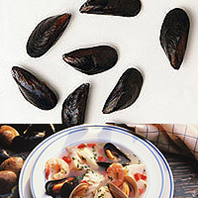 Mussel farms are across the bay. It’s a short trip to collect a hundred or so for dinner. We’ve had piles of steamed mussels, smoked mussels in pasta, mussels tossed on the coals, and eaten as soon as they opened – we’re still not tired of mussels. Just around the corner is a nice place to catch red snapper and we’ve been working our way through recipes including fried, grilled, and smoked. Locals pointed out a bay where pacific island oysters can be collected a low tide, there are scallops and lobsters for the taking around 50-60 feet. We’re surrounded by seafood, beautiful hills and snug anchorages.
 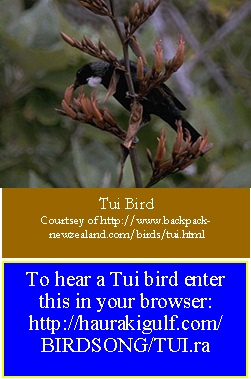 We’ll spend two or three more weeks in this area before heading to a marina in Auckland. We bought a car last season and it’s waiting for us in the parking lot. After a season of cruising in Fiji we have a long list of boat projects to attend to. There are welders, alternator repair shops, libraries, internet connections, fresh vegetables, ice cream, traffic lights and all the complexities of civilization just 40 miles away. Meanwhile we’re going to bed early, waking up to the song of the Tui bird and enjoying this bit of New Zealand.
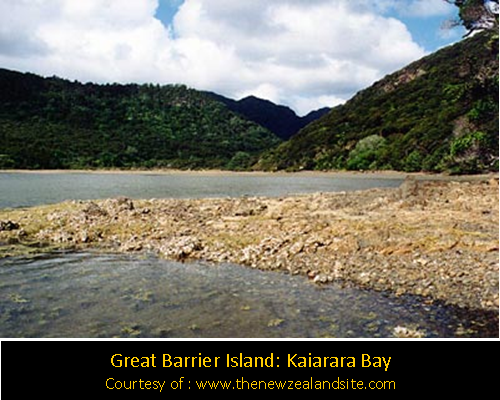 36º12S / 175º20E Early yesterday afternoon, at low tide, Rebecca and I went exploring. We zipped around the bay in the dinghy, waded on the mud flats digging bivalves out of their holes, and followed a freshwater creek through the woods – climbing over fallen trees and plowing through masses of ferns. After an hour we came back out of the woods to our beached dinghy and found a Kiwi yacht had anchored in our beautiful, isolated bay. They weren’t too close and it was time we started meeting the locals, but we had enjoyed having the place to ourselves for a couple of days. We picked up Karen and the three of us motored over to say hello. Turns out they were from the marina we stayed in last year, and were berthed next to our good friends on Cherokee Rose. When we left for Fiji last year, Cherokee Rose had stayed behind in NZ to do work on their boat. We had talked to them on the SSB and expected them to anchor next to us before evening. Looked like the party was getting bigger.
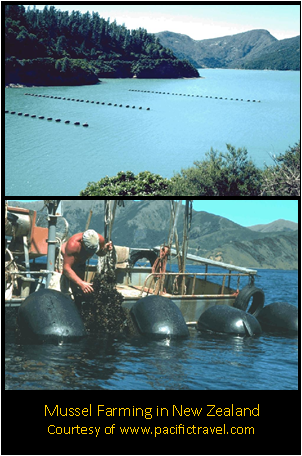 There are large, floating rafts of mussel farms all around the Great Barrier Island but we hadn’t found any mussels or oysters clinging to rocks at low tide. Turns out the farmers are perfectly happy for you to pick mussels off the buoys that support the dangling lines where the actual crop grows. They mechanically harvest the mussels on the down lines but it’s too much trouble to gather the wild ones that grow on the buoys. So, help yourself, limit 50 a day, don’t touch the down lines, please. There are mussel farms all over the Great Barrier Island, with several hundred buoys supporting each farm, one buoy has enough mussels to fill a large bucket so we find ourselves surrounded by thousands of mussels free for the taking. Our new Kiwi friends were also kind enough to point out a cove across the bay where they had been collecting scallops in 50 feet of water. The water is cold but, with a sea bed littered with scallops, I’ll certainly be diving. As long as I’m getting wet, there are plenty of lobsters living around 50-60 feet along the vertical walls of the islands. Then there are the ten-pound Snappers that bite when the current is running. What a Paradise!
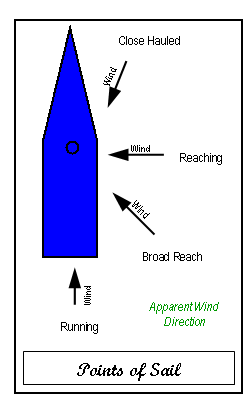 The dreaded low-pressure system passed over us yesterday with its accompanying cold front. Happily, this one wasn’t too strong and passed over us during daylight hours. We spent the day under gray skies with periods of torrential rain. Out came our seldom-worn foul-weather gear. In the tropics, we would enjoy the rain but this far south it’s cold! With our hard dodger it wasn’t bad and the winds stayed under 25 knots behind us.
 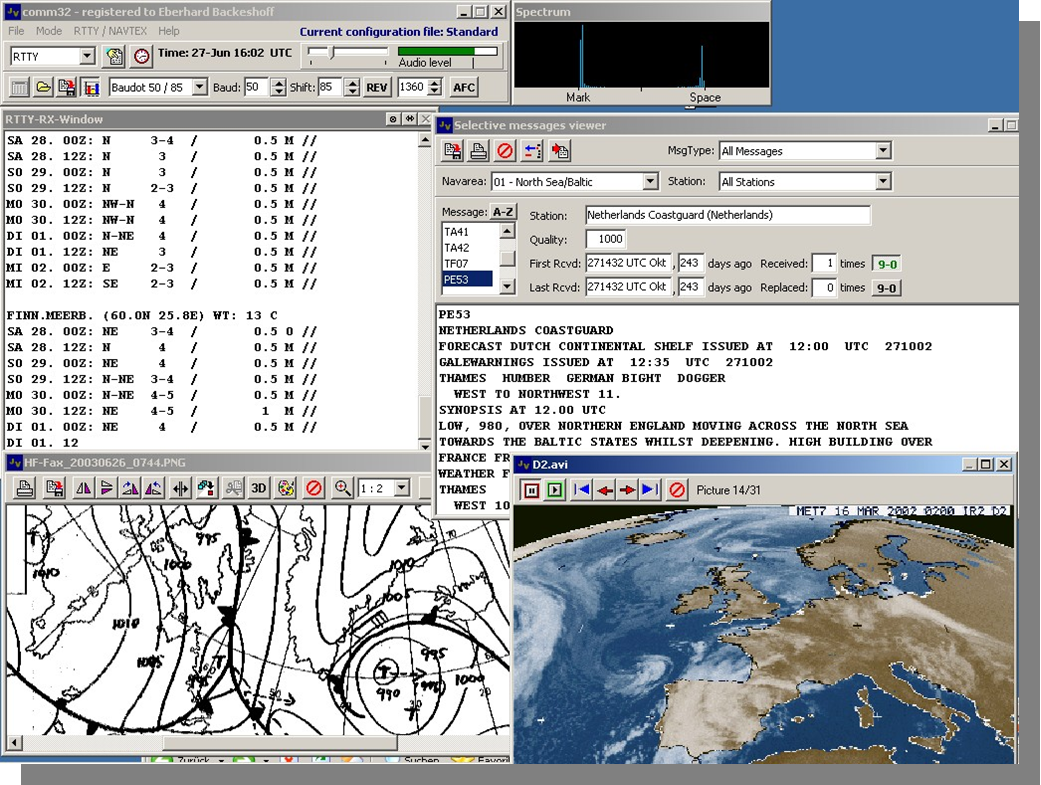 In answer to your question, the weather software we use is by a German company that receives weather faxes and grib files downloaded from the amateur radio Winlink network. Grib files are also available from commercial stations such as SailMail. Check K4CJX’s website for a description of Winlink and grib files.
 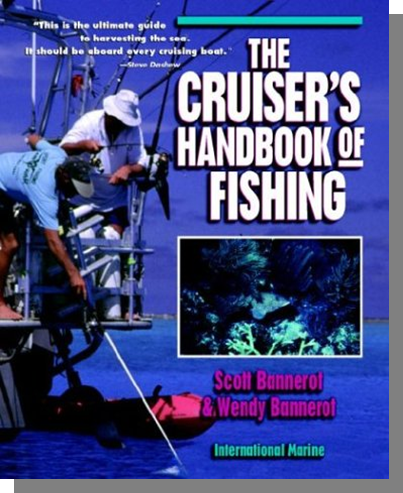 Anyone going cruising should have a copy of The Cruiser’s Handbook of Fishing. This book describes every possible fishing technique. For years we trolled with a small Penn Senator Reel and rod and a “meat line” (1/4″ 3-strand, 15 feet of wire leader, and a bungee cord to take the shock of a fish strike). After studying the book we graduated to trolling two Shimano rods and gorgeous Shimano Tiagra W-50, lever drag reels. Our lures are usually Rapella’s or plastic squids with metal heads. We use a wide range of colors and sometimes “decorate” the plastic squids with Mylar strips from wine box bladders, chip bags, bits of colorful yarn, etc. We’ve had a great fishing year and have done much better than friends on other boats. I give full credit to the book. Fishing is a whole lot more fun when you regularly catch fish. We’re looking forward to learning how to catch the large, 10-15 pound Snapper in New Zealand. There’s also plenty to learn about abalone, mussels and other mysterious creatures in New Zealand’s outlying islands.