• Skip to primary navigation
  • Skip to main content
  • Skip to footer

Houston's Premier Scuba and Dive Shop Oceanic Ventures Inc.

(713) 523-3483 (dive)
5808 Newcastle Drive
Houston, TX 77401

  • Home
  • Stay Current
    • Our Blog
    • Travel and Events Calendar
    • Club Aquarius Social Club
      • Club Aquarius Social Club Upcoming Events
      • Club Aquarius Social Club – The Past
    • Special Events
    • Local Scuba Diving Events
    • Photography Contest
    • Categorized Blog Posts
  • Equipment
    • Dive Equipment
    • Rebreather Systems
    • Cruise Ship Passengers
    • Repair & Maintenance
    • Air & Mixed Gas Blending
    • Pure Fiji Spa Products
  • Training
    • Become a Scuba Diver
    • Scuba In Your Home or Ours
    • Diving Programs for Young Explorers
    • Recreational Dive Courses
      • Recreational Dive Courses overview
      • The Briar Club Scuba Program
      • West University Scuba Program
      • Houstonian Scuba Program
    • Technical Diving Courses
      • Basics
      • Nitrox
      • Trimix
      • Rebreather
      • Wreck Diving Programs
      • Cave Programs
      • Blending
    • Leadership Dive Courses
  • Travel
    • Travel Escorted Adventures
    • Travel – Other Travel Programs
    • Travel – Custom Travel Adventures
    • Local Scuba Diving Events
    • Technical Travel
    • Scuba Diving Around Texas
    • Travel Insurance
    • Travel Forms
  • Company
    • About Oceanic Ventures
    • Meet Our Team
    • Testimonials
    • Facility Hours
    • Map
    • Oceanic Ventures Foundation
    • Resources & Articles
    • Archive
  • Shop
    • Online Store
    • Cart
    • Checkout
    • My Account
    • Policies regarding Privacy and Purchases
  • Contact

S/V Enchante

September 7, 2020 by Carl Strange

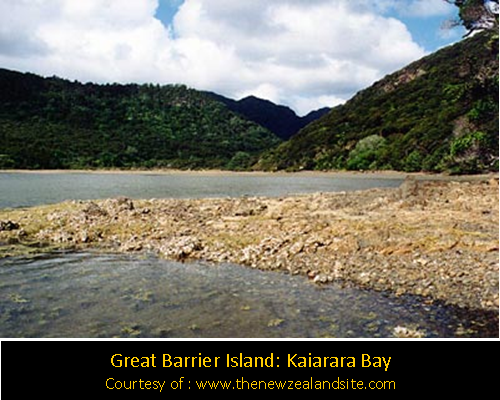
New Zealand – Kaiarara Bay, Great Barrier Island

36º12S / 175º20E Early yesterday afternoon, at low tide, Rebecca and I went exploring.  We zipped around the bay in the dinghy, waded on the mud flats digging bivalves out of their holes, and followed a freshwater creek through the woods – climbing over fallen trees and plowing through masses of ferns.  After an hour we came back out of the woods to our beached dinghy and found a Kiwi yacht had anchored in our beautiful, isolated bay.  They weren’t too close and it was time we started meeting the locals, but we had enjoyed having the place to ourselves for a couple of days.  We picked up Karen and the three of us motored over to say hello.  Turns out they were from the marina we stayed in last year,  and were berthed next to our good friends on Cherokee Rose.  When we left for Fiji last year, Cherokee Rose had stayed behind in NZ to do work on their boat. We had talked to them on the SSB and expected them to anchor next to us before evening.  Looked like the party was getting bigger.

A little later in the day, the couple invited us over for “sundowners before tea”.  (Translation: Sun Downers, noun, usually plural, yachters around the world recognize this as “bring your own drinks, we’ll supply snacks, enjoy the conversation as the sun goes down.  Tea, noun, NZ, and Aus, what we would call supper or dinner – if you are invited for tea, don’t eat before you go).  Another Kiwi boat had anchored nearby so seven (later nine when Cherokee Rose arrived) crowded around the cockpit.  Kiwi yachters know about seafood!  Rather than the typical snacks of peanuts, pretzels, olives, and cheese, or cut veggies,  Myra and Bevin served steamed mussels and lightly breaded pieces of snapper.  Around mouthfuls, we asked them to teach us how to collect and cook our own. 
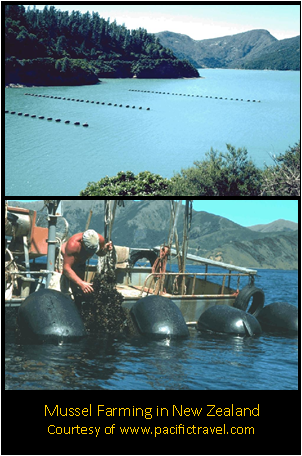
There are large, floating rafts of mussel farms all around the Great Barrier Island but we hadn’t found any mussels or oysters clinging to rocks at low tide.  Turns out the farmers are perfectly happy for you to pick mussels off the buoys that support the dangling lines where the actual crop grows.  They mechanically harvest the mussels on the down lines but it’s too much trouble to gather the wild ones that grow on the buoys.  So, help yourself, limit 50 a day, don’t touch the down lines, please.  There are mussel farms all over the Great Barrier Island, with several hundred buoys supporting each farm, one buoy has enough mussels to fill a large bucket so we find ourselves surrounded by thousands of mussels free for the taking.  Our new Kiwi friends were also kind enough to point out a cove across the bay where they had been collecting scallops in 50 feet of water.  The water is cold but, with a sea bed littered with scallops, I’ll certainly be diving.  As long as I’m getting wet, there are plenty of lobsters living around 50-60 feet along the vertical walls of the islands.   Then there are the ten-pound Snappers that bite when the current is running.  What a Paradise!

Carl Strange Avatar
Carl and his wife Karen set-off on a journey around the world on-board their sailboat S/V Enchante. Along the way, they had a lot of adventures and in Aruba, a new member of their crew was born. Now a family of three with Rebecca’s birth, they sailed the Caribbean and the Pacific experiencing life along the way.

Filed Under: Pacific, Sailing, Uncategorized Tagged With: S/V Enchante

August 31, 2020 by Carl Strange

New Zealand – We Have Arrived

We arrived on the Morning of the 30th during periods of pouring rain. We didn’t have much choice about getting out in the weather to drop sails and come alongside the Customs Quay. The officials’ normal enthusiasm was a bit dampened, however. Our papers were neatly in order, our prohibited foodstuffs were bagged and ready to hand over, and Rebecca was her normal, winning self. So clearance went smoothly and we felt welcomed back to New Zealand.

The cold rain over the last few days is taking a bit of getting used to. We are reading, napping, sleeping, and talking about the short list of tasks before getting underway again. This season we will cruise and land tour a lot of New Zealand. To get in the swing, we plan on leaving the marina in a couple of days and day-hopping down the coast to their Great Barrier Island. I understand the diving for “Crayfish” and abalone is spectacular. The locals recommend a 7-mil wet suit. I only have a 5-mil and haven’t seen my hood in years. If only I had a 75-foot trawler I could walk down to the dive locker and pull out a dry suit for these special occasions. If I remember correctly, I’m supposed to have two or three slugs of rum as a belly warmer before the dive.

According to Lonely Planet…

New Zealand is a country of rare seismic beauty: glacial mountains, fast-flowing rivers, deep, clear lakes, hissing geysers, and boiling mud. There are also abundant forest reserves, long, deserted beaches, and a variety of fauna, such as the kiwi, endemic to its shores. Any number of vigorous outdoor activities – tramping (hiking), skiing, rafting and, of course, that perennial favorite, bungy jumping – await the adventurous. You can swim with dolphins, gambol with newborn lambs, whale watch, or fish for fattened trout in the many streams. The people, bound in a culture that melds European with Maori ancestry, are resourceful, helpful, and overwhelmingly friendly. The extraordinary place names – try Te Awamutu, Whangamomona or Paekakariki for tongue-trippers – are resonant and, with a modicum of practice, easy to pronounce.

Because it’s such a compact place, travel within New Zealand – whether by plane, bus, rail, car, or bicycle – is affordable and efficient. Accommodation too is cheap and varied. And the culinary promise of venison, fresh seafood, sublime ice cream, and award-winning wines should more than whet the appetite. (Courtesy of www.lonlyplanet.com)

Carl Strange Avatar
Carl and his wife Karen set-off on a journey around the world on-board their sailboat S/V Enchante. Along the way, they had a lot of adventures and in Aruba, a new member of their crew was born. Now a family of three with Rebecca’s birth, they sailed the Caribbean and the Pacific experiencing life along the way.

Filed Under: Pacific, Sailing Tagged With: S/V Enchante, Sailing

August 3, 2020 by Carl Strange

Fiji – Saweni Bay (Navigation)

Navigation – What we use on S/V Enchante

Briefly on electronic charts.  We carry a full complement of traditional paper charts and have the appropriate set readily available at the Navigation Station for the area of the world we’re cruising.  More and more however we rely on electronic charts for route planning and plotting while moving near to shorelines.   The program CMap, sometimes running MapSea as an easier-to-use interface, is the most popular charting program in this part of the world.  It uses seamless, vectorized charts that cover the world on two CDs so it’s not necessary to buy expensive “chart kit” CDs for various areas.  Cap’n Voyager, Visual Navigator, and every other program I’ve had a chance to play with completely fail when planning a route across the E/W dateline.  With the exception of CMap/MapSea, every charting program refused to draw the roughly 1000-mile route from Tonga to New Zealand.  The program insisted on routing you eastward from Tonga, traveling completely around the world to arrive in New Zealand.  The other problem is the limited availability of charts for the “chart kit” type programs.  CMap/MapSea has become very popular and has very accurate, usable charts.

For redundancy, we have two GPSs always installed and running.  One at the Navigation Station and one in the cockpit.  The electronic charting program is interfaced with the GPS units so it can plot our position on the computer and we can upload waypoints of planned routes.

And, yes we carry a couple of sextants – a cheap Davis model and a more proper metal one.  We also carry sight reduction tables and an almanac.  Once in a rare while, I dig everything out and run a series of star sights.  After two or three days I get back in the swing and my calculated position starts getting close to my always-accurate GPS fix.  Lightening strikes and complete electronic failure aren’t unheard of on cruising boats. 

While we don’t go nuts with formal logkeeping when well offshore we do regularly record our position, course, and speed.  We can comfortably fall back to a completely paper-based navigation routine using celestial while well offshore and resorting to taking bearings when approaching land.  You’d be surprised how many boats are out here without a clue about navigation other than entering waypoints in their GPS and following the little pointers.  We know of nine boats that were lost last year because they ran onto reefs.  Two of them completely misread their position and the lights while making evening approaches to Papeete, French Polynesia and this is one of the best marked and lit approaches you’ll ever see.  Another ran into South Minerva Reef because they drew a line from Tonga to New Zealand on their electronic chart and didn’t realize their course crossed one of the most famous reef systems in the South Pacific.

Carl Strange Avatar
Carl and his wife Karen set-off on a journey around the world on-board their sailboat S/V Enchante. Along the way, they had a lot of adventures and in Aruba, a new member of their crew was born. Now a family of three with Rebecca’s birth, they sailed the Caribbean and the Pacific experiencing life along the way.

Filed Under: Sailing Tagged With: S/V Enchante

July 27, 2020 by Carl Strange

Fiji – Saweni Bay

17o28S / 177o24E

At least I hope we have left the west coast of Viti Levu and are snuggly anchored on the tiny island of Waya in the southern portion of the Yasawa group.  No cities, no streets, and fewer day charter boats the further north we go

Communications – What we use on Enchante

REbecca Strange on the Radio
Rebecca Calling Out

Long-distance cruising boats need long-distance radios.  VHF works for harbor and anchorage communications but its line of sight and limited to 10-15 miles even with mast-mounted antennas.  Up until the mid-80s or so cruising boats had Ham radios because commercial Single Side Band Radios (SSB) were much, much too expensive.  You took the Morse code and written exam and talked around the world for free.

SSB radios got cheaper and Morse code never quit being a pain so more and more boats started using SSBs  Only commercial, frequency-controlled radios can be legally used on SSB frequencies.  Typically these radios are electronically, restricted to the SSB bands and frequencies.  Ham radios cannot legally be used on the SSB frequencies and are electronically restricted to the ham bands.  However, Ham radio operators consider themselves radio experimenters and the helpful manufacturers make it trivial to disable the frequency restriction allowing the radio to transmit on any frequency.  I would be shocked to find a Ham radio on a cruising boat that hadn’t been altered to work on both Ham and SSB frequencies.  When pressed, the ham can point to the regulation allowing any form of communication in an emergency.   In reality, the bands are poorly policed, especially internationally.  For instance, there is a legal requirement to identify the ship station by radio call sign such as WB5ABC.  The great majority of boats simply use their boat name.  I would have to dig out my license to look up my Ship’s Station License.  In the real world, I am “Enchante“.  Ham frequencies are more disciplined and there I am known by my ham call sign.

For voice communications, it hardly matters if you install an SSB or Ham radio with the band restriction disabled.  Ham does give you access to a more formal system of “nets” stateside.  For instance, the Ham-operated Pacific Seafarers Net meets nightly to track boats traveling in the Pacific.  This is a friendly net that runs a formal roll-call of boats underway.  If you declare yourself underway you are expected to check in each evening.  Should you miss a couple of evenings, the net will get seriously “interested” in finding you.  If you are within a day of your destination, they’ll let you slide a couple of days assuming you are sleeping like a log after a long trip or tied up with Customs/Immigration procedures.  However, if your last report had you well offshore or you miss more than a couple of days the net will begin to alert authorities and ultimately will initiate a full-fledged search.  Hams check into this net knowing it is a lifeline should something go wrong.  A more informal SSB net has a much more relaxed attitude about “missing” boats and the daily operator will typically shrug your absence off with something like, “Guess they forgot”.  I suppose I prefer the more formal Ham approach when traveling far offshore.  On the other hand, most of the useful information about cruising areas, island check-in procedures, problem-solving “why does my starter make this noise?“, and general boat-to-boat chat is carried out on the SSB bands.  Hence the popularity of modified Ham rigs.

A huge advance in communications for cruisers started in the mid-90s with the introduction of Email via Ham radio.  Although it was painfully slow in the beginning, the ability to send and receive email brought new life to Ham Radio.  The software and hardware were developed by Hams for Hams.  Being Ham radio the software and shore-based service are completely free.  Of course, these guys aren’t dummies and quickly recognized a commercial market was needed to service all those boats with SSB radios since it’s perfectly legal to charge for services on these frequencies.  All of a sudden boats can send and receive mail daily instead of waiting for the three-month, bulk mail delivery that contains more junk mail than letters. 

Hams get email communications for free all around the world.  SSB users pay an annual fee and are allocated something like 15 minutes daily.  For a complete description check out K4CJX’s website or search for SailMail.  This mode of communication is advancing quickly.  Last year I could download weather faxes for fixed areas of the ocean.  This year I can download animated, wind, and isobar computer models for a multi-day forecast over any area of the ocean I’m interested in.  This is a huge improvement in forecasting weather for a voyage.  While anchored in Fiji I can request a five-day forecast extending all the way to the SW corner of Australia.  By watching the winter fronts developing over the Tasmanian Seas I can pick a decent departure time and not get clobbered by a cold front during the 1000-mile voyage to New Zealand.  At least that’s my plan ;-).

There are many sources of information on radio installations.  Being a ham I sometimes like to play around with different antenna designs.  Most boats install insulators on their back stays to electrically isolate a long piece of wire.  They run an antenna feed line and use this long portion of their backstay as an antenna.  I can’t understand doing something silly like breaking up such an important piece of standing rigging with insulators and spending a bunch of money to do so.  If one of those expensive insulators breaks you lose your rigging.  I ran a separate length of 14-gauge wire from the stern of the boat to the top of my mizzen mast.  The ends of this antenna are electrically isolated from the rig with two $1 egg insulators and a couple of short lengths of string.  The lower portion of the antenna is tied off at the rear end of the solar panel mount so the antenna doesn’t run right alongside the back stay.  This antenna works great and I don’t have to worry about compromising my rigging.  My 14-gauge wire (or an insulated backstay antenna’s feed line) leads through a deck fitting and connects to an automatic antenna tuner tucked away in a back locker.  Again, lots of information is available on recommended lengths of antennas and installation.  Like everyone says it is vitally important, and a royal pain, to install a good ground system.  Karen and I spent days running 3″ copper straps.  Now we have tied together an external cast-iron keel, fuel tank, engine, solid lifelines and other odds and ends.   The more connections we made the better signal reports we received.

Icom IC-7100 multi-band radio
The Icom 706MKII is no longer available but a new alternative is the Icom IC-7100

Finally, my Ham radio is a small little Icom 706MKIIG connected to a matching Icom automatic antenna tuner.  The radio is modern enough to support digital communications and happily mates with the popular SCS PTC-IIe radio modem upgraded to PACTOR Mode III.  All of this jargon can be cleared up by visiting the mentioned K4CJX website.  Basically, my Dell laptop is connected to the radio modem which, in turn, is connected to the radio.  Dell runs a free email program (AirMail) that sports the familiar email interface.  Airmail also knows how to control the radio modem and radio to send and receive messages.  Traveling in the South Pacific we have a wide selection of Ham stations in the States, New Zealand, and Australia.   The same software and SCS modem can be used with a variety of radios – check the web.

Carl Strange Avatar
Carl and his wife Karen set-off on a journey around the world on-board their sailboat S/V Enchante. Along the way, they had a lot of adventures and in Aruba, a new member of their crew was born. Now a family of three with Rebecca’s birth, they sailed the Caribbean and the Pacific experiencing life along the way.

Filed Under: Sailing Tagged With: S/V Enchante

July 13, 2020 by Carl Strange

Fiji – Mamanuca Islands

We’re currently enjoying life at the famous Musket Cove Yacht Club.  Basically, cruisers hang out next to a nice resort.  I suppose we’re all part of the tropical scenery for the resort guests so management doesn’t mind having us around.  Besides we pay a modest mooring fee and buy beer at the bar.  This is my first “yacht club” membership.  Lifetime membership costs $1 Fiji (50 cents US) but to qualify you have to have sailed at least 1000 miles from a foreign port.  No burgee or T-shirt to buy but they do carve your name, year, and yacht name in the beams at the fancy restaurant.  Look for ours when you come through.  From here we’ll head to Vanuatu or New Caledonia before heading back down to New Zealand for the next cyclone season.

I finally gave up on my old Windbugger and replaced it with a new KISS generator built in Trinidad.  More power, brushless motor, fiberglass case and all new parts.  What a treat to have something new on the boat.

Our combined power generation is the wind generator, five solar panels (18 amps with the sun directly overhead), a shaft driven alternator (10-15 amps) while sailing, and a 190 Amp alternator for the house batteries.  In the trade wind belt, with days of continuous 15-20 knot winds and bright sun through scattered cumulus clouds, a typical output from the KISS wind generator is 8-10 amps and, during mid-day hours, solar provides 12-15 amps.  Our Grunert refrigeration and Spectra water maker are both 12 volts and we can sometimes rest at anchor for days without running the engine for charging. 

Of course, there are plenty of days with no wind and solid overcast skies when we run the engine for one and 1/2 hours.  The four liters of diesel consumed gives us a cold ice box, solidly frozen meat in the freezer, and 24 gallons or so of very fresh water.

Our water heater works by circulating engine cooling water.  I’ve seen systems with electric elements and know boats that shunt extra power from wind and solar into making hot water.  After a couple of days without running the engine we resort to a more basic solar heater – green, 2-liter soft drink bottles laid on the back deck.  They get plenty hot after a couple of hours.  The only problem is getting around to taking your cockpit shower right after your sundown gin & tonic.  If we wait too long and the heat quickly leaves the bottled water.

The Spectra water maker continues to work well.  It truly produces 16 gallons/hour drawing only 16 amps.  I definitely prefer the flexibility of a 12-volt (or 110-volt with generator) over mounting the high-pressure pump to your main engine.  The flow rate of the pump, and subsequent system pressure, depend on the RPM of your engine.  With a belt-driven system, you have to decide if the water maker is going to run at idle or motoring speeds and size the drive pulley accordingly.  With a 12-volt (or 110-volt) system you can run the system whenever you have sufficient power.
We have been relaxing in Fiji and enjoying some of the local entertainment.  shipped home a kava bowl and some carvings.  There’s also a few bundles of kava in the forward head and a bag of ground stuff somewhere on the boat.

Carl Strange Avatar
Carl and his wife Karen set-off on a journey around the world on-board their sailboat S/V Enchante. Along the way, they had a lot of adventures and in Aruba, a new member of their crew was born. Now a family of three with Rebecca’s birth, they sailed the Caribbean and the Pacific experiencing life along the way.

Filed Under: Sailing Tagged With: Musket Cove Yacht Club, S/V Enchante, Sailing, The Strange Chronicles

January 2, 2020 by Carl Strange

Diving and Spearfishing Equipment for Cruising Sailors

When you start planning to go cruising you seek advice from professionals, friends, newsletters, articles, and any other resource you can find. You gather all of the information then distill it into a plan, find that you need a 100’ boat to store all the things you think you need, refine the plans, and set out to implement the plans hoping that you can get it done before you are too old to leave.

Since a cruising sailboat spends most of its time surrounded by water and one of the major activities that cruising sailors participate in is snorkeling and diving, we decided that we should outfit our boat for these activities. Of course little did my wife Karen know that the simple plan of outfitting a boat for some leisure time activities and some less leisurely charges would get out of hand.

Somewhere along the way, I became a NASDS Open Water Instructor and an IANTD Advanced Nitrox Instructor. I have logged hundreds of dives (much to the displeasure of my trainers I have given up logging them regularly).   My wife and I, and now our three-year-old daughter, have been living on our boat since 1992 and cruising since 1994.  Since Rebecca has entered our lives, Karen and I rarely dive together. Of course, even before Rebecca, I had a higher need for bottom time so much of my diving was and still is solo diving. There are times I dive with friends from other boats, but the reality of the situation is many cruisers learn to solo dive. [Even if you are trained and equipped as a “Solo Diver,” Oceanic Ventures does not advocate solo diving.  We have always felt divers are safer in the water if they have a dive buddy or partner.  This means you should find fellow cruisers in your anchorages and go diving with them.  Solo diving means you are placing yourself at a much higher risk.]

In addition to scuba diving, I also enjoy spearfishing while snorkeling and can happily spend hours swimming around a reef watching fish behavior and hunting for dinner. Cruisers have the advantage of living in some of the most beautiful waters of the world and, on Enchante’, we’re in the water almost every day.

My recommendations for scuba diving and snorkeling are based on my experiences as a cruiser and are for what I’ll call independent boat diving. By this, I mean diving or hunting out on a reef far from the support of a dive shop.  You should know I don’t sell equipment.  Basically, this is information I wish I’d had when we were preparing our boat for cruising.  There are numerous manufacturers of scuba diving and snorkeling equipment and many of their product offerings will fill the bill; so, with the exception of one or two cases, I won’t recommend specific manufacturers.

Oceanic Ventures Your door to adventure…

Your first priority should be to establish a relationship with a good dive shop.  Tell them what your plans are, listen to their recommendations, and decide if they seem interested in your adventure and are capable of providing you with long-range support for the next several years. Before we left Texas for the Caribbean we discovered Oceanic Ventures in Houston. After several years, we’ve become close friends with Ann and Eric, and don’t hesitate to recommend them to other cruisers.  They have personally been involved in helping to outfit cruising boats and reliably provide far-flung support to cruisers.  Since they own a sailboat, they have a good understanding of what you’re trying to accomplish.  It probably bears repeating that I don’t receive any commission from their shop.  In fact, they’re almost certainly going to disagree with some of my recommendations.  You can trust them to do as good a job for you as they have for us.

Presumably, you’re still enjoying civilization as you prepare to cruise and have, no doubt, considered buying equipment over the Internet. While you can probably find cheaper prices than through a dive shop, you need to be cautious.  Unless you know an awful lot about dive equipment, you can easily end up with junk.  You will also find warranty support to be an issue since reputable manufacturers sell through their dealers and expect those dealers to honor their regional boundaries.  You won’t have the benefit of discussing equipment choices or the chance to ensure a proper fit when you shop over the net.   It’s also very important to make a couple of trips to the dive shop’s pool to make sure everything is working properly, that you understand how to operate your new gear and that you’re comfortable with the fit.  Your first dive in new equipment shouldn’t start with a back roll off a moored dinghy looking down at the face of a wall that plunges several hundred feet.

It’s important to realize that once you’ve dealt with a store you’re considered a customer and can expect support from them wherever your travels take you.  A good shop will know how to ship equipment to a “yacht in transit”.  Perhaps, should you be anchored at a popular dive destination, they might even be able to arrange for a group of vacationing divers to bring equipment to you at considerable savings over FedEx.

Don’t even think about buying equipment from such sources as garage sales.  You need new, reliable equipment since you’re going to be venturing far from the services of a repair technician.

Okay, enough of that!  Let’s get onto the equipment list.

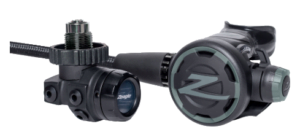
Air Delivery System (a.k.a. a Regulator System)

A typical cruising, sport diver has a couple of special requirements for an air delivery system that doesn’t involve turbulent airflow, external adjustment of the 2nd stage, or the latest and greatest bells and whistles.  Your requirements are for a rugged system that requires a minimum of tiny little parts when it’s rebuilt.

Both your dive shop and the equipment manufacturer recommend you rinse your regulator thoroughly and have it serviced annually.  They’re talking about equipment used once or twice a year on dive vacations. Out cruising, you’ll put more dives on your system in a year than most divers do during the entire time they own it.  Water is precious out here so you’re going to skimp when rinsing gear.  And it may be two or more years before you’re around a dive resort with a service technician you’ll trust.  In this environment, reliability is more important than how slick your system looks or slight differences in how it breathes at depth.  I’m sure you’ll find the top manufacturers all make very reliable equipment and you don’t have to buy their top-of-the-line model.  Stick with a quality brand and be sure to ask how complicated the rebuild is.  You might also consider a system with a “sealed 1st stage” to reduce exposure to salt water.

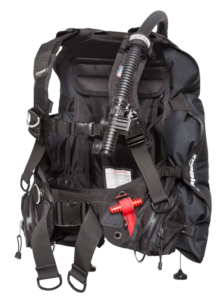
Buoyancy Compensators

I really don’t have much to say about BCs. I’ve been partial to integrated weight systems because I find them more comfortable and a lot easier to dump in an emergency.  You might also consider a couple of additional pockets and “d-rings” since some of your diving is going to be doing simple boat maintenance, such as replacing zinc’s and cleaning barnacles off the prop, and you’ll appreciate a place to put tools and parts.

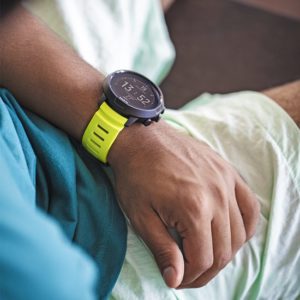
Computers

I can make both sides of the argument about dive computers for cruising divers.  I’ll let you know right up front that I wear a computer. I justified the purchase because of my technical diving.  I appreciate the confirmation and back up to my manual dive planning when I’m doing planned decompression stop diving.  Having justified spending the money, I must say I enjoy the computer immensely on sports dives.

First the ” I’ve gotta have one” argument.  When you’re diving completely out of contact with a decompression chamber or any treatment facility, you simply cannot afford to ignore dive planning.  If you manage to get a DCS hit (okay, bent) out in the middle of nowhere, you’ve got a serious and painful problem.  Be honest with yourself.  Are you going to plan every dive to ensure you’re within safe limits?  Do you even remember how to work with the tables? A computer, assuming you know how to read it, automates the planning process and keeps you safe.

Here’s another argument for diving with a computer.  Being an instructor, I taught dive table calculations till I could do them in my sleep.  I even had the “no decompression time limit” memorized for the most common depths.  When cruising, I typically have a surface interval of around 24 hours; so repetitive dive planning doesn’t ordinarily enter the picture.  Still, my computer is a great benefit during a typical dive, and here’s why.  The tables require you to dive a square profile – descend to the planned depth, spend the bottom time, and head to the surface making your shallow safety stop.  All very rigid diving and not at all like the way you’re going to actually dive.  A typical dive goes more like – drop down to 60 feet for a 20-minute tour of the wall, slowly work back up looking at coral, spend a few minutes enjoying an eel at 45 feet, turn around a couple of times trying to find your dive buddy and join her back at 50 feet, swim along for another 10 minutes or so until you decide to turn and head back to your dinghy, swim 20 minutes at 40 feet to get back to the mooring line.  Your dive plan has to say you spend something like 60 minutes at 60 feet and are close to a decompression limit.  A computer would have followed your actual profile and let you know you have several minutes to lay in the sand at 20 feet watching a seahorse that you noticed.


Here’s the “don’t need one” side.  A vacationing diver has one goal – cram as many dives into a single week in paradise as possible.  The only way to max out the number of dives is to use a computer.  You’d go nuts trying to work with a table and the dive boat isn’t necessarily going to take you to a suitable spot for your planned dive.  On the other hand, as a cruising diver, you can take all the time you need to see a location.  More than one dive a day is fairly tiring and why bother? Plan your dive for the heat of the early afternoon and enjoy the best lighting conditions while you’re cooling off at 60 feet.  Stick with a 24-hour surface interval, stay well within the table limits, don’t stop to look at any seahorses if you’ve reached your planned bottom time and you should be just fine.

This is a personal decision based on discipline.  I’m delighted to have converted to using a computer.  I’m a safer diver and enjoy more flexible profiles without worry.  I must stress that some of the locations you’ll be enjoying are several days’ travel from a chamber or treatment center and a computer could be considered a very good insurance policy.

Mask & Snorkel

Fiver with High Quality Fitted Diving Mask

You absolutely must have a quality dive mask with tempered glass and a Silicone skirt.  I’m not fanatical about caring for my mask.  It gets rinsed but it lives in the cockpit were it receives occasional damaging sun.  Maybe once a year I get around to spraying the skirt and strap with silicone.  It’s six years old, has spent thousands of hours in both the ocean and that nasty chlorinated pool water, and it still works like a charm.  I’ve calculated the cost at fractions of a penny per hour.  Don’t even think about the cost of your mask or other snorkeling equipment.  Considering how long it lasts it’s almost free.

Try on several masks at the dive shop, doing the “inhale to see if it sticks to your face” test to ensure they fit.  If the shop isn’t very interested in finding you the right mask, you’re not dealing with the right folks. Ask if you can take two or three mask to the pool to check fit and comfort.  Once you discover the delights of exploring a shallow reef, you’re likely to spend a couple of hours or more snorkeling. If your mask is a good fit, you won’t notice it’s there.  If it doesn’t fit, it will drive you nuts.

If you are like a lot of people and perfect eyesight is something others have; you can have the lenses in the mask adjusted for your eyesight. This is accomplished either by replacing the lenses with corrected ones or having lenses “bonded” to the mask. Your local dive shop can assist you with this process.

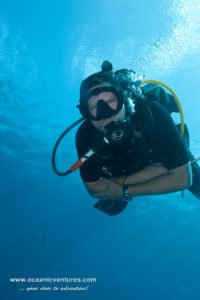
Diver with Soft Mask Strap

Add a “Slap Strap” or similar product to your mask.  This is a wide, neoprene cover for the strap.  It increases comfort and stops the hair-pulling of the normal silicon strap.  At $ 15 or so, it’s well worth the money.

Also, buy a dry box for your mask.   When you’re not going to be swimming every day, like those miserable times in the boat yard, your equipment will go into a locker.  The mask will perversely work its way to the bottom of the locker and will be damaged by the weight of everything else if not protected by a stiff box.

There really isn’t too much to say about snorkels. A bent tube gives you a bit more clearance at the surface, a large diameter makes for easier breathing and flex tubing near the mouthpiece adds to comfort.  For complete comfort, consider adding one of those “boil and bite” orthodontic mouthpieces.  These are marketed as regulator mouthpieces but you’re going to be breathing through your snorkel a lot more than your regulator.  A bright neon tip helps your buddies find you should you swim with others.

Booties & Fins

Avoid those silly fins that fits like a shoe – the back rips or your foot slips out and your fin is gone.  Stick with proper booties and a sturdy set of fins.  You’re going to be standing in the dinghy while traveling to and from your dive or hunting site.  That’s right, standing up, legs spread, hanging on to the painter with one hand, steering with the tiller extension and roaring over the water with your 15hp at full throttle.  Standing gets you out of the constant spray and gives you enough height to see reefs in the distance and avoid coral heads in the shallows.  You’ll appreciate the grip of your booties as you fly along. Try on a few pairs of booties to insure a good fit.

For years I wore my nice stiff fins, a pair of “Blades”, for both diving and snorkeling.  They started out a nice neon yellow/green so students could find me underwater.  After years of service, they were bleached almost white by the sun and still going strong.  Recently, I added a pair of fins specifically designed for free diving and was amazed by the difference.  These fins are longer, narrower and more flexible than SCUBA fins.  They don’t have the power to move your bulky, high drag SCUBA equipment through the water, but they will give you much greater speed and ease of movement in your streamlined snorkeling configuration.

You can certainly get by with one set of fins, provided they are designed for SCUBA.  Buy a good pair and ignore the price. Like your mask the cost will work out to a fraction of a penny per hour.

Knife

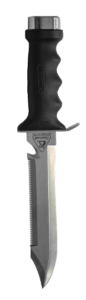
Go ahead and buy one of those little dive tools with a blunt tip and permanently attach it to your BC for SCUBA diving.  Then buy a six-inch or so, pointed dive knife to do double duty as a boat knife in the cockpit and for spearfishing.  Figure out a place to keep it near the companionway and, while your at it, put a fid/shackle tool and a Leatherman tool in the same spot.  If you get involved in hunting, you’ll eventually want to “finish off” a fish or do some other gruesome task and a blunt dive tool just won’t do.

Gloves

I’ll disagree with the dive shop here and recommend you head to Home Depot’s gardening center.  Buy several pair of cotton gloves with the black bumps all over the palm and fingers.  These gloves hold up very well in salt water.  You’ll use them while working under the boat, handling the anchor chain and hunting.  These won’t offer any protection from cold water, but the water in the tropics stays around 80 degrees. You want inexpensive, durable gloves.

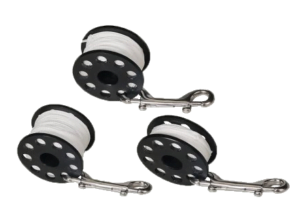
Spools & Reels Come in different Lengths

Reels and Spools

A small reel of line is indispensable for a cruising diver. Buy one, put a clip on the end of the line and store it with your dive equipment or stick it in the pocket of your BC. I can guarantee you’re going to drop something over the side and a carefully planned, circular search pattern is the only way you’ll find it.  The reel will more than pay for itself the first time you use it and that’s probably going to happen sooner than you expect.

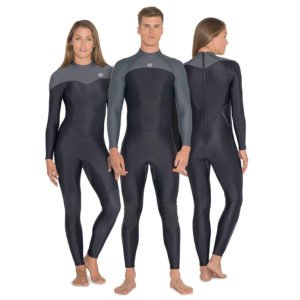
Thermocline PolarFleece Suits Offer a Comprimise From Traditional Wetsuits

Skins and Wetsuits

I don’t get cold readily in water.  Karen gets chilled quickly.  You need to learn how you’re body type responds to diving.  Keeping in mind tropic waters run around 80 Fahrenheit, I use a 3/5-mil wetsuit for long night dives and lightweight dive skins during the day.  You’ll appreciate the wetsuit after a night dive when you have a dinghy ride in the chilly evening air.  The diveskins are for protection from the sun more than anything else.  When you’re snorkeling, your back and legs are almost constantly exposed to the sun.  You don’t realize the burn is developing because the water keeps your skin nice and cool.  Always wear a diveskin when you’re snorkeling.  You’ll wear them out and they don’t take up much room so take a couple of spares.  I have five skins onboard right now – buying “in bulk” will sometimes get you a bargain.

Dive Lights

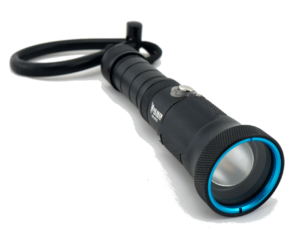
We carry two SL-4s and two SL-6s.  They serve double duty as boat lights and dive lights.  If they’ll take submersion to a couple hundred feet, they’ll certainly do well onboard.  They’re well-sealed, bright, and have no rusting parts.  We would have all SL-6s but we purchased the SL-4s before we realized just how general-purpose these lights were.

Since Carl wrote this article, technology has changed and one of the biggest shifts has been in lighting technology and battery technology.  The new lights are brighter, heat up less, and last longer.  One example of this new technology is the Kraken NR900Z which has 900 lumins and lasts for over three hours on a single battery charge (and yes it uses rechargeable batteries).  These can be used above water as well as below water.  There are other examples of lights that work for divers as well as above the water and your local dive shop can help you select the right model for your application.

Pneumatic Spear Guns

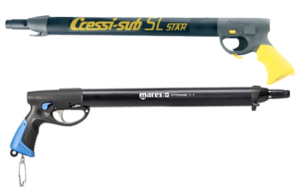
Speargun

Forget Hawaiian slings and rubber band guns and buy yourself a Mares Cyrano pneumatic speargun or one of the smaller models.  With a sling, you have to be close enough to almost poke the fish.  Rubber band guns are a pain to load, require constant maintenance, hurt when they break, and aren’t nearly as powerful as a pneumatic gun.  The Mares is well designed, powerful and only requires rinsing. I’ve used mine for years and it has never required any special attention.  Just store with the tip town to keep the O-rings lubed.

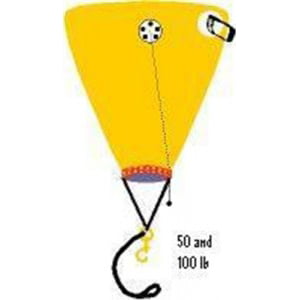
Open Bottom Lift Bag

Lift Bag

I would call this a highly optional piece of equipment, but when you need one, coming up with an improvisation is pretty difficult.  When I was inexperienced at both cruising and diving, I put myself and two other divers in a fairly dangerous situation.  We arrived at the anchorage in Bonaire just before nightfall.  Our engine overheated coming into the harbor so we sailed into the anchorage and weren’t able to back down and set the anchor.  It was also getting dark and I didn’t bother to dive on the anchor to ensure it was set.

This collection of problems, errors and the very poor holding in Bonaire led to us dragging during the night.  In the morning we discovered our 75-pound CQR had slid along the 20-foot bottom of the anchorage, fallen down the vertical wall, and was hung on some coral about 50 feet down.  A hundred feet of chain was tangled around pieces of coral adding to the problem. Fortunately, I suppose, the anchorage is off the main town in Bonaire and has been in pretty bad conditions for years.  Diving here you’ll find an interesting collection of auto tires, batteries, engine blocks and assorted trash contributed by the town.   So we didn’t feel too badly about being snagged on the wall, but we did need to clean up the problem before doing too much damage.

We started by putting our second anchor, a large Bruce, into our dinghy and carrying it to the anchorage.  Then the three divers put on their equipment and started to job of retrieving the heavy anchor and all that chain.  Here’s where we did something stupid that could have easily gotten one of us hurt.  To lift sections of chain and the anchor the three of us would get a good grip, fully inflate our BCs, and start swimming up the wall.  When the section of chain was untangled and stretched as far as we could get it, we would deflate, choose another section and repeat the process.  Obviously, when inflating, we were hanging on with one hand.  Should someone have lost their grip, they would have shot immediately to the surface and, to their surprise, would have been unlikely to remember to exhale forcefully on the way up. A rapid ascent from that depth could have easily led to an embolism and a bout of decompression illness.

Now we carry a 100-pound capacity lift bag.  It folds tightly, requires little room, and makes retrieving or moving heavy objects a simple task. Like all new pieces of dive equipment, ask for some instruction on the use of a lift bag.  Join your dive shop on an open water outing and get some practice – there are techniques to learn.

Scuba Diving Reference Library

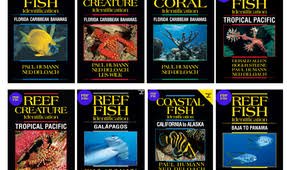
The Bible for fish identification is Paul Humann’s three book series – Reef Fish, Reef Coral and Reef Creatures Identification.  There is a companion CD that can make learning the fish more fun than flipping through the pages of the book.

We also have found the little book “Divers and Snorkelers Guide to the Fishes and Sea Life” by Joseph Stokes to be very useful.  In fact, if I just wanted to learn the names of the fishes, I would choose this simple book over the more technical Humann series.
Another book that teaches while you are having fun is “Marine Biology Coloring Book” by Thomas Niesen.  You can easily fritter away a rainy day working with this book and a box of colored pencils.

“Watching Fishes – Understanding Coral Reef Fish Behavior” is a fascinating book.  This book discusses why reef fish are more colorful than their open-water counterparts, why a two-ounce damselfish has the nerve to attack a diver when a 200-pound grouper won’t, what causes fish to form schools, and so forth.  This book really sparked my interest and appreciation of fish that keeps me continually interested in diving.

Diving Cylinders

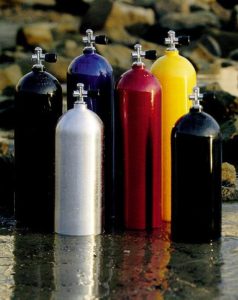
Not a whole lot to say here.  We carry four, 80 cubic foot, aluminum cylinders.  We also carry a small, 30 cubic foot “deco bottle”.  Dive shops are usually happy to fill your cylinders for you and will normally give you a price break if you open an account and pay for ten or so fills in advance.  The deco bottle comes in handy for making a quick “slap on the regulator and snorkeling gear” dive to inspect the bottom, untangle a line from the prop, and so forth.  It’s also an excellent backup air supply for a solo diver.  I’m not a big fan of the widely advertised Spare Air and a backup supply.  If you aren’t into technical diving and don’t know how to calculate the capacity of cylinders, ask one of the instructors at your dive shop how many breaths you can take on a Spare Air at 60 feet.  Compare that answer to the capacity and usefulness of a 30 cubic-foot cylinder with its normal valve.  Your dive shop can show you how to rig the small cylinder so it’s easily carried.  And yes, this is another opportunity to learn something in the pool.

Spare Parts

  • Mouthpieces for regulator and snorkel
  • Strap for mask
  • Backup mask, fins and snorkel – yours will wear out eventually
  • Complete strap assembly for fins
  • Low pressure hose
  • High pressure hose
  • Extra spear, a couple of tips and an O-ring set for the speargun
Gasoline Powered Breathing Air Compressor

Compressor

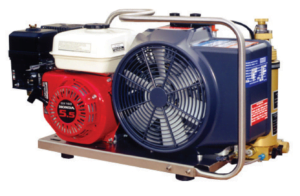
We recently returned to the States for a prolonged visit with family and to outfit Enchante’ for a cruise to the Pacific.  During the upgrades, we purchased a gasoline-driven compressor and built a deck box to store it in.  Since we spend considerable time in isolated areas far from dive shops and their compressors, we love the ability to fill our own cylinders.  The noise can be a bother to your neighbors in the anchorage, but we don’t anchor that close to other boats anyway.

Should you decide to go this far, I strongly suggest you contact Eric at Oceanic Ventures and let him help you configure your compressor.  He has the contacts in the industry to configure the compressor properly for more than occasional use.  You will also want some training on using the compressor before you leave.
 

Conclusion


So that’s it, my discourse on outfitting a cruising sailboat for diving and snorkeling. The best advice I can give you is to take your time and find good quality equipment that works and can be serviced anywhere in the world. And don’t forget the pool practice and training. Your investment upfront will pay off as you venture out into the beauty that awaits cruising sailors.
 

Carl Strange Avatar
Carl and his wife Karen set-off on a journey around the world on-board their sailboat S/V Enchante. Along the way, they had a lot of adventures and in Aruba, a new member of their crew was born. Now a family of three with Rebecca’s birth, they sailed the Caribbean and the Pacific experiencing life along the way.

Filed Under: Sailing, Travel Tagged With: Cruising, Diving from a sailboat, Enchante, Equipment, S/V Enchante, Sailing, Spearfishing

  • Page 1
  • Page 2
  • Page 3
  • Go to Next Page »

Footer

Contact Us

Oceanic Ventures, Inc
5808 Newcastle Dr.
Houston, TX 77401-3214
USA

Phone: 713-523-DIVE (3483)

eMail: divesafe@oceanicventures.net

Signup for our dive and scuba newsletters

Don’t miss news about the exciting happenings at Oceanic Ventures.


Map and Directions

Socialize

  • Email
  • Facebook

Why People Choose Us

People choose their friends carefully just as they should choose their adventure partners and Scuba Diving Instructors.  Oceanic Ventures is the premier scuba dive shop in Houston, Texas, and the Southwest because of our exceptional service and our sense of adventure.  In talking with our clients and friends, people choose us for a number of reasons such as: Passion – We love what we do and we want to share the beauty and excitement of the underwater world with everyone we meet. Caring- Our clients tell us they love us because we truly care about people and strive to make their scuba diving experiences safe, fun and enjoyable. Professional – Our staff members are the … [Read more …]

Copyright © 2026 all rights reserved Oceanic Ventures, Inc. · Sitemap · Log in