This past weekend, Santa came to visit and pose for underwater photographs. What a fun time! Here are some highlights…
Photography
Getting started with Underwater Photography

There are a number of ways to get started from jumping in with your GoPro to using your mobile phone in a case to take photographs. But, what is the best way? That is a difficult question to answer, It all depends on where you are in your land photography and where you want to go with your underwater photography. What so I mean by that? Let’s look at this further further.
IPhone Camera User
If your primary camera is your iPhone or Android phone even on vacation, then you will probably be happy starting with a simple underwater camera. These allow you to shoot video or still photographs and download them to your computer. Most of these cameras save files in a JPG format. However, some of the new models have a RAW file feature too. Not sure what these terms mean, check-out part 2 of this article about digital files and processing. Let’s just say that the JPG files are what you are used to seeing in your iPhone which means they have some processing done during the save function. Some examples of these camera are the SeaLife Micro 2.0 and a GoPro. You could also put your phone in a housing and take it with you. Kraken makes a new housing for phones.
 IPhone and Point and Shoot Camera User
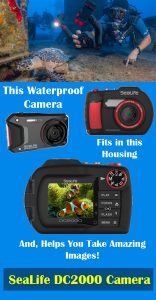
If you use both an iphone and anther camera during your trips, you are probably trying to get better images or different images that what you can get with your phone. For you, the SeaLife Micro 2.0 or the SeaLife DC 2000 might be good options. Both have basic functions but also expand to let you “tweek” your photos and your experience.
DSLR & Mirrorless Camera Users
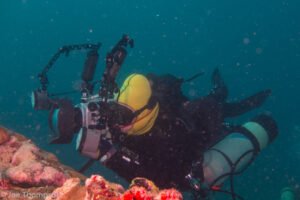
Now this is a wide-ranging area of underwater photography. You could stick with the simpler camera from above or you can expand to take your land camera underwater in a housing. A lot of it depends on what you want to accomplish underwater and how much you are willing to invest. The housings for your underwater camera can cost more than your initial camera investment and then there are the strobes… So you could look at the SeaLife DC2000 or a housing from Nauticam or Aquatica.
How to get started
Our Club Aquarius meeting this month will be focusing on “How to get Started in Underwater Photography.” We will be discussing how to meet your various goals and what equipment you might consider. We will also be discussing some things you can do to improve your photographs once you start with a system.
 Club Aquatrius Meeting:
- Speaker: Zaide Scheib and Eric Keibler
- When: 22 February 2018, 7:00 PM
- Where: The Black Labrador, 4100 Montrose Blvd. Houston, TX
Scuba Santa 2018

- What: Santa In the Pool
- Where: Houstonian Hotel, & Spa
- When: 10:00 AM to 12:00 PM
- Note: The Houstonian is a members only club so you must be a member of have a member set it up for you to have your photo made here.
On Wednesday, Santa will be at the Houston Racket Club with the Kinkaid Swim Team and the Houston Racket Club Swim Team and some of their members.
So you can see, he really gets around when he is town!
Equipment Special For Photographers the SeaLife DC2000
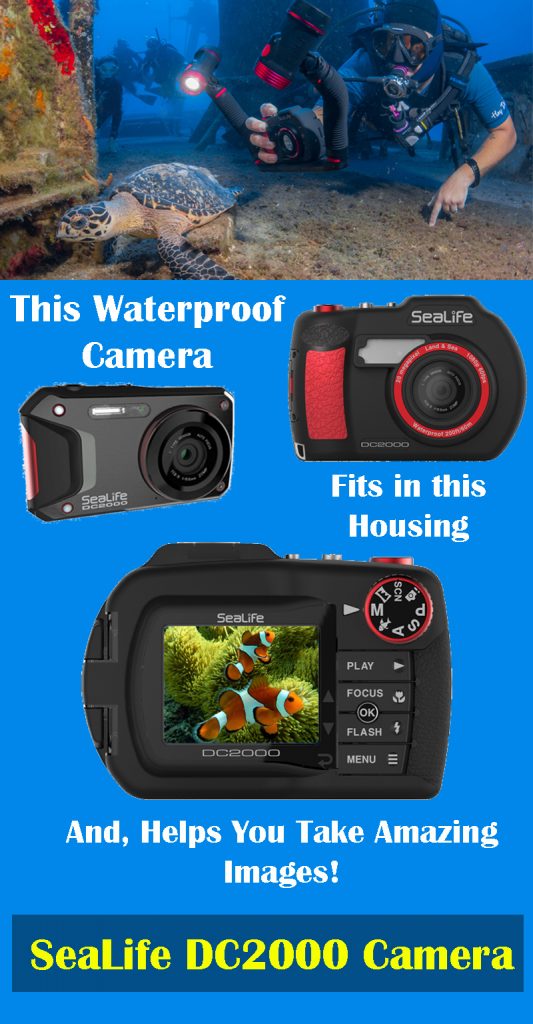
The new DC 2000 has a waterproof camera to 60 feet,that fits into a housing rated to 200 feet and shoots at 20 MP, Shoots RAW, JPG, 1080 HP video – Free Wide-angle lens
Free Wide Angle Lens: Urgent: The program ends on Friday but, Dive Mom has an extension so that you can order before noon on Monday, Oct 2 2017, so you can get the Free Wide angle lens.
Upgrade Offer: If you purchased a Sealife 2.0 Camera, from us in the last two years, and want to trade-it for the DC2000, you get a $150 credit toward the DC2000. This is an Oceanic Ventures only promotion and expires on Monday October 2 at noon. Please note, the camera must be in working order and traded in with the charger cord.
This is SeaLife’s most advanced camera!
Enjoy full creative freedom with SeaLife’s new DC2000 digital underwater camera. Featuring a large SONY® 1″ type back-illuminated 20MP image sensor and RAW formatting capabilities, the DC2000 will let your underwater inspirations guide you to stunning results.
- Full featured with nearly unlimited editing options
- With an ultra-fast auto focus and shutter response, you’ll never miss a shot with the SeaLife DC2000.
- Take control of your creativity by selecting from the 8 shooting modes: manual, aperture, underwater, shutter, program, intelligent auto, land, and panorama.
- JPEG and RAW (Adobe .dng) imaging formats are available, providing you with nearly endless photo editing options. Get the best of both worlds.
- With DSLR-like imaging results, you’ll want to make the DC2000’s waterproof inner camera your go-to land camera with the ability to capture rich landscapes and stunning close-ups and portraits.
- The DC2000 features a 31mm (film equivalent) lens with a variety of underwater lens options available.
- Ultra-fast shutter response of 0.1 seconds
- 4 Underwater Shooting Modes for sharp, colorful underwater pictures under any conditions
- 3 built-in underwater digital color correction filters: shallow water (snorkeling), deep water (diving) or “green” water (algae bloom)
- 25 Land Scene modes adjust camera settings for specific shooting environments
- Intelligent Auto Mode selects the optimal land scene mode for effortless shooting
- Continuous Burst Shooting shoots high resolution 20MP pictures up to 10 frames per second
- Manual White Balance control to customize UW color correction to your specific depth and water conditions
- Manual shutter and aperture for complete control over image exposure from 15 to 1/2000 seconds and F1.8 to F11 in 0.3 stop increments
- Auto focus from 4″(10cm) to infinity
- WiFi to wirelessly preview, download and share pictures/videos to smart phone or tablet with free Link123 Plus app. Includes Geotagging and “Auto Send” functionality.
- Micro SD, SDHC SDXC and UHS-1 memory card compatible up to 64GB
- Optical Image Stabilization (OIS) – CCD shift technology reduces camera shake
- Short-cut key for fast and easy access to favorite menu setting
- Expandable with Sea Dragon Flash(es), Photo-Video Lights and SeaLife lenses
- Rubber armored, shock-resistant for rough handling and tough environments
- Depth rated down to 200ft/60m (camera in housing)
- Depth rated down to 60ft/18m (inner camera)
Hidden Scuba Diving Treasures – Muck Diving

Simon is the best-selling author of Scuba Confidential – An Insider’s Guide to Becoming a Better Diver and Scuba Professional – Insights into Scuba Diver Training & Operations. Both books are available from Oceanic Ventures. Simon has also just published a new book for divers-to-be and absolute beginners called Scuba Fundamental – Start Diving the Right Way.
You roll off the boat and look down to get a hint of the wonders that await you on this dive but it seems you are in the wrong place. There are no glorious coral formations; in fact there is no reef at all. Instead the seabed seems grey and featureless and the visibility is reduced by the presence of a nearby river mouth.
Sixty minutes later, however, you return to the surface with your mind reeling and your camera’s memory card full of pictures of some of the most incredible marine life you could ever have imagined.
You have just been on an underwater treasure hunt; a game of hide and seek with some very clever opponents. This is muck diving!
The Genesis
While early scuba divers were marveling at the beauty of coral reefs and hanging out in the blue watching for whale sharks and manta rays, a whole universe of amazing creatures were going about their business under the sea completely un-noticed.
How could they have remained undetected for so long? Well, first they were small, second, they had developed the art of concealment to a very high degree and third they lived in places that were not particularly pleasing to the eye. Primarily, however, they remained unseen because nobody was looking for them.
Then a few things happened to bring these little creatures into the limelight.
First, the big fish became fewer in number and harder to find. Second, divers became older and a little lazier and, third, there were significant advances in underwater macro-photography.
Most importantly a few enterprising individuals in Papua New Guinea, Indonesia and Malaysia started looking for marine life in unusual places where nobody had looked before and began to find some absolutely astonishing things.
Muck diving is the quest for these beautiful animals in the sometimes-inhospitable environment where they hide.
Where to Go
New muck diving locations are being discovered all the time but, so far, the world capital is Lembeh Straits on the northeastern tip of Sulawesi in Indonesia. Other locations that also deserve honourable mention include a variety of sites right across northern Bali, Dumaguete in the Philippines, Pulau Mabul off the coast of Malaysian Borneo, Komodo, Ambon and Alor in the Indonesian archipelago and Milne Bay in Papua New Guinea.
 Muck Diving Techniques
At first it can appear an impossible task and you will be amazed at how your guides can see things that are almost invisible until you look carefully. Keep trying, however, and with a little experience you will be spotting your own hidden treasures. The thrill of discovery when you find something rare and exotic is hard to beat.
These tips may help: –
- Look ahead as well as beneath you
- Be alert for movement as you pass.
- Follow tracks in the sand
- Get as close as you can
- Examine everything from several angles
- Be patient and take your time
- Move slowly
- Stay as near to the sand as possible without disturbing it
- Use a fin-kick that does not involve downward fin movement so you do not disturb the sand: a gentle frog kick works well
More Spotting Tips
You can also increase your chances of spotting success by knowing where to look, for instance: –
- Ornate ghost pipefish hang out among feather stars.
- Pipefish and seahorses hide among sea grass.
- Baby clown frogfish love rotting wood.
- Sea cucumbers host colourful emperor shrimps as well as swimming crabs
- Harlequin shrimps feed on sea stars
- Urchins are often home to shrimps and baby fish
- Fire urchins are where zebra crabs live
- Tube anemones often have small harlequin swimming crabs on their trunks
- Sea pens shelter porcelain crabs in their fronds

Essential Equipment
An excellent tool that all the top guides use is a stainless steel 30 cm pointer, which you can thrust into the sand to help you balance as you hunt for animals. You can also use it gently to move aside a concealing weed to see more clearly. Attach the pointer with a lanyard to your BCD and tuck it into your harness when you are not using it.
Just Scratching the Surface
Remember, many of the creatures being discovered by muck divers today are new to science. It is exciting to imagine how much more there is to learn and what surprises remain to be discovered by someone with patience, a sharp eye and a pointer.
Scuba Divers Start Their Journey to Indonesia's Forgotten Islands

The first wave of divers departed Houston’s Intercontinental Airport for the Arenui via Moscow, Singapore and finally Bali where they will be spending a few days touring before heading off to Ambon then to Sumilaki to meet the boat. I say the first wave because Susan and Donna left on Monday for Bali and will meet up with the group along with more divers from Houston and a few other cities outside of the state.
The Bali touring contingent will be touring in the Ubud region of Bali. They have some temples and shopping on the list as well as some awesome overviews of the terraced rice patties in Bali.
Stay tuned for more details on their trip…