
• Skip to primary navigation
  • Skip to main content
  • Skip to footer

Houston's Premier Scuba and Dive Shop Oceanic Ventures Inc.

(713) 523-3483 (dive)
5808 Newcastle Drive
Houston, TX 77401

  • Home
  • Stay Current
    • Our Blog
    • Travel and Events Calendar
    • Club Aquarius Social Club
      • Club Aquarius Social Club Upcoming Events
      • Club Aquarius Social Club – The Past
    • Special Events
    • Local Scuba Diving Events
    • Photography Contest
    • Categorized Blog Posts
  • Equipment
    • Dive Equipment
    • Rebreather Systems
    • Cruise Ship Passengers
    • Repair & Maintenance
    • Air & Mixed Gas Blending
    • Pure Fiji Spa Products
  • Training
    • Become a Scuba Diver
    • Scuba In Your Home or Ours
    • Diving Programs for Young Explorers
    • Recreational Dive Courses
      • Recreational Dive Courses overview
      • The Briar Club Scuba Program
      • West University Scuba Program
      • Houstonian Scuba Program
    • Technical Diving Courses
      • Basics
      • Nitrox
      • Trimix
      • Rebreather
      • Wreck Diving Programs
      • Cave Programs
      • Blending
    • Leadership Dive Courses
  • Travel
    • Travel Escorted Adventures
    • Travel – Other Travel Programs
    • Travel – Custom Travel Adventures
    • Local Scuba Diving Events
    • Technical Travel
    • Scuba Diving Around Texas
    • Travel Insurance
    • Travel Forms
  • Company
    • About Oceanic Ventures
    • Meet Our Team
    • Testimonials
    • Facility Hours
    • Map
    • Oceanic Ventures Foundation
    • Resources & Articles
    • Archive
  • Shop
    • Online Store
    • Cart
    • Checkout
    • My Account
    • Policies regarding Privacy and Purchases
  • Contact

conservation

August 30, 2017 by Christian Fuss

Scuba Diver's Movie Night – Chasing Corals

Photo courtesy of Ocean Agency
Chef Eric
Chef Eric
There was a lot of time to waste during sitting out a devastating storm at home. Thanks to Chef Eric we had wonderful meals and thank God we had no major power or internet outages around our neighborhood. So as Jenny and I were fed with munches by Ann and Chef Eric was preparing a delicious meal in the kitchen, we sat down at the couch and started to browse the Netflix library to find something interesting to watch. The movie, “Chasing Coral” caught my attention (“Chasing Coral” a Netflix documentary by Jeff Orlowski).  Previously, I noticed the attention it got on Social Media when it first came out a few years ago and put it on my Netflix watch list where it has lured ever since. And, what started with “hey watch this” ended in the four of us sitting in front of the TV with dropped jaws, and numerous “wow” moments.  We also found ourselves replaying many scenes and soaking up the details.
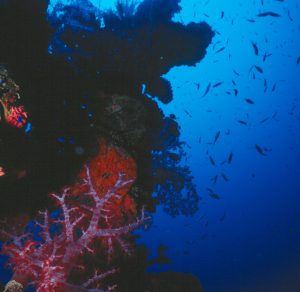
Fiji, Photo by Christian Fuss

Corals are colorful and beautiful to look at

Corals are colorful and beautiful to look at but, who thought they are also amazing, small, living creatures. If your watch “Chasing Coral on Netflix” and you will get a whole new view on the world of Coral Reefs. In watching many movies and documentaries about diving and the marine environment, I have rarely seen a documentary that shows how we, as humans,  with our behavior and treatment of  our environment are destroying the oceans. Since we are all divers,  we are interested in diving, marine life and the oceans; but, little did I realize that Corals in their full beauty and diversity in colors and forms, are not just beautiful and eye candy along with being decorative, but they also provide a vital function for the reefs.
We all know they play an important role for the Marine Ecosystem.  But, it hasn’t been too long since scientists and activists have started to warn about the so-called “coral bleaching” – and about the disastrous impact this could have on the whole Earth.
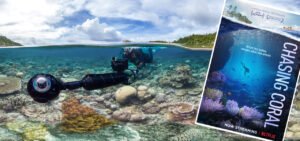
The documentary “Chasing Coral”, which is offered on Netflix for streaming, tells the story about causes, the extent of the damage as well as impact this could have on the world.
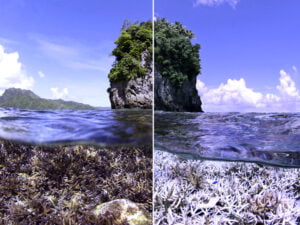
Photo Courtesy of the Ocean Agency

Coral Bleaching: Global Warming kills corals.

Coral Bleaching is a step in the process of the dying animals, yes, corals are animals. Corals live in symbiosis with various forms of algae.  In a bleaching event, the rid themselves of the algae to lessen the strain on the animal which results in the color loss or “bleaching.”What remains is a white skeleton.  While corals can recover from a short-term event, the longer it lasts or the more frequent it occurs inflicts permanent damage to the coral colony.  The main cause for is event is increased water temperature and/or strong sun radiation.
“Coral bleaching itself is a stress response, much like a fever in humans is a stress response. If the temperature spikes just a little bit above the normal range corals will start to bleach.” Dr. Ruth Gates, head of the Hawaii Institute of Marine Biology (HIMB) at the University of Hawaii explains, Coral Bleaching is a stress reaction by the corals, sort of like a fever in a human body. Just a little rise in temperature is enough for the corals to start bleaching.
Over the past two decades,  we have already seen two major coral bleaching events that were both caused by the weather phenomena El Niño. The current bleaching event however is the longest and most wide-spread so far.  According to scientists the world has lost about half of all corals within the past 30 years we are told in “Chasing Coral”
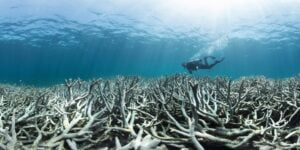
Photo Courtesy of the Ocean Agency

What does all this have to do with us?

No matter what you believe about the Global Warming argument, we are all affected by the Earth’s warming trend.  The rise of the oceans is a concern for islanders who see their land disappearing below the waves, and for others there are the severe weather disasters, hurricanes and floods.  These are all impacts of global warming.  The oceans play an important role in our lives because they absorb 93% of the heat in the atmosphere; and, because they are helping to moderate temperatures by absorbing the heat, the water temperatures in our seas have increased dramatically during the past couple of years.
Richard Vevers, founder and CEO of the NGO “The Ocean Agency” comments, “We look at climate change as if it is an issue in the air. And you go: one or two degrees Celsius, does that really matter? But when you talk about the ocean, it’s like your body temperature changing. And imagine your body temperature rises one degree centigrade or two degrees centigrade. Over a period of time that would be fatal. And that’s the seriousness of the issue when you look at it in terms of the ocean.”
In essence, the  man-made climate change is essentially heating up the oceans which then leads to the dying of corals and a whole ecosystem. Raising awareness among all people was the driving force behind the  documentary “Chasing Coral.”
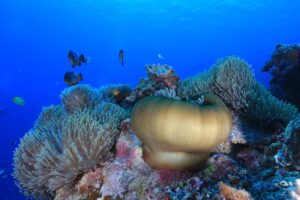
Fiji, Photo by Christian Fuss

Why we cannot afford to not to care!

Corals create reefs; these reefs are the home, food source and nursery for countless fish and other marine life. If corals die, whole habitats disappear. This does not just “mess up” the fragile balance within the oceans,  a large portion of the world population depends on fish and other marine life as source of protein. A mass dying of fish could follow a mass coral dying which would dramatically affect the lives of millions of people.
But the health of a reef does not only affect the security of food sources, they break waves, calming down the ocean before it gets to the coastline. If these fringing reef die or disappear the sea conditions will change becoming more unpredictable and dangerous for people living and working along the shores.  This is on top of the rising sea levels which we are already experiencing.
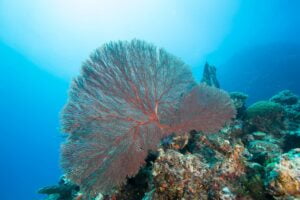
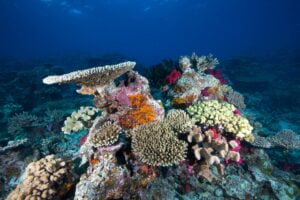
Fiji, Photo by Christian Fuss
All of the places, we as divers enjoy traveling to, like Indonesia, Philippines, Palau, Maldives, Mexico, Caribbean islands, Samoa, French Polynesia and many more these coral reefs are a major source of income from tourism – without the corals and without the fish these places would lose tourism resulting in starvation and lowering an already low standard of living.
In the documentary, divers, scientists, filmmakers and coral nerds try to document the current worldwide coral bleaching events and coral deaths for those who otherwise would never see what’s happening underneath the surface of our oceans.  The documentary took over 3 years to film and edit and included more than 500 hours under water and footage from more than thirty countries.  Despite the technical as well as whether challenges the photographers were able to catch breath-taking footage of reefs before and after they died.  Shockingly depressive are shots of whole reef ecosystems that are completely dead, where no life is left. It is incredibly disturbing to see that once the corals are dead the vibrant fish populations disappear as well.
 

There couldn’t have been a more perfect night to watch this movie!

We were watching this movie in the safety of our home with family and friends while the Hurricane Harvey flood aftermath was unfolding just right out at our doorstep. We were just experiencing one if not the most severe natural disaster the US has ever experienced, we were experiencing the sheer force of the effects of what is at least to some degree caused by the human impact on our environment. As I am writing this we are on day three of the disaster, many people have lost their homes, their belongings, their memories, some even their live or loved ones. This was day three of which they say is a five to seven-day stretch. Mother earth is teaching us a lesson those days what happens if we keep being careless.
I urge everyone to watch “Chasing Corals” unfortunately it is only available on Netflix there is no DVD. I invite everyone who does not have access to Netflix to come to Oceanic Ventures. Inc. and use our Netflix account to watch it in the classroom.
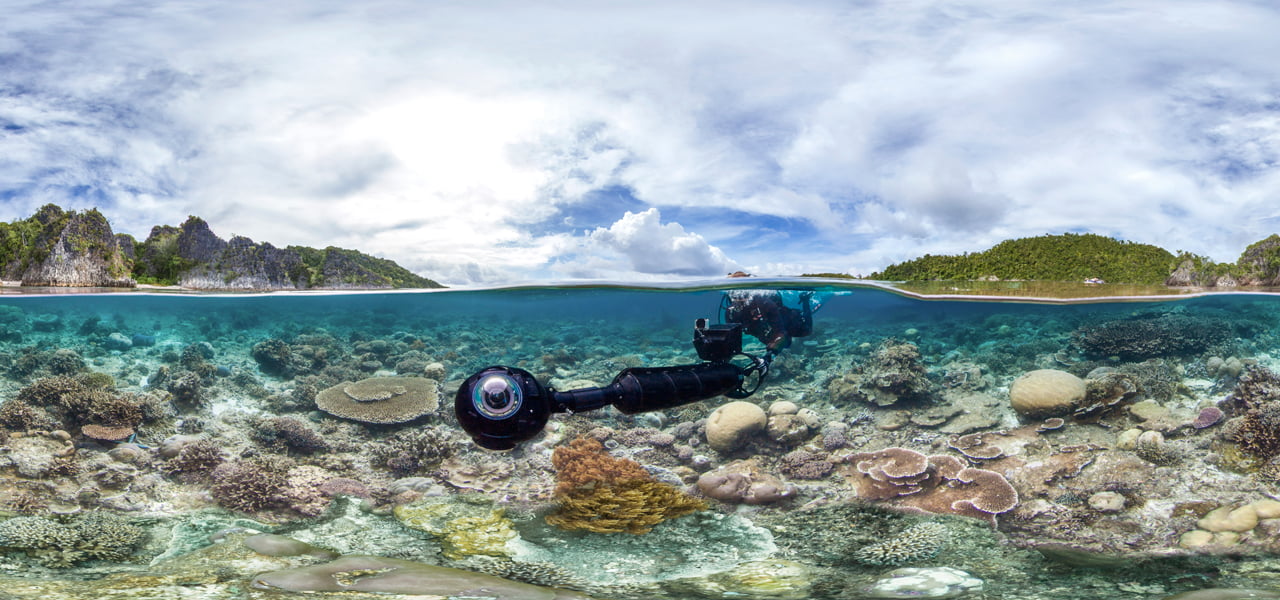

Photo Courtesy of the Ocean Agency

Filed Under: Conservation, Scuba Diving Activities Tagged With: conservation, Coral, coral bleaching, global warming

March 28, 2015 by Ann Keibler

Snakes – Conserving Wildlife and Protecting our World

seth tuba
Seth Providing Dinner Entertainment


Recently one of my young friends, Seth,  was talking to me about his “history changer project.”  Specifically, Seth’s concern and interest is in snakes.
You might ask, why would Ms. Ann care about snakes? Many of you may not know that I grew up in the desert. The desert I grew up in was the Sonoran Desert in Arizona, which is one of the great deserts of the world. It has a very unique ecosystem that contains a variety of endemic plants and animals, such as the Saguaro (Carnegiea gigantea) and Organ Pipe cactus (Stenocereus thurberi).

One of the threats to the health of the beautiful Saguaro cactus was people killing snakes. As the snake population decreased, the cactus mouse (which is the size of a field mouse) population increased.  These little mice like to eat holes in the base of the mighty cactus, which is not healthy for the cactus.
From the time I first started hiking and rock climbing in Arizona, I learned that when you saw a rattlesnake, you backed up and went the other way; but it was important you did not kill them.

My friend Seth is trying to protect one of his favorite creatures…the snake. Please look at his History Changer Brochure   Let’s help him spread the word!!!!

Ann Keibler Avatar


Filed Under: Conservation Tagged With: conservation, snakes

January 5, 2013 by Eric Keibler

What Is Coral?

Coral Structures
Coral Structures
Copyright Eric V. Keibler

This morning I was reading the NOAA Educational Newsletter and Kelly Drinnen, the coordinator for the Flower Gardens National Marine Sactuary and she had an interesting article on just what is coral. In it she writes “Steve Palumbi of Stanford University gives it his best shot with this great 3-minute Microdoc in which he explains that corals are, among other things, tiny animals that make skeletons big enough to be seen from outer space. We love this; it makes the underwater world a bit easier to understand, which we think is essential for conservation.” In the video, Dr. Palumbi explains coral and a coral reef using a coffee cup, a glass and a plumaria flower. He also cuts back to underwater scenes to demonstrate his points.  I have to admit is is a very effective way to explain the nature of this small animal. You should watch it…it is only about 3 minutes long.

Filed Under: Conservation, Pacific, Scuba Diving Activities, Video Tagged With: conservation, Coral, marine life, pacific, underwater photography

Footer

Contact Us

Oceanic Ventures, Inc
5808 Newcastle Dr.
Houston, TX 77401-3214
USA

Phone: 713-523-DIVE (3483)

eMail: divesafe@oceanicventures.net

Signup for our dive and scuba newsletters

Don’t miss news about the exciting happenings at Oceanic Ventures.


Map and Directions

Socialize

  • Email
  • Facebook

Why People Choose Us

People choose their friends carefully just as they should choose their adventure partners and Scuba Diving Instructors.  Oceanic Ventures is the premier scuba dive shop in Houston, Texas, and the Southwest because of our exceptional service and our sense of adventure.  In talking with our clients and friends, people choose us for a number of reasons such as: Passion – We love what we do and we want to share the beauty and excitement of the underwater world with everyone we meet. Caring- Our clients tell us they love us because we truly care about people and strive to make their scuba diving experiences safe, fun and enjoyable. Professional – Our staff members are the … [Read more …]

Copyright © 2026 all rights reserved Oceanic Ventures, Inc. · Sitemap · Log in