In case you missed it, June 25 is “Red Hat Day.” If this is news to you and you are wondering what Red Hat Day is all about, it is a tradition started by the National Marine Sanctuaries. Specifically, “on June 25, 1997, the ocean lost a great advocate—Jacques Yves Cousteau. Rather than mourn the loss, the National Marine Sanctuaries choose to celebrate the inspiration he provided to many of us in the field of ocean conservation today.
Red Hat Day is now a National Marine Sanctuaries tradition. It’s a day to remember the wonderful films that gave us our first glimpses beneath the waves; the hypnotic, French-accented narrations that described the beauty of the underwater world; the new technology that made the ocean that much more accessible to future generations.”
In late 2017, Fourth Element introduced a special edition red hat in honour of Jacques Cousteau. We were among the first to purchase them and gave them to our staff at the holiday party. Since then, the demand was so great, that Fourth Element added them to their line as a regularly offered product (although they are sometimes in short supply).
Now you may be asking yourself why did he wear that red cap? According to the Historical Diving Society, “During the days of the standard-dress diver, enclosed in canvas suit and copper helmet, the diver was obliged to wear something on his head to keep him warm, because the breathing air that continuously blows into the helmet is very cold. It was even colder than the surrounding water, because by the time it arrived down the long air hose through the water, it had not only attained the low water temperature, but as it enters the helmet it expands slightly, thus chilling it a little more. Further, the air is deliberately blown around the helmet to ensure effective ventilation and to prevent any build-up of expired air, as well as prevent condensation build-up on the viewing ports. This adds a ‘wind-chill’ factor to the cooling effect.
The early divers would have used whatever was the common form of thermal head protection around at the time helmet apparatus was introduced, viz the 1840s. This tended to be a red woolly cap that was commonly used by sailors of the time and especially the oyster fishermen from Whitstable in Kent, England, the ‘home’ of helmet diving. A quotation referring to these hats came about in 1851 when someone described the oyster fishermen tied up at London’s Billingsgate fish market, selling their loads of oysters:
“Who’s for Baker’s?” “Who’s for Archer’s” Who’ll have Alston’s” shout the oyster merchants and the red cap of the man in the hold bobs up and down as he rattles the shells about with a spade”
Contemporary paintings of sailors and boatmen also illustrate the common use of the red woolly cap. Even men in diving-bells needed to keep their heads warm and so used the red woolly cap.
The caps themselves were of the ‘sleeve’ pattern, in that they were knitted as a sleeve. The two ends were stitched up and then the sleeve was half-pulled inside-out, making it a doubled layered sleeve, now open at one end. The open end was pulled over the head and the lower edge was turned up to provide a four layered band around the forehead. The red diver’s cap tradition was therefore established at the same time as diving helmets were introduced at the oyster fishing port of Whitstable, UK.
It is interesting to also note that the famous British diving equipment manufacturers, C. E Heinke & Co and Siebe Gorman & Co of the 19th century, included the red woolly cap in full sets of their diving apparatus sold. (Ref: “Another Whitstable Trade” by Dr. John Bevan)
Like those early divers, current divers find warmth with “watch caps,” whether they are the traditional red or the newer polar fleece versions also available at your favorite Dive Facility – Oceanic Ventures (yes, Fourth Element makes these too). At the end of the dive day, if you put on your cap you will get warm in record time — ok maybe a little hot tea or hot chocolate will help too.
So grab your hat, some good wine (Cousteau was French after all) and sit back and watch an episode of the Undersea World of Jacques Cousteau…
Conservation
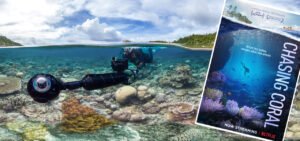
Scuba Diver's Movie Night – Chasing Corals

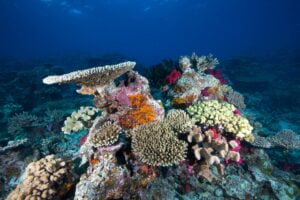
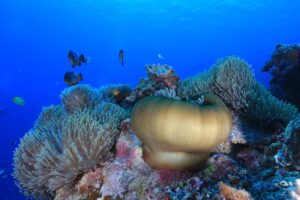
Corals are colorful and beautiful to look at
Corals are colorful and beautiful to look at but, who thought they are also amazing, small, living creatures. If your watch “Chasing Coral on Netflix” and you will get a whole new view on the world of Coral Reefs. In watching many movies and documentaries about diving and the marine environment, I have rarely seen a documentary that shows how we, as humans, with our behavior and treatment of our environment are destroying the oceans. Since we are all divers, we are interested in diving, marine life and the oceans; but, little did I realize that Corals in their full beauty and diversity in colors and forms, are not just beautiful and eye candy along with being decorative, but they also provide a vital function for the reefs.
We all know they play an important role for the Marine Ecosystem. But, it hasn’t been too long since scientists and activists have started to warn about the so-called “coral bleaching” – and about the disastrous impact this could have on the whole Earth.
The documentary “Chasing Coral”, which is offered on Netflix for streaming, tells the story about causes, the extent of the damage as well as impact this could have on the world.
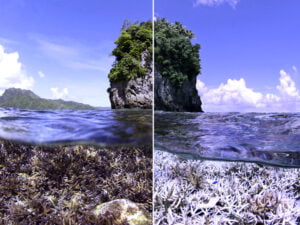
Coral Bleaching: Global Warming kills corals.
Coral Bleaching is a step in the process of the dying animals, yes, corals are animals. Corals live in symbiosis with various forms of algae. In a bleaching event, the rid themselves of the algae to lessen the strain on the animal which results in the color loss or “bleaching.”What remains is a white skeleton. While corals can recover from a short-term event, the longer it lasts or the more frequent it occurs inflicts permanent damage to the coral colony. The main cause for is event is increased water temperature and/or strong sun radiation.
“Coral bleaching itself is a stress response, much like a fever in humans is a stress response. If the temperature spikes just a little bit above the normal range corals will start to bleach.” Dr. Ruth Gates, head of the Hawaii Institute of Marine Biology (HIMB) at the University of Hawaii explains, Coral Bleaching is a stress reaction by the corals, sort of like a fever in a human body. Just a little rise in temperature is enough for the corals to start bleaching.
Over the past two decades, we have already seen two major coral bleaching events that were both caused by the weather phenomena El Niño. The current bleaching event however is the longest and most wide-spread so far. According to scientists the world has lost about half of all corals within the past 30 years we are told in “Chasing Coral”
What does all this have to do with us?
No matter what you believe about the Global Warming argument, we are all affected by the Earth’s warming trend. The rise of the oceans is a concern for islanders who see their land disappearing below the waves, and for others there are the severe weather disasters, hurricanes and floods. These are all impacts of global warming. The oceans play an important role in our lives because they absorb 93% of the heat in the atmosphere; and, because they are helping to moderate temperatures by absorbing the heat, the water temperatures in our seas have increased dramatically during the past couple of years.
Richard Vevers, founder and CEO of the NGO “The Ocean Agency” comments, “We look at climate change as if it is an issue in the air. And you go: one or two degrees Celsius, does that really matter? But when you talk about the ocean, it’s like your body temperature changing. And imagine your body temperature rises one degree centigrade or two degrees centigrade. Over a period of time that would be fatal. And that’s the seriousness of the issue when you look at it in terms of the ocean.”
In essence, the man-made climate change is essentially heating up the oceans which then leads to the dying of corals and a whole ecosystem. Raising awareness among all people was the driving force behind the documentary “Chasing Coral.”
Why we cannot afford to not to care!
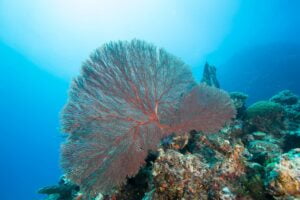
Corals create reefs; these reefs are the home, food source and nursery for countless fish and other marine life. If corals die, whole habitats disappear. This does not just “mess up” the fragile balance within the oceans, a large portion of the world population depends on fish and other marine life as source of protein. A mass dying of fish could follow a mass coral dying which would dramatically affect the lives of millions of people.
But the health of a reef does not only affect the security of food sources, they break waves, calming down the ocean before it gets to the coastline. If these fringing reef die or disappear the sea conditions will change becoming more unpredictable and dangerous for people living and working along the shores. This is on top of the rising sea levels which we are already experiencing.
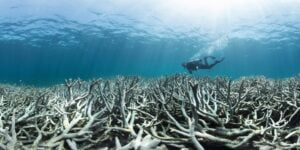
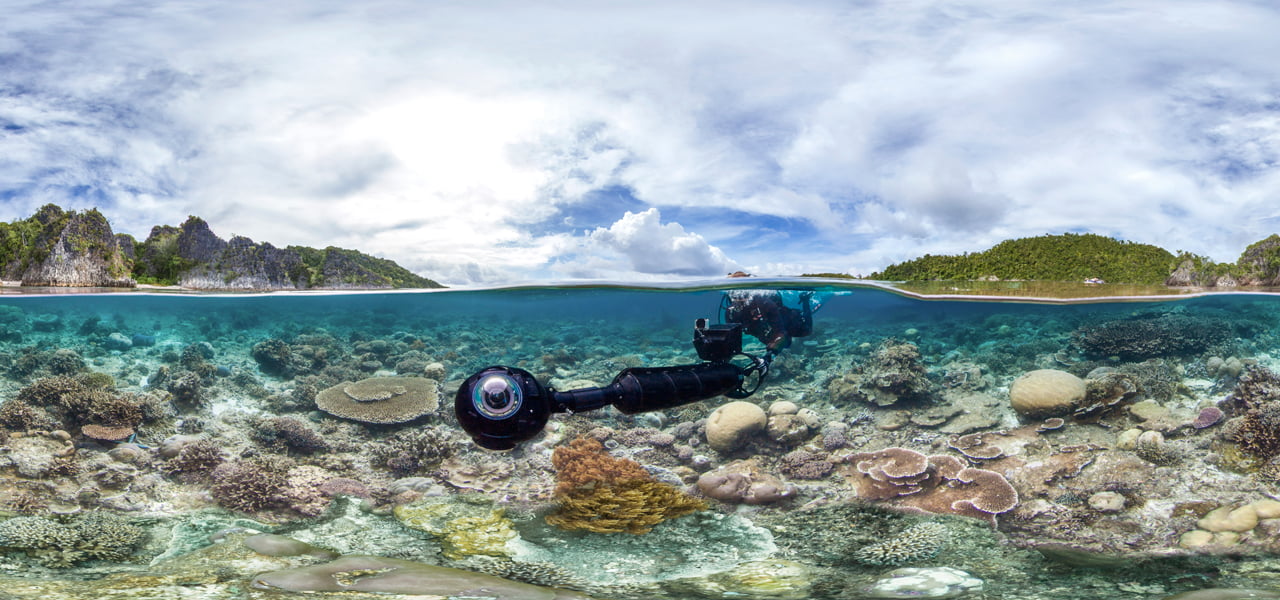
In the documentary, divers, scientists, filmmakers and coral nerds try to document the current worldwide coral bleaching events and coral deaths for those who otherwise would never see what’s happening underneath the surface of our oceans. The documentary took over 3 years to film and edit and included more than 500 hours under water and footage from more than thirty countries. Despite the technical as well as whether challenges the photographers were able to catch breath-taking footage of reefs before and after they died. Shockingly depressive are shots of whole reef ecosystems that are completely dead, where no life is left. It is incredibly disturbing to see that once the corals are dead the vibrant fish populations disappear as well.
There couldn’t have been a more perfect night to watch this movie!
We were watching this movie in the safety of our home with family and friends while the Hurricane Harvey flood aftermath was unfolding just right out at our doorstep. We were just experiencing one if not the most severe natural disaster the US has ever experienced, we were experiencing the sheer force of the effects of what is at least to some degree caused by the human impact on our environment. As I am writing this we are on day three of the disaster, many people have lost their homes, their belongings, their memories, some even their live or loved ones. This was day three of which they say is a five to seven-day stretch. Mother earth is teaching us a lesson those days what happens if we keep being careless.
I urge everyone to watch “Chasing Corals” unfortunately it is only available on Netflix there is no DVD. I invite everyone who does not have access to Netflix to come to Oceanic Ventures. Inc. and use our Netflix account to watch it in the classroom.
Investigation of East Flower Garden Bank coral die-off continues amid new coral bleaching event

Scientists continue to explore a broad spectrum of possible causes for July’s mass mortality event at East Flower Garden Bank within Flower Garden Banks National Marine Sanctuary, including environmental conditions and human activities. Meanwhile, their efforts are now complicated by a new but unrelated coral bleaching event, which can happen this time of year when corals are stressed by warmer water temperatures.
A preliminary review of vessel traffic data revealed a lack of vessels in the vicinity just before the mortality event. This effectively rules out the possibility of an acute discharge of pollutants as the cause of the die-off. Earlier analyses indicated that no hydrocarbons were present in the area of the mortality, which further reduces the likelihood that the event was due to some sort of petroleum-based contamination.
Ongoing response efforts are now focused on additional analysis of oceanographic dynamics (see animation below) and water quality. NOAA research divers conducting additional response surveys earlier this month observed dead sponges in other locations around East Flower Garden Bank and on a nearby production platform just outside the boundary of Flower Garden Banks National Marine Sanctuary. The die-off and whatever caused it, therefore, may have been more widespread than initially thought. [READ MORE]
Coral Bleaching Outlook for 2016
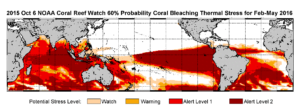
As record ocean temperatures cause widespread coral bleaching across Hawaii, NOAA scientists confirm the same stressful conditions are expanding to the Caribbean and may last into the new year, prompting the declaration of the third global coral bleaching event ever on record….[READ MORE]
Snakes – Conserving Wildlife and Protecting our World

Recently one of my young friends, Seth, was talking to me about his “history changer project.” Specifically, Seth’s concern and interest is in snakes.
You might ask, why would Ms. Ann care about snakes? Many of you may not know that I grew up in the desert. The desert I grew up in was the Sonoran Desert in Arizona, which is one of the great deserts of the world. It has a very unique ecosystem that contains a variety of endemic plants and animals, such as the Saguaro (Carnegiea gigantea) and Organ Pipe cactus (Stenocereus thurberi).
One of the threats to the health of the beautiful Saguaro cactus was people killing snakes. As the snake population decreased, the cactus mouse (which is the size of a field mouse) population increased. These little mice like to eat holes in the base of the mighty cactus, which is not healthy for the cactus.
From the time I first started hiking and rock climbing in Arizona, I learned that when you saw a rattlesnake, you backed up and went the other way; but it was important you did not kill them.
My friend Seth is trying to protect one of his favorite creatures…the snake. Please look at his History Changer Brochure Let’s help him spread the word!!!!

Scuba Science – Methane Seep Off Coast

This lithodid crab is perched on a mussel bed at 1 mile (1.6 kilometers) beneath the surface of the Atlantic Ocean
Scientists just found perhaps the largest methane seep in the world (about one kilometer long). Around this seep they discovered a vast ecosystem that was supported by the constant leak of methane. This seep of methane was found in the western part of the North Atlantic Ocean, and it is only the third one to be found off the coast of the United States. Mussels were found covering the seep of methane. Since these mussels were so deep in the sea, the sun’s energy did not reach them, so they relied on bacteria that used the methane to make energy. Researchers also found sea cucumbers squeezing themselves between the mussels. Around this mound of mussels and sea cucumbers, scientists found shrimp swimming around (most likely eating leftover food). Many strange fish were also found circling this ecosystem. It will be interesting for deep sea divers to collect specimens from this methane ecosystem someday to study them in more detail. Since methane is a gas that contributes to the atmospheric greenhouse effect, understanding how these creatures use methane might help us slow global warming.