• Skip to primary navigation
  • Skip to main content
  • Skip to footer

Houston's Premier Scuba and Dive Shop Oceanic Ventures Inc.

(713) 523-3483 (dive)
5808 Newcastle Drive
Houston, TX 77401

  • Home
  • Stay Current
    • Our Blog
    • Travel and Events Calendar
    • Club Aquarius Social Club
      • Club Aquarius Social Club Upcoming Events
      • Club Aquarius Social Club – The Past
    • Special Events
    • Local Scuba Diving Events
    • Photography Contest
    • Categorized Blog Posts
  • Equipment
    • Dive Equipment
    • Rebreather Systems
    • Cruise Ship Passengers
    • Repair & Maintenance
    • Air & Mixed Gas Blending
    • Pure Fiji Spa Products
  • Training
    • Become a Scuba Diver
    • Scuba In Your Home or Ours
    • Diving Programs for Young Explorers
    • Recreational Dive Courses
      • Recreational Dive Courses overview
      • The Briar Club Scuba Program
      • West University Scuba Program
      • Houstonian Scuba Program
    • Technical Diving Courses
      • Basics
      • Nitrox
      • Trimix
      • Rebreather
      • Wreck Diving Programs
      • Cave Programs
      • Blending
    • Leadership Dive Courses
  • Travel
    • Travel Escorted Adventures
    • Travel – Other Travel Programs
    • Travel – Custom Travel Adventures
    • Local Scuba Diving Events
    • Technical Travel
    • Scuba Diving Around Texas
    • Travel Insurance
    • Travel Forms
  • Company
    • About Oceanic Ventures
    • Meet Our Team
    • Testimonials
    • Facility Hours
    • Map
    • Oceanic Ventures Foundation
    • Resources & Articles
    • Archive
  • Shop
    • Online Store
    • Cart
    • Checkout
    • My Account
    • Policies regarding Privacy and Purchases
  • Contact

Archives for January 2011

January 31, 2011 by Eric Keibler

Creating Exciting Photographic Scenics

Rainbow Reef
Rainbow in Fiji
One of the central tenants of Buddhism is to be here in the moment and to experience the moment fully.  When you get behind the camera, it is important no to get too wrapped up in the technical side of photography but rather experience the beauty that is all around you at that moment.
Try and capture what you are seeing and experiencing.  Digital photography makes it easy to experiment.  Look at how the sun  plays off the leaves, trees, bark, water droplets; see how it illuminates the spider web or causes the water to shimmer.
When the sun is hidden behind a flat white sky, look for textures and contrasts.
In his article about landscape photography (PhotoSecrets.com), Mark Fenwick encourages his readers to look for:

  • Light -shadows and highlights,
  • Shapes – round and angular,
  • Colour – harmony and discord,
  • Texture – rough and smooth,
  • Composition – strong and weak,
  • Tones – light and dark
  • Patterns – even and odd,
  • Mystery.

 While you are exploring, move around your subject.  Look for alternate vantage points and angles.  If you can, try it at different times of the day.  By mneung around and exploring a site at different times, the landscape will reveal more to you.
You can also try using different lens apertures.  Ansell Adams is well known for shooting everything at f22 in order to capture all of the detail in his scenes.  You can also use that depth of field to your advantage by blurring an unattractive or distracting foreground while keeping the remainder of the scene in sharp focus.
You can always start with the standard shot of an area but then start experimenting.  Move around, lay on the ground, climb a tree, blur the foreground, or frame the image with a tree of bush.   You can change the perspective by switching from a wide angle lens to a telephoto lens or have a little fin and try a fish eye lens.  
Enjoy your photographic safaris or walks and learn to see what is happening at the moment you are there.  Don’t settle for a standard shot, experiment and try something different.

Filed Under: Digital, Photography, Underwater Tagged With: photographic scenics, photography, Surface Photography, underwater photography

January 28, 2011 by David Snyder

Dave Talks About Rebreathers – Part 3


Rebreather divers on the Carrie Lee in Grand Cayman
Q: When did you start using a rebreather?

A: The key question that I had to answer before I began using a rebreather was,  “Why do divers die on a rebreather.” The short answer is rebreather divers die when they forget or stop believing that the laws of physics apply to them.
 
Q: But when the above mentioned have failed for one reason or another, the next law implied should be survival. Would not the presence of a partner/buddy in close proximity of you, help?
A: Rebreathers are not complex machines but they do require one to setup them properly. Most accidents can be traced to actions or inactions on the surface. Even that, most times does not kill divers, it then takes ignoring warning signs. Generally a rebreather setup properly just works. Monitor it and you will be fine. From the accidents I have been able to research 99% have been diver error. When I use my rebreather I always tell myself the laws of physics still apply to me and complacency and stupidity kills. The definition of an accident is the lost of control. Typically there is a series of events each of itself not causing a loss of control but together causes an accident. Breaking the chain of events prevents the accident. When using a rebreather this is done by paying attention and following your training.
Q; When I dive with my partner/buddy, I have to be honest, I feel as though I am somewhat responsible for his safety, and he mine.
A: When I dive with someone I tell them that no matter what, I am coming back safely. Implied by that is I will drag their sorry butt back also, but I need to know where they are at.

Filed Under: Rebreathers, Scuba Diving Equipment Tagged With: Rebreather, Technical Diving.Rebreather Diving, Training

January 18, 2011 by amosnachoum

In the Company of Big Animals

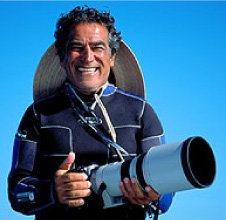
I want to introduce you to Amos Nachoum, a self-proclaimed Ambassador of the Big Animals. He is an award winning photographer who has publised photographs in magazines around the world including National Geographic. In a presentation Amos made top the Explorer’s Club in New York City, he said “to live up to that ambassador role I’ll be in the city, presenting my best stories and information about some of the most fragile regions of the underwater world. I’ll be showing and discussing photographs from my expeditions around the world and will probably include a few “classics” from the hundreds of my images that have appeared in National Geographic, Time, Life, The New York Times, Condé Nast Traveler, Le Figaro, and Der Spiegel. You can also see more of my images on my website, plus news about my latest expeditions. It’s all part of spreading my message that only through observation and interaction with these animals can people understand and respect some of the most impressive citizens of our planet. In a few words, “you have to go there and experience this firsthand.” Amos recorded a presentation for Google entitled “In the Company of Big Animals.” You will hear Amos and he talks about his expeditions and shos his photographs. Sit back, pour yourself a cocktail and be prepared to be wowed…

Filed Under: Digital, Photography, Presentations, Scuba Diving Activities, Travel, Underwater, Video

January 7, 2011 by David Snyder

Dave Talks About Rebreathers – Part 2, CO2

Eric on an Inspiration Classic in Grand Cayman
CO2 sensors are the next great break through in rebreathers, maybe. Scrubber media works until it doesn’t. That means the CO2 spikes rapidly when the scubber media begins to fail. CO2 sensors may be able to show the spike but can never be predictive. If the CO2 is spiking during the dive you are screwed. A much better paradigm is being conservative and not run the scubber media to it’s theoretical end point. Therefor a CO2 sensor is not as much value as it would appear on first blush. There is something called a temp stick used in a couple of rebreathers using axial canisters. The scubber media reacts on a plane within the canister generating heat. By tracking this heat you get an idea how much scubber media is left. A bit more predictive but not perfect correlation. Still left with being conservative and changing scubber media as the best method. A typical canister of scubber media will last about three hours depending on conditions.
As for a CO2 hit, the symptoms are headaches, rapid breathing then unconsciousness. When in doubt bailout.
Q: On open circuit, I breath very lightly, but it would seem to me that, that style of breathing would not lend itself to rebreather?
All rebreathers have unidirectional gas flow. This is done via flapper valves on either side of the bailout valve (BOV). Breathing type or rate is irrelevant to the movement of gas within the loop. There are some issues related to dwell time in the scubber media in extremely rapid breathing conditions. This would be a CO2 issue.
Q: Is it the outside pressure exerted on the counter lungs that forces your breath through the scrubber, and thus returning it to you?
As your lungs expand the counterlung collapses, as you exhale the counter lung expands, pressure on one cancels out the other. External pressure is not relevant, but gas density is however. Counterlungs are but one part of the loop. Work of breathing (WOB) is the resistance encountered. Commercial rebreather units have to have acceptable WOB else no one would buy them. Some units are better than others.

Filed Under: Rebreathers, Scuba Diving Equipment Tagged With: CO2, Sensors, Work of Breathing

January 4, 2011 by Eric Keibler

Happy New Year!

Eric and Ann with Ann's Mother and Aunt at the Musical Instrument Museum in Scottsdale, Arizona
Athbhliain faoi mhaise duit or Happy New Year to you! 2010 came to a quiet close and 2011 opens with optimism and a promise of good things to come.
The staff at Oceanic Ventures spent the end of the year relaxing with family and getting ready for a fun 2011. Vernon spent part of his December vacation visiting “the Mouse” in Florida while Barney finished recovering from shoulder surgery and Barbara waited on him hand and foot (ok, maybe not so much). Ashton spent New Years in San Diego, and Jean-Luc went west to Los Vegas for a family outing. Joel spent some quiet time at home and Dave was forced to spend time at home due to the winter snow in New York.
Snow was also in the plans for Bob in Park City, Melanie in Steamboat and Santa Fe for Mike while warmer temperatures attracted Jeremy to Mexico City. Steve J spent time with his family, something his job allows little of and Wade spent time visiting family. Steve and Ann had company in while Stephanie and Stan spent time planning on how to pay for Marina’s college plans.
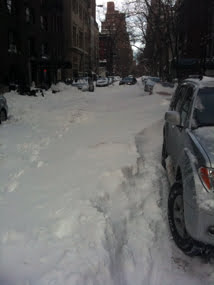
Snow on 72nd Street in New York City
Ed and his wife spent time in LaGrange while Ed W spent time at church (no rest for church staff during Christmas). Jordan visited relatives and spent some quality time with Inja after spending too much time with a bunch of guys in a saturation system.
Nigel had time to work on his photos and Holly was finally home to check on her cat and to put her feet up for a while. Relatives found Zaide visiting and David visited Marisa’s family and lamented the upcoming loss of his “man cave.” Brit spent time with family and friends.
Ann and I spent time in Houston and then left Christmas day to spend time in Scottsdale with her Mother and Aunt. The time change sure helps make the Christmas activities last longer!  We stayed a few extra days touring and enjoying the sites and sounds of Scottsdale.  We watched some traditional native dancing, met some incredible Navajo singers and toured an incredible museum, the Musical Instruments Museum.
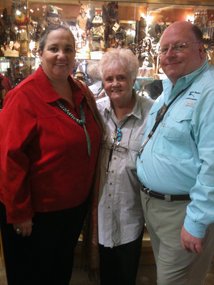
Ann and Eric Keibler with their friend Jan Phares in Scottsdale Arizona. Jan is a long time friend and a sales professional at Gilbert Ortega's.
Of course no visit to Arizona is complete without a visit with our friend Jan Phares, at Gilbert Ortega’s.  Jan and I have had a long relationship due to Ann’s love of turquoise jewelry.  Jan has helped me on numerous occasions to pick out just the right gift for Ann.  And, like I expected, Ann fell in love with a new necklace.
One thing we all have in common is that we are looking forward to diving in the New Year! I have a trip leaving in a few weeks and Ann and Steve have one scheduled for March. There is a lot happening so we all hope you will stop by and start diving soon! We are here to help you realize your diving dreams.
Now that everyone is back from their holiday visits, it is time to start thinking about diving.  We have some great blog posts coming over the next year with some really cool posts from some guest writers.  Keep in touch and let me know what you would like to know about diving, photography, rebreathers or technical diving.  Here is to a stellar 2011!

Let’s go Diving!

Filed Under: Art, Navajo Tagged With: Arizona, handicrafts, jewelry, leather, snow, staff holiday

Footer

Contact Us

Oceanic Ventures, Inc
5808 Newcastle Dr.
Houston, TX 77401-3214
USA

Phone: 713-523-DIVE (3483)

eMail: divesafe@oceanicventures.net

Signup for our dive and scuba newsletters

Don’t miss news about the exciting happenings at Oceanic Ventures.


Map and Directions

Socialize

  • Email
  • Facebook

Why People Choose Us

People choose their friends carefully just as they should choose their adventure partners and Scuba Diving Instructors.  Oceanic Ventures is the premier scuba dive shop in Houston, Texas, and the Southwest because of our exceptional service and our sense of adventure.  In talking with our clients and friends, people choose us for a number of reasons such as: Passion – We love what we do and we want to share the beauty and excitement of the underwater world with everyone we meet. Caring- Our clients tell us they love us because we truly care about people and strive to make their scuba diving experiences safe, fun and enjoyable. Professional – Our staff members are the … [Read more …]

Copyright © 2026 all rights reserved Oceanic Ventures, Inc. · Sitemap · Log in