• Skip to primary navigation
  • Skip to main content
  • Skip to footer

Houston's Premier Scuba and Dive Shop Oceanic Ventures Inc.

(713) 523-3483 (dive)
5808 Newcastle Drive
Houston, TX 77401

  • Home
  • Stay Current
    • Our Blog
    • Travel and Events Calendar
    • Club Aquarius Social Club
      • Club Aquarius Social Club Upcoming Events
      • Club Aquarius Social Club – The Past
    • Special Events
    • Local Scuba Diving Events
    • Photography Contest
    • Categorized Blog Posts
  • Equipment
    • Dive Equipment
    • Rebreather Systems
    • Cruise Ship Passengers
    • Repair & Maintenance
    • Air & Mixed Gas Blending
    • Pure Fiji Spa Products
  • Training
    • Become a Scuba Diver
    • Scuba In Your Home or Ours
    • Diving Programs for Young Explorers
    • Recreational Dive Courses
      • Recreational Dive Courses overview
      • The Briar Club Scuba Program
      • West University Scuba Program
      • Houstonian Scuba Program
    • Technical Diving Courses
      • Basics
      • Nitrox
      • Trimix
      • Rebreather
      • Wreck Diving Programs
      • Cave Programs
      • Blending
    • Leadership Dive Courses
  • Travel
    • Travel Escorted Adventures
    • Travel – Other Travel Programs
    • Travel – Custom Travel Adventures
    • Local Scuba Diving Events
    • Technical Travel
    • Scuba Diving Around Texas
    • Travel Insurance
    • Travel Forms
  • Company
    • About Oceanic Ventures
    • Meet Our Team
    • Testimonials
    • Facility Hours
    • Map
    • Oceanic Ventures Foundation
    • Resources & Articles
    • Archive
  • Shop
    • Online Store
    • Cart
    • Checkout
    • My Account
    • Policies regarding Privacy and Purchases
  • Contact

Conservation

October 25, 2012 by marinawatowich

Are Beluga Whales Mimicking Human Speech?

Delphinapterus_leucas_2 beluga whale by steven snodgrass
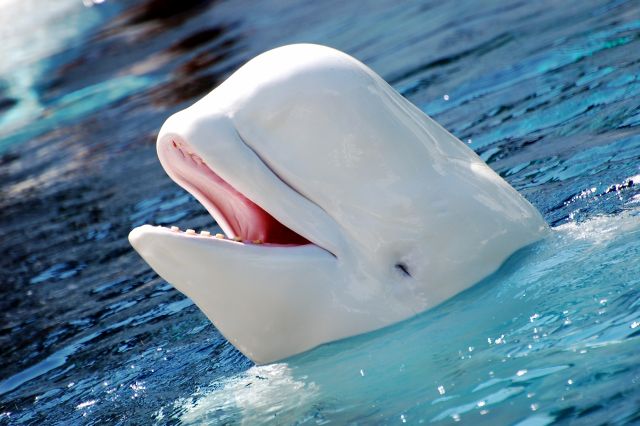
Beluga Whale (Delphinapterus Leucas) copyright Steven Snodgrass

Many animals have been taught to mimic human behaviors, particularly human speech patterns but no animal has been found to do so naturally, until now. A beluga whale at the National Marine Mammal Foundation in California has been found to make sounds at lower octaves than usual and in patterns atypical for whales. While a researcher diving with the beluga heard unusual sounds the research team decided to investigate. They traced the sounds to one nine-year old male named NOC and recorded his sounds. What the discovered was that NOC was making vocal noises in bursts of about three seconds with pauses that are close to human speech patterns but not whale communication. They also found that the frequencies of NOC’s noises were varied into “harmonics” that were similar to humans but very distinct from whales. As the researchers gave NOC rewards for the human-like sounds he was taught to make them on command so they could be better studied. It was found that NOC can change the pressure in his naval cavity quickly as well as adjusted a few other body parts involved in vocalization to create lower frequency sounds in order to produce these sounds that whales have not been heard to make ever before.

This is a really exciting discovery and is one step closer to us understanding whale communication, adaptability and intelligence!

Filed Under: Conservation, Marine Life Tagged With: marine life, whales

August 30, 2012 by Eric Keibler

Help Save the Whales

Photograph of Beluga Whale
Photo courtesy of savebiogems.org
This post is courtsey of Amos Nachoum and the staff at biganimals.com

Pierce Brosnan has narrated a video to call attention to the plight of the last 284 beluga whales of Alaska’s Cook Inlet. According to Brosnan, the actor and ocean activist, and also NRDC, the Apache Alaska Corporation is about to launch a seismic airgun attack that could push the white whales over the brink, into extinction.

The explosive noise of airguns used to explore for oil and gas can deafen, injure and even kill whales.
-Natural Resources Defense Council (NRDC)

According to NRDC, the oil exploration company is planning to launch an “acoustic onslaught in the beluga’s only home in the world” and apparently the Obama Administration has given Apache Alaska Oil the greenlight to go forward. The company, says Brosnan in the video, will use devices that create loud air blasts to explore for oil and gas – blasts that will occur every ten seconds, perhaps for months on end. At a distance, Brosnan says, the blasts can cause the whales to abandon their habitat and stop eating. At close range, they can cause deafness, even death.

“Don’t let the belugas go silent. Help protect them before time runs out.”
-Pierce Brosnan


Watch Pierce Brosnan’s video and then visit this NRDC website to tell the Obama Administration to stop the Apache Alaska Corporation from launching an airgun attack on belugas.  View the latest information from NRDC about this attack on belugas

Filed Under: Conservation, Marine Life Tagged With: environmental, marine life, whales

September 16, 2011 by Eric Keibler

Oceanic Ventures Team Trash – Trashfest Texas 2011

Trashfest LogoOceanic Ventures and Club Aquarius are once again a sponsor of Trashfest  We are sponsoring TEAM TRASH and we are looking for a few more divers to join our team of 8 divers who will join 400 other divers in scouring the Comal river looking for trash and prizes.  If you have an interest in joining TEAM TRASH, please contact Ashton.  As a member of TEAM TRASH, you will receive a free Oceanic Ventures t-shirt, specifically made for divers and have your admission to the event paid.  Be sure to let Ashton know you want to participate since the team size is limited.  The fee to join the team is free to Club Aquarius members and $8.00 for non-members.  Remember, space is limited!
TrashFest is the nation’s oldest underwater cleanup campaign bringing together scuba divers to improve the quality of the Comal River in New Braunfels, Texas. The Comal River became famous when Ripley’s Believe It or Not featured it as the shortest river in the world. The 2.5-mile Comal River is one of the largest springs in Texas with 8 million gallons of water flowing through every hour. The water is pure, clear, about 73° – 85°F year round, and attracts thousands of tubers and tourists each year. After the tubing season winds down, divers from all over Texas and beyond gather to pull cans, shoes, sunglasses and other assorted trash and debris out of the river.
 Since the first clean up in 1974*, more than 10,800 volunteers have removed more than:

  • 205,000 pounds of trash
  • 310,000 cans and bottles
  • 353,400 pop-tops and bottle caps
  • 7,200 sunglasses and shoes
  • The above numbers include data from 1980-2010. No records available prior to 1980.

 While cleaning up the Comal is the events top priority, TrashFest also:

  •  Raises public awareness of the aquatic environment in Texas
  • Educates citizens about the sources of, and impact of, debris and litter in the aquatic environment
  • Promotes recycling programs and community involvement
  • Serves as a model for other river and aquatic cleanup programs around the country
  • Involves young children and educates them about the importance of protecting our environment

This year, TrashFest will be held on Saturday on October 1, 2011.
Registration will be held at the Comal County Fairgrounds, and the trash weigh-in and collection will be at Prince Solms Park in New Braunfels, TX.

Filed Under: Charity, Conservation, Local Diving, Travel Tagged With: Trash Fest

May 9, 2011 by amosnachoum

The Law of the Wild – Revised?

042701cbc8b067a818a0FA34BDBF@OwnerPC 300x136 The Law of the Wild   Revised?The Law Of The Wild says kill only when you are hungry. Photographer Michel Denis-Huot, who captured these amazing pictures on safari in Kenya’s Masai Mara in October last year, said he was astounded by what he saw:
“These three brothers (cheetahs) have been living together since they left their mother at about 18 months old,’ he said. ‘On the morning we saw them, they seemed not to be hungry, walking quickly but stopping sometimes to play together. ‘At one point, they met a group of impala who ran away.. But one youngster was not quick enough and the brothers caught it easily’.”
These extraordinary scenes followed.
042701cbc8b067a818a0FA34BDBF@OwnerPC 300x136 The Law of the Wild   Revised?
042601cbc8b067a7f190FA34BDBF@OwnerPC 300x235 The Law of the Wild   Revised?
042501cbc8b067a7f190FA34BDBF@OwnerPC 300x168 The Law of the Wild   Revised?
042401cbc8b067a7f190FA34BDBF@OwnerPC 300x116 The Law of the Wild   Revised?
The images, which ran in the Daily Mail, show the cheetahs playing with the impala and the sequence ends with the impala running away, you assume to safety and a happy ending. But that’s not the whole story. When you look at Denis-Huot’s website, he posts the entire series, which ends with the big cats eating the impala. Sorry, no Disney ending here.
The picture sequence shows how complicated the animal world really is, and how often we want to simplify it by putting our own human vision on it. Cheetahs are hunters at heart, and those in the pictures probably didn’t kill the impala right away because they weren’t so hungry, or because it was a different time of the day than when they usually hunt, or for some other reason. Many animals, though, show kindness, and even to people. There are sometimes reports of dolphins rescuing fishermen from capsized boats, and there was even one recently about a pod of dolphins helping a lost dog. Naturalists like Bernd Heinrich have written about how ravens will share food with each other in the dead of winter, and scientists Frans de Waal have studied how primates will help their sick and take care of their elders. We may have a lot in common with animals, but we also need to respect them for who they are, not for what we think they are. This is a truth that I discover, and share with you, on so many of my BigAnimals trips.
Follow me on Twitter. Look at my How I Did It series on Facebook. I tell you how I made some of my iconic photographs.
[If you would like to join Amos on one of his Big Animal Adventures, let Dive Mom know and she will take care of all of your reservations with Amos]

Filed Under: Conservation, Photography, Wild Life Tagged With: altruism, animal behavior, animals helping people, cheetah, dolphins, impala, safari

April 21, 2011 by swatowich

An Encounter with Dr. Sylvia Earle

Stephanie and her family with Sylvia Earle

This year, my family and I and other members of the Oceanic Ventures team were fortunate to meet an extraordinary individual, Dr. Sylvia Earle, who has a deep commitment to protecting and conserving the marine environment. Sharing a few impressions from our encounter will, I hope, show how we can all work toward having a lasting positive impact on oceanocean conservation.

You might ask why this topic is of any importance, and how protecting the oceans will affect you or your family. Simply put, the human race depends on the oceans for life. And as divers, we rely on the oceans for our recreation and exploration.

The oceans are responsible for the production of a major portion, up to 50-70%, of atmospheric oxygen. Oceans also sequester carbon dioxide that we produce but are unable to metabolize. Billions and billions of tiny microorganisms living in the ocean use photosynthesis to produce oxygen by capturing carbon dioxide and energy from sunlight. Furthermore, oceans support the essential water cycle that brings rain and freshwater to land, allowing us ample water resources for agriculture and recreation.

The oceans are already showing the stress of human activities. If we fail to take action to further protect these vast and wonderful environments, we risk facing a world with insufficient oxygen, an altered water cycle with unknown consequences, and further buildup of toxic carbon dioxide in the atmosphere.

But the news isn’t entirely grim. Sylvia Earle emphasizes that we are living in the very best of times. We have the knowledge and resources to protect and conserve our marine environments, while also sustaining important activities for humans, including fishing, drilling for oil and oceanic shipping.

Sylvia is an oceanographer and a National Geographic Explorer-in-Residence. Many of us would know her through her diving history. Sylvia holds the record as having made the deepest untethered dive to a depth of 1000 meters (3300 feet) for men or women, an amazingly impressive feat. Sylvia has logged over 6000 hours underwater, on par with Ann and Eric! She’s been diving all over the world, but has a deep passion for the Gulf of Mexico, where she first dove and spent many hours enjoying as a child.

Sylvia spoke on April 5 at the Progressive Forum in Houston. Her message was loud and clear. We must take action to protect and conserve our marine environments, while also finding better ways to utilize the oceans for human needs. Sylvia reported that we are seriously overfishing, particularly large ocean fish such as bluefin tuna and sharks. Beyond the absolute beauty and impressive size of these creatures, they are critical for maintaining the balance of life in the oceans. As animals near at or near the top of the food chain, they keep smaller fish species in check, which is important for the health of the rest of marine ecosystems such as coral reefs. Other long-lived and slowly reproducing species such as orange roughy are also threatened by overfishing.

What you can do: become more aware of how our lifestyle might inadvertently contribute to overfishing. The Monterey Bay Aquarium in California is a great place to get started.

 Sylvia also emphasized that we must invest time and effort into finding better methods to better utilize the oceans for human activities. An obvious example was brought to light last year during the Deepwater Horizon drilling disaster. This accident took the lives of 11 people and countless numbers of marine species. We still don’t understand the ecological ramifications of the oil that was spilled, or the dispersants that were used, particularly their effect at deep depths in the Gulf. A major impact may be on the tiny photosynthetic organisms that produce oxygen for our atmosphere, as well as larger marine and bird species. As the Deepwater Horizon disaster revealed, we need to ensure that we develop cutting-edge technologies to explore and drill, and contain unanticipated oil leaks. One mile (or 161 ATM in diver terms) or more beneath the ocean surface prneudes extraordinary challenges. Sylvia pointed out that the oil industry and Houston itself were leaders in developing the needed technology.

What you can do: support investments in education and technology development that prneude the most efficient methods of extracting and using energy resources such as oil.

 A third point Sylvia discussed is to develop a system of protected marine environments, similar to the National Parks on land that prneude areas for human recreation and conservation of thousands of terrestrial species. President George W. Bush designated three Marine National Monuments within the last few weeks of his presidency that will prneude much needed protection for coral reefs in the Pacific Ocean. But more work is needed to protect areas in the Pacific as well as other oceans, and our own backyard, the Gulf of Mexico.

What you can do: become informed about conservation efforts through agencies such as the Nature Conservancy, World Wildlife Fund and Sylvia’s own Mission Blue.

 mission blue logoMission Blue is specifically aimed at conserving and protecting the oceans.  We are all capable of contributing to this effort, on large or small scales, depending on our resources, expertise and time. Protecting the oceans for our use, the vast numbers of marine species, the health of the planet, and future generations, is within our grasp. Here are a few ways to get started:

  • Learn about sustainable seafood. 
  • Let your government representatives know that you support agencies that conduct marine research.
  • Support marine conservation agencies. 
  • Support educational efforts about marine environments and their protection; let your government representatives know that you think education is vital. 
  • Help locally with beach clean-ups. 
  • Think about what you put on your lawn, and the fact that it will eventually end up in the Gulf of Mexico. 
  • Reduce waste, reuse and recycle.

Filed Under: Conservation, Marine Life, Presentations Tagged With: fish, National Geographic, ocean, sustainable fishing, Sylvia Earl

  • « Go to Previous Page
  • Page 1
  • Page 2
  • Page 3

Footer

Contact Us

Oceanic Ventures, Inc
5808 Newcastle Dr.
Houston, TX 77401-3214
USA

Phone: 713-523-DIVE (3483)

eMail: divesafe@oceanicventures.net

Signup for our dive and scuba newsletters

Don’t miss news about the exciting happenings at Oceanic Ventures.


Map and Directions

Socialize

  • Email
  • Facebook

Why People Choose Us

People choose their friends carefully just as they should choose their adventure partners and Scuba Diving Instructors.  Oceanic Ventures is the premier scuba dive shop in Houston, Texas, and the Southwest because of our exceptional service and our sense of adventure.  In talking with our clients and friends, people choose us for a number of reasons such as: Passion – We love what we do and we want to share the beauty and excitement of the underwater world with everyone we meet. Caring- Our clients tell us they love us because we truly care about people and strive to make their scuba diving experiences safe, fun and enjoyable. Professional – Our staff members are the … [Read more …]

Copyright © 2026 all rights reserved Oceanic Ventures, Inc. · Sitemap · Log in