What a trip! This was my first trip back to Palau for over 20 years and I can’t understand why I stayed away for so long.
Like on our previous trip we stayed at the beautiful Palau Pacific Resort. This is one of the nicest hotels on the island and over the years since my last visit they have added a small, exclusive hotel within the property as well as some over the water bungalows complete with glass viewing ports. But while the hotel has grown, the warm, friendly atmosphere created by the staff has not changed. They excited to be there and made us all feel welcome. The staff at the poolside bar was simply fantastic (yes we spent a lot of time her). Maria even remembered every customer’s name and room number as well as what you were drinking the previous night — if only I had her memory.
While on our previous trips the Mantas alluded us in German Channel, on this trip they were in abundance also with sharks visiting the cleaning stations – wait until you see the photos. The weather was even calm enough for us to visit Pelilu and dive Pelilu wall.
Navot and Tova from Fish -n-Fins have assembled a great team. Our dive guide, Hiro, was wonderful to work with and he was patient having to work with normal recreational divers, CCR divers and even divers using sidemount. He made it a nice trip for me taking much of the burden for the group underwater He was assisted on the dive by his “trainee” IB and Captain Rodney. They were all fun to work with and kept things light and fun during the day as we visited multiple dive sites each day (3 dives a day).
I am only sorry the trip had to end but I and 1/2 of the guests were headed to Truk Lagoon for another wreck diving adventure.
I hope it doesn’t take me so long to come back.
Pacific
Diving the Philippines – A Teaser
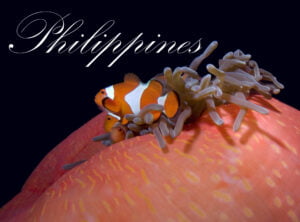
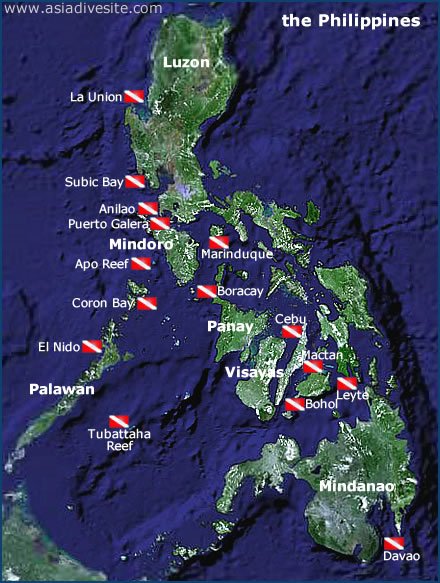 The Philippines is a country with over 186,000 square miles and over 7600 islands. There are over fifteen primary areas for diving, stretching from La Union in the north to Davao in the south. All but Apo Reef and Tabathaha are just off island communities; these reefs must be reached by boat.
In her presentation at Club Aquarius on 22 March 2018, Ann Keibler will be talking about diving in the Philippines and the differences between the various regions of the Country and where she thinks the most diverse diving areas are located.
Come find our more by attending the meeting at 7:00 PM at the Black Labrador Pub.
Scuba Diving – Life on Liveaboards

Have you ever dreamed of living and scuba diving right on top of one of the world’s best dive sites, starting the day by pulling on your wetsuit, slipping into your dive gear, and dropping into the clear, warm ocean above a coral reef teeming with fish all waiting to wish you good morning?
This is the dream made real by liveaboard dive boats, which have been multiplying in recent years in response to demand from divers with busy lives who want to make the most of the leisure time they have.
There are options for all budgets, from dormitory accommodation to palatial private cabins, from canteen-style buffets to fine dining. You can share the deck with a couple of dozen other keen divers or scuba in style on an exclusive boutique luxury vessel with personal rinse tanks and dive valets to look after you and your gear. Some liveaboards offer weekend schedules; others extended voyages to really let you get away from it all.
What are the pros and cons of Liveaboard Scuba Diving?

The main advantages are that you get access to more remote and unspoiled places that see comparatively few divers and you can easily dive four or even five times a day.
The disadvantage is that you are living on a boat, which can be uncomfortable if sea conditions become rough. Your food options are limited and nightlife is usually non-existent. If you do not get on with your fellow travelers it is hard to escape but liveaboards are usually very convivial places full of like-minded, outgoing folk.
A Typical Liveaboard Day


You wake early, roused from your sleep by sunrise and the sound of activity. You throw on your swimsuit and a t-shirt and head for the galley for a snack to wake you up and give you energy and hydration for the first plunge of the day.
You greet your companions on the dive deck where your equipment is ready to go. You showed the crew how you like it set up on the first day and they are quick learners. During the trip, your dive gear lives permanently in the space allocated to you. Your wetsuit hangs nearby although you will be diving so frequently it will never get really dry! On some boats you gear up fully on deck and jump straight in; other liveaboards use small boats called tenders to take you back and forth to the sites.
Breakfast follows the first dive and from there the day progresses in a sequence of rest – dive – eat – rest – dive – eat until you fall into bed and are rocked to sleep by the sea.
Every boat has a sunbathing area, shaded deck space, and a communal lounge where there might be a Scrabble game going on or someone running through their photos from the last dive. If you want some privacy, you can retreat to your cabin, which on most boats is a shared twin room with bunks or single beds. If you are traveling alone you may find yourself sharing with a stranger, usually of the same sex. This is not necessarily a bad thing. You may find you have made a buddy for life!
There are fresh water showers on deck and usually in the cabins but expect hot water to be in short supply. Think of it as a wonderful surprise if you get some and use it sparingly as you may not be the most popular person on board if you are the only one that got to enjoy it!
Tips for Liveaboard Trips for Scuba Divers

Join a pool session or a local dive. Run an in-water check on your equipment before you go. If you find problems get them fixed and then go back in the water and check everything again before you leave.
Pack light: liveaboard life is very informal. Take a few T-shirts and pairs of shorts, a sarong or two, and a sweatshirt for the cool evenings at sea. Don’t bring shoes apart from those you wear to travel; you will go barefoot on board and can use your dive booties for any beach walking.
Be prepared with: –
- Multiple surface signaling devices such as a torch, a noisemaker, and a tall, brightly coloured safety sausage
- A small spares kit containing a mask strap, regulator mouthpiece, and two fin straps, (as they both tend to break at the same time!)
- A personal medical kit containing anti-motion-sickness pills, patches, or wristbands; eardrops; antibiotic ointment for coral cuts and hydrocortisone cream for hydroid stings.
Warning: liveaboard diving can be very addictive!
Simon is the best-selling author of Scuba Confidential – An Insider’s Guide to Becoming a Better Diver and Scuba Professional – Insights into Scuba Diver Training & Operations. Both books are available from Oceanic Ventures. Simon has also just published a new book for divers-to-be and absolute beginners called Scuba Fundamental – Start Diving the Right Way

Hidden Scuba Diving Treasures – Muck Diving

Simon is the best-selling author of Scuba Confidential – An Insider’s Guide to Becoming a Better Diver and Scuba Professional – Insights into Scuba Diver Training & Operations. Both books are available from Oceanic Ventures. Simon has also just published a new book for divers-to-be and absolute beginners called Scuba Fundamental – Start Diving the Right Way.
You roll off the boat and look down to get a hint of the wonders that await you on this dive but it seems you are in the wrong place. There are no glorious coral formations; in fact there is no reef at all. Instead the seabed seems grey and featureless and the visibility is reduced by the presence of a nearby river mouth.
Sixty minutes later, however, you return to the surface with your mind reeling and your camera’s memory card full of pictures of some of the most incredible marine life you could ever have imagined.
You have just been on an underwater treasure hunt; a game of hide and seek with some very clever opponents. This is muck diving!
The Genesis
While early scuba divers were marveling at the beauty of coral reefs and hanging out in the blue watching for whale sharks and manta rays, a whole universe of amazing creatures were going about their business under the sea completely un-noticed.
How could they have remained undetected for so long? Well, first they were small, second, they had developed the art of concealment to a very high degree and third they lived in places that were not particularly pleasing to the eye. Primarily, however, they remained unseen because nobody was looking for them.
Then a few things happened to bring these little creatures into the limelight.
First, the big fish became fewer in number and harder to find. Second, divers became older and a little lazier and, third, there were significant advances in underwater macro-photography.
Most importantly a few enterprising individuals in Papua New Guinea, Indonesia and Malaysia started looking for marine life in unusual places where nobody had looked before and began to find some absolutely astonishing things.
Muck diving is the quest for these beautiful animals in the sometimes-inhospitable environment where they hide.
Where to Go
New muck diving locations are being discovered all the time but, so far, the world capital is Lembeh Straits on the northeastern tip of Sulawesi in Indonesia. Other locations that also deserve honourable mention include a variety of sites right across northern Bali, Dumaguete in the Philippines, Pulau Mabul off the coast of Malaysian Borneo, Komodo, Ambon and Alor in the Indonesian archipelago and Milne Bay in Papua New Guinea.
 Muck Diving Techniques
At first it can appear an impossible task and you will be amazed at how your guides can see things that are almost invisible until you look carefully. Keep trying, however, and with a little experience you will be spotting your own hidden treasures. The thrill of discovery when you find something rare and exotic is hard to beat.
These tips may help: –
- Look ahead as well as beneath you
- Be alert for movement as you pass.
- Follow tracks in the sand
- Get as close as you can
- Examine everything from several angles
- Be patient and take your time
- Move slowly
- Stay as near to the sand as possible without disturbing it
- Use a fin-kick that does not involve downward fin movement so you do not disturb the sand: a gentle frog kick works well
More Spotting Tips
You can also increase your chances of spotting success by knowing where to look, for instance: –
- Ornate ghost pipefish hang out among feather stars.
- Pipefish and seahorses hide among sea grass.
- Baby clown frogfish love rotting wood.
- Sea cucumbers host colourful emperor shrimps as well as swimming crabs
- Harlequin shrimps feed on sea stars
- Urchins are often home to shrimps and baby fish
- Fire urchins are where zebra crabs live
- Tube anemones often have small harlequin swimming crabs on their trunks
- Sea pens shelter porcelain crabs in their fronds

Essential Equipment
An excellent tool that all the top guides use is a stainless steel 30 cm pointer, which you can thrust into the sand to help you balance as you hunt for animals. You can also use it gently to move aside a concealing weed to see more clearly. Attach the pointer with a lanyard to your BCD and tuck it into your harness when you are not using it.
Just Scratching the Surface
Remember, many of the creatures being discovered by muck divers today are new to science. It is exciting to imagine how much more there is to learn and what surprises remain to be discovered by someone with patience, a sharp eye and a pointer.
Scuba Diving Adventure to Indonesia Comes to a Close
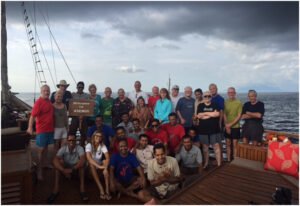
The Oceanic Ventures Adventure Trip to Indonesia’s Forgotten Islands is rapidly coming to a close. The group has left the boat and is currently in Bali or Jakarta (the group took different routes to get there) and are preparing for the journey home. The Bali group is lounging in Nusa Dua and will be starting home tomorrow.
Keep watching for more updates on this trip and I am sure we will see some of the photographs in the !
Scuba Divers Wandering Through Bali

There is no rest for the adventure traveler! The group has been very busy in Bali visiting temples, rice fields and yes, shopping. I mean what type of trip would it be without a shopping opportunity? If you are wondering about their time in Bali, here is the schedule for Ann’s group prior to starting toward the Arenui:
| Day 1 | Upon arrival in Bali 9:35 AM Transfer to Ubud (approx. 1hr 10mins)Tour John Hardy’s Factory, then to hotel | |
| Day 2 | 08:00 Tour begins with a visit to Taman Ayun, Ulun Danu Bratan – Jatiluwih Rice Terrace. Lunch at Local Restaurant. Return to hotel | |
| Day 3 | 09:30 Tour begins with a visit to Monkey Forest Ubud , a Batik Factory, a Silver Shop at Celuk Village, a Balinese Traditional House at Mas Village. and transfer back to Nusa Dua for evening | |
| Day 4 | 5:30 AM Transfer to airport for flight to Ambon |

Well that is not really true. Ann was up early in the hotel and wrote this “I have left the perch atop the dining room and went to my original destination. It is a deck overlooking the rice terraced rice-fields, across the tangled jungle ravine carved by the river. The sky is not yet fully bright and I can hear the full, constant roar of the river over the very loud sound of birds, frogs, chickens and distant village noises. The air is cool, damp, very still. Two groups of egrets and another pair fly over to reach their favorite morning feeding location. Although I know there are morning smells the natural lemon grass oil bugs spray on my arms dominates my nasal passages. As I look up to the sky through the palm trees I see there is ever so slight a breeze.
The touring is now done and they are resting for their early morning transfer back to the airport for the flight to Ambon and then on to Sumilaki the next day to meet the boat.
And I just heard — they are at the airport…