• Skip to primary navigation
  • Skip to main content
  • Skip to footer

Houston's Premier Scuba and Dive Shop Oceanic Ventures Inc.

(713) 523-3483 (dive)
5808 Newcastle Drive
Houston, TX 77401

  • Home
  • Stay Current
    • Our Blog
    • Travel and Events Calendar
    • Club Aquarius Social Club
      • Club Aquarius Social Club Upcoming Events
      • Club Aquarius Social Club – The Past
    • Special Events
    • Local Scuba Diving Events
    • Photography Contest
    • Categorized Blog Posts
  • Equipment
    • Dive Equipment
    • Rebreather Systems
    • Cruise Ship Passengers
    • Repair & Maintenance
    • Air & Mixed Gas Blending
    • Pure Fiji Spa Products
  • Training
    • Become a Scuba Diver
    • Scuba In Your Home or Ours
    • Diving Programs for Young Explorers
    • Recreational Dive Courses
      • Recreational Dive Courses overview
      • The Briar Club Scuba Program
      • West University Scuba Program
      • Houstonian Scuba Program
    • Technical Diving Courses
      • Basics
      • Nitrox
      • Trimix
      • Rebreather
      • Wreck Diving Programs
      • Cave Programs
      • Blending
    • Leadership Dive Courses
  • Travel
    • Travel Escorted Adventures
    • Travel – Other Travel Programs
    • Travel – Custom Travel Adventures
    • Local Scuba Diving Events
    • Technical Travel
    • Scuba Diving Around Texas
    • Travel Insurance
    • Travel Forms
  • Company
    • About Oceanic Ventures
    • Meet Our Team
    • Testimonials
    • Facility Hours
    • Map
    • Oceanic Ventures Foundation
    • Resources & Articles
    • Archive
  • Shop
    • Online Store
    • Cart
    • Checkout
    • My Account
    • Policies regarding Privacy and Purchases
  • Contact

Rebreather

October 21, 2009 by Eric Keibler

Photographers Corner – Buoyancy Control

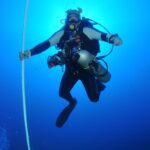
Kevin Gurr of Eric smallOne of the most important things you can learn that will improve your underwater photography is proper buoyancy control.  Learning how to control your buoyancy and your related attitude in the water will enable you to capture your subjects more effectively and easier.
One of the most effective ways to improve your buoyancy is to practice without your camera in a local lake.  One of my favorite places for this is the Beautiful Blue Lagoon in hunstsville Texas.  There is an old wooden sailboat sitting at a slight angle with the toe rail at about 15 feet.  Using this rail as a visual reference, concentrate on maintaining a proper horizontal attitude and the rail in your site all while not kicking or skulling with your hands.
Dave and I discovered the usefullness of this drill during a Principles of Technical Diving course confined water session.  We found ourselves underwater when an thunderstorm went overhead.  We dicided it was safer to remain underwater so the students received an elongated hover session while we waited for an improvement in the weather.  It was amazing how much their buoyancy improved.
Since that class, I have incorporated this drill in all of my classes, no matter where I find myself teaching.  I also try and repeat it myself when I add new equipment to my diving kit.  Everyone can improve from better buoyancy control, even if you are not planning on taking photographs.

Filed Under: Rebreather

July 26, 2009 by Eric Keibler

Side-Mounting, are you kidding?

Mammoth Lake
Mammoth Lake
When Pete Nawrocky and I were talking recently, he said “when I come down, we need to go over side-mounting and do some dives.”  What was he thinking, I don’t dive technically on open circuit anymore.  Pete even said once you try this you won’t want to put on a set of doubles again.  He is right, I don’t want to put on a set of twins again, I replaced them with a rebreather.  So had he really lost his mind or was he mistaking me for an open circuit diver?  Not really.
When Pete arrived we again talked about the side-mounting.  He has found a lot of interest in this style of diving from technical divers but increasingly from open water divers wanting a way to increase their time underwater without needing twin cylinders.   This increasing interest may be due in part the aging diving population.  By splitting the twin cylinders into two independent bottles, you can carry them separately to the water and done them there or have someone help you carry them to the water, even going so far as handing them to you while you are in the water.
I hear you die-hard doubles divers out there yelling, wait, what about the redundancy afforded by twin cylinders.  Well the answer is you are right and mistaken at the same time.  You are right, the redundancy prneuded by the manifold cannot be denied, so for a side-mount diver, there has to be a different gas management procedure employed.  That is one of the things you learn in the class.
Pete came in and we rigged up some bottles for diving, configured a Transpac with a Nomad wing and sidemount kit.  A pretty simple rig when you look at it but the truth was in the water.  During the weekend, Dive Rite Tech tour, at Mammoth Lake, we took the assembled harness and headed to the water.  Pete had already taken the bottles down to the water; they were equipped with Dive Rite ADS’ one with a 22” hose on a lanyard, and the other with a 40” hose.  Attaching the bottles to the harness was simple with the top snap put on the bungee and the bottom on the Nomad rail.  It was time to enter the water…easier than doing so with a similar set of twin cylinders.
Diving could not have been easier.  The trim was easy and I just seemed to fall into place – trimmed and ready for the dive.  The set-up was streamlined and easy to propel through the water, even if the water resembled a latte rather than water.  We found some “clearer water” in about 10 to 18 feet near the shore.  Being this shallow sometimes presents buoyancy problems but the rig made easy work of the buoyancy.
I can see why people are attracted to side-mount diving and why there is growing interest in it.  As we worked with people during the weekend I watched divers with various levels of experience slip into the rig and go diving.  It appeared they had fewer problems adjusting to the set-up than a similar experience in a set of twin cylinders.
So, what is the conclusion?  Well, I’m not trading in my rebreathers for a set of side-mount bottles but for those times I need to dive open circuit (yes every once in a while), I believe this a great way to do it.  I also believe it is an effective alternative to twins for Technical diving.  Pete you convinced me!  I think we will be adding this as an option in our training program.
This wasn’t the only thing happing while Pete and Ron Carlo were in town.  Pete came in and gave our Club Aquarious group a very interesting presentation covering diving on the East coast from New York to Florida.  It featured both technical and non-technical dives so there was something of interest for everyone.  Pete had photos of sea life common to these waters and the areas where they live, all synchronized to Pink Floyd.  He followed this up with a discussion of the areas and promoted the idea of diving locally, a very important fact.
The weekend found Pete, Ron, JoLynn as well as Oceanic Ventures staff members, Eric, Ashton, Jordan, and Wade down at Mammoth Lake diving and introducing some curious divers to Dive Rite equipment.  Pete was on-hand to introduce side-mount diving and to take divers on side-mount experiences and yes there were a number of takers.  Most of those who went with Pete were convinced this was a better way.
It was fun showing divers what things were available from Dive Rite including their new lights and computer.  Ron was having fun taking divers out for a rebreather experience, despite the limited visability.  They were even getting more dives for their DiveAroundTexas dives – marching towards San Marcos in September to collect on some way-cool prizes!
Thanks to Pete, Ron and Dive Rite for coming out and showing us the new and old toys as well as a new way to do things.  Diving is only getting better and better!  Thanks for helping keeping it fun!

Filed Under: Demo Days, Local Diving, Presentations, Rebreather Tagged With: Configuration, Dive Rite Tech Tour, Sidemounting

July 6, 2009 by Eric Keibler

Horns or Halo???

July 4th finds in Cozumel with 39 of our close, warm, personal friends.  Ok, this included the three staff members who joined me on this holiday trip.  Why so many staff members you might ask?  Well, there are a number of reasons with the primary one being we don’t normally run large trips; but, when we do, we try and make them have the feel of our smaller more personal trips.  So, despite the large number of divers, we had three boats and separate, local Dive Masters for each group.  Of course we all met for lunch at the pier each day so we had the best of both worlds – lots of friends and a personal touch.
Stephanie, Dave, Ashton and BrittanOf course, there were some clients who would have preferred a little less attention to their needs.  Ashton Arsement, Brittan Clark and Stephanie Watawich were under the watchful eye of their Principals of Technical Diving Instructor – none other than our own Dave Snyder.  Dave has a reputation of being a little devilish at times, so his students came up with a hand-sign for him during the dives.  Dave was fortunate to have discovered this sign after Stephanie’s son Mathew visited at dinner and asked are you the Dave (with his hands on his head making horns) or are you “Dave” with a faraway dreamy or nice look (this would be Dave Sweeten).
Yes Stephanie saw the hand-sign starting but was too far away to have stopped the revelation.  The cat was out of the bag and Dave Snyder had a new hand-sign for himself underwater.  In fact, his wife Martha even started using in when she signaled to me asking “where is Dave.”
The diving was really nice despite some unusual currents.  Harvey Sisco commented that looking up a wall in Cozumel from 300’ was really spectacular and he could see why we liked doing those dives on a wall.  The wall itself at this depth was sparse but looking up at the coral heads, the fish and the surface way in the distance creates a lasting impression that carries you through the 90 minutes of decompression.  Of course you do have the advantage of decompressing on the reef you were looking at from below, so it is a wonderful way to dive.
Stephanie celebrated a birthday with us and Brittan Clark, Morgan Hann, and Liz Kreiger all completed there 100th dive on this trip.  Ashton, Brittan and Stephanie finished their Principals of Technical Diving Course and Harvey Sisco completed his CCR Trimix Course on during this trip.  Congratulations everyone!

Filed Under: Caribbean, Rebreather, Trimix Tagged With: Cozumel, Snyder, Technical Diving

June 21, 2009 by Eric Keibler

Dry Tortugas Tech Week

Clear blue water and the gentle hum of the generators breaking the silence of the early morning hours. The wind gently blowing across the deck creates the only other sound.  As the sun rises, the water surrounding us shimmers and shines.   The sleeping explorers start to stir as the sun rises further from its slumber over the horizon.   Soon the boat will be active with divers getting ready to plunge into the crystal clear waters of the Florida straights.
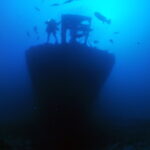
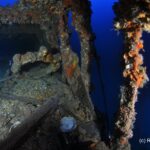
1 Rhein8Our Florida wreck diving trip once again finds us over the final resting place of the MS Rhein a causality of the Second World War.  The German freighter was sacrificed by her crew in December of 1940 when they set her afire rather than allow her to be captured by the US Navy.  This stunning wreck lays in 240 feet of water with her kingposts reaching upwards to 140 feet.  Now the home of large schools of fish and goliath groupers, the MS Rhein is seen by few divers. 
Today, ten divers (two on open circuit scuba and eight on Closed Circuit Scuba) diving from the M/V Spree had the privilege of visiting this long forgotten piece of history.  This is to be the fist of many historical wrecks this group will be visiting.   According to Michael Barnette in his book, The Shipwrecks of the Sunshine State:
During 1940 much of the world was focused on the growing hostilities in Europe.  However, numerous countries had yet to enter the war, preferring neutrality to a repeat of the bloodshed they encountered in World War I.  While the American population opted to ignore and isolate itself from the “European problem,” the Roosevelt Administration recognized that Hitler was a clear and present danger to national security.  While neutral at the time, the United States government fully supported Great Britain and her allies.  The Declaration of Panama, adopted on October 3, 1939, ordered belligerent nations to stay out of a 300-mile neutrality zone off the coasts of the United States and Latin America.  However, this declaration was unilaterally enforced and never applied to those countries fighting the Axis powers.  Neutrality Patrols were established in order to assist with the war effort against Germany, while the United States remained “officially” neutral.
The MS Rhein was a 439-foot long freighter, built in Hamburg, Germany, by the Hamburg-America Line in 1926.  The latter half of 1940 found the freighter in the neutral port of Tampico, Mexico, separated from the safety of German waters by the expanse of the Gulf of Mexico and the Atlantic Ocean, both filled with prowling Allied warships.  November 29, 1940, also found a U.S. Neutrality Patrol consisting of the destroyers USS Simpson (DD-221), USS Broome (DD-210), and USS McCormick (DD-223) on station off Tampico.  At 8:35 a.m., the Rhein and Idarwald, another German merchant ship, were observed leaving port and steaming south, staying within Mexican territorial waters.  The USS Broome pulled anchor and slowly shadowed the German freighters.  On December 7, 1940, the USS McCormick was ordered to relieve the Broome and keep the Rhein under surveillance as she steamed east towards the Florida Straits and the open Atlantic.  As the Rhein steadily approached Florida, the USS MacLeish (DD-220) was given emergency orders and hastily sailed from Key West at 2:05 p.m. to rendezvous with the McCormick in the Gulf of Mexico.  At 3:50 p.m., the Dutch man-of-war Van Kinsbergen, sailing under the British flag, was sighted by the MacLeish and informed of the approaching German freighter.  The two warships sped westward to rendezvous with the McCormick and intercept the Rhein.  Nearing the Dry Tortugas, the 6,050 ton Rhein was finally intercepted by the Van Kinsbergen on the morning of December 11.  As the U.S. warships moved off, the Van Kinsbergen turned on her spotlights and fired a warning shot across the bow of the Rhein.  With no escape possible, the crew of the Rhein attempted to scuttle their vessel and set fire to the ship.  A boarding party from the Van Kinsbergen attempted to salvage the freighter but abandoned efforts due to the fire that raged out of control, as well as armed resistance from the German crew.  After the skirmish, the MacLeish reported observing an empty lifeboat riddled with bullet holes and stained with blood.  That afternoon, the HMS Caradoc arrived to receive the German prisoners from the Van Kinsbergen.  The Caradoc then proceeded to fire 22 six-inch projectiles at the still-burning freighter, eventually sending her to the bottom at 3:56 p.m.
The waters were calm but there were currents all the way down to the wreck.  The group made two dives on the wreck, with Richie and Dan finding a number of artifacts inside the vessel; most of which they left for future divers to find.  Carrie told Richie that she already felt like she lived in a Bennigan’s Restaurant so he could only bring home china and glass – no brass!
1 ArabyOur next stop the highlight of the trip for our avid group of soon to be transformed treasure divers ( treasure fever seems to hit all of the divers when they watch, as Captain Frank puts it “Pigpen I and Pigpen II digging in the wreck and coming up with portholes, deck prisms, a door lintel, a saucer, and other goodies. True to form treasure fever did hit and the divers elected to remain on the Araby Maid for two days.  Not everyone was successful with their treasure collecting, Bernie Chowerdy and his student were forced to abandon the porthole they had been working on and Ian only came back with some incredible video of the wreck (of course that is the only treasure he was looking for).
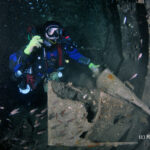
After leaving the Araby Maid, our cure for treasure fever, we moved on to the wreck of submarine U2513.  According to Michael Barnette:
The U-2513 was a Type XXI German U-boat built in 1944. Boasting a length of 252′, she was the most technologically advanced U-boat built during World War II. Advanced sonar capability, greater torpedo delivery (6 bow tubes), greater depth range, and a hydraulic torpedo loader allowed for total reloading in 12 minutes. Known as an “elektroboat,” she could stay submerged for a greater period than her predecessors due to her robust battery supply. Unfortunately for the German war effort, the Type XXI U-boats were introduced too late in the war to make a difference; only 12 Type XXI boats were cruise-ready by the end of the war.
The U-2513 was eventually towed 23 miles northeast of the Dry Tortugas to be sunk as a target by the destroyer U.S.S. Robert A. Owens on 7 October 1951. Supposedly Navy divers visited the wreck in the 1950s, but recreational divers did not visit her remains until almost 1990. She now sits in 214′ of water with damage fore and aft of the conning tower. Part of her sail lays in the sand off to the starboard, with hedgehogs (anti-submarine weapons) residing on the port side.

Captain Frank on Deco
It was a beautiful day for a dive with calm seas,  100’ visability and very manageable surface currents.  This is a beautiful wreck with fish all around including some very large Goliath Groupers.  After one dive it was time to move closer to Key West and a night dive on the newly sunk Vandenburg.
According to Captain Frank’s trip report:
… after an 8 hour steam, we arrived at the Vandenberg. Mel got in to set the sideline in zero current. By the time it was set, current was ripping. The Vandenberg has been populated by some pretty cool fish, but the highlight, at least for those on deck, was the ocean sunfish, or Mola Mola that came to visit. It was a small one, about 3 feet fin tip to fin tip. It hung out at the boat for a little while, then wandered off to do fish things.
The next morning Captain Frank put it best, “Saturday morning dawned bright and clear, with a screaming current. No one could swim against it. Melanie used all of her wiles and tricks to put in a sideline, and off we went…. Er… Off we looked and said “Ummm… Maybe another cup of coffee.   This was not a “sporty” current but rather a ripping current. 
The divers relaxed, lounged, and watched divers on the local day boats try and battle the ever increasing current.  At around 11:00 the current had slacked and divers began hitting the water.  Like Captain Frank, Dave and I went exploring the wreck to determine its usefulness for future training trips.  Captain Frank’s conclusion “…I went to the sand at 157 feet, and sure enough, you can do an advanced nitrox and deco procedures class here.”  Dave and I swam the entire wreck, ducking inside from time to time to escape the currents and to improve our view since the visibility was poor due to the currents.  I think we decided this will be a good location for future training trips.  There are a lot of spots to duck out of the current that do not violate standards for no penetrations as well as a number of good penetration routs for a penetration course.
As with all of my trips with Captain Frank, it was a fun and exciting trip with a lot of good diving.  I can’t wait for next year’s wreck trip…I am already signed up.
Wreck Dive
In the Foc’sle
Captain Frank on Deco

Filed Under: Rebreather, Trimix, Wreck Diving Tagged With: Araby Maid, Rhein, Spree

March 27, 2009 by Eric Keibler

Thoughts on Decompression Theory

Lost – at least that is what the people I knew thought when they saw me at this year’s Beneath the Sea show in New Jersey.  It was common to hear “what are you doing here?”  I had a number of reasons for coming to this show this year, among them were to try and find some connections to some students for our Expedition Trimix Course in Grand Cayman this summer.


Friday evening found Dave and I in a presentation by Dr. Gozum about Personal Decompression Strategies.  He has been looking at a number of Decompression & Doppler Bubble studies all the way back to the 1940’s.  In looking at the raw data, he found that there three groups of divers in these studies:

  • Divers who never got bent, no matter what was done to them
  • Divers who sometimes got bent and
  • Divers who always got bent


His theory is that were individuals that are resistant to DCS.  In looking at their Doppler readings, even when they showed a high number of bubbles, they exhibited no signs of DCI.  While this population represents a small part of the study, he felt that it is an important finding.


One of the things he advocates is performing Doppler studies on yourself to determine a safer decompression routine for yourself.  Since the actual Doppler devices are $400+, a baby ultrasound device ($100) can be used.  These less expensive devices have a larger head and are not generally reparable but give reasonable readings to begin a study.


Another point he made is that studies have shown that post dive exertion has lead to DCI.  After a dive a diver may show no signs of DCI, and after doing something strenuous, i.e. pulling up an anchor, mneung equipment, etc the suddenly developed DCI.  For this reason he recommends refraining from strenuous exertion after a decompression dive.  I have seen this exact situation in a diver who because of pride issues moved equipment and immediately began showing signs of DCI.  It took a table 6 ride in the chamber to confirm the hit and eliminate the pain.


In talking about this with Larry Elsevier later that evening, he felt that the results could be skewed by the individual diver’s metabolism.  According to Larry, in a study at the university of Southern California (he thought) it was shown that DCS was not detected in divers who had 7-8 glasses of water 24 hours before diving but DCI was noted in divers who did not consume water the prior day.  The study concluded that an individual’s metabolism, affected by dehydration, played a significant role in the incidence of DCI.


Further, he noted that in some studies while some people did not note any of the traditional signs of DCI, some reported feeling funny.  In some cases, this funny feeling was a precursor to more serious DCI symptoms.


In talking with Tom Mount in our Expedition Trimix course, his experience has been that especially on deep dives, what works is not necessarily what the formulas say to do.  “You have to listed to your body” and be aware of signs that tell you things are not quite right.  By being in tune with yourself, you can modify your schedule to try and get things back in balance before continuing.  He calls this Intuitive Decompression.  I have been on dives when I felt that I needed to elongate a stop beyond what the computers were telling me to do.  I also know that Ann has felt the same way on some of her dives.  She will even tell you she “feels the nitrogen” and gets an overwhelming feeling that she needs to pause and spend more time at her current depth.


What does this mean to divers?  The first thing we should know is that decompression is not an exact science. There seem to be a number of factors influencing the elimination of inert gasses and the possibility of developing symptoms of DCI.  The importance of proper diet and hydration play a major role in preventing DCI as does individual physiology.  While there are some individuals who are resistant to DCI, there appears to be a far larger number of diver’s susceptible to DCI.  Prevention of symptoms may include using Intuitive Decompression, to modify your decompression schedule depending on how you feel underwater.  Additionally, if is important to avoid post dive exercise when possible, especially if you “feel funny.”

Filed Under: Presentations, Rebreather

January 24, 2009 by Eric Keibler

Dave &Eric’s Adventure to Florida

Here we are in the middle of the cold weather season, Dave’s favorite time to escape New York.  Dave tries to tell Martha that he has been bad and that she should banish him to Texas for a few months.  It never really works.  However, I was able to arrange for a few weeks off to spend some time in sunny Florida.  Of course, winter seems to have followed us as it was cold in Florida.


We had an ambitions schedule planned.  We contacted Tom Mount to help us accomplish a few goals for the year.  Dave needed to finish his Meg Instructor course so I volunteered to be his student and I needed to complete my OC/CCR Trimix Instructor Trainer Certification so Dave volunteered to be my candidate for the session.


Tom set up two weeks worth of training and diving for us.  We planned to do a lot of wreck diving while we were in the area as part of our course.  Our plans called for dives on a variety of wrecks at various depths.


During the next few days the winds built and came from the wrong direction.  What this meant for us was more time at Tom’s house in lectures and in pools.  In fact it meant a lot of extra lecture time and discussions about new training materials.


During our dive on the Speigel Grove, my training dive on the Meg, I had two instructors, Dave and another instructor candidate along wit Tom.  Since I was the student, I was anticipating a lot of drills with my instructors.  What happened was not at all what I expected.  During the descent it became apparent that the other instructor candidate was having problems with buoyancy and we found that his jacket was having trouble holding air.  Of course while Dave was helping him sort it out, Tom, who had grown impatient with the lack of attention to me, the student quickly appeased himself by giving me a “boom scenario” to deal with.  Having successfully accomplished the procedure for dealing with the “problem” our other instructor candidate signaled he was ok and ready to continue.  Tom started on the dive. 


Dave soon realized  that this other person was not in the proper space for the dive and was having trouble maintaining buoyancy.  So rather than focus on me “the student” he decided that he needed to watch the other candidate.  As Tom approached a wide opening that traverses the wreck, everyone apparently signaled ok and in he went.  I have to admit I was really laughing at myself in the passageway.  I kept getting stuck.  This was not my normal configuration!  Imagine a Wreck Instructor getting stuck on a simple dive.  I soon realigned myself and pulled my way out into the opening, under Tom’s watchful eyes.  As I turned around there was no one behind me.  Tom and I waited and still there were no divers behind us.  I looked back down the passage and there was no one there.  I communicated this to Tom and then after a little more of a delay the other candidate entered the passage creating a cloud of silt for Dave to swim through.  Dave later told us that he had a difficult time getting the other person to follow.


It was at this point, we all noticed how poor his buoyancy was and that he appeared to be struggling to stay afloat in the water column.  Further, Dave was signaling Tom that the diver was low on dil.  Tom, immediately terminated the dive leading us to the mooring line.  After our safety stop, we exited the water to a surprised crew.  We were supposed to be go for 2 hours and we were surfacing before the other recreational divers.


Tom started to talk to Dave about the lack of drills for his “student” during the dive but quickly changed his focus when the entire situation became known.  Then his attention switched to the other diver/candidate. 


In the end, Dave and I did accomplish our goals.  Dave received his Meg Instructor and his CCR Normoxic Trimix Instructor credentials and I received my OC/CCR Trimix Instructor credentials.  We also decided that January was not the best time to travel to Florida for diving.  The winds are unpredictable and the diving is likely to get blown out.  Something Tom knew and tried to tell us but who said we ever listen.


Oh well, live and learn…

Filed Under: Rebreather, Travel, Trimix, Wreck Diving

  • « Go to Previous Page
  • Page 1
  • Page 2
  • Page 3
  • Page 4
  • Page 5
  • Page 6
  • Go to Next Page »

Footer

Contact Us

Oceanic Ventures, Inc
5808 Newcastle Dr.
Houston, TX 77401-3214
USA

Phone: 713-523-DIVE (3483)

eMail: divesafe@oceanicventures.net

Signup for our dive and scuba newsletters

Don’t miss news about the exciting happenings at Oceanic Ventures.


Map and Directions

Socialize

  • Email
  • Facebook

Why People Choose Us

People choose their friends carefully just as they should choose their adventure partners and Scuba Diving Instructors.  Oceanic Ventures is the premier scuba dive shop in Houston, Texas, and the Southwest because of our exceptional service and our sense of adventure.  In talking with our clients and friends, people choose us for a number of reasons such as: Passion – We love what we do and we want to share the beauty and excitement of the underwater world with everyone we meet. Caring- Our clients tell us they love us because we truly care about people and strive to make their scuba diving experiences safe, fun and enjoyable. Professional – Our staff members are the … [Read more …]

Copyright © 2026 all rights reserved Oceanic Ventures, Inc. · Sitemap · Log in