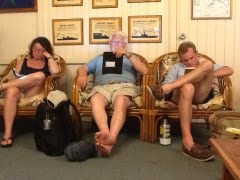
Waiting seems to be a part of international travel. The time between check-out and leaving for e next phase of the trip do not seem to mesh. So here we sit, relaxing at the resort in anticipation of being picked up by the crew of the Odyssey for our next adventure here in Chuuk.
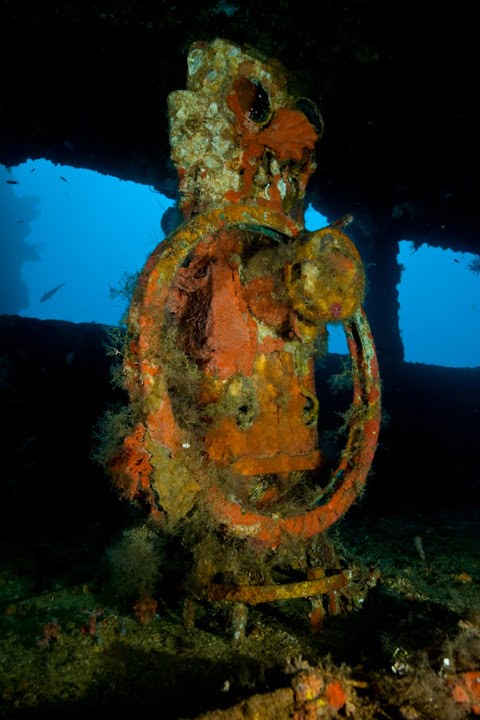
We have had some awesome technical scuba dives during our short stay here. Today we did one of my favorite dives here in the lagoon, the Aikoku Maru. Descending down the line the first thing you notice are the massive king posts, covered I coral growth and teaming with life. There is only half of e original ship the remainder having been blown off by a massive explosion ink the forward munition hold. But what remains is impressive. The stern gun still points to the sky as does the one remaining anti-aircraft gun on the top of the bridge structure.
The fly bridges and hallways are collapsing and some of the interior spaces are also sinking toward the bottom. There is a lot of growth all over the wreck but not so much as to obscure the features like the shallower wrecks.
Our visit to the wreck was short, 25 minutes on the bottom and 35 more minutes in the water column; and, no sharks today to entertain us.
We were also treated to a bar BQ by our dive master, Daniel, and the boat crew. A wonderful way to end our shore visit and to begin our live-aboard experience.
The diving continues…
pacific
Travel Log – Scuba Diving in Truk Lagoon Finally
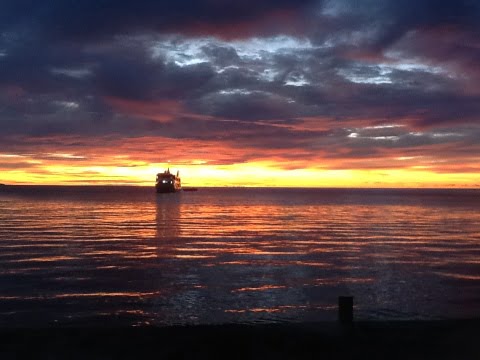
The weather system we avoided in Kosrae seems to have followed us to Chuuk. The basic schedule is It rain overnight, clearing slightly in the morning until just the point where we are loading the boats to go diving and then a small squall runs through kicking up the seas and making for a wet ride out to the dive site. The skies and seas remain a little disturbed while we are underwater and then just after we re-board the boat after our decompression stops, the seas lay down making the ride back to the resort a smooth affair.
We have had some great dives during the shore based portion of our trip. We started with the Fujikawa Maru, which is a spectacular wreck with lots of sea life and coral growth. The engine room and forward holds were a little murkey, probably as a result of divers who were there before us. While the zeros are still there, they show signs of deteriation. It really demostrates that things built for a terestrial environment are not as well suited to life iunderwater.
Because we were here earlier than we had origionally planned, the group decided to dive the deeper wrecks in Truk Lagoon, especially since we will not be visiting them next week. We also decided to do some of the dives using Helium. Using Helium out here is a mixed blessing. It makes for a clearer head and safer diving but there is a price to pay. First, Trimix diving generally requires longer decompression times when compared to air diving which means that we all have to get used to hanging around in shallow water and looking at one another,
Of course the biggest price to pay will come on Sunday when the Blue Lagoon Dive Shop presents us with our diving and gas bill. Helium is $4.50 per cubic foot! The rebreather divers are each using about 7 cubic feet per day while the open circuit divers are using about 38 cubic feet per day. Lest we forget, there are also the oxygen and the bottle rentals. Deep diving in the tropics can be expensive!
I have also come to realize that in order to successfully dive in remote locations, you not only have to be a compotent diver, but you also have to be part mechanic and part dreamer, with a good dose of MacGuiver tossed in. We have already had our share of equipment glitches and malfunctions. Some we have had the spare parts for and others we have not. Parts are not readily available in this remote part of the world but Pam is arriving on Sunday with some parts to make our repairs easier and more permanent. I am already compiling a list of things I need to add to my expedition kit.
So far we have dove the following wrecks:
The Fujikawa Maru,
The Hein Maru,
The Shotan Maru, twice,
The Nippo Maru, and
The Fujisan Maru.
And for all of those fish lovers we have seen a large school of Baracuda, Tuna hunting, Eagle Rays and lots of small reef fish. Alex was so popular with three little yellow stripped fish that they followed him all the way around the wreck and up to his 10 foot stop. It was like having a bunch of high school girls following him around; the only thing missing was the fish trying to flirt with him.
Great diving and good friends, what more can you want. Ok, it would be far better if Ann were here instead of manning the store at home but the world is not a perfect place.
The diving continues…
The Misunderstood Great White Shark
Today’s post comes from Amos Nachoum, an award winning photographer, specializig in Big Animals, like great white sharks, leopard seals, polar bears, etc. We first met Amos as we were planning for our Antartica Trip. Talking to Amos you immediately get wrapped up in his enthusiasm and his love of the sea. If you talk to him long enough, you’ll be making some incredible dives in some unusual places, think Antartica or the Artic. If you ever meet him, tell him you know Dive Mom!
Written by Amos Nachoum
Great White Sharks – Nasty Predator?
 My expeditions to encounter the Great White Shark tend to sell out fast. That’s what just happened to my last two October expeditions. My favorite spot in the world to see Great Whites is in Mexico’s Baja California. The trips sell out fast for a good reason. People are fascinated with Great Whites, even though these sharks have the undeserved reputation of being a nasty predator. They’ve got a lot of teeth, as many as 300. They’re big – 12 to 16 feet long, and they weigh a couple thousand pounds. Steven Spielberg gave a starring role to a Great White in Jaws, and that didn’t help their reputation as a ferocious man eater.
But the truth is they are one of the most fascinating animals you’ll ever encounter, and one of the most rare.
When young, they feed on small harbor seals and later go after sea lions, elephant seals and even small toothed whales. They like to ambush their prey from below – one big bite usually does the trick. They will also scavenge – eating the carcass of a whale shark. They will sometimes eat sea turtles and sea otters.
Let’s be fair, though. Scientists and others who study the Great White say that in the past 100 years more people have been killed by dogs than by Great White sharks. That’s not to say that they don’t look scary. They do, especially when you’re facing one close up. But that’s only part of what makes them so fascinating.
The Great White Shark: A Rare Species
There are only about 100 adult Great Whites in the state of California’s waters. Scientists say less than 3,500 Great Whites are left in the world’s oceans, making them rarer than tigers. They are long distance swimmers, capable of traveling 12,000 miles over a nine month period. A trip from California to Hawaii is a common trip for them. Scientists have tracked them swimming from South African to Australia and back in nine months’ time.
The Monterey Bay Aquarium has been capturing young white sharks, exhibiting them for a a short time, and then releasing them. The first time they did this, in 2004, the shark had almost a million visitors. The aquarium’s executive director Julie Packard said the shark was “the post powerful emissary for ocean conservation in our history.” The aquarium is also studying the adult Great White sharks to learn how to protect them from overfishing and the effects of bycatch – sharks that get caught in the nets of industrial fishing operations, get injured and can die because of it.
That’s what happened to one of the Monterey Bay Aquarium’s White sharks, a female. Captured on August 26, 2009 and released on November 4, the shark traveled more than 500 miles, from Monterey Bay to Baja California. There, she was accidentally caught in a gill net and died.
Baja California – One of the Best Dive Sites for Epic Shark Diving
There’s no doubt that Great White sharks are worthy of great respect. They’re found in the waters of Mexico, Australia, New Zealand and South Africa. It’s true that are amazing dives to be enjoyed in all of those locations, but my favorite place to see them is in Baja California. The water is clear and warm and the shark encounters will always be your best memories of shark diving.