• Skip to primary navigation
  • Skip to main content
  • Skip to footer

Houston's Premier Scuba and Dive Shop Oceanic Ventures Inc.

(713) 523-3483 (dive)
5808 Newcastle Drive
Houston, TX 77401

  • Home
  • Stay Current
    • Our Blog
    • Travel and Events Calendar
    • Club Aquarius Social Club
      • Club Aquarius Social Club Upcoming Events
      • Club Aquarius Social Club – The Past
    • Special Events
    • Local Scuba Diving Events
    • Photography Contest
    • Categorized Blog Posts
  • Equipment
    • Dive Equipment
    • Rebreather Systems
    • Cruise Ship Passengers
    • Repair & Maintenance
    • Air & Mixed Gas Blending
    • Pure Fiji Spa Products
  • Training
    • Become a Scuba Diver
    • Scuba In Your Home or Ours
    • Diving Programs for Young Explorers
    • Recreational Dive Courses
      • Recreational Dive Courses overview
      • The Briar Club Scuba Program
      • West University Scuba Program
      • Houstonian Scuba Program
    • Technical Diving Courses
      • Basics
      • Nitrox
      • Trimix
      • Rebreather
      • Wreck Diving Programs
      • Cave Programs
      • Blending
    • Leadership Dive Courses
  • Travel
    • Travel Escorted Adventures
    • Travel – Other Travel Programs
    • Travel – Custom Travel Adventures
    • Local Scuba Diving Events
    • Technical Travel
    • Scuba Diving Around Texas
    • Travel Insurance
    • Travel Forms
  • Company
    • About Oceanic Ventures
    • Meet Our Team
    • Testimonials
    • Facility Hours
    • Map
    • Oceanic Ventures Foundation
    • Resources & Articles
    • Archive
  • Shop
    • Online Store
    • Cart
    • Checkout
    • My Account
    • Policies regarding Privacy and Purchases
  • Contact

photography

June 24, 2013 by Matthew Watowich

ROV Follows an Elusive Oarfish in the Gulf of Mexico

United States servicemen holding a 23-foot (7.0 m) Giant Oarfish, found washed up on the shore near San Diego, California in 1996 (c) US Navy

Scientists accidentally took a video of the elusive oarfish. This video is the best quality and longest video that has ever been shot of an oarfish in its natural habitat. This video also appears to show a parasitic isopod attached to the fish’s dorsal fin. The mysterious oarfish lives about a mile deep in the ocean and it can grow to be 50ft long. Oarfish look like giant eels, with their head pointing toward the surface and the rest of their body hanging down below. The oarfish is also believed to be the largest bony fish in existence. The one in this video is only eight feet long. This video was shot while researchers were investigating the BP oil spill in the Gulf of Mexico. A camera was sent down to look at the oil pipes and figure out how to fix them. However, the camera stumbled upon this oarfish.

Scientists were surprised to see the oarfish since it has rarely been seen in its habitat. Another reason why oarfish are rarely seen is because they live far offshore. The video of the oarfish can be viewed below. The best pictures of the fish are about 6 minutes into the video.
Filed Under: Marine Life, Underwater Tagged With: marine life, photography, underwater photography

October 31, 2012 by marinawatowich

Sea Shells – Something to Think About

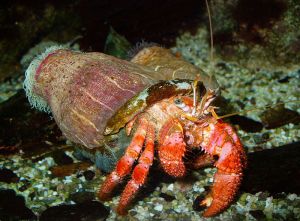
copyright H. Zell, from Wikipedia

The ocean has always amazed humans and it is well known that it is a crucial part of life on Earth. But one of the most fascinating aspects of the ocean is its key role in facilitating important life sustaining processes and interactions. We can experience this every time we go scuba diving, how the ocean helps balance life sustaining gases, how currents redistribute debris and animals around the world, how it prneudes a habitat for hundreds of thousands of species and many other processes. But there are many interactions that are minute and overlooked, but if you look close enough you’ll begin to realize their occurrences.  

Tides prneude a vital exchange between the ocean and land, in one way that may be unexpected. Marine snails are crucial players in their ecosystems and their shells can often be seen under the waves. But as the ocean redistributes resources, empty shells can end up on land, scattered on beaches. Here, not only are they beautiful finds during a walk on the beach, they are also of ecological importance. Terrestrial hermit crabs use these shells as homes because shells large enough for a hermit crab are hard to come by on land. Hermit crabs inhabit these marine snail shells and burrow into them, thinning out the walls to make more room for themselves as they grow, and making more space to carry eggs in the shell (up to 1,000 eggs!). 

As the crab grows too large for the shell, it must find another, but modifying snail shells takes a lot of effort and crab prefers to use a shell that has been hollowed out already. The really fascinating part of this is that when crabs want to change shells they will gather with other crabs, usually groups of 3 hermit crabs will attract a congregation of dozens of others. The crabs will then form somewhat of a line from largest to smallest and wrench the larger crab from its shell, taking for themself. The largest crab is often left without a shell and must quickly find one. This is an amazing example of the sociality of crabs and the way the ocean helps facilitate this exchange. So the next time you see a marine snail while diving, just think about the long lifecycle the shell could go through!

Filed Under: Conservation, Marine Life Tagged With: marine life, photography, underwater photography

October 1, 2012 by Ann Keibler

Trip Report – Live Aboard Scuba Diving in Belize

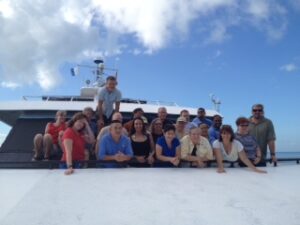
Belize Adventurers Photo
The group aboard the Belize Sun Dancer

The Belize Sundancer Adventurers are on their way back to Houston, they are all sad to see their week of fun and adventures being replaced by emails and text messages.  (@#$%& Internet).  But despite the return of reality.  the trip was awesome with 26 dives, and over 35 hours of bottom time for all!!!

Looking back on the week there were some fun things and some memorable notes.  Karen loved her new second strobe, Steve loved his new strobe and tey both have the photos tp [rpve it.  Mike promised to have an awesome YouTube video for us of fish and divers including a feeding octopus on one of the night dives. ( You will have to wait for a future post to see this one — video takes a little time to assemble.)

 Zaide once again ran out of socks to lend everyone…thanks Z!!! (Alex will be stocking up on socks so everyone can have a pair.)  Gordon helped the new divers find their way back to the boat so they could lose track of boat “bus” stop and just enjoy the fish while Kris helped refresh Ann’s memory by looking in her logbook to see if they were correct that they had met the Cpatain, Eddy, on a past trip when he was the dive master of the Bay Island Aggressor when it was moved to Belize especially for our group.

Thinking about Half Moon Wall I found it even more beautiful than I remembered it from my last dive here in 2003.  Sofie arrived with only 6 dives and became an Advanced Open Water Diver on the trip!! Congratulations Sofie!!!  Steve completed his 100th  dive and Bill his 300th dive.  And speaking of Bill, he & Debbie learned to really like their new full face masks.  Bill was even hear to comment that Debbie did not talk as much as he thought she would but he was happy for the communications device when the shark went by; Bill didn’t miss it while he was taking photos of blennies.

Barbara and Barney were first in the water on all of the  dives save for one and met their goal of photographing spotted eagle rays.  Rich was awarded the best buddy for a photographer and he and Steve prompted Ann to offer a Marine Life Id course while on board.

Two cylinder man, John, and Sharkbait Karen were able to finish Ann’s fish-id check list on one dive, at 30 feet under the boat without mneung more than two feet.  Great Lion Fish Hunter Jess assisted by Mike suggessfully removed 35 lionfish from the reefs.  Steve commented that there were more little fish this year and less lion fish.  An autompsy of the lionfish showed why….their favorite meals were sergeant majors, juvineele runners, and gobies.

Chef Jerry feed us wonderful local Belzian dishes, fresh fish or stuffed pork chops, peanut butter chocolate chips bars, fluffy rich cheese cake, and even turkey dinner.  Karim, John Eddie and Jerry lead the dives, photographed the fish and the guests, and waited at the ladder for up to an hour for each guest to get out of the water after leading dives just to help take off our fins and hand up equipment.  Waiting at the “bus stop” for the hang bar to swing was almost as much fun the ride the bar for the safety stop.

The comment after tubing sums up the week: “Where are we going next year?”   This says it all…great time, good friends, aweomse crew, memorable vacation.

My only comment is why wait until next year?

Filed Under: Caribbean, Photography, Scuba Diving Activities, Travel Tagged With: photography, Travel

January 25, 2012 by Eric Keibler

Eric Keibler is in the News

cayman newspaperEric Keibler and Oceanic Ventures made the newspaper in Grand Cayman this morning!
The Cayman Compass publised Eric’s photograph and a note about the upcoming Rebreather Scuba Diving Event in Houston on March 29-April 1, 2012.
See the post here.
We hope everyone in the Houston area will join us for a unique evnt which featuers rebreather trials in the pool, presentations by Leon Scamahorn, CEO of Inner Space Systems and dinner with Leon on Saturday evening.
Form more information, please email Eric.

Filed Under: Caribbean, Charity, Photography, Presentations, Rebreather, Scuba Diving Activities, Social Activities Tagged With: charity, Dive Travel, Megalodon, Pathfinder, photography, Rebreather

April 11, 2011 by amosnachoum

Jules Verne

Underwater explorers like me owe a lot to the novelist Jules Verne, who was born 183 years ago. Google honored him with one of their “doodles,” but in that doodle is a clue to Verne’s greatness – it’s an image that reminds you of the electric submarine, the Nautilus, from Twenty Thousand Leagues Under the Sea.

google verne 300x117 Jules Verne

When Verne’s words were published in 1869, electric submarines didn’t exist – they were just something out of his imagination. As National Geographic wrote, Verne also predicted that news wouldn’t just come from newspapers, but would be “spoken to subscribers,” in the way that radio and television news happens today. He thought of that in a story that was published nearly thirty years before the first radio broadcast.
The Verne list of firsts goes on. In 1865, in From the Earth the Moon, he thought there could be such a thing as a solar-powered spacecraft, and of course he wrote about traveling to the moon long before the first astronaut got there. He even thought of skywriting, videoconferencing, the Taser, and landing a spaceship in the ocean for a “splashdown.”
The mention of water brings us back to the ocean, and the visionary thoughts of Verne make it possible for me to do what I do today – explore the hidden depths and the distant lands that I want to share with you. Verne didn’t have any engineering training at all, just a lot of imagination. That’s all you need to come along on an adventure with me. My polar bear expedition to the high arctic has an April 17 departure and there are just two spaces left. Will you join me?
[If you would like to Join Amos on one of his Big Animal adventures, you can send Dive Mom a note or contact Amos directly.  Be sure to tell him that you read about his trips here.]

Filed Under: Photography, Travel, Underwater Tagged With: adventure, amos nachoum, arctic, Jules Verne, photography, polar bears

February 14, 2011 by Eric Keibler

Preplanning a Scuba Diving Silhouette Photograph

Photograph by Eric Keibler - Penetration

Penetration

© Eric V. Keibler

Here is a natural light photograph taken in a cargo hold in Truk Lagoon.  While the shot may look completely natural, it was set-up prior to getting in the water.  Todd Emons and I decided to go in the water together to take some photographs of one another in various locations on the ship.

Todd works on the Odyssey so he is very familiar with the wrecks and had some ideas of what shots might look good in this wreck. This type of local knowledge helps you to capture photographs that you might otherwise miss.  Of course, you still have to do everything to take the image but setting up the shot can make things easier.  You need to discuss the general sight and then make a plan with your dive buddy.  It is easier to discuss what you want to do on the surface rather than underwater.  Working with a model can be quite challenging underwater and having a plan before you go in makes it much simplier.

To take this shot, I swam to the lower portion of the cargo hold.  While getting in position, it was important not to kick up the bottom or dislodge too much debris from the ceiling because the debris would ruin the shot.  I set the camera on manual and set the camera to properly capture the blue light throwing everything else into shadows.  After everything was set, I signaled Todd who was perched at the lip of the hold and he began to swim toward the camera being careful not to shine his light in the direction of the camera.  You can see just a small beam coming from the light but because the hold was so large, and the backlight so strong, his light had little effect in the final image.

Also notice that while Todd is the subject of the shot, he is not in the center of the image but rather is in the top third of the picture.  In general, it is more pleasing to the eye if the subject is not centered but rather offset into another quadrant.  We call this division the rule of thirds which is a compositional tool.  Look for a better discussion of this “Rule” in another post on composition.

Remember, when taking silhouette shots, it is important to make sure that you keep the meter reading set for the backlight and not let the camera adjust to the target swimming towards you. 

Camera Specifications: Canon 5D, fitted with a 17mm-40mm lens at 20mm, f4.0 at 1/25 sec, ISO 640

Filed Under: Digital, Pacific, Photography, Scuba Diving Activities, Travel, Underwater, Wreck Diving Tagged With: photography, silhouette, underwater photography, Wreck Diving

  • « Go to Previous Page
  • Page 1
  • Page 2
  • Page 3
  • Page 4
  • Go to Next Page »

Footer

Contact Us

Oceanic Ventures, Inc
5808 Newcastle Dr.
Houston, TX 77401-3214
USA

Phone: 713-523-DIVE (3483)

eMail: divesafe@oceanicventures.net

Signup for our dive and scuba newsletters

Don’t miss news about the exciting happenings at Oceanic Ventures.


Map and Directions

Socialize

  • Email
  • Facebook

Why People Choose Us

People choose their friends carefully just as they should choose their adventure partners and Scuba Diving Instructors.  Oceanic Ventures is the premier scuba dive shop in Houston, Texas, and the Southwest because of our exceptional service and our sense of adventure.  In talking with our clients and friends, people choose us for a number of reasons such as: Passion – We love what we do and we want to share the beauty and excitement of the underwater world with everyone we meet. Caring- Our clients tell us they love us because we truly care about people and strive to make their scuba diving experiences safe, fun and enjoyable. Professional – Our staff members are the … [Read more …]

Copyright © 2026 all rights reserved Oceanic Ventures, Inc. · Sitemap · Log in