Dave and I recently attended a trade show for diving retailers in Los Vegas. It was a chance to visit with old friends, visit with the inside sales staff from our manufacturers and see what products will be coming out over the next year.
We found it interesting that two rebreather manufacturers have introduced semi-closed rebreathers targeted at the recreational diver. The unit available from Jetsam Technologies, makers of the KISS retbreathers, is a fairly simple rebreather while Technology in Depth, manufacturers of the Oroborus and Sentinel rebreathers have approached the unit with a lot of electronic sophistication. Both units use a Micropore cartridge
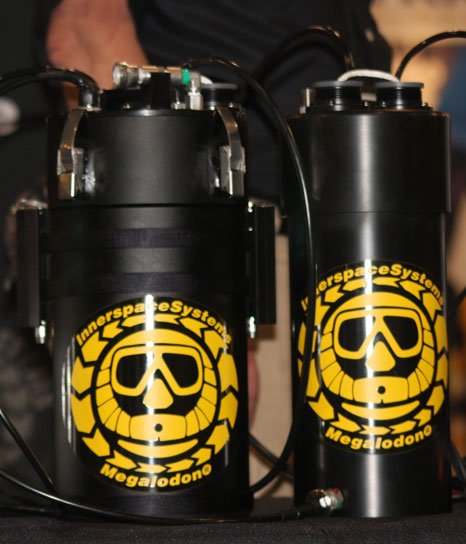
I am not sure why manufacturers are revisiting the semi-closed rebreather. Fully closed rebreathers offer a number of distinct advantages and flexibility that are not present in a semi-closed model which is why ISC has chosen to go that route.
Perhaps one driving force is that in 2011 PADI is scheduled to introduce a rebreather course. It appears the semi-closed rebreathers are geared to this program. In talking with Kim Smith of Jetsam and Kevin Gurr or Techhnology in depth, it appears they are hoping to find a unit that appeals more to less sophisticated or technical minded divers. They are also trying to keep the price point for these units lower than their other offerings which may broaden their appeal to a more recreational user.
Archives for December 2010
What Skiers Can Teach Technical Divers
I guess the cold wind blowing the other night really brought back skiing memories. I remember being in Steamboat Springs riding the chairlift all the way to the top and being greeted by a frigid cold wind blowing straight at me and kicking up the snow almost to a point I couldn’t see in front of me. Of course once we skied down the ridge a little, it was a beautiful run with fresh snow.
One year when visiting Wolf Creek around Christmas time, we met a retired ski instructor. His family would not let him drive anymore so his wife dropped him off every morning and picked him up in the afternoon. I really wish I could remember his name because he taught me a lot about skiing and about life.
One morning, we all went skiing and he offered to help me with my turns. We spent the next several hours skiing down the mountain making tight turns followed by some wide turns to loosen up the muscles. The goal for me, was to stay directly behind him and follow his skies making the turns as tight as he did. The object was not only to force me to make tight turns but to concentrate on staying the course and not getting frustrated and just skiing off on another route.
I have not skied for a while, but recently, I was working with a student at 288 Lake and he was having buoyancy issues. New rebreather students generally do. As we swam around the lake, I remembered my skiing lesson and I started using the same idea while swimming underwater.
Since local lake diving can sometimes get monotonous, you can use this same method to improve your diving skills and relieve your boredom during practice. So, get together with you buddy and vow to follow one another through a series of turns in and around the rocks, tires, or other objects. The targets do not really have to be at a point you can swim through, swimming over them works just as well. Concentrate on making the turns without using your hands and without kicking up the bottom. This forces you to refine your kicking style and your attitude in the water. If you are “tail dragging” you will leave a silt cloud behind you.
Why do all of this? By working on making tighter turns without using your hands, you will begin to develop a greater sense of control underwater and a better sense of where your feet, hands and head are during the dive. This increased state of awareness and the highly refined swimming skills will make diving in caves or wrecks safer and more enjoyable.
Escape the Winter Cold, Let’s Go Scuba Diving in January!
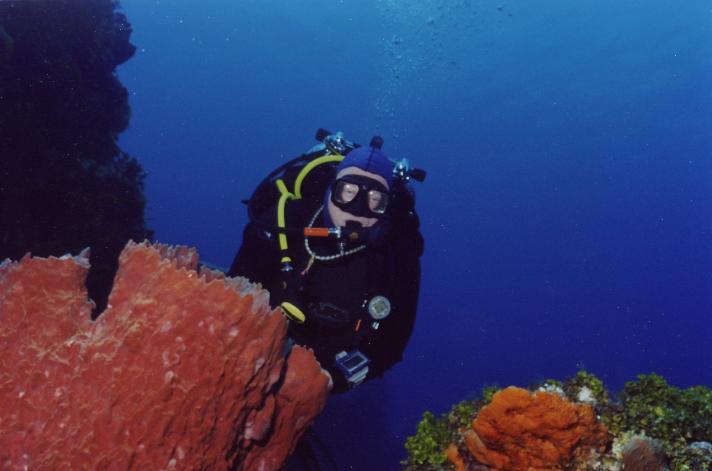 It is sometimes hard for me hard to believe that I used to be an avid skier. In college, I spent a number of weekends, a week around Christmas and Spring Break skiing. It was fun, exhilarating and challenging. My underwater camera saw more frozen moisture than liquid.
After mneung to Houston in…well let’s not go there…I changed from a skier to a sailor and a diver. White powdery slopes were replaced by soft sand beaches, boats, bikinis, dive equipment and clear blue water. Oh, and yes the warm weather.
Winters in Houston are a far cry from the cold wind-blown snow and ice of Lubbock, but I still find that winters can be cold. I guess I have just gotten used to the warmth so the mild winters here seem cold to me at times.
Despite the executives from Continental trading in their shorts and t-shirts for wool sweaters, wool pants and poly-propylene long underwear, Houston remains the gateway to the Caribbean and the soft sand and clear blue waters I discovered later in life. In the Caribbean there is plenty of warmth to go around and diving on some of the worlds most beautiful reefs. The walls stretch for miles down the coasts and in some places for miles down as well.
While Bing Crosby is singing “Let It Snow…” I am picturing a boat parked over a tropical reef, the top of the reef opening up eighty feet below me with the nearby wall plunging down 400 feet and the current guiding me along this natural aquarium. The fish are swimming, feasting in the current and the corals are gently swaying in the water.
The easiest place to go for a long weekend is Cozumel, Mexico a limestone island once home to the Mayan Oracle and a Mayan pilgrimage destination. Cortez removed the Oracle and used the island as a staging area for his conquest of Mexico.
Jacques Cousteau helped make the island a diving Mecca when he first visited the island in 1960. He found the sleepy little island a paradise above and below the water. Of course he probably would not recognize the Cozumel of today with 2 cruise ship terminals which can accommodate up to six ships. The current economic slowdown in the United States has thankfully reduced the number of ships visiting the island but unfortunately to the detriment to the local people.
Cozumel is the home of the second Marine Park founded in Mexico and is the first not to allow local fisherman to spear fish or line fish on the reefs. The primary industry in Cozumel is tourism with divers making up a large part of the tourist business, especially with the reduced cruise ship traffic.
 The reefs, which took a beating in Hurricane Gilbert are still beautiful. The southern end of the island has steep walls and beautiful corals and fish, while the North end of the island was sloping walls and fast currents with up and down currents to boot. For rebreather divers especially, the areas without the up and down currents are more enjoyable and my favorite dives are in the vicinity of Palancar Gardens and Palancar Caves. It is really special to come up from the stark limestone depths into a garden of colour and lives, swirling around you as you swim in, out and around the pillars of coral. You float along, the currents carrying you along toward the north (generally) with the scene constantly changing and renewing the colour and life.
Hmm, I think I need to go diving! Luckily for me, the travel department at Oceanic Ventures, namely Ann, has put together a long weekend in Cozumel so I can complete some training for some students who are also looking forward to warm water and wetsuits instead of the cold water and dry suits I have been making them use for training up to this point. But, despite my being involved in a training class, there are a number of people who, like me, want to escape the cold and enjoy some warm tropical breezes.
If you can get away, you are welcome to join us in Mexico 13-17 January 2011. If you cannot make it this time, keep your head warm and remember someone else is staying warm for you.