• Skip to primary navigation
  • Skip to main content
  • Skip to footer

Houston's Premier Scuba and Dive Shop Oceanic Ventures Inc.

(713) 523-3483 (dive)
5808 Newcastle Drive
Houston, TX 77401

  • Home
  • Stay Current
    • Our Blog
    • Travel and Events Calendar
    • Club Aquarius Social Club
      • Club Aquarius Social Club Upcoming Events
      • Club Aquarius Social Club – The Past
    • Special Events
    • Local Scuba Diving Events
    • Photography Contest
    • Categorized Blog Posts
  • Equipment
    • Dive Equipment
    • Rebreather Systems
    • Cruise Ship Passengers
    • Repair & Maintenance
    • Air & Mixed Gas Blending
    • Pure Fiji Spa Products
  • Training
    • Become a Scuba Diver
    • Scuba In Your Home or Ours
    • Diving Programs for Young Explorers
    • Recreational Dive Courses
      • Recreational Dive Courses overview
      • The Briar Club Scuba Program
      • West University Scuba Program
      • Houstonian Scuba Program
    • Technical Diving Courses
      • Basics
      • Nitrox
      • Trimix
      • Rebreather
      • Wreck Diving Programs
      • Cave Programs
      • Blending
    • Leadership Dive Courses
  • Travel
    • Travel Escorted Adventures
    • Travel – Other Travel Programs
    • Travel – Custom Travel Adventures
    • Local Scuba Diving Events
    • Technical Travel
    • Scuba Diving Around Texas
    • Travel Insurance
    • Travel Forms
  • Company
    • About Oceanic Ventures
    • Meet Our Team
    • Testimonials
    • Facility Hours
    • Map
    • Oceanic Ventures Foundation
    • Resources & Articles
    • Archive
  • Shop
    • Online Store
    • Cart
    • Checkout
    • My Account
    • Policies regarding Privacy and Purchases
  • Contact

Trimix

February 8, 2013 by Eric Keibler

At The Office – A Trip Report From St. Croix

St Croix

When David started diving with Oceanic Ventures, he talked a lot about the Virgin Islands and his desire to introduce us his home town, Christiansted, St. Croix. It seems that he has a lot of his Grandmother in his blood and he wants to introduce everyone to the uniqueness that is St. Croix. (David’s Grandmother, Janet Foster, was the Commissioner of Tourism for St. Croix and along with Vogue Magazine, coined the term The Island of Superlatives).

While he has taken several people to the island during the past few years, on February 1 he got one of his wishes; we took ten of our close warm personal friends to the island to discover what David already knew — there is good diving in St. Croix and a lot more.

We were fortunate to hook up with Ed and Molly Buckley from SCUBA in St Croix and Elsie from the Caravelle Hotel. They helped us coordinate everything from transfers, to Nitrox, Trimix, Sorb and rebreather bottles.

The diving in St Croix varies from steep deep walls to shallow flats with coral bommies and then spur and groove formations. Their are a lot of sharks in the area as well as other marine life from turtles to eels, snappers to butterfly fish. While it appears the large groupers have been fished out, other reef fish have survived and thrived.
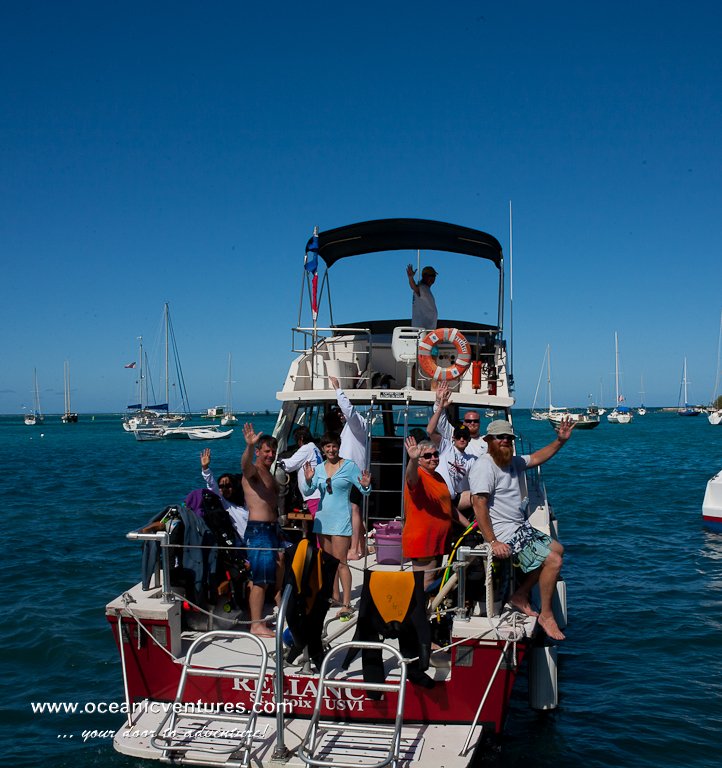
St. Croix DivingThe water temperature in this area is a little colder than the western Caribbean with temperatures ranging from 79 to 80 degrees. The waters off the island are not as protected as in some locations so there is a little more surface activity (i.e. waves) which may deter some divers from venturing out too far.

Because of the waves, winds and the relative health of our diving group, we dove mostly around the Salt River area and the channel area on the North side of St Croix. There are some other spectacular pillars and deep walls in the Cane Bay Area (I’ve seen photographs and heard stories) but the boat ride to these sites is long compared to the Salt River sites.

Despite diving solely in these areas we found the sites to be beautiful with some fun steep walls and cut-throughs in the coral formations. Because the water temperature is a little colder, there are fewer species of corals than in more temperate waters. However, the corals are healthy and plentiful.

After the dives, it seems that the national pastime in St Croix is drinking. The boardwalk is lined with bars and there are bars all around town. That is not to say that there are not restaurants serving nice meals but they tend to close early while the bars stay open until all hours of the night. Thursdays and Fridays are the big nights on the island with Saturdays being rather tame because everyone goes to the beach on Sundays (this was according to Alexandra “Alex” Morris, David’s Sister, who lives in St. Croix).
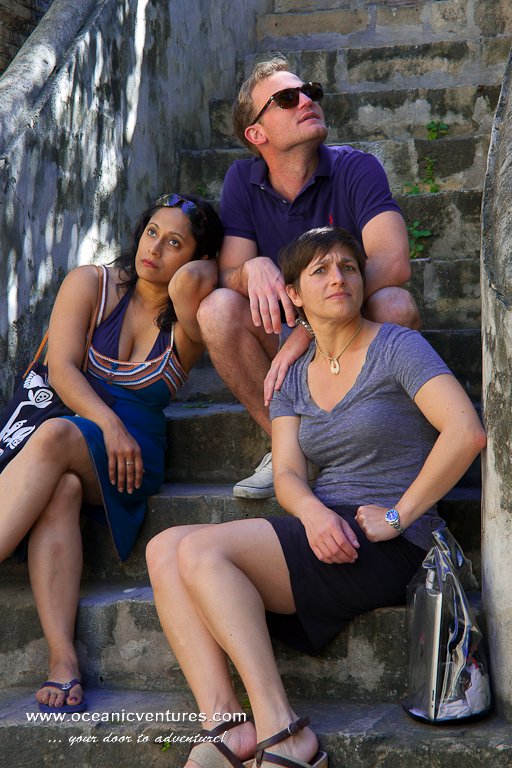
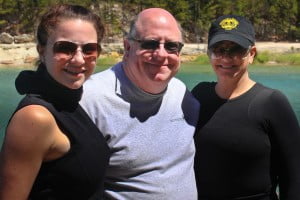
Alex & the GirlsFood ranges from fresh sea food to burgers and steaks. There is a distinct West Indian flair to much of the cooking which adds a unique flavour to the dishes. Hints of Coriander, Cumin and Tamarind can be found in many of the dishes. And, there are the lobsters. Prepared in a variety of ways, all sweet and buttery.

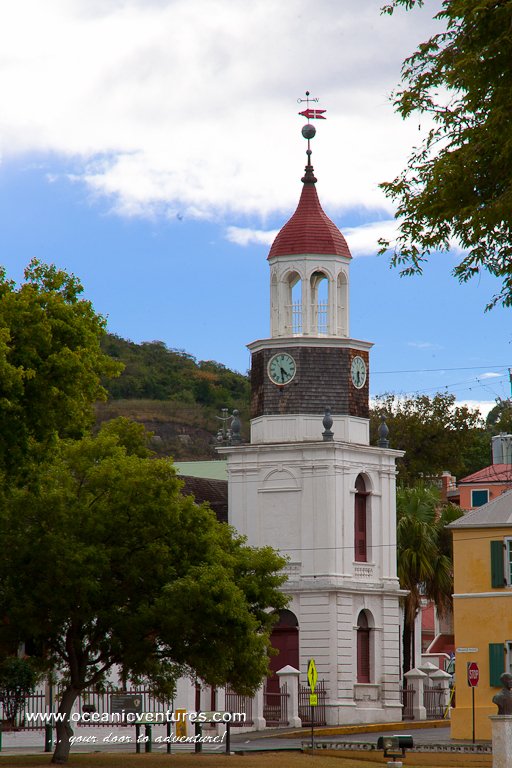
On the last night, David arranged for a special treat for the group — a dinner in one of the St. Croix great houses with dinner prepared by none other than Alexandra Morris, a young, up and coming chef on the island. The house was built as a town house in the late 1700’s by a pair of sugar plantation owners whose plantations were several days ride from Christiansted.

This Town House is decorated with period antiques showing that the owners are well traveled. The feel is of a traditional west indian home but with antiques from the orient and Europe. This would have showcased the wealth of the land owners who built the home.
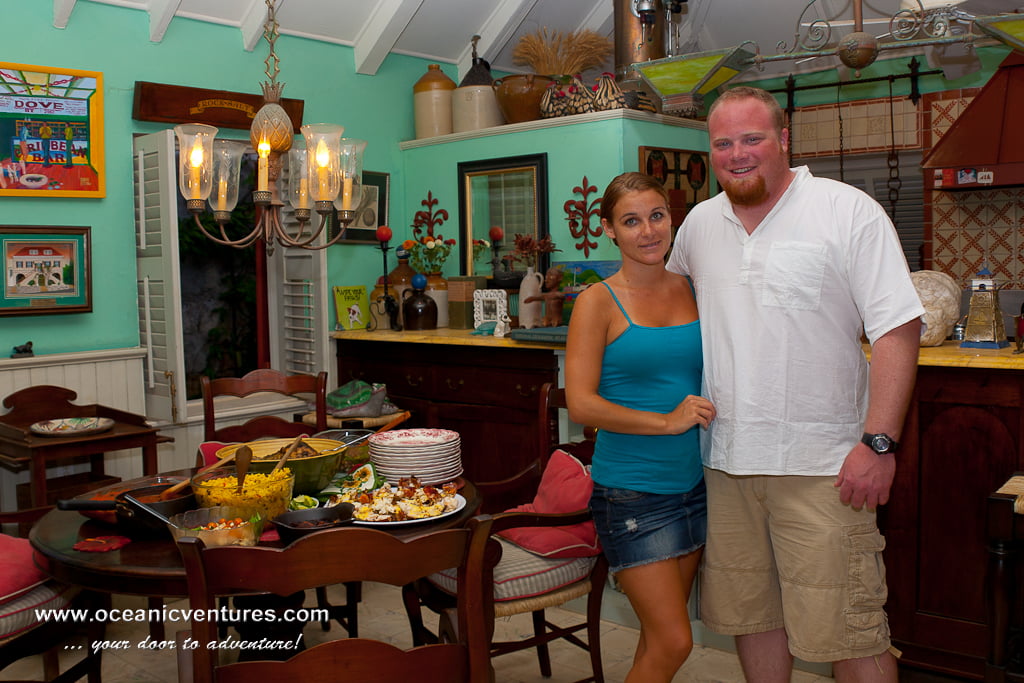
David Morris & Alexandra Morris
David Morris With His Sister Alexandra Morris

Our meal, served out in the Gazebo featured more of the local lobster, this time marinated in Cruzan Coconut Rum with toasted coconut sprinkled on top, as well as jerked chicken with a cream sauce, traditional peas and rice, local okra with mushrooms, sweet potatoes (made with spices and mashed white potatoes), a fruit salad and beans. All of this was followed by a traditional Cruzan Rum Cake (yes, it is better than the Cayman Rum Cakes) and Alexandra’s now famous passion fruit cheese cake (amazingly, there was a vine still producing passion fruit this far out of season). Fun food and fellowship, this is a way to end a trip.

Of course, David’s other goal for this trip was to finish his Principles of Technical Diving Course. Hence the reason we needed all of the logistical help from Ed and Molly. They are a tech friendly facility with Nitrox, Trimix and rebreather support available. They have granular sorb, cartridges, rebreather cylinders, twins or double cylinders, 40 cubic foot pony cylinders and other cylinders available, with or without rigging. They have a good group of gas blenders available as well as some technically trained Dive Masters to help lead the dives.

Getting to St. Croix from Houston is not as easy as the western Caribbean because this is primarily an American destination out of Miami. We went through San Juan and took an American Eagle flight over to the island. There are some other smaller carriers as well but luggage may be more of an issue with them.
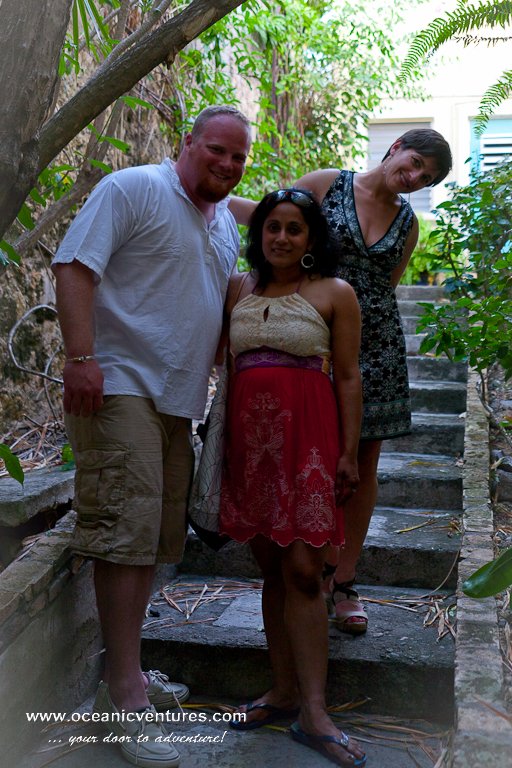
David & the Girls
David Morris with Deeba and Yuliya

One other thing to be aware of when heading to St. Croix is the island is expensive. Food, diving, technical diving supplies, etc are all expensive. Most things are imported from the states and the operating cost (water, power, fuel, etc) are expensive. This means that the prices are higher than you might expect so be prepared.

So what can I say other than traveling with David to St Croix is special and fun. He made sure everyone had a good time and for Dive Mom, he helped everyone have an exceptional shopping experience. Almost everyone came back with a St. Croix hook bracelet! Most of them purchased multiple ones — you know, it is hard to make a decision.

David loves to show off the finest points of St Croix because he is proud of the island and what it has to offer. He is truly a off-island minister of tourism. I am sure his Grandmother is smiling down on him.

Newspaper quote

Filed Under: Art, Caribbean, Marine Life, Rebreather, Rebreathers, Scuba Dive Training, Scuba Diving Activities, Travel, Trimix Tagged With: Dive Travel, diving, jewelry, Rebreather, scuba, St Croix, Technical Diving, Technical Diving.Rebreather Diving, Trimix, US Virgin Islands, Virgin Islands

May 18, 2011 by Eric Keibler

Technical Training at Local Destinations or Not?

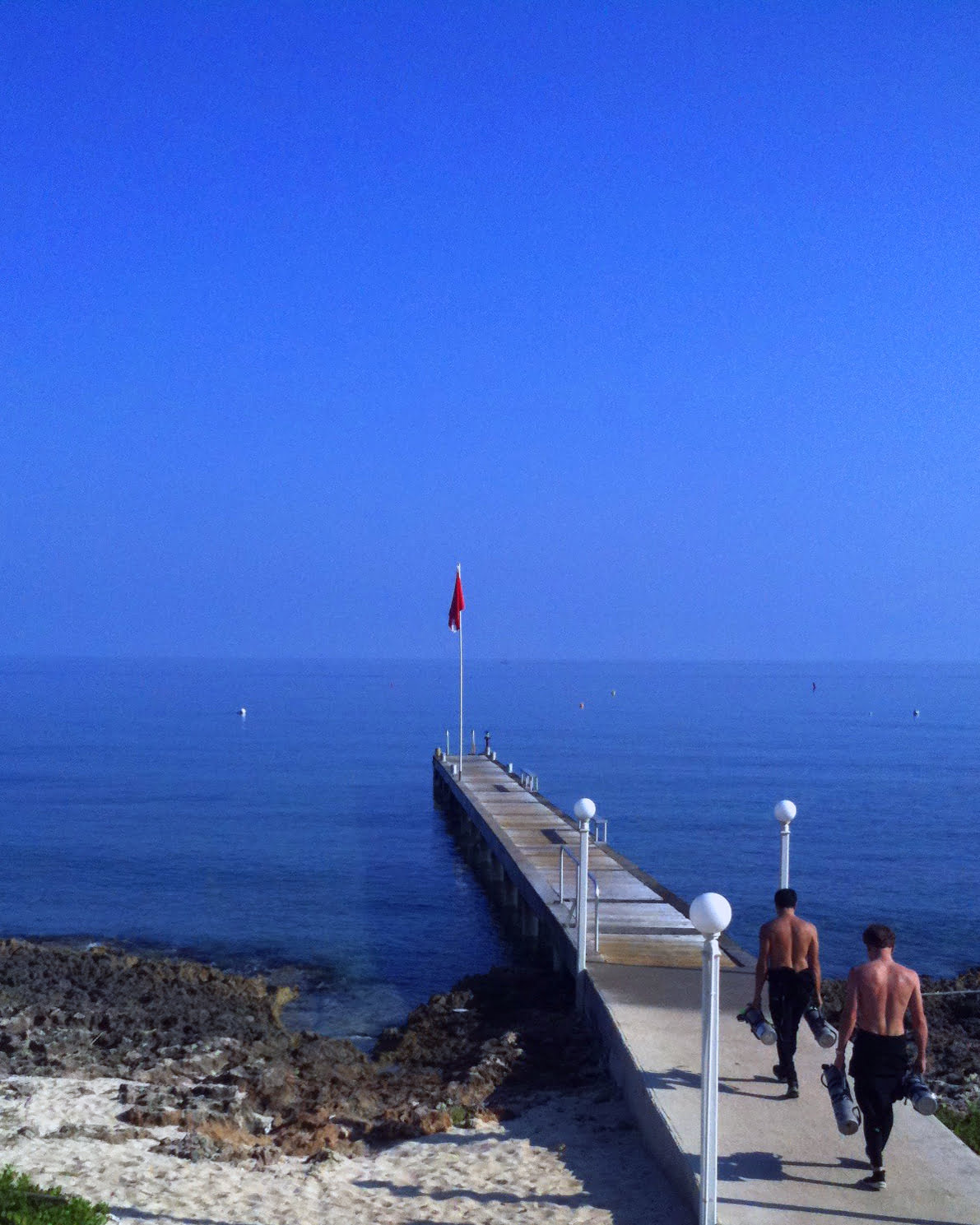
Divers walking to waterRecently I was asked why I don’t do more technical training in the deep lakes in Texas.  My reasoning has to do with both philosophy and the environment. 

First, let’s look at the environment itself.  The lakes have the advantage of being close allowing for short drives from home. To some, this helps keep the training costs lower, especially if you can camp near the lake.  They are familiar dive sites to many of the divers in the area so there is an increased comfort level which is beneficial for the student.  The problem with the lakes is that they are generally not very clear because of sediment and algae.  Because of the reduced visibility, class sizes are limited, which is not a bad thing, and students are forced to swim very close to one another or on a line.  While following a line is a good skill to learn, it inhibits the diver’s ability to fully integrate the skills and procedures into their diving.

The deeper lakes also tend to be cold at depth.  To properly train in this environment, the student needs a drysui or at a minimum a thick wetsuit.  This requires that they be comfortable with drysuit diving before the course starts because starting a technical diving program introduces more equipment and skills so adding a suit that the diver is not familiar with diving adds more complications to an already stressful situation.

This is not to say that a student cannot learn in this environment.  There are many skilled and successful divers who started their training in murky local lakes and quarries.  However, it takes more effort to become proficient in less than ideal conditions.

The second reason I prefer other locations is one of philosophy.  Beginning down the road of technical diving requires that the student develop skills, intuition, and procedures to survive and enjoy the dives.  Swimming with multiple cylinders whether manifolded or separate, as in a side mount configuration, or even on a rebreather requires that you retrain your brain to deal with different buoyancy characteristics and with mass.  I find that students master these skills faster, with more confidence, when they can see what they are doing in relation to their instructor and fellow students.  Further, by allowing them to have more room between them, they can develop better swimming and buoyancy skills in a shorter period of time.  Additionally, with clearer visibility, the stress on the instructor is reduced which I believe makes me more effective in the learning environment.

I also believe that students start this type of diving to do something or to go somewhere.  Some take it merely for the training, but moreover the student has a goal in mind when they enroll in a course.  I have yet to find someone who came to me saying they wanted to find out what the mud looked like at the bottom of Lake Travis.  Diving is about experiences and in my mind it should be predominately positive experiences.

This is not to say that these locations do not have their place in technical diving.  Before leaving for a destination, open water, I like to take the students to one of the shallow training lakes.  This allows them to refine their equipment configurations and develop some buoyancy skills in their new equipment.  You don’t need deep water to work on buoyancy; in fact, it is better to work on it in a shallow area because the trim changes are magnified.  Additionally, these locations allow me to teach some of the skills needed for this type of diving and the start helping them create procedures to deal with equipment and to start building more diving intuition.

For the final dives, I find it to be a more positive experience to go where the water is clear and there is depth and support for the type of diving you are learning.  Since we have completed the knowledge or classroom portion of the course and some basic skills dives prior to leaving for the destination, we can concentrate on the diving and planning when we arrive.

One argument against completing the open water divers in a destination rather than a local lake is the cost.  However, once you figure in the cost of fuel, lodging, meals, entry fees, etc.  The differences are not that great.  By electing to complete your training in a destination like Grand Cayman or Cozumel you will have a better experience and will enjoy the dives more.  Additionally, I believe you will learn faster and progress in this style of diving further because you have a solid foundation on which to build.

Filed Under: Caribbean, Dry Suit Diving, Open Circuit, Rebreathers, Scuba Dive Training, Scuba Diving Activities, Scuba Diving Equipment, Travel, Trimix Tagged With: Rebreather, Technical Diving, Technical Diving.Rebreather Diving, Training, Trimix

December 16, 2010 by David Snyder

Technical Diving and Commitment

Now what would possess one to want to strap over 100 pounds of stuff onto their body and jump into water over their head? When you find the answer you have found a technical diver.
My answer was that I wanted to go to places that required that commitment. It all started when I first went to Bikini Atoll. Prior to our trip, I had heard about that Nitrox thing and since I knew we were going deep I decided to take a class. Well back in 1995 Nitrox was still a voodoo gas in many eyes. So after much searching I found someone to teach it. In addition to the Nitrox class we took a Deep Air class, sort of a introduction to decompression stop diving. Didn’t think we needed it, but what the heck. After completing the classes off to Bikini we went. We knew what we were doing now!
Well, all dives in Bikini are decompression stop dives. The average dive depth is 155 feet. After a week of this diving, had a great time, but we realized we did not have a clue and that clearly was not acceptable. So after our return, back to the dive shop we went and said we wanted to finish our training. Finish our training meant hypoxic trimix and cave.
At that point I had made the commitment to become a technical diver. After completion of the trimix and cave classes I was a certified cool tech diver, or was I? In the fullness of time I have realized that to truly be a technical diver you have to do technical dives. In order to do technical dives you have to want to do technical dives. So in the end the Why is because there is something down there you want to see and technical diving is how to see it safely.

Filed Under: Cave Diving, Open Circuit, Rebreathers, Scuba Diving Activities, Scuba Diving Equipment, Trimix Tagged With: Bikini, Nitrox, Technical Diving, Training, Trimix

December 1, 2010 by Eric Keibler

Escape the Winter Cold, Let’s Go Scuba Diving in January!

Eric Underwater in cozumelIt is sometimes hard for me hard to believe that I used to be an avid skier.  In college, I spent a number of weekends, a week around Christmas and Spring Break skiing.  It was fun, exhilarating and challenging.   My underwater camera saw more frozen moisture than liquid.
After mneung to Houston in…well let’s not go there…I changed from a skier to a sailor and a diver.  White powdery slopes were replaced by soft sand beaches, boats, bikinis, dive equipment and clear blue water.  Oh, and yes the warm weather.
Winters in Houston are a far cry from the cold wind-blown snow and ice of Lubbock, but I still find that winters can be cold.  I guess I have just gotten used to the warmth so the mild winters here seem cold to me at times. 
Despite the executives from Continental trading in their shorts and t-shirts for wool sweaters, wool pants and poly-propylene long underwear, Houston remains the gateway to the Caribbean and the soft sand and clear blue waters I discovered later in life.  In the Caribbean there is plenty of warmth to go around and diving on some of the worlds most beautiful reefs.  The walls stretch for miles down the coasts and in some places for miles down as well.
While Bing Crosby is singing “Let It Snow…” I am picturing a boat parked over a tropical reef, the top of the reef opening up eighty feet below me with the nearby wall plunging down 400 feet and the current guiding me along this natural aquarium.  The fish are swimming, feasting in the current and the corals are gently swaying in the water.
The easiest place to go for a long weekend is Cozumel, Mexico a limestone island once home to the Mayan Oracle and a Mayan pilgrimage destination.  Cortez removed the Oracle and used the island as a staging area for his conquest of Mexico.
Jacques Cousteau helped make the island a diving Mecca when he first visited the island in 1960.  He found the sleepy little island a paradise above and below the water.  Of course he probably would not recognize the Cozumel of today with 2 cruise ship terminals which can accommodate up to six ships.  The current economic slowdown in the United States has thankfully reduced the number of ships visiting the island but unfortunately to the detriment to the local people.
Cozumel is the home of the second Marine Park founded in Mexico and is the first not to allow local fisherman to spear fish or line fish on the reefs.  The primary industry in Cozumel is tourism with divers making up a large part of the tourist business, especially with the reduced cruise ship traffic.
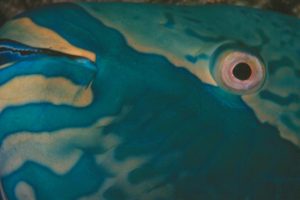
Parrot FishThe reefs, which took a beating in Hurricane Gilbert are still beautiful.  The southern end of the island has steep walls and beautiful corals and fish, while the North end of the island was sloping walls and fast currents with up and down currents to boot.  For rebreather divers especially, the areas without the up and down currents are more enjoyable and my favorite dives are in the vicinity of Palancar Gardens and Palancar Caves.  It is really special to come up from the stark limestone depths into a garden of colour and lives, swirling around you as you swim in, out and around the pillars of coral.  You float along, the currents carrying you along toward the north (generally) with the scene constantly changing and renewing the colour and life.
Hmm, I think I need to go diving!  Luckily for me, the travel department at Oceanic Ventures, namely Ann, has put together a long weekend in Cozumel so I can complete some training for some students who are also looking forward to warm water and wetsuits instead of the cold water and dry suits I have been making them use for training up to this point.  But, despite my being involved in a training class, there are a number of people who, like me, want to escape the cold and enjoy some warm tropical breezes.
If you can get away, you are welcome to join us in Mexico 13-17 January 2011.  If you cannot make it this time, keep your head warm and remember someone else is staying warm for you.

Filed Under: Caribbean, Marine Life, Rebreather, Scuba Diving Activities, Travel, Trimix Tagged With: Continental, Cozumel, diving, Rebreather, Skiing, Trimix

March 10, 2008 by Eric Keibler

Trimix In Cozumel

It has been a long time since I did any Technical Diving in Cozumel.  My last experience was in 2003 and the logistics and dealing with the “technical” dive shop on the island made doing it there more effort than it was worth. 


Recently I was introduced to Don Labruzzo, owner of Dive Extreme who like any good salesman pursued our business and invited us to dive with him.  He came with good references, Wayne Cooper, a recent Optima rebreather student spoke highly of him.  Wade Sparks, one of our Assistant Instructors, agreed to try him out while he was on a vacation with his wife in Playa del Carmen.  Wade too brought back good reports of Don’s operation.


 In talking with my current Trimix students, Madison and Jerry, I proposed the idea of completing our open water session in Cozumel.  Looking at the costs of going to Florida and the quality of the deep diving in comparison to the walls in Cozumel, it made good sense to go to Cozumel (cost wise it was about $200.00 more).  Two other of our technical diving clients, Kelly and Geoff, also agreed that a weekend of diving in Cozumel sounded like fun, They joined us.


The plan was to do one dive on Thursday, two on Friday, two on Saturday and return on Sunday.  Maximum depth, 240 feet.  We arrived in Cozumel with a strong north wind which made the diving a little rough.  The first dive was on Villa Blanca Wall, not too far out by boat so we could get a long dive in and be done before dark.  Don’s boat is a 40’ modified sport fisher with lots of room and a good crew.


The next day the winds were still up but had shifted so the waves abated a little.  Dives onto Yucaab wall and Paradise.  Not the most picturesque walls in the area but a reasonable run with the weather the way it was and the drills I needed to do with the students.  In-between dives, Don and his crew treated us to a lunch of fresh baked bread (from that morning), cheese, cold cuts, fresh made salsa, tortillas and guacamole.


Our plan for Saturday included a run down to Palancar for some truly spectacular wall diving.  Unfortunately, the winds shifted again and the port was closed to all baot traffic.  That meant no diving offshore.  Don offered to take us all to a local Cenote but I was not comfortable taking everyone into one of the small openings found in Cozumel with their current skills. 


However, Kelly and Geoff jumped at the offer.  According to them, they had an adventure that involved a local army/police unit, a stalled truck, no change of clothes and a fantastic dive.  I think they are truly hooked on Yucatan diving.


Unfortunately the storm did not abate so we returned to Houston, still in need of some extra dives. 


I did find diving with Don’s operation a pleasant surprise when compared to my previous experiences.  He is runs a good operation, with a great group of men and woman who understand customer service and want to build a relationship with their clients.  We will be back.

Filed Under: Caribbean, Rebreather, Trimix Tagged With: Cozumel, Trimix

Footer

Contact Us

Oceanic Ventures, Inc
5808 Newcastle Dr.
Houston, TX 77401-3214
USA

Phone: 713-523-DIVE (3483)

eMail: divesafe@oceanicventures.net

Signup for our dive and scuba newsletters

Don’t miss news about the exciting happenings at Oceanic Ventures.


Map and Directions

Socialize

  • Email
  • Facebook

Why People Choose Us

People choose their friends carefully just as they should choose their adventure partners and Scuba Diving Instructors.  Oceanic Ventures is the premier scuba dive shop in Houston, Texas, and the Southwest because of our exceptional service and our sense of adventure.  In talking with our clients and friends, people choose us for a number of reasons such as: Passion – We love what we do and we want to share the beauty and excitement of the underwater world with everyone we meet. Caring- Our clients tell us they love us because we truly care about people and strive to make their scuba diving experiences safe, fun and enjoyable. Professional – Our staff members are the … [Read more …]

Copyright © 2026 all rights reserved Oceanic Ventures, Inc. · Sitemap · Log in