• Skip to primary navigation
  • Skip to main content
  • Skip to footer

Houston's Premier Scuba and Dive Shop Oceanic Ventures Inc.

(713) 523-3483 (dive)
5808 Newcastle Drive
Houston, TX 77401

  • Home
  • Stay Current
    • Our Blog
    • Travel and Events Calendar
    • Club Aquarius Social Club
      • Club Aquarius Social Club Upcoming Events
      • Club Aquarius Social Club – The Past
    • Special Events
    • Local Scuba Diving Events
    • Photography Contest
    • Categorized Blog Posts
  • Equipment
    • Dive Equipment
    • Rebreather Systems
    • Cruise Ship Passengers
    • Repair & Maintenance
    • Air & Mixed Gas Blending
    • Pure Fiji Spa Products
  • Training
    • Become a Scuba Diver
    • Scuba In Your Home or Ours
    • Diving Programs for Young Explorers
    • Recreational Dive Courses
      • Recreational Dive Courses overview
      • The Briar Club Scuba Program
      • West University Scuba Program
      • Houstonian Scuba Program
    • Technical Diving Courses
      • Basics
      • Nitrox
      • Trimix
      • Rebreather
      • Wreck Diving Programs
      • Cave Programs
      • Blending
    • Leadership Dive Courses
  • Travel
    • Travel Escorted Adventures
    • Travel – Other Travel Programs
    • Travel – Custom Travel Adventures
    • Local Scuba Diving Events
    • Technical Travel
    • Scuba Diving Around Texas
    • Travel Insurance
    • Travel Forms
  • Company
    • About Oceanic Ventures
    • Meet Our Team
    • Testimonials
    • Facility Hours
    • Map
    • Oceanic Ventures Foundation
    • Resources & Articles
    • Archive
  • Shop
    • Online Store
    • Cart
    • Checkout
    • My Account
    • Policies regarding Privacy and Purchases
  • Contact

Archives for September 2016

September 28, 2016 by Eric Keibler

Scuba Diving Adventure to Indonesia Comes to a Close

Oceanic Ventures Group aboard the Arenui in Indonesia's Forgotten Islands
Oceanic Ventures Group aboard the Arenui in Indonesia’s Forgotten Islands

The Oceanic Ventures Adventure Trip to Indonesia’s Forgotten Islands is rapidly coming to a close.  The group has left the boat and is currently in Bali or Jakarta (the group took different routes to get there) and are preparing for the journey home.  The Bali group is lounging in Nusa Dua and will be starting home tomorrow.
Keep watching for more updates on this trip and I am sure we will see some of the photographs in the !

Filed Under: Far East, Pacific

September 27, 2016 by Eric Keibler

Investigation of East Flower Garden Bank coral die-off continues amid new coral bleaching event

Scientists documenting the bleaching event underway in Flower Garden Banks National Marine Sanctuary. Photo: G.P. Schmahl/NOAA.
From the NOAA Marine Sanctuaries website…
Scientists continue to explore a broad spectrum of possible causes for July’s mass mortality event at East Flower Garden Bank within Flower Garden Banks National Marine Sanctuary, including environmental conditions and human activities. Meanwhile, their efforts are now complicated by a new but unrelated coral bleaching event, which can happen this time of year when corals are stressed by warmer water temperatures.
A preliminary review of vessel traffic data revealed a lack of vessels in the vicinity just before the mortality event. This effectively rules out the possibility of an acute discharge of pollutants as the cause of the die-off. Earlier analyses indicated that no hydrocarbons were present in the area of the mortality, which further reduces the likelihood that the event was due to some sort of petroleum-based contamination.
Ongoing response efforts are now focused on additional analysis of oceanographic dynamics (see animation below) and water quality. NOAA research divers conducting additional response surveys earlier this month observed dead sponges in other locations around East Flower Garden Bank and on a nearby production platform just outside the boundary of Flower Garden Banks National Marine Sanctuary. The die-off and whatever caused it, therefore, may have been more widespread than initially thought. [READ MORE]

Filed Under: Conservation, Gulf Diving, Scuba Diving Activities Tagged With: gulf of mexico, NOAA, Texas

September 15, 2016 by Eric Keibler

Scuba Divers Wandering Through Bali

Bali Pool
There is no rest for the adventure traveler!  The group has been very busy in Bali visiting temples, rice fields and yes, shopping.  I mean what type of trip would it be without a shopping opportunity?  If you are wondering about their time in Bali, here is the schedule for Ann’s group prior to starting toward the Arenui:

Day 1 Upon arrival in Bali 9:35 AM Transfer to Ubud (approx. 1hr 10mins)Tour John Hardy’s Factory, then to hotel
Day 2 08:00 Tour begins with a visit to Taman Ayun, Ulun Danu Bratan – Jatiluwih Rice Terrace. Lunch at Local Restaurant. Return to hotel
Day 3 09:30 Tour begins with a visit to Monkey Forest Ubud , a Batik Factory, a Silver Shop at Celuk Village, a Balinese Traditional House at Mas Village. and transfer back to Nusa Dua for evening
Day 4 5:30 AM Transfer to airport for flight to Ambon
Black-crowned Night-Heron  in Bali Indonesia
Black-crowned Night-Heron in Bali Indonesia
Well that is not really true.  Ann was up early in the hotel and wrote this “I have left the perch atop the dining room and went to my original destination.  It is a deck overlooking the rice terraced rice-fields, across the tangled jungle ravine carved by the river. The sky is not yet fully bright and I can hear the full, constant roar of the river over the very loud sound of birds, frogs, chickens and distant village noises. The air is cool, damp, very still.  Two groups of egrets and another pair fly over to reach their favorite morning feeding location.  Although I know there are morning smells the natural lemon grass oil bugs spray on my arms dominates my nasal passages. As I look up to the sky through the palm trees I see there is ever so slight a breeze.
The touring is now done and they are resting for their early morning transfer back to the airport for the flight to Ambon and then on to Sumilaki the next day to meet the boat.
 
And I just heard — they are at the airport…

Filed Under: Far East, Pacific, Travel Tagged With: Adventure Travel, Bali, Dive Travel, indonesia, Travel

September 13, 2016 by Eric Keibler

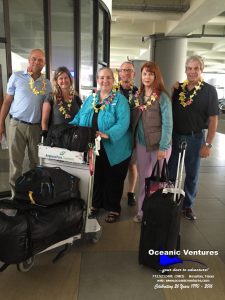
Scuba Divers Start Their Journey to Indonesia's Forgotten Islands

Cheryl, Coad, Rich and Ann at the airport in Houston.
The first wave of divers departed Houston’s Intercontinental Airport for the Arenui via Moscow, Singapore and finally Bali where they will be spending a few days touring before heading off to Ambon then to Sumilaki to meet the boat.  I say the first wave because Susan and Donna left on Monday for Bali and will meet up with the group along with more divers from Houston and a few other cities outside of the state.
The Bali touring contingent will be touring in the Ubud region of Bali.  They have some temples and shopping on the list as well as some awesome overviews of the terraced rice patties in Bali.
Stay tuned for more details on their trip…
Laura, Mark, Ann Coad, Cheryl and Rich sitting down to eat after flying around the world.
A portion of the group reaches Bali!
Laura, Mark, Ann Coad, Cheryl and Rich sitting down to eat after flying around the world.

Filed Under: Far East, Photography, Travel Tagged With: pacific, Travel

September 2, 2016 by Ann Keibler

Adventure Travel – Dive Mom's Travel Hints

My TSA defense mechanism or ..don’t let your things be molested in route.

My friend and fellow diver, Lauren has been asking for articles for a newsletter and I have been wanting to write a series of blog posts: “Tips for travelers; from a professional tour leader.” So here is the first in a series of articles for your reading enjoyment ; hopefully with one new idea to aid in your adventures and travels.
I often tell clients, you should be able to travel for 2 days or 2 weeks in only one check bag, a rolling carry-on and purse (i.e. back pack, lap top or camera bag) and still be able to bring with you your total diving system, all the clothes you need for a tropical vacation, and personal items. Remember divers like having their own equipment so, as a “regular traveler” it is even easier to pack!!!

Specter Pack-It Cubes available at Oceanic Ventures


One of the solutions to accomplishing this task is packing cubes; that simple square, or long zippered cloth and mesh bag popularized by Eagle Creek and sold by Oceanic Ventures, Inc. here in Houston. I have found that if all of my items are organized in cubes, tubes, and bags, they tend to arrive “un-molested” and organized. Not only do they provide you organization both in route and once you reach your destination; but you have helped prevent the TSA from handling all of your personal items one at a time. Picture this – the TSA officials all wear gloves. It is to protect themselves, not you. Those gloves do not get changed between “guests”, so they have passed through all your things after handling “42 billion” other travelers that shift. What I have found in both the TSA line in the terminal and in the TSA search of my checked bags, is that items packed in organization cubes, tended to stay in those cubes. At most the cube is handled and patted down, but seldom opened. And now only the cube is touched, not your personals items.
So here is how I use these cubes.
For your rolling carry bag:

  • Standard Cube or Packing Folder- change of clothes, and your night clothes. Fits on one cube.
    Standard Cube – my regulator, bathing suit, diving computer and mask. If you are not a diver, then that cube gets dedicated to the trip purpose; those things critical to the trip purpose.
  • Half Tube Cube or the SAC—all the electronic cords, charges et al
  • Half Tube Cube—left for other things you need.

For your “purse”, i.e. back pack, lap top case or tote bag:

  • Half Tube Cube—personal kit
  • Shoe Bag Cube—for documents
  • Pack-it Sack—the little “back of the seat” bag for long flights. I’ll send you my essentials list although that is a blog in itself! With new inflatable travel pillow (yes, we have those too!!)
  • Covered Half Cube—stack of foreign currency (For international travel to places requiring cash. I love to shop in local markets, and craft centers and that is better done in cash.)
  • Tube Cube—healthy snacks
  • Reusable—empty water bottle

For your checked bag:

  • Cubes—of all sizes and shapes depending on the purpose of travel.

Oceanic Ventures has two display racks of packing items on our small store!!! So here is my promise to you –before your next trip, make an appointment to stop by the store with your list of items you take on your trip. I will send you home with an arm load of packing accessories best suited for your travels. You can  bring back what you don’t need, and we charge you for the ones that you kept that you thought were useful. It is the way I learned to pack—everything went on the guest room bed, and I had brought a stack of organizers home from the store. Now I have my favorite ones—but somehow each trip I might just add a new one!!!
Enjoy………….Fair Winds and Safe Travels.

Filed Under: Travel Tagged With: Dive Travel, Packing, Travel

September 1, 2016 by Simon Pridmore

Scuba Diving – The Black Gasses

Nitrogen is commonly painted as the bogeyman gas for divers, but there are two other gases that can cause scuba divers problems. Carbon dioxide (CO2) and carbon monoxide (CO) are the real black gases of scuba diving.
By Simon Pridmore
Simon is the best-selling author of Scuba Confidential – An Insider’s Guide to Becoming a Better Diver and Scuba Professional – Insights into Scuba Diver Training & Operations. Both books are available from Oceanic Ventures. Simon has also just published a new book for divers-to-be and absolute beginners called Scuba Fundamental – Start Diving the Right Way.
 
EVK-1596The dangers of CO2 in particular have come to attention in sport diving recently with the increasing popularity of rebreather diving, where it has been a factor in many accidents. However, it is important to appreciate that open circuit divers are also at risk. CO2 build up is a major contributor to one thing that, above all else, causes divers to come to harm – panic!
The risk of CO2 poisoning is something that all divers should be aware of but its importance is often understated in basic training manuals, where headaches are commonly given as the only adverse effect. Divers therefore often do not think of it as a threat at all.

How CO2 can affect us all

CO2 is a waste product of the metabolic process and is potentially toxic. Usually, we automatically regulate the level of CO2 in our bodies just by breathing. If there is too much, our brain detects what is happening and causes our breathing rate to increase in order to to flush out the excess.
Divers tend to develop higher-than-normal levels of CO2 during a dive. This is because when we are underwater we do not eliminate enough of the CO2 that our body is producing, especially when we are deep and exerting effort.
This is due to a number of factors, including: –

  • Water pressure on the chest;
  • The extra resistance to breathing imposed by the our equipment, and
  • The increased density of air at depth.

A high level of CO2 in the bloodstream produces a condition called hypercapnia. Hypercapnia does indeed give you a headache but it can also make you confused, dizzy, disorientated, light-headed, short of breath and panicky.

How to Prevent and Combat CO2 Poisoning

The key strategies to deal with the threat posed by hypercapnia are awareness and prevention. Know that it is a risk, anticipate situations where it is likely to occur and avoid such situations. CO2 build up happens mainly when you descend fast, head down, or when you swim hard at depth, perhaps when you are swimming against a strong current or hurrying to get back to the boat because you are low on air.
Because the deeper you go, the more dense your air becomes, working hard on deeper dives carries a greater risk of CO2 build up. So, if you are deep and find yourself fighting a current, change direction and go with the flow. Or ascend to a shallower depth so you are not dealing simultaneously with the twin challenges of both depth and exercise.
If you know beforehand that your dive might involve a long, hard swim at depth, always ensure your regulator is set to give you the least breathing resistance possible. Consider using specialized equipment such as a scooter to help reduce your workload.

Carbon Monoxide

The other black gas is carbon monoxide, which is completely invisible and odorless, but potentially fatal if it is present in your scuba cylinder in even small quantities.

How does it get into the scuba cylinder?

Carbon monoxide usually gets into the cylinder because there is an engine exhaust close to the compressor intake. The source might be a permanent fixture such as the exhaust from the compressor engine itself or a dive boat engine. It could also be something temporary. Perhaps a car was parked with its engine running close to the compressor intake while your cylinder was being filled.

How will you know?

Analyzers are available which can be used to detect the presence of carbon monoxide in a scuba cylinder. They work in much the same way as an oxygen analyzer. Otherwise, you will not know until you start feeling unwell during a dive. The initial symptoms are headache, fatigue, irritability, dizziness and confusion. Carbon monoxide poisoning causes oxygen deprivation that leads to loss of consciousness, cell damage and death. As you probably know, carbon monoxide is a threat in the home as well, for instance, if you run a car engine in a confined space such as a closed garage or if your heating system is poorly maintained or poorly ventilated.

What Can You Do?

If you ever feel unwell during a dive then you should immediately abort the dive and ascend slowly WITH your buddy. Do not just go up on your own in case your situation becomes worse during the ascent. Make yourself positively buoyant at the surface, remove your regulator and take a few long deep breaths. Do NOT resume your dive, even if you start to feel better. Once you are safely back home, let the folk at the dive center that filled your cylinder know what happened, so that they can test the air in your cylinder and check their systems. The problem might have been carbon monoxide. It might have just been something you ate. But they should be told, just in case.

Filed Under: Scuba Diver Health Tagged With: gasses, safety, Scuba Diving

  • Page 1
  • Page 2
  • Go to Next Page »

Footer

Contact Us

Oceanic Ventures, Inc
5808 Newcastle Dr.
Houston, TX 77401-3214
USA

Phone: 713-523-DIVE (3483)

eMail: divesafe@oceanicventures.net

Signup for our dive and scuba newsletters

Don’t miss news about the exciting happenings at Oceanic Ventures.


Map and Directions

Socialize

  • Email
  • Facebook

Why People Choose Us

People choose their friends carefully just as they should choose their adventure partners and Scuba Diving Instructors.  Oceanic Ventures is the premier scuba dive shop in Houston, Texas, and the Southwest because of our exceptional service and our sense of adventure.  In talking with our clients and friends, people choose us for a number of reasons such as: Passion – We love what we do and we want to share the beauty and excitement of the underwater world with everyone we meet. Caring- Our clients tell us they love us because we truly care about people and strive to make their scuba diving experiences safe, fun and enjoyable. Professional – Our staff members are the … [Read more …]

Copyright © 2026 all rights reserved Oceanic Ventures, Inc. · Sitemap · Log in