• Skip to primary navigation
  • Skip to main content
  • Skip to footer

Houston's Premier Scuba and Dive Shop Oceanic Ventures Inc.

(713) 523-3483 (dive)
5808 Newcastle Drive
Houston, TX 77401

  • Home
  • Stay Current
    • Our Blog
    • Travel and Events Calendar
    • Club Aquarius Social Club
      • Club Aquarius Social Club Upcoming Events
      • Club Aquarius Social Club – The Past
    • Special Events
    • Local Scuba Diving Events
    • Photography Contest
    • Categorized Blog Posts
  • Equipment
    • Dive Equipment
    • Rebreather Systems
    • Cruise Ship Passengers
    • Repair & Maintenance
    • Air & Mixed Gas Blending
    • Pure Fiji Spa Products
  • Training
    • Become a Scuba Diver
    • Scuba In Your Home or Ours
    • Diving Programs for Young Explorers
    • Recreational Dive Courses
      • Recreational Dive Courses overview
      • The Briar Club Scuba Program
      • West University Scuba Program
      • Houstonian Scuba Program
    • Technical Diving Courses
      • Basics
      • Nitrox
      • Trimix
      • Rebreather
      • Wreck Diving Programs
      • Cave Programs
      • Blending
    • Leadership Dive Courses
  • Travel
    • Travel Escorted Adventures
    • Travel – Other Travel Programs
    • Travel – Custom Travel Adventures
    • Local Scuba Diving Events
    • Technical Travel
    • Scuba Diving Around Texas
    • Travel Insurance
    • Travel Forms
  • Company
    • About Oceanic Ventures
    • Meet Our Team
    • Testimonials
    • Facility Hours
    • Map
    • Oceanic Ventures Foundation
    • Resources & Articles
    • Archive
  • Shop
    • Online Store
    • Cart
    • Checkout
    • My Account
    • Policies regarding Privacy and Purchases
  • Contact

buoyancy

February 9, 2016 by Simon Pridmore

Scuba Diving – Get Control of your BCD!

A note about the author – Simon is the best-selling author of Scuba Confidential – An Insider’s Guide to Becoming a Better Diver and Scuba Professional – Insights into Scuba Diver Training & Operations. Both books are available now from Oceanic Ventures.

As you discovered when you first learned to scuba dive, the letters BCD stand for Buoyancy Control Device. This implies that your BCD is an appliance that controls your buoyancy in the water. It would be nice if that were the case but sadly it is not true. No matter how technologically advanced your BCD is, you are still the one responsible for controlling your buoyancy in the water. Your BCD is just a tool that you can use to help you.

But first you need to get the BCD itself under control!

stellitoBuy the right one

Most people buy BCDs that are the wrong size because they try them on in a dive shop while standing up and wearing their normal land-based-life clothes.

Try the BCD on in the shop while wearing your wetsuit and once you have chosen a model, ask to try a sample out in the pool first. Take along the size that fitted you best in the shop and take the next size down with you also. The smaller one is probably the one you will keep.

Your BCD should fit you closely, especially around the shoulders, but not restrict normal movement nor constrict you with the bag full and the straps loosened. It must have enough buoyancy when fully inflated to float you comfortably at the surface with your head clear of the water, but no more.

It is best avoid the bulky, top of the range models. They are usually very buoyant even when not inflated and will require you to wear a lot of extra weight to compensate. An oversized BCD can start moving around on its own under water and be impossible to control!

Charlie in TrukKnow how it works

Spend plenty of time studying your new BCD. Hold it up in front of you horizontally and imagine where the air will be when you are underwater. It will always be in whichever part of your BCD is closest to the surface.

Learn where the controls are. While you are swimming, practice finding your inflator mechanism by touch alone: then, practice using it in different positions. Remember it is not a pump; it will only release air when a) it is above your left shoulder and when b) your left shoulder is the part of your body closest to the water’s surface. Otherwise the air will remain trapped inside no matter how fiercely you depress the button. See how need to turn your body while swimming so that your left shoulder is at the highest point. Usually you can manage this by dipping your right shoulder.

Notice that if you are swimming with your head down and feet up, the air will be close to your butt. Most BCDs have a “tail dump” so you can release air in this position. Make sure you know instinctively if the tail dump is on the right or left.

Learn how to empty your BCD completely. Failure to master this skill can make it difficult for you to descend, cause you to carry too much weight to compensate and, worst of all, place you at risk of an out of control ascent.

Stephanie Watowich in Truk Lagoon

Set it up properly

Control your safe second stage (octopus) and your console so that you know where to find them instinctively when you need them and also so that they do not swing around below you and damage that beautiful coral you are swimming over. This means controlling the object at the end of the hose, not just the hose. Clips that retain only the hose still allow the object on the end to swing free below you and turn your accessories into reef-wrecking balls.

Minimize the number of extra bits and pieces you carry on every dive and make sure the essential items things, such as your safety sausage and dive light, are stowed away or attached securely. The two golden rules are:

  • only one thing in each pocket because if you have several items in the same pocket and pull one thing out, everything else will come out with it: and
  • attach everything by two points so that,
    1. it does not dangle and,
    2. if one of the attaching points breaks you do not lose it.


Filed Under: Open Circuit Tagged With: buoyancy, Scuba Dive Training, scuba equipment

February 16, 2015 by Susan Long

The Making of a Scuba Diver

Scuba Diver Susan Long Relaxing in Fiji
Susan Long Relaxing in Fiji

I have been scuba diving for over two years – since December 2012. Not only that, I had 100 dives within 10 months, and I had another 100 dives within another 10 months. I LOVE it! I am 59 years old, a retired IT professional, not athletic or mechanical in the slightest. How did I get here?

When we got married in 1992, my husband and I made a deal. He would not buy a Harley, and I would not go scuba diving. That way, we thought we could keep each other alive for a good long time. I have always had friends who scuba dived, and I have long been intrigued by it.

I swam for exercise in college – or more precisely, struggled through maybe 10 lengths a session. It was awful and so difficult, but for some reason, I did it. I did not enjoy it at all. Fast forward 25 years, and we went with some diving friends to the Yucatan for vacation. They did some diving, and we all snorkeled one day. I was terrified! I did not understand how I was supposed to breathe underwater. But I made myself jump in and try it, and within a minute or two, I was having a great time! There were lots of glamorous fish! Who knew? And I really enjoyed being in the water – which was also a surprise, after my college swimming experiences.

Scuba Divers Susan & Larry on a motorcycle trip
Susan and her husband, Larry on their last motorcycle trip.

After I retired in 2005, I decided to go to graduate school in Spanish Linguistics at the University of Houston. The parking is horrible! (The classes were great!) I soon realized if I had a motorcycle or scooter, I could park in the designated areas much more easily. So I bought a Vespa scooter! When my husband got over the shock, he got himself a Harley! So now I had permission to scuba dive! (We now both really enjoy our motorcycle trips together!)

I had permission to scuba dive, but on the other hand, I knew it was an expensive habit. I was reluctant to get a lot more “stuff”. We already had plenty of stuff. Being overweight, I didn’t think there would be enough weight available to keep me down (seriously). I also knew myself it could be dangerous – I had looked at some books detailing scuba diving “incidents” and they are pretty scary. You wonder why anyone comes back alive!

In the fall of 2012, my friend Donna Collins (another scuba diver, and Oceanic Ventures, Inc. denizen) and I were planning to go on a cruise to Costa Rica and Panama. She suggested that we could go snorkeling, and she might try to go diving. I was enthusiastic – I had not had a chance to go snorkeling in years! She took me to Oceanic Ventures to look into getting my own mask, snorkel, fins to take on the trip.

My First Trip the the Dive Store

Ann, Alex and David Morris were in the shop, and I will never forget the warm welcome. David took me under his wing and explained everything I wanted to know about masks, snorkels, fins. I could not believe how expensive they were! But I was sold on the part of getting good equipment so I could really enjoy the experience. I left with the mask, snorkel, fins, a bag, a skin, and maybe a few other goodies. David offered to give me a snorkeling class for free, which I gladly took him up on, since I was certainly not an expert snorkeler, having only done it once.

At the snorkeling class, I learned quite a bit, especially how to “duck dive!” David offered to give me a Try Scuba session, and I was, well, OK, sure! If he’s offering, I sure will try it. Within a few days, I was trying out the scuba equipment in the West U pool, and learning the first rule of scuba. I don’t remember exactly how it happened, but the next inevitable step was signing up for Open Water Scuba classes so I could go on the Cozumel trip that December. And buying all my equipment. Oceanic Ventures made it so easy. I could not have chosen (and still can’t) between Buoyancy Compensaters, Air Delivery System’s or computers. I trusted their advice, and I really liked the idea that they had a lot of experience with the equipment they sold, and they believed in it for all levels of diving.

Open Water Scuba Training with Oceanic Ventures

I had a great time in the Open Water Scuba training with David and Alex. It was hard for me to clear my mask, but eventually I figured it out. It was hard remembering all the steps for sharing air, or the out-of-air ascent. But I did it! The Cozumel trip was fantastic. I did my open water dives there with Alex as my instructor, and it was so much fun! He was so calm, and knowledgeable, and encouraging. I could see it was going to take some time for me to get really comfortable with my buoyancy, and the breathing, but I was plenty comfortable enough to enjoy the diving, and the Oceanic Ventures group was so wonderful. All those experienced divers were so encouraging and helpful to the brand-new,” baby diver.”

Scuba Diving in the Solomon Islands Susan Long and Ann Keibler
Scuba Diving in the Solomon Islands with Susan Long and Ann Keibler

David had let me know in the  Open Water Scuba training that he was the first Oceanic Ventures student to get 100 dives in a year. That sounded like a challenge to me, and I like challenges! Also it was quite clear after the Cozumel trip that the more experience I had, the more fun I could have as a diver. So I set myself the informal goal of getting 100 dives in a year. In order to keep diving through the winter, I started drysuit training and bought a drysuit. I started Advanced Open Water Scuba training, if for no other reason that it was more diving experience! I went with Oceanic Ventures to St. Croix, Belize, Cozumel, and then to Grand Cayman in August! (Donna and I did get to do a few dives on our trip to Costa Rica.) By the time I got to Grand Cayman, I had achieved the 100 dives, between the trips, the training, and being a fun diver at Blue Lagoon and 288 Lake.

Where I Am Now…

So what about all the concerns I had, and my husband had? Well, first off, safety is obviously the first priority at Oceanic Ventures. Now that I am diving, I wonder how people got themselves into those situations in those scary dive books. Of course, mistakes can happen, but most of those incidents are inconceivable on an Oceanic Ventures trip. Yes, diving is expensive, and I have a LOT of stuff. I am still dealing with how to organize it and where it all needs to go between trips. Oh well! The experiences I have had as a diver, and the friends I have made, have been more than worth it.

Scuba Diver Susan Long Diving in Fiji
Susan in Fiji

I love being a part of the Oceanic Ventures “tribe.” It feels like home. I am very impressed with the emphasis on safety and professionalism at Oceanic Ventures. Ann and Eric Keibler run a tight ship, with little room for error, but lots of room for fun. It is easy to have fun when you have confidence in the trip leader, the dive location, the divemasters, and the choice of dive sites. And you get to go play with your dive peeps!

My husband has put up with all this graciously, taking me to the airport and kissing me goodbye as I go off on my next diving adventure. I am so happy to report that since his retirement last August he has become a certified scuba diver, and we are going on our second trip to Cozumel with Oceanic Ventures next month!

Filed Under: Caribbean, Dry Suit Diving, Local Diving, Pacific, Scuba Dive Training, Scuba Diving Activities, Scuba Diving Equipment, Skills, Travel Tagged With: buoyancy, Cozumel, Dive Travel, DiveAroundTexas.com, diving, diving skills, drysuit, Grand Cayman, Scuba Dive Training, Training, Travel

October 15, 2012 by Eric Keibler

Scuba Diving Practice – Local Lake Diving

open water october 2012
The Early Morning Arrivals for Wades Excelent Adventure Barbeque

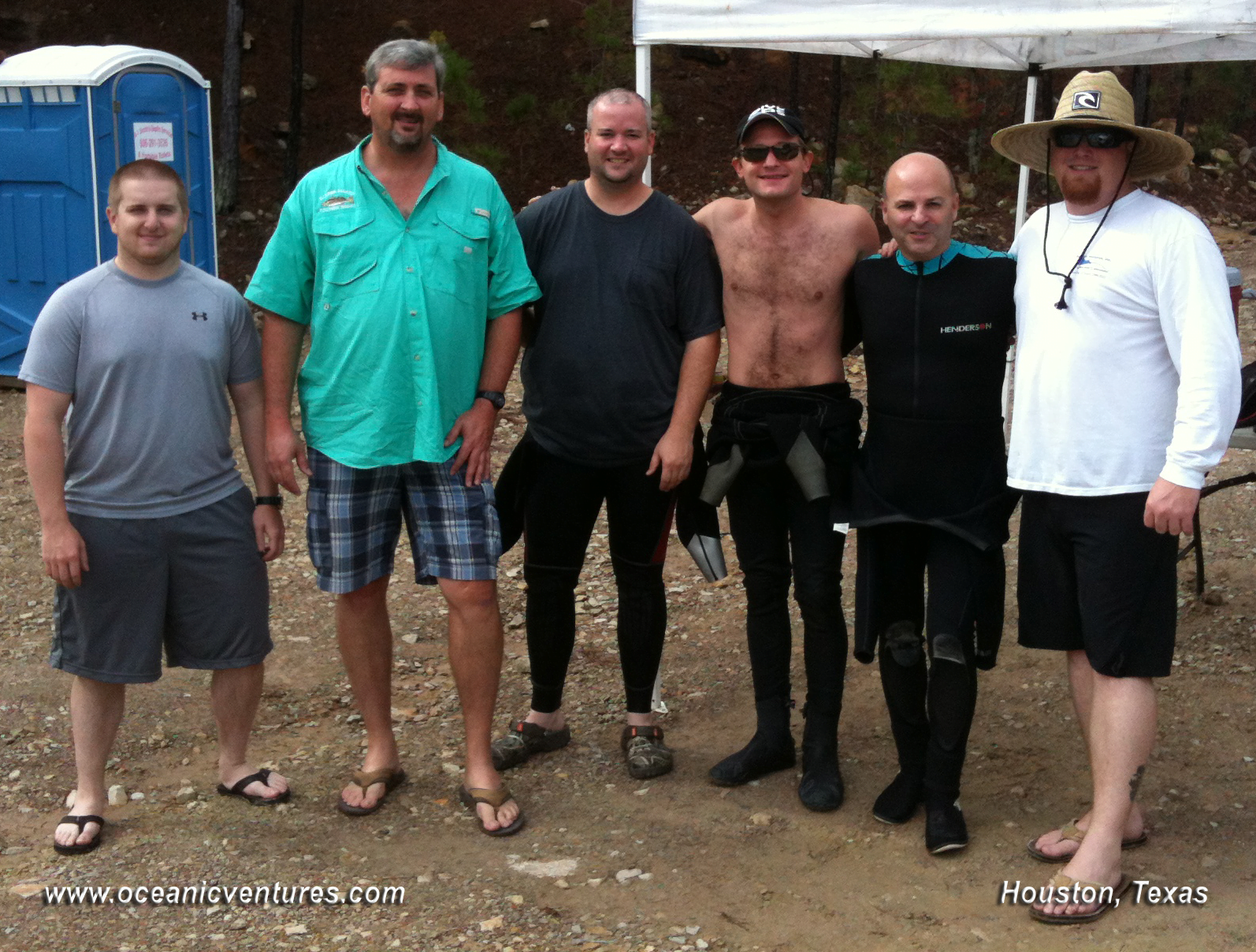
Wow!  We had a great time up at Blue Lagoon yesterday.  Wade proved once again that he is a master at the smoker and grill.  The wild boar and grass fed brisket were awesome and no one went away hungry.  While the weather threatened and delivered on the ride up to Huntsville, the weather at the Lagoon was nice and we had clear skies in the afternoon. 

Practice your buoyancy skills locally…

I am often asked “do you still enjoy diving at Blue Lagoon?”  I think what they actually mean is, that since I have been all over the world what can I possible find to do at Blue Lagoon or any local diving venue for that matter.  What they fail to understand is that local diving affords you the opportunity to practice and maintain your skills.  There is also a social aspect to local diving which I have often described as a barbecue interrupted by diving.

In order to keep the dives interesting you have to go in with a plan or purpose.  In my earlier diving days I used local diving as a way to improve my navigational skills.  It was a challenge to find all of the objects in the lake and return to the beach without surfacing.  These skills have served me well over the years.  To keep these skills sharp, I still practice underwater navigation in the lakes. 

You can use your time underwater at these local venues to improve your buoyancy.  In an earlier article I talked about using the underwater boats as a fixed point of reference and forcing yourself to hover in place.  Another drill is to swim like a slalom skier maintaining neutral buoyancy and proper trim while swimming in and around rocks, trees, stumps, etc. 

Pick objects on the bottom and swim around them, maintaining your trim and placement in the water.  Work on making the turns without using your hands for steering.  As you improve, try making sharper turns and then introduce changes in depth to your drills.  Remember the first rule of scuba, breath continuously.  Some people start concentrating too much on the drills and maintaining neutral buoyancy that they start violating this rule.  Keep breathing but use your breathing to help you achieve these depth changes (unless you are on a rebreather of course). 

As you do these drills, work on not kicking up the bottom.  The tighter your turns, the more you will need to be in a bent leg diving position using “helicopter turns” and small very specific kicks to move through your course.  If you are unfamiliar with these turns or this style of diving, then you might find an Advanced Buoyancy Control class useful. 

The group diving with me this weekend got to experience this type of diving first hand as we wove through the boulder fields around the lake.  Of course they skipped a few turns because they thought I was just doubling back, lost.  Little did they know we were heading back to our entry point 50 more minutes in the future.

Filed Under: Club Aquarius, New Students, Scuba Dive Training, Scuba Diving Activities, Skills, Social Activities Tagged With: BarBQ, buoyancy, local diving, Scuba Dive Training

April 15, 2011 by Eric Keibler

Storage Solutions for Technical Divers – Pockets

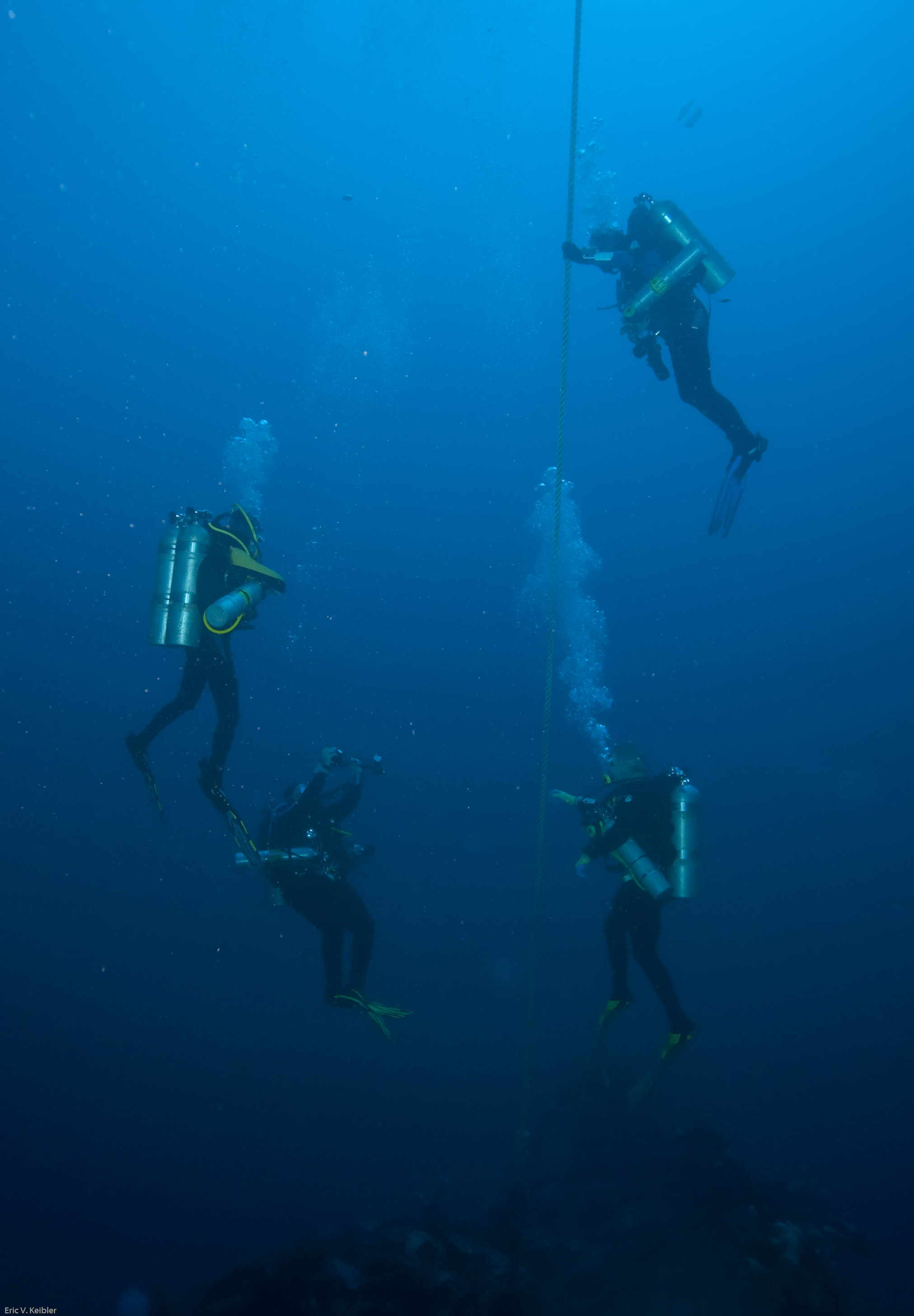
Divers on DecoPart of being a self-sufficient diver is having the necessary redundant life support equipment and safety equipment on with you on a dive.  This does not mean that you carry everything in your dive bag underwater with you, but rather, the items you need to execute the dive you have planned safely with back-up and safety equipment that you believe you will need or may need on the planned dive.  The items a technical diver might carry are:

  • Primary light
  • One or two back-up lights
  • Spare mask
  • Diver’s tool
  • Spare cutting tool (shears, knife, z-knife, etc)
  • Surface marker buoy (SMB)
  • Second SMB
  • Emergency SMB
  • Reel
  • Spool(s)
  • Whistle
  • Lifeline GPS radio
  • Strobes
  • Wet Notes
  • Slate
  • Bailout tables
  • Cable ties
  • Goodie bag
  • Lift Bag
  • Tools

 To safely carry these items underwater, you need to be able to store them out of the way.  We do this using bungee or inner tube on the straps for some things, bungee on the sides of the plate and or under the plate for others.
However, there is only so much room on the plate and straps, so adding pockets will give you more room to stow the equipment you have decided to carry.  There are a number of pocket styles that you can use with your kit.  The most widely used pockets are those that fit on the harness waist strap.  Horizontal pockets are the most traditional and are designed to carry flat items like slates, wet notes, small lights, whistles, etc.  Traditionally, they are not wide or long because of the limited “real estate” on the waist strap.  I am a fan of horizontal pockets but I do not carry too many items in a pocket. 
Another pocket style is a waist pocket with a vertical orientation.  These can either be thin like the horizontal pockets or bellows style pockets which expand to allow for more items to be placed inside.  Again, you still have the problem with limited “real estate” on the waist strap.  Some divers like vertical pockets and on some dives I have added a small spare mask pocket to the waist strap.
Dry suit divers discovered a solution to this lack of room on the waist belt years ago.  They added thigh pockets onto their suits.  You will now see wetsuit divers adding pockets to their suits as well.  Of course, if you have multiple suits you have to glue pockets on each suit.  One other thing to keep in mind is when your suit wears out, you have to cut off the pocket and re-glue it to your new suit. 

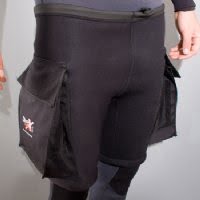
Dive X-Tras Shorts
Dive X-Tras Shorts
Another method of adding pockets to your wetsuit, is to use diving shorts with pockets included.  These shorts are basically neuprene shorts with two bellows pockets attached. 
The major problem with pockets on your thighs or hips is drag.  When these pockets are full, they add about two to four inches to your profile.  But remember, everything is a compromise and if you need the space, they are great to have but there is a trade-off.
Before deciding which system is right for you, you need to decide what items need to fit in the pockets. Do you need to carry flat items like slates and tables only or do you want to keep a spare mask and SMB handy? 
My personal choice is a horizontal pocket on the waist strap with the addition of other pockets as I need them.  While I have pockets on my drysuit, I only use them for small items like spare spools.  Your decision may be different based on your style of diving and how you want to store your equipment for a dive.

Filed Under: Open Circuit, Rebreathers, Scuba Diving Equipment Tagged With: buoyancy, Equipment, Pockets, Storage, Trim

Footer

Contact Us

Oceanic Ventures, Inc
5808 Newcastle Dr.
Houston, TX 77401-3214
USA

Phone: 713-523-DIVE (3483)

eMail: divesafe@oceanicventures.net

Signup for our dive and scuba newsletters

Don’t miss news about the exciting happenings at Oceanic Ventures.


Map and Directions

Socialize

  • Email
  • Facebook

Why People Choose Us

People choose their friends carefully just as they should choose their adventure partners and Scuba Diving Instructors.  Oceanic Ventures is the premier scuba dive shop in Houston, Texas, and the Southwest because of our exceptional service and our sense of adventure.  In talking with our clients and friends, people choose us for a number of reasons such as: Passion – We love what we do and we want to share the beauty and excitement of the underwater world with everyone we meet. Caring- Our clients tell us they love us because we truly care about people and strive to make their scuba diving experiences safe, fun and enjoyable. Professional – Our staff members are the … [Read more …]

Copyright © 2026 all rights reserved Oceanic Ventures, Inc. · Sitemap · Log in