• Skip to primary navigation
  • Skip to main content
  • Skip to footer

Houston's Premier Scuba and Dive Shop Oceanic Ventures Inc.

(713) 523-3483 (dive)
5808 Newcastle Drive
Houston, TX 77401

  • Home
  • Stay Current
    • Our Blog
    • Travel and Events Calendar
    • Club Aquarius Social Club
      • Club Aquarius Social Club Upcoming Events
      • Club Aquarius Social Club – The Past
    • Special Events
    • Local Scuba Diving Events
    • Photography Contest
    • Categorized Blog Posts
  • Equipment
    • Dive Equipment
    • Rebreather Systems
    • Cruise Ship Passengers
    • Repair & Maintenance
    • Air & Mixed Gas Blending
    • Pure Fiji Spa Products
  • Training
    • Become a Scuba Diver
    • Scuba In Your Home or Ours
    • Diving Programs for Young Explorers
    • Recreational Dive Courses
      • Recreational Dive Courses overview
      • The Briar Club Scuba Program
      • West University Scuba Program
      • Houstonian Scuba Program
    • Technical Diving Courses
      • Basics
      • Nitrox
      • Trimix
      • Rebreather
      • Wreck Diving Programs
      • Cave Programs
      • Blending
    • Leadership Dive Courses
  • Travel
    • Travel Escorted Adventures
    • Travel – Other Travel Programs
    • Travel – Custom Travel Adventures
    • Local Scuba Diving Events
    • Technical Travel
    • Scuba Diving Around Texas
    • Travel Insurance
    • Travel Forms
  • Company
    • About Oceanic Ventures
    • Meet Our Team
    • Testimonials
    • Facility Hours
    • Map
    • Oceanic Ventures Foundation
    • Resources & Articles
    • Archive
  • Shop
    • Online Store
    • Cart
    • Checkout
    • My Account
    • Policies regarding Privacy and Purchases
  • Contact

marine life

February 23, 2024 by Scott Singleton

Dive Site Geology Series – Revillagigedo Islands

Technically speaking Isla Socorro is one of the Revillagigedo Islands. However, it is the largest of the four islands that make up this island chain, the others consisting of San Benedicto, Roca Partida, and Clarion (Figure 1). But since ‘Revillagigedo’ is almost unpronounceable in English, most people merely refer to the island chain as the Socorro Islands.

The islands are a popular dive location due to their location as an isolated seamount in the open ocean, thus resulting in it being used by migratory and transient ocean-dwelling creatures. The principal animals passing through this chain are giant mantas, hammerhead sharks, whale sharks, and humpback whales. Resident large animals include silky sharks, Galapagos sharks, whitetip reef sharks, silvertip sharks, and bottlenose dolphins. The primary dive attraction is the giant mantas that cycle through to visit cleaning stations populated by abundant schools of jacks and other fish species. Supposedly the mantas are accustomed to divers and swim overhead so that diver bubbles tickle their undersides, which mimics the action of cleaner fish. All of this provides some pretty exciting dive adventures.

Some of the more inquisitive among us might ask why these remote islands are out in the middle of the deep ocean in the first place. Well, I’m glad you asked that question. Here, in installment 2 of my Dive Site Geology Series, I will explain how and why these islands are here. You can see the first Dive Site Geology article here.

The Socorro/Revillagigedo Hotspot

In a nutshell, the Socorro Islands are a hotspot within a relict mid-ocean spreading ridge. Now, let’s deconstruct that statement. Hotspots are a common feature in the deep ocean and even on land occasionally (Figure 2). They result from a plume of magma rising through the mantle, piercing the crust, and erupting on the earth’s surface (Wikipedia, 2024a). The most common example that Americans are familiar with is the Hawaiian Island chain (Figure 2). Chains such as the Hawaiian Islands do not look stationary because pieces of the earth’s crust are continually moving. This is known as plate tectonics. So as a particular plate moves past a hotspot, a chain of volcanoes will trace the direction and speed of movement of that crustal piece. In our particular case, notice how Clarion Island and Roca Partida are off to the west of San Benedicto and Socorro Islands. This traces the movement of this section of the earth’s crust.

As expected, Clarion Island and Roca Partida do not have recorded eruptions and are in the process of eroding and slowly sinking into the sea from the weight of rock on top of a relatively thin oceanic crust. This is a common occurrence that is well documented in the abundant volcanic island atolls of the southwest Pacific. Roca Partida in particular doesn’t have a very long life ahead of it since it currently only consists of two spires above the surface of the ocean (Figure 3).

The same cannot be said of San Benedicto and Socorro Islands. Mount Evermann on Socorro Island last erupted in 1993 with prior eruptions in 1951, 1905, 1896, and 1848. Vulcanologists think they can trace eruptions back at least to 3090 BC (+/- 500 years) (Wikipedia, 2024b). San Benedicto has two large craters, the southern of which is currently active. Its most recent eruption was in 1952 and was so large that it wiped out all life on the island. It has since been repopulated naturally by species from either the mainland or other islands, that is except for the San Benedicto rock wren which became extinct (there are other species of rock wren on other islands of this chain) (Wikipedia, 2024c).

The East Pacific Rise

The East Pacific Rise (EPR) is a divergent plate tectonic boundary, which means that new ocean crust is being created along its entire length and the crustal plates on either side are moving away (Wikipedia, 2024d) (Figure 4). In the Mexican portion of the EPR, the plate to the west is the Pacific Plate and to the east is the Cocos Plate. The Cocos Plate in turn is being subducted beneath the North American Plate in a feature known as the Middle America Trench (this is known as a ‘convergent’ plate tectonic boundary) due to the fact that the North American Plate is moving westward and will eventually completely consume the Cocos Plate.

Currently the EPR is located some distance to the east of the Socorro Islands (Figure 1). This is because 3.5 million years ago the EPR shifted to its current location, having previously been located directly underneath the Socorro Islands. Today this relict feature is known simply as Mathematicians Ridge. Lateral translation (or jumping) of spreading centers sometimes does occur due to reasons that are not well understood but are likely related to the fact that the oceanic crust is thin and weak in the vicinity of these spreading centers and if the mantle plumes feeding them shift slightly then the spreading center will also shift.

Geology (and dive experience) of the Socorro Islands

Let’s take a tour of what sights a diver might see when visiting these islands on a dive trip. Since the boats all come from Cabo San Lucas, the first island you reach will be San Benedicto. It is common to visit a popular site on the south end of the island called El Canyon (Figure 5). From the sheltered bay there you get a great view of the active volcano called Volcan Barcena (Figure 6). This barren landscape reminds one of being on the moon or some other similarly desolate place. The dives here are on volcanic rubble bottoms that have lots of fish but the primary attraction are the schools of sharks that make VERY close passes to divers (Figure 7) because we are associated with possible food handouts (not because we ARE food).

The Boiler

You might then be treated to a dive site on the other side of the island called The Boiler. Here is where you get your first chance to see giant mantas performing acrobatics above you. The pictures from here often have steep volcanic cliffs as a compositional element, which make for some very dramatic images (Figure 8). I’ve seen some company advertising literature framed on these volcanic walls, and for good reason (Figure 9)

Roco Partida

Next is Roca Partida. The time I went we spent two days diving on the same ‘rock’. That gives you an impression of what we thought of this isolated seamount in the middle of the Pacific. The underwater environment is very similar to The Boiler in that you swim around the seamount waiting for the mantas to show up. While you’re waiting there is lots of fish and sharks to photograph. Here you use the same compositional technique as you did previously by including rock outcrops on the seamount whenever possible (Figure 10). An additional world-famous ‘must-see’ picture from here is of resting white-tip reef sharks (Figure 11) which have the unique ability to lie on the bottom while sleeping, unlike most sharks that cannot breathe unless they are moving.

Socorro

Eventually, you make it to the southernmost island of Socorro, the largest island in the chain. Here the geology is very interesting because you see layered igneous stratigraphy wherever you look (Figure 12). There are two special things you might experience here. First is a night snorkel behind the boat with a whole herd of silky sharks just beneath the surface (they hunt flying fish, so the trick here is not to act like one so they don’t take a bite out of you). The second is a Zodiac ride to the rugged coastline where you go on a tour of the dramatic landscape up close and personal, which as you can imagine is like a kid in a candy store for a geologist (Figure 13).

This all adds up to an experience not to be missed in this lifetime.

Figure 13: The author on a Zodiac tour of the coastline on the northeast side of Socorro Island. The cliff face behind me consists of a layered series of volcanic ash flows interspersed with several basalt flows. There are at least two paleosols (ancient soil layer that was subsequently covered) that are indicated by a thin layer of orange. These represent quiescent periods between volcanic eruptions. (Photo by Eileen Singleton. Used with permission).

References

Buck, W. R., C. Small, and W. B. F. Ryan (2009), Constraints on asthenospheric flow from the depths of oceanic spreading centers: The East Pacific Rise and the Australian-Antarctic Discordance. Geochemistry Geophysics Geosystems, 10, Q09007, doi:10.1029/2009GC002373.

Wikipedia, 2024a: Hotspot (geology) – Wikipedia, accessed in February, 2024

Wikipedia, 2024b: Socorro Island – Wikipedia, accessed in February, 2024

Wikipedia, 2024c: Revillagigedo Islands – Wikipedia, accessed in February, 2024

Wikipedia, 2024c: East Pacific Rise – Wikipedia, accessed in February, 2024

Scott Singleton
Growing up in the wastelands of New Mexico Scott was surrounded by rocks and dirt but it wasn’t until he read Jules Vern’s Journey to the Center of the Earth that he began to see them as exciting! Knowing that the trip that Jules Vern described was somewhat impossible, Scott pursued Geophysics so he could see what was under the surface without leaving his air-conditioned trailer. Receiving his Bachelor of Science from the New Mexico Institute of Mining and Technology was the first step on his journey which continued through the oil fields of Texas, Oklahoma, and his beloved New Mexico. He later climbed higher receiving his Master’s Degree from Texas A&M University. When he isn’t looking for oil, Scott has become one of the leading experts on wood found in the fossil record in Texas. He recruited his entire family to help on these fossil hunting quests spending hours scrabbling over rocks and brush to find clues to the past. Never ones to sit still, the Singletons (Scott, Eileen and Loraine) discovered the world under the surface of the water, and all became scuba divers traveling to the far reaches of the earth photographing and videoing the underwater and surface scenes they encounter. He combines his love of rocks and fossils with his underwater adventures.

Filed Under: Marine Life Tagged With: Geology, marine life, Revillagigedo Islands, Socorro

November 27, 2015 by Eric Keibler

Coral Locations in the Gulf Of Mexico

Gulf Council Publishes Known Coral Locations in Gulf

gulf corals[News release from Kelly Drinnin at the NOAA Marine Sanctuary] Coral reefs are a crucial foundation for many of the marine species living in the Gulf of Mexico. They provide food, shelter, and nursery grounds to a seemingly endless list of fish, shellfish, marine mammals, and other inhabitants. Many of the fish we target as commercial or recreational fishermen spend some part of their life on a reef feeding, growing, or seeking shelter   that s why these habitats are so important.
Unfortunately, coral reefs, their health, and abundance, are threatened by many things including; oil spills, ocean acidification, climate change, and rising ocean temperatures. Advances in technology such as satellite imagery and remote sensors that monitor the ever-changing ocean environment have allowed scientists to better understand the factors threatening coral reefs. Identifying coral communities allows for better management against the many threats posed on corals.
The coral web mapper created by the Gulf Council allows scientists, managers, and the public to explore the different corals in the Gulf of Mexico.
The five categories of corals/organisms that are depicted on the map tool are:

  •   Black Coral
  •   Octocoral
  •   Sea Pen
  •   Soft Coral
  •   Sponge
  •   Stony Coral

Check out the map tool to explore this comprehensive inventory of known coral locations in the Gulf of Mexico. See the map here.
SOURCE: Gulf of Mexico Fishery Management Council

Filed Under: Gulf Diving, Marine Life Tagged With: Coral, gulf of mexico, marine life, Texas

June 27, 2013 by Matthew Watowich

Underwater Scientists Discover Camouflage Techniques

Photo by: Milla-Maria Salo

Scientists at the University of Texas at Austin recently found that some open water fish such as the Lookdown have a way of camouflaging themselves by reflecting polarized light at different angles. Polarization of light occurs when light waves are aligned parallel to one another. Humans are not able to see polarized light well; however, many types of fish can. Most fish use their scales as mirrors to reflect the color and intensity of the light hitting them, which then gets distributed evenly into the water surrounding the fish. This serves to camouflage the fish, and has been thought to be the major way that fish avoid detection. However, some fish have evolved to reflect polarized light such that it matches the majority of light polarization found in the water at a specific time. As the sun moves throughout the sky, the polarized light field is constantly changing, which could make fish vulnerable to predators that can detect polarized light. Lookdown fish use their scales to change angle of the polarized light hitting them, to match the angle of light found most in the water at that time. Scientists are not sure how the lookdowns do this; however, they think that understanding the process could be useful in future technology such as camouflage for boats that travel in open water.

Filed Under: Marine Life Tagged With: marine life

June 24, 2013 by Matthew Watowich

ROV Follows an Elusive Oarfish in the Gulf of Mexico

United States servicemen holding a 23-foot (7.0 m) Giant Oarfish, found washed up on the shore near San Diego, California in 1996 (c) US Navy

Scientists accidentally took a video of the elusive oarfish. This video is the best quality and longest video that has ever been shot of an oarfish in its natural habitat. This video also appears to show a parasitic isopod attached to the fish’s dorsal fin. The mysterious oarfish lives about a mile deep in the ocean and it can grow to be 50ft long. Oarfish look like giant eels, with their head pointing toward the surface and the rest of their body hanging down below. The oarfish is also believed to be the largest bony fish in existence. The one in this video is only eight feet long. This video was shot while researchers were investigating the BP oil spill in the Gulf of Mexico. A camera was sent down to look at the oil pipes and figure out how to fix them. However, the camera stumbled upon this oarfish.

Scientists were surprised to see the oarfish since it has rarely been seen in its habitat. Another reason why oarfish are rarely seen is because they live far offshore. The video of the oarfish can be viewed below. The best pictures of the fish are about 6 minutes into the video.

Filed Under: Marine Life, Underwater Tagged With: marine life, photography, underwater photography

June 18, 2013 by Eric Keibler

Rebreather Scuba Diving – Not Just for Technical Divers


Warning: Undefined array key "file" in /home/oceanicventures/oceanicventures.net/wp-includes/media.php on line 1788
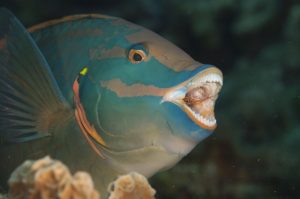
Parrot Fish in Cleaning Station by Robert Hew
Photograph (c) Robert Hew

Imagine just floating and watching a parrot fish or a grouper in a cleaning station. While you are there, you see the little fish swimming in and out of the gills while small shrimp crawl around on the fish; their claws snapping at unseen items and yet content to continue their work. At the same time, there are other fish swimming next to you apparently unaware of your presence or more like unconcerned – except of course for the Damsel fish that keeps swimming around eyeing you like an unwanted visitor to his neighborhood. This entire time, the grouper just sits there waiting for the cleaning process to be complete, never very concerned about your presence. As the grouper swims away you slide your hand into the cleaning station and the shrimp crawl onto your hand for a quick cleaning…

This is a scene experienced by rebreather divers on a regular basis. The fish are less concerned by your presence when the bubbles are eliminated. For underwater photographers, this means that you have new opportunities for exceptional photographs simply because there are more photographic opportunities available to you. Recently, I was talking with Chris Parsons from Nauticam and he was relating a story about one of his favorite local dive sites. He said he gets a lot of strange looks when he jumps in the water with his rebreather… the water depth is only about 20 fsw to 25 fsw. But he said “I just love my rebreather – I can get much closer to the subject.”

One of the things I love to do is swim with a school of fish. Tarpon or snappers will often let me join the school and swim in circles with them. It simply amazes new rebreather divers when I am able to do this. On another dive in Grand Cayman, Dave and I watched mating squid up close and personal. It was a really fun experience (of course I didn’t have the camera then).

A rebreather offers photographers a number of advantages including:

  • ability to get closer to the subject matter,
  • Longer bottom times (i.e. more photographs),
  • Neutral buoyancy even while breathing, and
  • The Marine life behavior is not modified because of the bubbles.
  • And let’s not forget, you look cool in a rebreather!

So, what if you are not a photographer? Can a recreational diver benefit from a rebreather? Remember a rebreather is the great equalizer. A student of mine once commented that the reason he started rebreather diving was so he could stay in the water as long as the better divers. He was a big guy with large lungs. Instead of being the first one back on the boat, he wanted to be the last one on the boat. So, a rebreather enabled him to achieve his goal.

Rebreathers have allowed technical divers to make some incredible dives and participate in some awesome adventures. However, they have also allowed for some not-so-technical divers to achieve their goals and open up new worlds. Some of the photographs taken by rebreather divers rival those made by seasoned professionals and new fish behaviors have been watched and documented.

Rebreathers are here to stay and units like the Pathfinder from Inner Space Systems are making it easier and more affordable for all divers. So what are you waiting for? Come join the revolution before you are left behind!

Eric Keibler
Eric’s Father used to say that Odessa (where Eric grew up) was the hub of water in the state. You can drive 500 miles in any direction and hit water but there was nothing in-between. So it is not surprising that Eric moved to the coast to be nearer to water and trees. An avid diver and sailor, Eric loves being on the water. He serves as the Managing Director for Oceanic Ventures, Houston’s premier Scuba Diving facility where he teaches both recreational and technical diving. He is also an accomplished author, photographer and sailor.

Filed Under: Marine Life, Photography, Rebreather, Rebreathers, Underwater Tagged With: diving, diving skills, marine life, Rebreather, Technical Diving.Rebreather Diving, underwater photography

June 5, 2013 by Matthew Watowich

Scuba Science – Methane Seep Off Coast

NOAA-OER / BOEM / USGS
This lithodid crab is perched on a mussel bed at 1 mile (1.6 kilometers) beneath the surface of the Atlantic Ocean

Scientists just found perhaps the largest methane seep in the world (about one kilometer long). Around this seep they discovered a vast ecosystem that was supported by the constant leak of methane. This seep of methane was found in the western part of the North Atlantic Ocean, and it is only the third one to be found off the coast of the United States. Mussels were found covering the seep of methane. Since these mussels were so deep in the sea, the sun’s energy did not reach them, so they relied on bacteria that used the methane to make energy. Researchers also found sea cucumbers squeezing themselves between the mussels. Around this mound of mussels and sea cucumbers, scientists found shrimp swimming around (most likely eating leftover food). Many strange fish were also found circling this ecosystem. It will be interesting for deep sea divers to collect specimens from this methane ecosystem someday to study them in more detail. Since methane is a gas that contributes to the atmospheric greenhouse effect, understanding how these creatures use methane might help us slow global warming.

Filed Under: Conservation, Marine Life, Uncategorized Tagged With: marine life, Science

  • Page 1
  • Page 2
  • Page 3
  • Go to Next Page »

Footer

Contact Us

Oceanic Ventures, Inc
5808 Newcastle Dr.
Houston, TX 77401-3214
USA

Phone: 713-523-DIVE (3483)

eMail: divesafe@oceanicventures.net

Signup for our dive and scuba newsletters

Don’t miss news about the exciting happenings at Oceanic Ventures.


Map and Directions

What People Say…

Kelley Jones Minor

Appreciate the personal service and care at Oceanic Ventures

Ann really took her time helping to fit my niece with her first mask and fins. We so appreciated the personal attention, and we loved that she was open to talking about dive certification, but she wasn't giving us the hard sell. We live out toward Tomball but would happily drive back here vs. going to a nearby competitor simply for the service.

Jean Jansen

Oceanic Ventures is wonderful

They gave been wonderful all the way. My son started in Scuba Rangers and now we are both certified; thank you for taking care of us!

I loved it

I loved the course!

Holland Geibel

Oceanic Ventures is great with children

They are great with children!

Andrea Lebovitz

Thank you for the memories

I will never forget diving with my teen aged son for the first time. Thank you for the memories.

Dick Long

Eric Keibler is an Ambassador

Eric is a real ambassador for the rebreather world. Thanks for all of your hard work.

Pam Radford

I learned a lot from Oceanic Ventures

I really enjoyed my Technical Diver Course and I learned a lot.

Pam Radford

Oceanic Ventures is the best dive shop

Best Dive Shop I've ever used. I've been diving since 1984 and you will not find more talented staff anywhere else. They are small, family owned and service oriented #1. You get personal service from start to finish from people who actually dive all over the world. I've taken simple to advance courses from them and the trainers are excellent. Dive trips are well organized to unique locations and always fun. This type of depth of knowledge is very difficult to find, especially in Texas.

Nancy Easterbrook
DiveTech Grand Cayman

Oceanic Ventures is a great dive shop

Great dive shop with wonderful instructors to share your passion for the underwater world. They have fun for the whole family from kids diving programs through advanced diving. Checkout their scuba diving vacation to some of the best diving in the world. I really like the Diva dive vacation to Grand Cayman.

Charles Franklin

Oceanic Ventures is the best

I have been to many scuba stores in Houston and this one is by far the best. Most scuba stores have a couple of salespersons who will show you one of the 40 types of fins and 10 types of regulators that they have in stock and immediately try to sell these to you. Most of these same stores really cater only to people just getting certified. Oceanic ventures has a very different business model. While they do have an inventory, it is not as large as other stores. The difference is that they really try to foster a dive community. It works. People come back again and again. Further, unlike many stores, they teach just about everything possible. If you want to teach your child how to snorkel, they teach that. If you want to learn how to dive 350 feet down on a rebreather using helium gas mixes and several additional scuba tanks, they teach that. They teach everything in between. Not many stores do that. Additionally, the staff is very knowledgeable about all the equipment they sell. You will never get an "I don't know about that" type of answer.

Socialize

  • Email
  • Facebook

Why People Choose Us

People choose their friends carefully just as they should choose their adventure partners and Scuba Diving Instructors.  Oceanic Ventures is the premier scuba dive shop in Houston, Texas, and the Southwest because of our exceptional service and our sense of adventure.  In talking with our clients and friends, people choose us for a number of reasons such as: Passion – We love what we do and we want to share the beauty and excitement of the underwater world with everyone we meet. Caring- Our clients tell us they love us because we truly care about people and strive to make their scuba diving experiences safe, fun and enjoyable. Professional – Our staff members are the … [Read more …]

Copyright © 2026 all rights reserved Oceanic Ventures, Inc. · Sitemap · Log in