• Skip to primary navigation
  • Skip to main content
  • Skip to footer

Houston's Premier Scuba and Dive Shop Oceanic Ventures Inc.

(713) 523-3483 (dive)
5808 Newcastle Drive
Houston, TX 77401

  • Home
  • Stay Current
    • Our Blog
    • Travel and Events Calendar
    • Club Aquarius Social Club
      • Club Aquarius Social Club Upcoming Events
      • Club Aquarius Social Club – The Past
    • Special Events
    • Local Scuba Diving Events
    • Photography Contest
    • Categorized Blog Posts
  • Equipment
    • Dive Equipment
    • Rebreather Systems
    • Cruise Ship Passengers
    • Repair & Maintenance
    • Air & Mixed Gas Blending
    • Pure Fiji Spa Products
  • Training
    • Become a Scuba Diver
    • Scuba In Your Home or Ours
    • Diving Programs for Young Explorers
    • Recreational Dive Courses
      • Recreational Dive Courses overview
      • The Briar Club Scuba Program
      • West University Scuba Program
      • Houstonian Scuba Program
    • Technical Diving Courses
      • Basics
      • Nitrox
      • Trimix
      • Rebreather
      • Wreck Diving Programs
      • Cave Programs
      • Blending
    • Leadership Dive Courses
  • Travel
    • Travel Escorted Adventures
    • Travel – Other Travel Programs
    • Travel – Custom Travel Adventures
    • Local Scuba Diving Events
    • Technical Travel
    • Scuba Diving Around Texas
    • Travel Insurance
    • Travel Forms
  • Company
    • About Oceanic Ventures
    • Meet Our Team
    • Testimonials
    • Facility Hours
    • Map
    • Oceanic Ventures Foundation
    • Resources & Articles
    • Archive
  • Shop
    • Online Store
    • Cart
    • Checkout
    • My Account
    • Policies regarding Privacy and Purchases
  • Contact

Cruising

January 2, 2020 by Carl Strange

Diving and Spearfishing Equipment for Cruising Sailors

When you start planning to go cruising you seek advice from professionals, friends, newsletters, articles, and any other resource you can find. You gather all of the information then distill it into a plan, find that you need a 100’ boat to store all the things you think you need, refine the plans, and set out to implement the plans hoping that you can get it done before you are too old to leave.

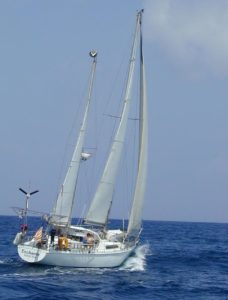
Since a cruising sailboat spends most of its time surrounded by water and one of the major activities that cruising sailors participate in is snorkeling and diving, we decided that we should outfit our boat for these activities. Of course little did my wife Karen know that the simple plan of outfitting a boat for some leisure time activities and some less leisurely charges would get out of hand.

Somewhere along the way, I became a NASDS Open Water Instructor and an IANTD Advanced Nitrox Instructor. I have logged hundreds of dives (much to the displeasure of my trainers I have given up logging them regularly).   My wife and I, and now our three-year-old daughter, have been living on our boat since 1992 and cruising since 1994.  Since Rebecca has entered our lives, Karen and I rarely dive together. Of course, even before Rebecca, I had a higher need for bottom time so much of my diving was and still is solo diving. There are times I dive with friends from other boats, but the reality of the situation is many cruisers learn to solo dive. [Even if you are trained and equipped as a “Solo Diver,” Oceanic Ventures does not advocate solo diving.  We have always felt divers are safer in the water if they have a dive buddy or partner.  This means you should find fellow cruisers in your anchorages and go diving with them.  Solo diving means you are placing yourself at a much higher risk.]

In addition to scuba diving, I also enjoy spearfishing while snorkeling and can happily spend hours swimming around a reef watching fish behavior and hunting for dinner. Cruisers have the advantage of living in some of the most beautiful waters of the world and, on Enchante’, we’re in the water almost every day.

My recommendations for scuba diving and snorkeling are based on my experiences as a cruiser and are for what I’ll call independent boat diving. By this, I mean diving or hunting out on a reef far from the support of a dive shop.  You should know I don’t sell equipment.  Basically, this is information I wish I’d had when we were preparing our boat for cruising.  There are numerous manufacturers of scuba diving and snorkeling equipment and many of their product offerings will fill the bill; so, with the exception of one or two cases, I won’t recommend specific manufacturers.
Oceanic Ventures Your door to adventure…

Your first priority should be to establish a relationship with a good dive shop.  Tell them what your plans are, listen to their recommendations, and decide if they seem interested in your adventure and are capable of providing you with long-range support for the next several years. Before we left Texas for the Caribbean we discovered Oceanic Ventures in Houston. After several years, we’ve become close friends with Ann and Eric, and don’t hesitate to recommend them to other cruisers.  They have personally been involved in helping to outfit cruising boats and reliably provide far-flung support to cruisers.  Since they own a sailboat, they have a good understanding of what you’re trying to accomplish.  It probably bears repeating that I don’t receive any commission from their shop.  In fact, they’re almost certainly going to disagree with some of my recommendations.  You can trust them to do as good a job for you as they have for us.

Presumably, you’re still enjoying civilization as you prepare to cruise and have, no doubt, considered buying equipment over the Internet. While you can probably find cheaper prices than through a dive shop, you need to be cautious.  Unless you know an awful lot about dive equipment, you can easily end up with junk.  You will also find warranty support to be an issue since reputable manufacturers sell through their dealers and expect those dealers to honor their regional boundaries.  You won’t have the benefit of discussing equipment choices or the chance to ensure a proper fit when you shop over the net.   It’s also very important to make a couple of trips to the dive shop’s pool to make sure everything is working properly, that you understand how to operate your new gear and that you’re comfortable with the fit.  Your first dive in new equipment shouldn’t start with a back roll off a moored dinghy looking down at the face of a wall that plunges several hundred feet.

It’s important to realize that once you’ve dealt with a store you’re considered a customer and can expect support from them wherever your travels take you.  A good shop will know how to ship equipment to a “yacht in transit”.  Perhaps, should you be anchored at a popular dive destination, they might even be able to arrange for a group of vacationing divers to bring equipment to you at considerable savings over FedEx.

Don’t even think about buying equipment from such sources as garage sales.  You need new, reliable equipment since you’re going to be venturing far from the services of a repair technician.

Okay, enough of that!  Let’s get onto the equipment list.

Air Delivery System (a.k.a. a Regulator System)
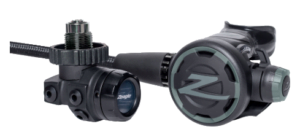
A typical cruising, sport diver has a couple of special requirements for an air delivery system that doesn’t involve turbulent airflow, external adjustment of the 2nd stage, or the latest and greatest bells and whistles.  Your requirements are for a rugged system that requires a minimum of tiny little parts when it’s rebuilt.

Both your dive shop and the equipment manufacturer recommend you rinse your regulator thoroughly and have it serviced annually.  They’re talking about equipment used once or twice a year on dive vacations. Out cruising, you’ll put more dives on your system in a year than most divers do during the entire time they own it.  Water is precious out here so you’re going to skimp when rinsing gear.  And it may be two or more years before you’re around a dive resort with a service technician you’ll trust.  In this environment, reliability is more important than how slick your system looks or slight differences in how it breathes at depth.  I’m sure you’ll find the top manufacturers all make very reliable equipment and you don’t have to buy their top-of-the-line model.  Stick with a quality brand and be sure to ask how complicated the rebuild is.  You might also consider a system with a “sealed 1st stage” to reduce exposure to salt water.

Buoyancy Compensators

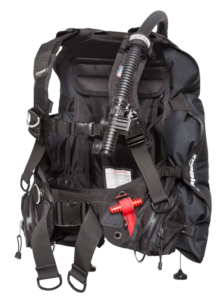
I really don’t have much to say about BCs. I’ve been partial to integrated weight systems because I find them more comfortable and a lot easier to dump in an emergency.  You might also consider a couple of additional pockets and “d-rings” since some of your diving is going to be doing simple boat maintenance, such as replacing zinc’s and cleaning barnacles off the prop, and you’ll appreciate a place to put tools and parts.
Computers

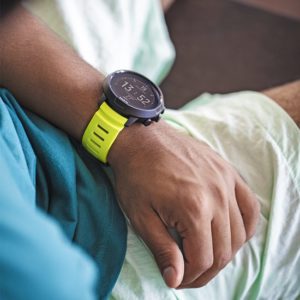
I can make both sides of the argument about dive computers for cruising divers.  I’ll let you know right up front that I wear a computer. I justified the purchase because of my technical diving.  I appreciate the confirmation and back up to my manual dive planning when I’m doing planned decompression stop diving.  Having justified spending the money, I must say I enjoy the computer immensely on sports dives.

First the ” I’ve gotta have one” argument.  When you’re diving completely out of contact with a decompression chamber or any treatment facility, you simply cannot afford to ignore dive planning.  If you manage to get a DCS hit (okay, bent) out in the middle of nowhere, you’ve got a serious and painful problem.  Be honest with yourself.  Are you going to plan every dive to ensure you’re within safe limits?  Do you even remember how to work with the tables? A computer, assuming you know how to read it, automates the planning process and keeps you safe.

Here’s another argument for diving with a computer.  Being an instructor, I taught dive table calculations till I could do them in my sleep.  I even had the “no decompression time limit” memorized for the most common depths.  When cruising, I typically have a surface interval of around 24 hours; so repetitive dive planning doesn’t ordinarily enter the picture.  Still, my computer is a great benefit during a typical dive, and here’s why.  The tables require you to dive a square profile – descend to the planned depth, spend the bottom time, and head to the surface making your shallow safety stop.  All very rigid diving and not at all like the way you’re going to actually dive.  A typical dive goes more like – drop down to 60 feet for a 20-minute tour of the wall, slowly work back up looking at coral, spend a few minutes enjoying an eel at 45 feet, turn around a couple of times trying to find your dive buddy and join her back at 50 feet, swim along for another 10 minutes or so until you decide to turn and head back to your dinghy, swim 20 minutes at 40 feet to get back to the mooring line.  Your dive plan has to say you spend something like 60 minutes at 60 feet and are close to a decompression limit.  A computer would have followed your actual profile and let you know you have several minutes to lay in the sand at 20 feet watching a seahorse that you noticed.


Here’s the “don’t need one” side.  A vacationing diver has one goal – cram as many dives into a single week in paradise as possible.  The only way to max out the number of dives is to use a computer.  You’d go nuts trying to work with a table and the dive boat isn’t necessarily going to take you to a suitable spot for your planned dive.  On the other hand, as a cruising diver, you can take all the time you need to see a location.  More than one dive a day is fairly tiring and why bother? Plan your dive for the heat of the early afternoon and enjoy the best lighting conditions while you’re cooling off at 60 feet.  Stick with a 24-hour surface interval, stay well within the table limits, don’t stop to look at any seahorses if you’ve reached your planned bottom time and you should be just fine.

This is a personal decision based on discipline.  I’m delighted to have converted to using a computer.  I’m a safer diver and enjoy more flexible profiles without worry.  I must stress that some of the locations you’ll be enjoying are several days’ travel from a chamber or treatment center and a computer could be considered a very good insurance policy.

Mask & Snorkel
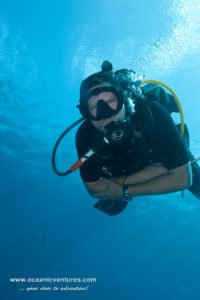
Fiver with High Quality Fitted Diving Mask

You absolutely must have a quality dive mask with tempered glass and a Silicone skirt.  I’m not fanatical about caring for my mask.  It gets rinsed but it lives in the cockpit were it receives occasional damaging sun.  Maybe once a year I get around to spraying the skirt and strap with silicone.  It’s six years old, has spent thousands of hours in both the ocean and that nasty chlorinated pool water, and it still works like a charm.  I’ve calculated the cost at fractions of a penny per hour.  Don’t even think about the cost of your mask or other snorkeling equipment.  Considering how long it lasts it’s almost free.

Try on several masks at the dive shop, doing the “inhale to see if it sticks to your face” test to ensure they fit.  If the shop isn’t very interested in finding you the right mask, you’re not dealing with the right folks. Ask if you can take two or three mask to the pool to check fit and comfort.  Once you discover the delights of exploring a shallow reef, you’re likely to spend a couple of hours or more snorkeling. If your mask is a good fit, you won’t notice it’s there.  If it doesn’t fit, it will drive you nuts.

If you are like a lot of people and perfect eyesight is something others have; you can have the lenses in the mask adjusted for your eyesight. This is accomplished either by replacing the lenses with corrected ones or having lenses “bonded” to the mask. Your local dive shop can assist you with this process.
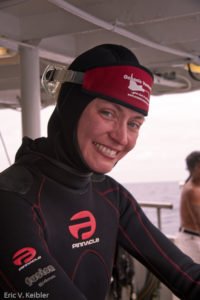
Diver with Soft Mask Strap

Add a “Slap Strap” or similar product to your mask.  This is a wide, neoprene cover for the strap.  It increases comfort and stops the hair-pulling of the normal silicon strap.  At $ 15 or so, it’s well worth the money.

Also, buy a dry box for your mask.   When you’re not going to be swimming every day, like those miserable times in the boat yard, your equipment will go into a locker.  The mask will perversely work its way to the bottom of the locker and will be damaged by the weight of everything else if not protected by a stiff box.

There really isn’t too much to say about snorkels. A bent tube gives you a bit more clearance at the surface, a large diameter makes for easier breathing and flex tubing near the mouthpiece adds to comfort.  For complete comfort, consider adding one of those “boil and bite” orthodontic mouthpieces.  These are marketed as regulator mouthpieces but you’re going to be breathing through your snorkel a lot more than your regulator.  A bright neon tip helps your buddies find you should you swim with others.

Booties & Fins
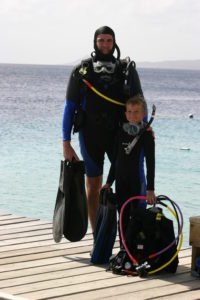
Avoid those silly fins that fits like a shoe – the back rips or your foot slips out and your fin is gone.  Stick with proper booties and a sturdy set of fins.  You’re going to be standing in the dinghy while traveling to and from your dive or hunting site.  That’s right, standing up, legs spread, hanging on to the painter with one hand, steering with the tiller extension and roaring over the water with your 15hp at full throttle.  Standing gets you out of the constant spray and gives you enough height to see reefs in the distance and avoid coral heads in the shallows.  You’ll appreciate the grip of your booties as you fly along. Try on a few pairs of booties to insure a good fit.

For years I wore my nice stiff fins, a pair of “Blades”, for both diving and snorkeling.  They started out a nice neon yellow/green so students could find me underwater.  After years of service, they were bleached almost white by the sun and still going strong.  Recently, I added a pair of fins specifically designed for free diving and was amazed by the difference.  These fins are longer, narrower and more flexible than SCUBA fins.  They don’t have the power to move your bulky, high drag SCUBA equipment through the water, but they will give you much greater speed and ease of movement in your streamlined snorkeling configuration.

You can certainly get by with one set of fins, provided they are designed for SCUBA.  Buy a good pair and ignore the price. Like your mask the cost will work out to a fraction of a penny per hour.
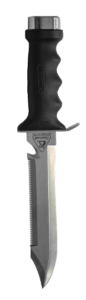
Knife

Go ahead and buy one of those little dive tools with a blunt tip and permanently attach it to your BC for SCUBA diving.  Then buy a six-inch or so, pointed dive knife to do double duty as a boat knife in the cockpit and for spearfishing.  Figure out a place to keep it near the companionway and, while your at it, put a fid/shackle tool and a Leatherman tool in the same spot.  If you get involved in hunting, you’ll eventually want to “finish off” a fish or do some other gruesome task and a blunt dive tool just won’t do.

Gloves

I’ll disagree with the dive shop here and recommend you head to Home Depot’s gardening center.  Buy several pair of cotton gloves with the black bumps all over the palm and fingers.  These gloves hold up very well in salt water.  You’ll use them while working under the boat, handling the anchor chain and hunting.  These won’t offer any protection from cold water, but the water in the tropics stays around 80 degrees. You want inexpensive, durable gloves.
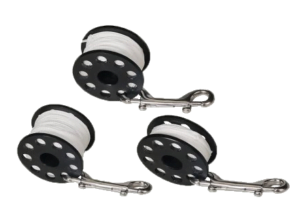
Spools & Reels Come in different Lengths

Reels and Spools

A small reel of line is indispensable for a cruising diver. Buy one, put a clip on the end of the line and store it with your dive equipment or stick it in the pocket of your BC. I can guarantee you’re going to drop something over the side and a carefully planned, circular search pattern is the only way you’ll find it.  The reel will more than pay for itself the first time you use it and that’s probably going to happen sooner than you expect.
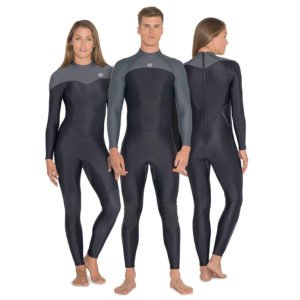
Thermocline PolarFleece Suits Offer a Comprimise From Traditional Wetsuits

Skins and Wetsuits

I don’t get cold readily in water.  Karen gets chilled quickly.  You need to learn how you’re body type responds to diving.  Keeping in mind tropic waters run around 80 Fahrenheit, I use a 3/5-mil wetsuit for long night dives and lightweight dive skins during the day.  You’ll appreciate the wetsuit after a night dive when you have a dinghy ride in the chilly evening air.  The diveskins are for protection from the sun more than anything else.  When you’re snorkeling, your back and legs are almost constantly exposed to the sun.  You don’t realize the burn is developing because the water keeps your skin nice and cool.  Always wear a diveskin when you’re snorkeling.  You’ll wear them out and they don’t take up much room so take a couple of spares.  I have five skins onboard right now – buying “in bulk” will sometimes get you a bargain.
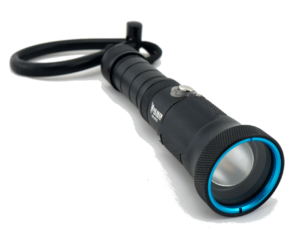
Dive Lights

We carry two SL-4s and two SL-6s.  They serve double duty as boat lights and dive lights.  If they’ll take submersion to a couple hundred feet, they’ll certainly do well onboard.  They’re well-sealed, bright, and have no rusting parts.  We would have all SL-6s but we purchased the SL-4s before we realized just how general-purpose these lights were.

Since Carl wrote this article, technology has changed and one of the biggest shifts has been in lighting technology and battery technology.  The new lights are brighter, heat up less, and last longer.  One example of this new technology is the Kraken NR900Z which has 900 lumins and lasts for over three hours on a single battery charge (and yes it uses rechargeable batteries).  These can be used above water as well as below water.  There are other examples of lights that work for divers as well as above the water and your local dive shop can help you select the right model for your application.
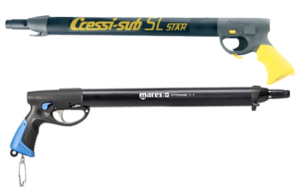
Pneumatic Spear Guns

Speargun

Forget Hawaiian slings and rubber band guns and buy yourself a Mares Cyrano pneumatic speargun or one of the smaller models.  With a sling, you have to be close enough to almost poke the fish.  Rubber band guns are a pain to load, require constant maintenance, hurt when they break, and aren’t nearly as powerful as a pneumatic gun.  The Mares is well designed, powerful and only requires rinsing. I’ve used mine for years and it has never required any special attention.  Just store with the tip town to keep the O-rings lubed.
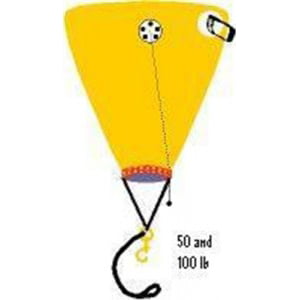
Open Bottom Lift Bag

Lift Bag

I would call this a highly optional piece of equipment, but when you need one, coming up with an improvisation is pretty difficult.  When I was inexperienced at both cruising and diving, I put myself and two other divers in a fairly dangerous situation.  We arrived at the anchorage in Bonaire just before nightfall.  Our engine overheated coming into the harbor so we sailed into the anchorage and weren’t able to back down and set the anchor.  It was also getting dark and I didn’t bother to dive on the anchor to ensure it was set.

This collection of problems, errors and the very poor holding in Bonaire led to us dragging during the night.  In the morning we discovered our 75-pound CQR had slid along the 20-foot bottom of the anchorage, fallen down the vertical wall, and was hung on some coral about 50 feet down.  A hundred feet of chain was tangled around pieces of coral adding to the problem. Fortunately, I suppose, the anchorage is off the main town in Bonaire and has been in pretty bad conditions for years.  Diving here you’ll find an interesting collection of auto tires, batteries, engine blocks and assorted trash contributed by the town.   So we didn’t feel too badly about being snagged on the wall, but we did need to clean up the problem before doing too much damage.

We started by putting our second anchor, a large Bruce, into our dinghy and carrying it to the anchorage.  Then the three divers put on their equipment and started to job of retrieving the heavy anchor and all that chain.  Here’s where we did something stupid that could have easily gotten one of us hurt.  To lift sections of chain and the anchor the three of us would get a good grip, fully inflate our BCs, and start swimming up the wall.  When the section of chain was untangled and stretched as far as we could get it, we would deflate, choose another section and repeat the process.  Obviously, when inflating, we were hanging on with one hand.  Should someone have lost their grip, they would have shot immediately to the surface and, to their surprise, would have been unlikely to remember to exhale forcefully on the way up. A rapid ascent from that depth could have easily led to an embolism and a bout of decompression illness.

Now we carry a 100-pound capacity lift bag.  It folds tightly, requires little room, and makes retrieving or moving heavy objects a simple task. Like all new pieces of dive equipment, ask for some instruction on the use of a lift bag.  Join your dive shop on an open water outing and get some practice – there are techniques to learn.

Scuba Diving Reference Library
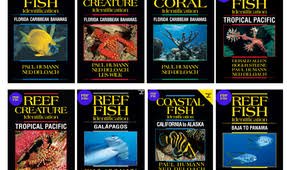
The Bible for fish identification is Paul Humann’s three book series – Reef Fish, Reef Coral and Reef Creatures Identification.  There is a companion CD that can make learning the fish more fun than flipping through the pages of the book.

We also have found the little book “Divers and Snorkelers Guide to the Fishes and Sea Life” by Joseph Stokes to be very useful.  In fact, if I just wanted to learn the names of the fishes, I would choose this simple book over the more technical Humann series.
Another book that teaches while you are having fun is “Marine Biology Coloring Book” by Thomas Niesen.  You can easily fritter away a rainy day working with this book and a box of colored pencils.

“Watching Fishes – Understanding Coral Reef Fish Behavior” is a fascinating book.  This book discusses why reef fish are more colorful than their open-water counterparts, why a two-ounce damselfish has the nerve to attack a diver when a 200-pound grouper won’t, what causes fish to form schools, and so forth.  This book really sparked my interest and appreciation of fish that keeps me continually interested in diving.
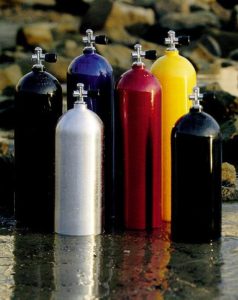
Diving Cylinders

Not a whole lot to say here.  We carry four, 80 cubic foot, aluminum cylinders.  We also carry a small, 30 cubic foot “deco bottle”.  Dive shops are usually happy to fill your cylinders for you and will normally give you a price break if you open an account and pay for ten or so fills in advance.  The deco bottle comes in handy for making a quick “slap on the regulator and snorkeling gear” dive to inspect the bottom, untangle a line from the prop, and so forth.  It’s also an excellent backup air supply for a solo diver.  I’m not a big fan of the widely advertised Spare Air and a backup supply.  If you aren’t into technical diving and don’t know how to calculate the capacity of cylinders, ask one of the instructors at your dive shop how many breaths you can take on a Spare Air at 60 feet.  Compare that answer to the capacity and usefulness of a 30 cubic-foot cylinder with its normal valve.  Your dive shop can show you how to rig the small cylinder so it’s easily carried.  And yes, this is another opportunity to learn something in the pool.

Spare Parts

  • Mouthpieces for regulator and snorkel
  • Strap for mask
  • Backup mask, fins and snorkel – yours will wear out eventually
  • Complete strap assembly for fins
  • Low pressure hose
  • High pressure hose
  • Extra spear, a couple of tips and an O-ring set for the speargun

Gasoline Powered Breathing Air Compressor

Compressor

We recently returned to the States for a prolonged visit with family and to outfit Enchante’ for a cruise to the Pacific.  During the upgrades, we purchased a gasoline-driven compressor and built a deck box to store it in.  Since we spend considerable time in isolated areas far from dive shops and their compressors, we love the ability to fill our own cylinders.  The noise can be a bother to your neighbors in the anchorage, but we don’t anchor that close to other boats anyway.

Should you decide to go this far, I strongly suggest you contact Eric at Oceanic Ventures and let him help you configure your compressor.  He has the contacts in the industry to configure the compressor properly for more than occasional use.  You will also want some training on using the compressor before you leave.
 

Conclusion
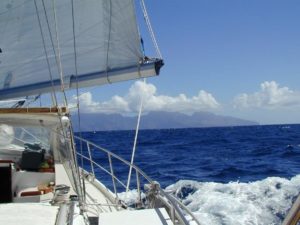

So that’s it, my discourse on outfitting a cruising sailboat for diving and snorkeling. The best advice I can give you is to take your time and find good quality equipment that works and can be serviced anywhere in the world. And don’t forget the pool practice and training. Your investment upfront will pay off as you venture out into the beauty that awaits cruising sailors.
 

Carl Strange Avatar
Carl and his wife Karen set-off on a journey around the world on-board their sailboat S/V Enchante. Along the way, they had a lot of adventures and in Aruba, a new member of their crew was born. Now a family of three with Rebecca’s birth, they sailed the Caribbean and the Pacific experiencing life along the way.

Filed Under: Sailing, Travel Tagged With: Cruising, Diving from a sailboat, Enchante, Equipment, S/V Enchante, Sailing, Spearfishing

October 31, 2019 by Carl Strange

The Tuamotus (#10)

20 July

Your Wasabe Wings sounds like something we’ll try when we reach somewhere with propane refills. We are being fairly conservative with our supply of propane since we don’t have French Poly. adaptors and don’t want to pay their outrageous prices. As a side note, it might be interesting to see just how much money the French government doles out to each individual islander. We balk at $3 for a small box of cookies – the locals walk out with handfuls. Few of them seem to have jobs – store clerks, post office employees, dump truck drivers. Lots of folks sitting, swimming, drinking, and generally enjoying life [Carl is talking about the locals and not the cruisers visiting the island].

Got to go. Another boat is due for smoked salmon and champagne in a few minutes. A celebration and thanks for the work they did to help us with the repairs. I need to be slicing limes and onions instead of typing.

8 August

We’re still in the Tuamotus anchored in tiny little Tahenea. This is a large lagoon with no distracting village and only one other boat to play with. The numerous grouper make it simple to get dinner so I should have plenty of time to write. We’ll linger here for a bit over a week then make the 250 or so miles to Tahiti. Looking forward to fresh vegetables and fruit after a steady diet of coconuts We are also looking forward to the big dance festival that happens next month.

12 August

I loaned one of my Mares Cyrano spear guns to a guy we’ve been buddy-boating with for several weeks. He is just learning to snorkel and hunt and is having a great time on the reefs. We split up for a few days to enjoy our individual islands at the lovely, unpopulated, Tahanea atoll in the Tuamotus. Today he told me, with a hang-dog expression, he had lost a spear. He’s especially embarrassed since he was doing something stupid – shooting a small shark off the back of his boat. Apparently, he hit the thing, it snapped at the line, bit it in two, and swam off with an embedded spear. He’s amazed he did something so silly since he couldn’t have dealt with the shark on board and had no idea what he was going to do with it anyway. Reminds me of hunting sparrows with my BB gun! Anyway, he has offered to buy me a new spear, once I find out the price for one.

20 August

Typical backyard in Ua-Pou
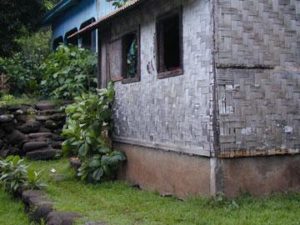
Hand-Woven Wall

We have enjoyed walking around the island. The people here all seemed to love landscaping with flowers and plants. The whole village was lovely. We passed out several packets of Impatient and Zinnia seeds to the delight of the recipients. Got gifts of bananas, pamplemouse and limes in exchange.

23 August

Throughout the islands, we found some huts with walls woven out of coconut palms. However, they are not really used in regular housing anymore but they make useful sheds and snack bar walls. We saw a few women and older children weaving mat fronds in an assembly fashion. The kids split the fronds and lay them out. The women smoked hand-rolled cigarettes, talked, and joked as they wove. It only took a few minutes to make each section. A useful process to know when you need a quick bit of shade or something clean to sit on around a beach fire. We still need a bit of practice to make them well.

24 August

Try to find two delightful stories – the creation myth of the Marquesas and the revenge of Mataheuna. You’ll know you’ve found the right myth if the story is about a man and a woman in a tropical setting. The woman asks the man to build her a house. He asks the gods for help and the process starts. The name of each island translates into part of the structure. I only remember Ua Pou as being the two beams supporting the structure.
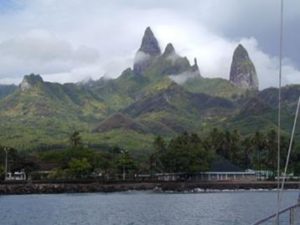
The Mighty Spire Mataheuna was a young rock with a spire from one of the other Marquesan islands that traveled through the island groups smashing the lesser spires to the ground. He swore revenge, grew strong, smote all the other spires, and is regarded as the mightiest to this day.
These stores were told to us by a delightful young man who runs a tiny museum on Ua Pou. Many people have donated items for him to present. He changes his exhibits every three months or so and passes the stories and traditions along especially to the school children. He’s a great storyteller and we really enjoyed our time with him.

26 August

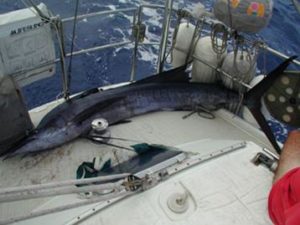
We left the peaceful harbors of Tuamotus to continue our explorations. One day out we hooked a 9-foot marlin. That is it measured 9 feet from head to tail and we didn’t include the spear shaped snout. Getting it onboard was a two-hour struggle.
I broke my favorite cleaver trying to cut steaks. Then I switched to a hack saw to cut through the spine but soon gave up on that. Finally, we spent a couple of more hours cutting it into fillets. We gave lots of fish away and I can’t count the number of ways we prepared it. Next time we’ll release anything over four feet or so.
 

Carl Strange Avatar
Carl and his wife Karen set-off on a journey around the world on-board their sailboat S/V Enchante. Along the way, they had a lot of adventures and in Aruba, a new member of their crew was born. Now a family of three with Rebecca’s birth, they sailed the Caribbean and the Pacific experiencing life along the way.

Filed Under: Pacific, Sailing, Travel Tagged With: Cruising, Enchante, S/V Enchante, Sailing, The Marquesas

October 24, 2019 by Carl Strange

"Bang" Repairs in the Tuamotus (#9)

30 June

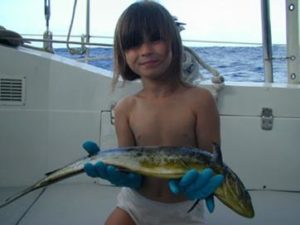
Rebecca with her catch – a Mahi Mahi

Okay, okay, okay! I just checked the running “From the Log of…” and it has been a while since our last update. Just for your information, we arrived safely in Fatu Hiva and stayed for a few days. The morning winds, that blasted down the mountains, drove us away quicker than we would have liked. Since then we’ve checked in at Atuana, Hiva Oa, and spent a few nights anchored at isolated spots on Hiva Oa and Tahuata. We’re traveling in loose company with a British couple on S/V Hannakin.

The general plan in to be drift diving in the pass of Tuamotu island in a few days.

The locals have been very friendly in the small, outlying villages. The one larger town we visited wasn’t so gracious. Everyone has fruit growing in their front yards and we’ve had no trouble trading for limes, bananas, coconuts, and Pamplemousse. French baguettes are available, hot and fresh, at $.40 per loaf. Sadly, tomatoes, potatoes, cucumbers, onions, and other vegetables are harder to come by. The locals have a few farms up in the valleys but we haven’t stayed in one place long enough to work out a trade.

The man on S/V Hannakin was PADI certified in ’92 and hasn’t been diving since. He asked for a class so we’ll work our way through a quick refresher course and head for blue water.

I have managed my first dive in the South Pacific. A short visit to a pretty reef at 40 feet then an hour of scrubbing the bottom. Our brand new Jotun paint isn’t working well at all. Our paint is black. S/V Hannakin has been in the same conditions with Red Jotun and looks great. Our theory is so much pigment is added to make the paint black that the copper/tin additives end up very diluted.

We’re still moving frequently to get to the isolation of the Tuamotus in fairly short order. Still, I’ll make time to sit down and write another installment of “From the Log…”.

19 July

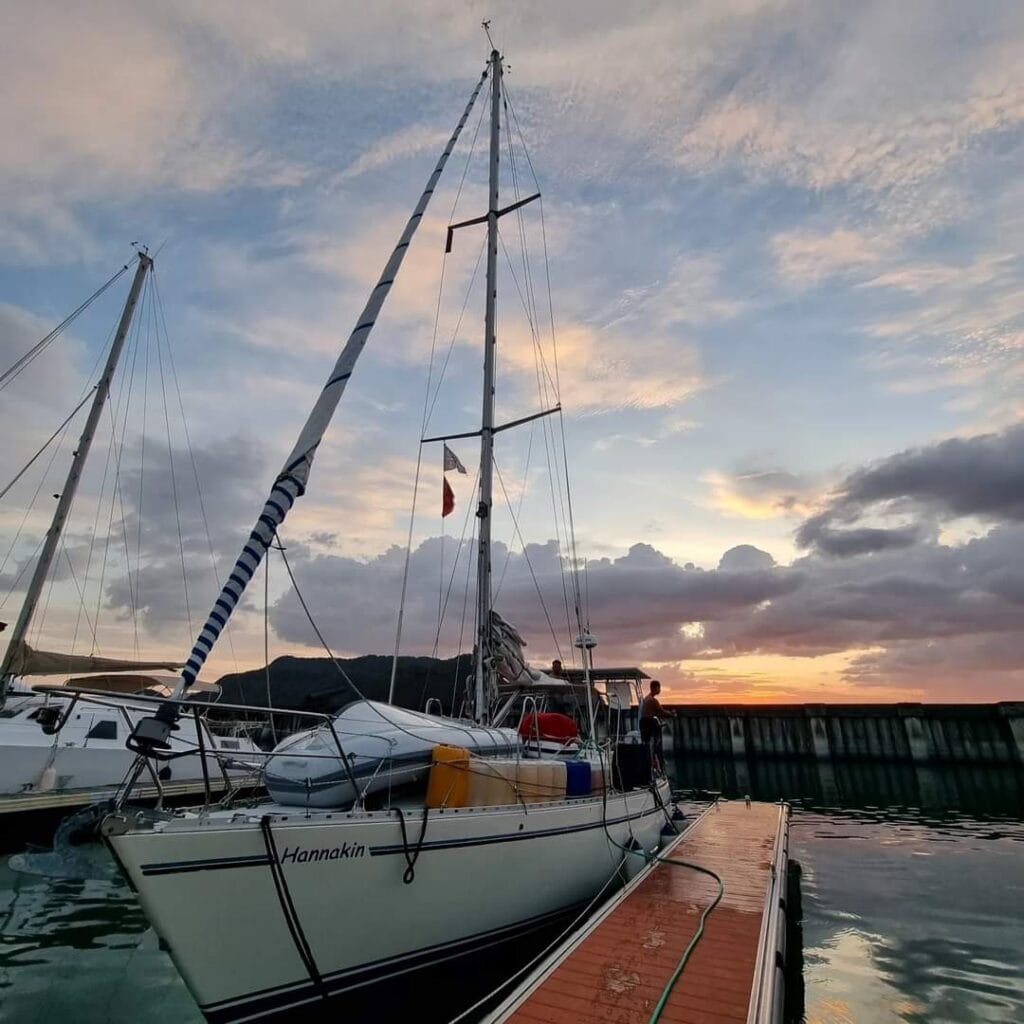
S/V Hannakin in a marina

I’m well aware that you haven’t received any updates lately but I have a much better excuse than “the dog ate it”.
Sailing south from Marquesas to Tuamotus we encountered a squall with 30-35 knots of wind. The seas and winds had been building slowly and we were a little slow on reducing sail. We had the headsail about halfway rolled up when we discovered a crack in the only swage fitting on the boat. I’m getting a little ahead of the story – we didn’t actually see the crack until a few days after the squall.

I was hauling away on the furling line and Karen was handling the sheets when there was a loud “Bang” forward. It took several seconds to realize the headsail was completely missing. The top head stay fitting had exploded and the partially rolled up headsail, roller furling system, and several yards of lines had gone over the side. We managed to drop the mainsail before wind pressure took the masts over the side as well. It took a couple of hours of hard work in squally weather to get the failed rigging back on deck and strapped down. Six miles of motoring into the squall took us to a protected bay in Oa Pou where we met our friends on S/V Hannakin.

We spent a couple of days licking our wounds and figuring out how to make temporary repairs. There was no chance of support from the local village since some of the women still knew how to make rope by weaving shredded coconut husks. After several days of exhausting repairs, we enjoyed sea trials on our new rig. Friday we’re stocking up with whatever fresh produce we can find in the local village and Saturday we’re heading towards the Tuamotus. More permanent repairs will be made in Tahiti and we’ll be replacing a lot of bent rigging in New Zealand. But at least we’re a sailboat again.
After the three or four-day sail to Tuamotus, we’ll rest for a day or two. Then I’ll sit down and catch up on our stories from the Marquesas.

All’s well onboard – sorta.

Carl Strange Avatar
Carl and his wife Karen set-off on a journey around the world on-board their sailboat S/V Enchante. Along the way, they had a lot of adventures and in Aruba, a new member of their crew was born. Now a family of three with Rebecca’s birth, they sailed the Caribbean and the Pacific experiencing life along the way.

Filed Under: Pacific, Sailing, Travel Tagged With: Cruising, Enchante, S/V Enchante, Sailing, The Marquesas, The Strange Chronicles

October 17, 2019 by Carl Strange

Hiva Oa in The Marquesas (#8)

23 June Taahuku Bay, Hiva Oa, Marquesas 9 48 S / 139 02 W

We motored the seven miles from Tahuata to Hiva Oa and anchored in Taahuku Bay. We are here to visit the town of Atuona and legally check into French Polynesia. The town has the necessary gendarme and bank so we can get our paperwork in order and pay our fees. (“Yes sir we came straight from the Galapagos.” “Oh no sir, we didn’t stop anywhere else in the Marquesas before coming to your office!”). We are required to deposit a bond to ensure there are sufficient funds to get us out of the country should the officials decide to do so. These islands have had long years of experience with cruisers arriving, losing their boat on a reef or in a cyclone or perhaps a crew member jumping ship, and the governments are tired of paying the expense to fly them home. Requiring a bond is their simple solution. Our funds will be returned when we check out of French Polynesia in a few months. Meanwhile, we lose a bit of interest and are charged on the currency exchanges – dollars converted to PolyFrancs to pay the bond – refunded in PolyFrancs then converted to dollars. We smile and pay the bond.

Friends have reported the town is wonderful complete with groceries and fresh food — if you come on the right day. It’s been a long time since we visited a place with regular air and sea freight service and the differences are staggering. The stores have much more than simple basic supplies. Of course, the prices are outrageous compared to Central and South America. Knowing this in advance, Enchante’s lockers are packed with almost a year’s worth of food. Karen has done a great job and we need little – mainly pasta, fruit and vegetables. Since these are staples with locals everywhere they are always reasonable. Of course, we splurge on ice cream, even buying some for a couple of other cruising kids Rebecca is friends with. At $7 for three cones, it’s made clear what a “rare” treat ice cream is going to be.

The anchorage is small and rolly so everyone puts out a stern anchor to hold their position in the shifting currents. Of course, this means a snarl of lines and twice as many anchors to drag in a blow. Since we’re held in one position despite the direction of the winds, we lose much of our natural ventilation. This may turn out to be a hot and buggy place. It’s a mile walk over a hill to get into town. The delightful locals are good at spotting cruisers walking on the road and frequently stop to give rides.

Rebecca and I were sitting on a bench in front of one of the little stores while we waited for Karen. We were chatting and enjoying people-watching when a nicely dressed man walked up and said, “Boy it’s great to hear English. Can I talk to you?” He was a young Mormon missionary in his second year of a two-year service in the area.

Fresh out of Utah, he spent a few weeks in Tahiti learning French and Marquesan and came to join a small program in Hiva Oh. Here he lives with a local family and is completely immersed in the language and culture. According to him, the locals are losing their native language to French and English. He can have long conversations with older people but the children spend hours watching satellite TV and can only exchange a few words. There are several churches on these tiny islands and he said we would see many on every one we visited. He is enjoying his service but is getting excited about returning home. We had a nice time chatting and learned a couple of new Marquesan words.

30 June

Okay, okay, okay! I just checked the running “From the Log of…” and it has been a while since our last update. Just for your information, we arrived safely in Fatu Hiva and stayed for a few days. The morning winds, that blasted down the mountains, drove us away quicker than we would have liked. Since then we’ve checked in at Atuana, Hiva Oa, and spent a few nights anchored at isolated spots on Hiva Oa and Tahuata. We’re traveling in loose company with a British couple on S/V Hannakin.

The general plan is to be drift diving in the pass of Tuamotu island in a few days.

The locals have been very friendly in the small, outlying villages. The one larger town we visited wasn’t so gracious. Everyone has fruit growing in their front yards and we’ve had no trouble trading for limes, bananas, coconuts, and Pamplemousse. French baguettes are available, hot and fresh, at $.40 per loaf. Sadly, tomatoes, potatoes, cucumbers, onions, and other vegetables are harder to come by. The locals have a few farms up in the valleys but we haven’t stayed in one place long enough to work out a trade.

The man on S/V Hannakin was PADI certified in ’92 and hasn’t been diving since. He asked for a class so we’ll work our way through a quick refresher course and head for blue water.
I have managed my first dive in the South Pacific. A short visit to a pretty reef at 40 feet then an hour of scrubbing the bottom. Our brand new Jotun paint isn’t working well at all. Our paint in black. S/V Hannakin has been in the same conditions with Red Jotun and looks great. Our theory is so much pigment is added to make the paint black that the copper/tin additives end up very diluted.

We’re still moving frequently to get to the isolation of the Tuamotus in fairly short order. Still, I’ll make time to sit down and write another installment of “From the Log…”.

Carl Strange Avatar
Carl and his wife Karen set-off on a journey around the world on-board their sailboat S/V Enchante. Along the way, they had a lot of adventures and in Aruba, a new member of their crew was born. Now a family of three with Rebecca’s birth, they sailed the Caribbean and the Pacific experiencing life along the way.

Filed Under: Pacific, Sailing, Travel Tagged With: Cruising, Enchante, Marquesias, S/V Enchante, Sailing, Strange Chronicles

October 10, 2019 by Carl Strange

Fatu Hiva in The Marquesas (#7)

21 June – Fatu Hiva, Marquesas 10° 27S / 138°29W
Yesterday, we awoke to find the dinghy upside down with our small, 2HP motor in the water. The wind gusts coming down from the mountains are not to be believed. Five dinghies were flipped. Lots of flushing of outboards going on yesterday. Happily we noticed ours quickly and didn’t have any damage from saltwater. We didn’t go to shore in the morning because we simply would not have made it against the winds and chop. It was amazing. In the afternoon, the winds slacked enough that we could go to shore to pick up the bread we had ordered.
The “bakery” is a small wooden shack next to a small house. Flour and other ingredients are mixed in long wooden troughs and the lumpy, round loaves are baked in an ancient looking stone oven. Order a day in advance and pick it up the next afternoon. Unfortunately, the lady had forgotten to write down our order the day before so no bread for us.
We did have a nice time wandering around the small town and visiting with the locals. I carried a nice supply of Chiclets gum and had a great time surprising kids with a small gift. These types of treats are not generally available, word spread quickly through the town and I was constantly approached by shy, smiling children. In a few cases the parents also were delighted by the gum.
I had taken photos on our previous visit and gave a few prints to people we especially enjoyed. Several cruisers have digital cameras and color printers these days and you see prints proudly displayed on walls in houses.
Woodcarvings and tapa cloth prints are much higher priced than in years passed. Cruisers, and tourists in Tahiti, have bid up the prices over the years. We passed on the $150 carved tikis and the $180 manta rays since they looked like something you could buy at Pier One Imports. However we did get hooked on tapa art. Tapa is made by stripping tender young pieces of bark from trees – banyan and mulberry are popular. The pieces are laid on stone and pounded with a wooden mallet to form a thin, fabric looking rectangle. A black ink, made from a local plant, is used to draw very intricate art. Only a small number of ladies create this laborious art these days and now only on a couple of the Marquesan islands. We asked ladies on the street, chased rumors, approached several houses with our best Marquesan “kaoha” and finally found a lady with nice art and very reasonable prices. We bought a couple of her pieces and are delighted with our finds.

22 June – Tahuata, Marquesas 9° 55 S / 139°06 W

The winds died overnight and we were anxious to escape the windy anchorage so we sailed the few miles to Tahuata. It as tempting to anchor in Resolution Bay, named after Captain James Cook’s second ship, but our guide book showed a more protected bay a few miles further north. We joined a few other boats at Hana Moe Noa (Long Sleep).
Our two day stay was spent harvesting coconuts and limes from an abandoned grove, an evening fire on the pristine sand beach and diving on the boat bottom to scrape a few goose barnacles picked up crossing the Pacific.

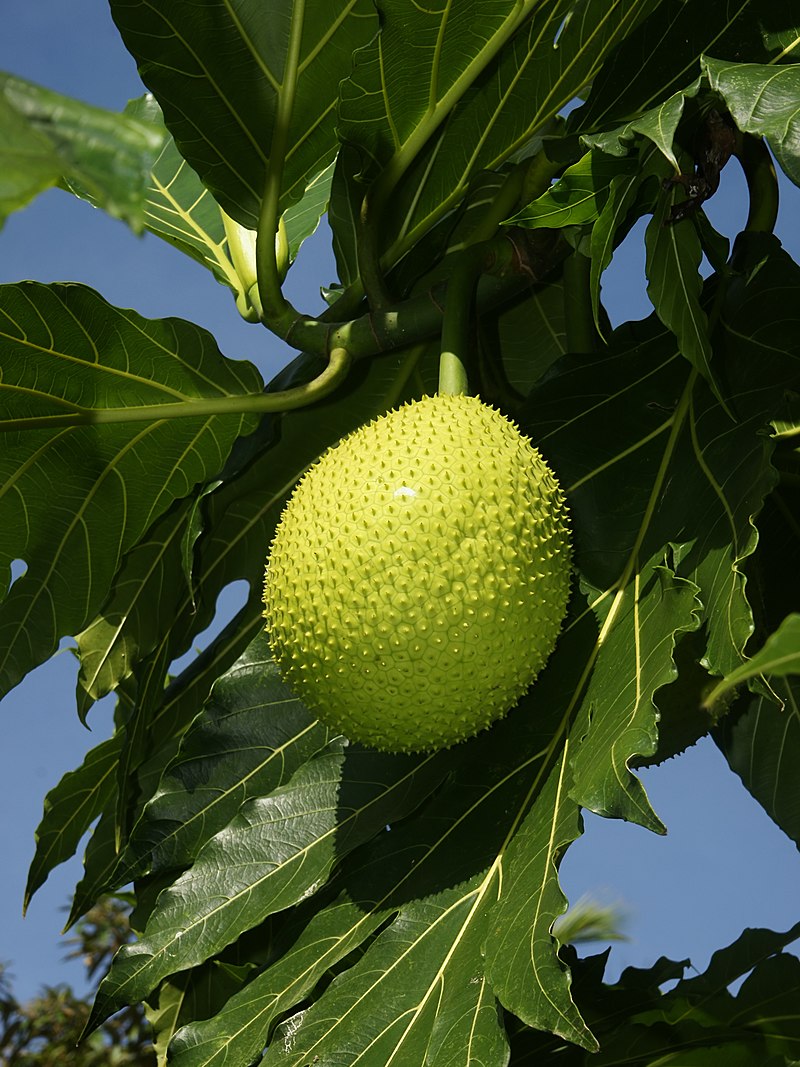
Breadfruit

Pamelo also known as pamplemousse

Our new culinary treats are breadfruit and pamplemousse. Breadfruit is supposed to be treated like a potato. We made thin, salted fried chips from ours. It was interesting but I would hate to live off the stuff. Pamplemousse on the other hand is wonderful. This is a very large, sweet grapefruit growing all over the Marquesas. Delightful!

A few Recipes from the Enchanté Galley

Breadfruit Omelet

  • 1 c ground meat, ham, or sausage 1/2 c green onion, chopped
  • 2 c breadfruit, cooked and cubed 1 tomato, chopped
  • 2 eggs salt and pepper to taste
  • 2 cloves garlic, crushed

Saute the garlic, onions and tomato in oil. Add breadfruit and meat. Cook until meat and breadfruit are done.
Beat eggs well and add to the breadfruit mixture. Pour into pan. When one side is cooked, turn and cook the other side until done. serve hot.

Cream of Taro or Breadfruit Soup

  • 1T margarine 3/4 c cream
  • 1 T flour 1/2 t salt
  • 1/2 t onion, minced 1/16 t pepper
  • 3/4 c taro, cooked and mashed 11/2 c water
  • 1/2 c celery, chopped fine

Saute onion in butter. Blend in flour and add water while stirring constantly. Cook over medium heat until thick. Add taro and mix well. Cook for 5 minutes. Pour cream into the mixture and season. Serve hot. Can substitute breadfruit for taro.

Filed Under: Food, Pacific, Travel Tagged With: Cruising, Enchante, Marquesias, Recipe, S/V Enchante, Sailing, Strange Chronicles

October 3, 2019 by Carl Strange

Landfall – The Marquesas, Paradise at Last (#6)

16 June 2002 –  10° 30S / 128° 32W Land Ho! Marquesas

Rebecca spots land, 19-days out of the Galapagos
[An excerpt from Carl’s Log] We spotted Fatu Hiva, Marquesas at 0930 local time. Islands first appear as an indistinct gray smudge on the horizon. Finally, your eyes recognize structure and you realize it’s not a cloud or wave. It is always exciting. Land means seeing colors other than blue, resting at anchor, and taking a walk. A major island means meeting other cruisers, eating fresh fruit and vegetables, going to a small restaurant, and sitting at a table without having to hold onto your plate with one hand! Land also brings the danger of hitting something and the worry of finding a secure anchorage. We are all three on deck for most of the morning and we are almost always looking towards the island.

As we close with Fatu Hiva colors and civilization start to appear – green, a microwave antenna high on a mountain, a lone white cross on a hill. Finally, there are huts, houses, and tended fields. The smell of land is intoxicating – dirt and vegetation, flowers, smoke. The island is gorgeous. By afternoon we’ll be anchored in the Bay of Virgins. The old name for the bay, before European churches arrived, described the phallic rock spires the stuck up around the area.

It took 19 days to get here from Galapagos. It was a wonderful passage and faster than average. Slower boats have required 30-45 days for the trip.

Dinner will be the remains of the 4-foot Mahi Mahi we caught yesterday afternoon. Plenty will be left over to make pate’ and Karen is thinking about trying a pickling recipe someone gave us.

Tonight we’ll sleep together for the first time in a month. Both of us will wake up at our two-hour watch intervals. There will be a sudden panic with the realization that no one is one watch. It takes a couple of nights to adjust to the lack of sailing noise and motion and to relearn how to sleep for several uninterrupted hours. We will jump at the sound of a dog bark or a motor.

18 June 2002 – Fatu Hiva, Marquesas 10°27S / 138°29W

“The Bay of Vergins” Fatu Hiva

The anchorage here is beautiful but the holding isn’t too good. People anchor in a horseshoe because the big area in the middle is rocky and boats tend to drag in the 30+ knot gusts that come screaming down from the mountains. It’s not rolly so we are grateful, but we pop up every 5 minutes or so with each gust to make sure all is well in the anchorage. Makes one nervous about leaving the boat unattended.

Yesterday, we went ashore with the crews of two other boats. The French officials say we aren’t allowed to stop here without first visiting an official Port of Entry far downwind from Fatu Hiva. The Marquesans have always been sailors and the locals know we are not going to beat several miles to windward after passing their island. The Mayor of Fatu Hiva welcomes cruisers and invites them to stay for a few days before continuing on to talk to the French. The welcome is passed over the long-range radio nets used by cruisers. There is no airport on the island, no normal tourists, and all supplies arrive on a small freighter. We are an important source of trade and we buy crafts that would normally be sold at a discount to a dealer in Tahiti.

A breakwater is being built in the harbor. We were stunned to see heavy equipment moving concrete blocks and dirt and the noise is incredible after days at sea. The equipment and material came on a barge and will be taken away when the job is completed. It’s a scramble to come into the landing and climb up through the mess to shore. But we’ve been to worse landings and it is a delight to be ashore.

Immediately on shore, a lady greeted us and asked, in a mixture of French and English, if we wanted fruit and had anything to trade. As we were to learn hot items are perfume, lipstick, nail polish, ballpoint pens, t-shirts and jewelry. We didn’t want to haul fruit around during our walk so we declined and carried on.

The lady mayor is also the school teacher. It was break time so we went into the schoolyard to say hello and ask permission to stay. Children came running from everywhere. They were anxious to try out their English skills the whole of which consisted of, “What is your name? How old are you?” Each child came up and asked that in turn. We must have answered the questions a hundred times and were delighted to do so. The children were amazed to hear our ages and went to great pains to translate carefully for ones who didn’t catch our English numbers.

The mayor spoke English well and grabbed her purse and took us to see the town. A cluster of children joined our parade and people came out to say hello to us or speak to the major. Our little group of eight cruisers turned into a small mob of thirty or so. We were taken to the houses of the lady who bakes bread, a local wood carver who happens to be married to the mayor’s sister, and a lady who makes tapa – art on a cloth made from the bark of trees. Children were assigned as tour guides to lead us around.

At one point we pulled out a guide book of the Marquesas Islands. We had carried it ashore because it had a map of the small village and we thought it might help us get around. We had no idea that a local child would always attach themselves to act as our guide in the village and would help us find everything including the trash landfill. The children were delighted with the book especially when we showed them the chapter on Fatu Hiva. Published pictures of their bay and a couple of sites around the area fascinated them. Despite the fact that it was written in English, they loved it because they recognized their town. They really wanted to trade for it – one small girl offered the plum she had in her pocket. We needed the book as we continued through the Marquesas and kept it, much to their disappointment. It’s not at all that they are uneducated or backward but Fatu Hiva is a tiny dot even on a map of the Pacific and to see a publication with a whole chapter dedicated to their bay delighted them.

The town was a great introduction to the South Pacific and Rebecca even got to see some ladies with flowers in their hair. She’s been looking forward to that for a while. No grass skirts, much to her disappointment, but maybe on another island because they are practicing for the big dance festival that happens next month.

Carl Strange Avatar
Carl and his wife Karen set-off on a journey around the world on-board their sailboat S/V Enchante. Along the way, they had a lot of adventures and in Aruba, a new member of their crew was born. Now a family of three with Rebecca’s birth, they sailed the Caribbean and the Pacific experiencing life along the way.

Filed Under: Pacific, Sailing, Travel Tagged With: Cruising, Enchante, Fatu Hiva, Marquesas, S/V Enchante, Sailing, Strange Chronicles

  • Page 1
  • Page 2
  • Go to Next Page »

Footer

Contact Us

Oceanic Ventures, Inc
5808 Newcastle Dr.
Houston, TX 77401-3214
USA

Phone: 713-523-DIVE (3483)

eMail: divesafe@oceanicventures.net

Signup for our dive and scuba newsletters

Don’t miss news about the exciting happenings at Oceanic Ventures.


Map and Directions

Socialize

  • Email
  • Facebook

Why People Choose Us

People choose their friends carefully just as they should choose their adventure partners and Scuba Diving Instructors.  Oceanic Ventures is the premier scuba dive shop in Houston, Texas, and the Southwest because of our exceptional service and our sense of adventure.  In talking with our clients and friends, people choose us for a number of reasons such as: Passion – We love what we do and we want to share the beauty and excitement of the underwater world with everyone we meet. Caring- Our clients tell us they love us because we truly care about people and strive to make their scuba diving experiences safe, fun and enjoyable. Professional – Our staff members are the … [Read more …]

Copyright © 2026 all rights reserved Oceanic Ventures, Inc. · Sitemap · Log in