• Skip to primary navigation
  • Skip to main content
  • Skip to footer

Houston's Premier Scuba and Dive Shop Oceanic Ventures Inc.

(713) 523-3483 (dive)
5808 Newcastle Drive
Houston, TX 77401

  • Home
  • Stay Current
    • Our Blog
    • Travel and Events Calendar
    • Club Aquarius Social Club
      • Club Aquarius Social Club Upcoming Events
      • Club Aquarius Social Club – The Past
    • Special Events
    • Local Scuba Diving Events
    • Photography Contest
    • Categorized Blog Posts
  • Equipment
    • Dive Equipment
    • Rebreather Systems
    • Cruise Ship Passengers
    • Repair & Maintenance
    • Air & Mixed Gas Blending
    • Pure Fiji Spa Products
  • Training
    • Become a Scuba Diver
    • Scuba In Your Home or Ours
    • Diving Programs for Young Explorers
    • Recreational Dive Courses
      • Recreational Dive Courses overview
      • The Briar Club Scuba Program
      • West University Scuba Program
      • Houstonian Scuba Program
    • Technical Diving Courses
      • Basics
      • Nitrox
      • Trimix
      • Rebreather
      • Wreck Diving Programs
      • Cave Programs
      • Blending
    • Leadership Dive Courses
  • Travel
    • Travel Escorted Adventures
    • Travel – Other Travel Programs
    • Travel – Custom Travel Adventures
    • Local Scuba Diving Events
    • Technical Travel
    • Scuba Diving Around Texas
    • Travel Insurance
    • Travel Forms
  • Company
    • About Oceanic Ventures
    • Meet Our Team
    • Testimonials
    • Facility Hours
    • Map
    • Oceanic Ventures Foundation
    • Resources & Articles
    • Archive
  • Shop
    • Online Store
    • Cart
    • Checkout
    • My Account
    • Policies regarding Privacy and Purchases
  • Contact

Scuba Dive Training

February 9, 2016 by Simon Pridmore

Scuba Diving – Get Control of your BCD!

A note about the author – Simon is the best-selling author of Scuba Confidential – An Insider’s Guide to Becoming a Better Diver and Scuba Professional – Insights into Scuba Diver Training & Operations. Both books are available now from Oceanic Ventures.

As you discovered when you first learned to scuba dive, the letters BCD stand for Buoyancy Control Device. This implies that your BCD is an appliance that controls your buoyancy in the water. It would be nice if that were the case but sadly it is not true. No matter how technologically advanced your BCD is, you are still the one responsible for controlling your buoyancy in the water. Your BCD is just a tool that you can use to help you.

But first you need to get the BCD itself under control!

stellitoBuy the right one

Most people buy BCDs that are the wrong size because they try them on in a dive shop while standing up and wearing their normal land-based-life clothes.

Try the BCD on in the shop while wearing your wetsuit and once you have chosen a model, ask to try a sample out in the pool first. Take along the size that fitted you best in the shop and take the next size down with you also. The smaller one is probably the one you will keep.

Your BCD should fit you closely, especially around the shoulders, but not restrict normal movement nor constrict you with the bag full and the straps loosened. It must have enough buoyancy when fully inflated to float you comfortably at the surface with your head clear of the water, but no more.

It is best avoid the bulky, top of the range models. They are usually very buoyant even when not inflated and will require you to wear a lot of extra weight to compensate. An oversized BCD can start moving around on its own under water and be impossible to control!

Charlie in TrukKnow how it works

Spend plenty of time studying your new BCD. Hold it up in front of you horizontally and imagine where the air will be when you are underwater. It will always be in whichever part of your BCD is closest to the surface.

Learn where the controls are. While you are swimming, practice finding your inflator mechanism by touch alone: then, practice using it in different positions. Remember it is not a pump; it will only release air when a) it is above your left shoulder and when b) your left shoulder is the part of your body closest to the water’s surface. Otherwise the air will remain trapped inside no matter how fiercely you depress the button. See how need to turn your body while swimming so that your left shoulder is at the highest point. Usually you can manage this by dipping your right shoulder.

Notice that if you are swimming with your head down and feet up, the air will be close to your butt. Most BCDs have a “tail dump” so you can release air in this position. Make sure you know instinctively if the tail dump is on the right or left.

Learn how to empty your BCD completely. Failure to master this skill can make it difficult for you to descend, cause you to carry too much weight to compensate and, worst of all, place you at risk of an out of control ascent.

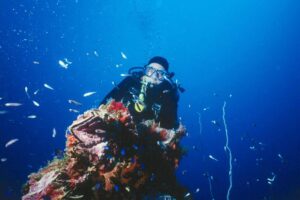
Stephanie Watowich in Truk Lagoon

Set it up properly

Control your safe second stage (octopus) and your console so that you know where to find them instinctively when you need them and also so that they do not swing around below you and damage that beautiful coral you are swimming over. This means controlling the object at the end of the hose, not just the hose. Clips that retain only the hose still allow the object on the end to swing free below you and turn your accessories into reef-wrecking balls.

Minimize the number of extra bits and pieces you carry on every dive and make sure the essential items things, such as your safety sausage and dive light, are stowed away or attached securely. The two golden rules are:

  • only one thing in each pocket because if you have several items in the same pocket and pull one thing out, everything else will come out with it: and
  • attach everything by two points so that,
    1. it does not dangle and,
    2. if one of the attaching points breaks you do not lose it.


Filed Under: Open Circuit Tagged With: buoyancy, Scuba Dive Training, scuba equipment

January 14, 2016 by Simon Pridmore

Ten Tips for Reducing Your Air Consumption While Scuba Diving

 
A note about the author – Simon is the best-selling author of Scuba Confidential – An Insider’s Guide to Becoming a Better Diver and Scuba Professional – Insights into Scuba Diver Training & Operations. Both books are available now from Oceanic Ventures.

Once you have completed your first Scuba course and begin diving with more experienced divers, one of the first things you may notice is how much longer their air seems to last in comparison to yours. You are always running low before the rest of the group and having to cut short your buddy’s dive.

The people who scuba dive with you will not mind at all. They know you are a new diver and it was not so long ago that they were in a similar situation. However, you probably will mind and you will be looking for ways to breathe more efficiently and make your dives last longer.

Here are 10 tips guaranteed to improve your air consumption and also make you a better scuba diver in many other respects at the same time. Notice that none of these involves using a bigger cylinder!

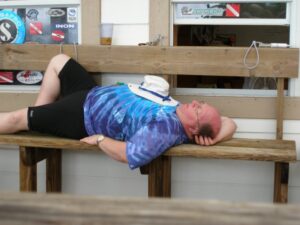
Eric Relaxing before Scuba Diving in Grand Cayman
Eric Relaxing in Grand Cayman

Tip One – Get in the Mood

Take some quiet time on your own before each dive to relax and focus on what lies ahead. Breathe deeply and find a nice peaceful place in your mind. Put away any negative thoughts concerning other aspects of your life. You are going diving; there is nothing you can do about anything else while you are underwater.

Tip Two – Breathe Properly

Learn to breathe like a scuba diver. Breathe from the diaphragm; push your stomach out to allow your lungs to expand and draw in as much air as possible. Then breathe out long and slow, bringing your stomach in to reduce your lung volume to a minimum. Practice this long, deep, slow breathing cycle until it becomes instinctive. Not only will this help you to use less air, it will help you stay calm and think clearly.

Tip Three – Get Fit

Diving is a sport and the fitter you are, the better you will dive and the less air you will use. Start a programme of aerobic training and increase the level of your training as a dive trip approaches.

Scuba Diving in Chuuk (a.k.a. Truk Lagoon)Tip Four – Don’t Move

When you are underwater, only move your fins when you need to go somewhere. If you are not going anywhere, keep them still. Tuck your arms in, only use your hands if you need to signal and incline your body like a motorcyclist if you want to change direction or regain your equilibrium.

Tip Five – Remove Weight

Like many new divers, there is a good chance that you are wearing too much weight. A reliable indicator of this is if, after your initial descent, you have to add quite a lot of air to your BCD to keep you off the bottom. What happens next is that, when you start you swim, the air in your BCD lifts your upper torso and the weight around your middle drags your butt and legs down. This gives you the head up, tail down posture of a seahorse. Look at other new divers or ask a friend to take a short video of you, to see what I mean. Moving through water in this position requires much more effort and causes you to use up much more air than if you are horizontal, as you should be.

The trick is to reduce the amount of weight you are carrying. Start by removing one piece and, if you can still make a comfortable initial descent by exhaling fully as you leave the surface, remove another. If, at the end of a dive, you can hang at a depth of 10 to 20 ft. with 750 psi in your cylinder and an empty BCD, you are correctly weighted. Another little thing to remember: if you are wearing a weight-belt and a wetsuit, the belt will loosen and slip down onto your hips a little as the water pressure compresses your suit. So, once you are at depth, take a moment to hitch your weight-belt higher on your waist and tighten it a little. This will lift your legs up and give you a more horizontal posture in the water.

Tip Six – Do an In-Water Check

The whole gearing up, entry and descent process can be awkward and strenuous. For instance, you may be wearing a thick suit on a hot sunny day, there may be a lot of other divers around or the sea might be choppy. A whole host of factors can conspire to undo the positive effects of your pre-dive relaxation and the consequent stress can cause you to go through your air more quickly. So, once you are underwater and the confusion on the surface is behind you, make it a habit to pause briefly and go through a quick in-water check. Take a few seconds to compose yourself, get your slow, deep breathing cycle going, inspect your gear for problems and verify your cylinder pressure (Tip Eight) before heading off to the depths.

Tip Seven – Kick Differently

There are a number of easier ways to fin than the classic wide, full-legged scissor kick you used when you started diving. Learn about alternative techniques like frog kicks and modified flutter kicks. Ask your instructors to show you how or just watch and copy what they do. Using energy-saving fin techniques will reduce your air consumption considerably.

Tip Eight – Know your True Starting Pressure

The cylinder pressure you see when you check your gauge on a sunny boat deck is misleading, as the reading changes with the drop in temperature when you enter the relatively cool water. The underwater reading is your true starting pressure. If you are aware of this you can calculate your airtime (Tip Nine) and this will help you relax. A relaxed diver uses less air.

Tip Nine – Always Know How Much Air You Have

Always know how much air you have left and also have at least a rough idea in your mind of how long it is going to last. This is how you do it.

  1. As you descend, make a mental note of your air pressure, say 2900 psi
  2. After five minutes at depth, look again. Maybe you now have 2700 psi.
  3. This means you have used 200 psi.
  4. Assuming you are diving the deepest part of your dive first, you now know that you will use a maximum of 200 psi every five minutes.
  5. If you want to surface with 500 psi, you have 2200 psi left to use.
  6. So a simple calculation ((2200 / 200) x 5 minutes) tells you that you have AT LEAST 55 minutes of airtime left.

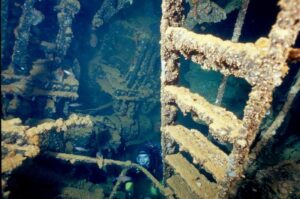
Scuba Diving in the Kensho maru engine roomTip Ten – Keep Calm

If you ever find yourself becoming anxious underwater, the chances are that the reason for this is that you have lost your deep, slow breathing cycle without noticing it. Maybe you have been fighting a current or trying to keep up with a buddy who is swimming at a pace that you are uncomfortable with. As soon as you are aware of your increasing anxiety, stop finning. Calm yourself down by inhaling fully and, most importantly, exhaling fully for a couple of minutes. As you take deeper and gradually less frequent breaths your mind will clear. Check your contents gauge. If you still have plenty of air left, continue with your dive. If your air supply is lower than you expected, ascend to a shallower depth. Remember, the shallower you are the less air you use.

Filed Under: Scuba Dive Training, Skills Tagged With: diving skills, Scuba Dive Training, Training

April 27, 2015 by Eric Keibler

New Scuba Diving Instructors

Hear Ye, Hear Ye, Hear Ye!  Let it be known that Oceanic Ventures Has Four New Scuba Diving Instructors!

New Scuba Diving  Instructors John Davis, Joe Henry, Joel Hershey and Steve Soulen.  Also Pictured are Ann Keibler, Eric Keibler and Alex Witschey
New Scuba Diving Instructors John Davis, Joe Henry, Joel Hershey and Steve Soulen. Also Pictured are Ann Keibler, Eric Keibler and Alex Witschey

After a lot of time listening to lectures, working through a mound of homework, having special sessions, apprenticing with the staff and a great deal of stressful studying, John Davis, Joe Henry, Joel Hershey and Scuba Steve Soulen completed their Instructor Evaluation Clinic, IEC, this past weekend and are now officially Open Water Scuba Diving Instructors — well ok, once the paperwork is processed at SSI headquarters.  Their journey to this point has been a long winding road.  There were a lot of classroom sessions with me as well as pool classes and open water sessions.  During the process, they all became Dry Suit divers so they could stand the winter and early spring waters at the lake and they learned to work with troublesome students (thank you Alex Witschey and Madison Lee.)  They worked with new students and divers wanting to join Neptune again (i.e. Scuba Skills Updates).  They plowed through standards and textbooks looking for the gems that they would be tested over as well as their Science of Diving materials (the physics and physiology of diving.)
Throughout the process they maintained a positive attitude and stepped-in to help where ever they could.  Along the way, they, along with Dive Coordinator, Susan Long, came up with some awesome marketing ideas and some ways to improve the diving programs at Oceanic Ventures. All the while, Dive Mom had to remain out of their training and could not help them through the training process.  However, I think the preparation program was just as hard for Dive Mom, because she could not participate in the program nor assist them in any way.  She had to maintain her distance since she was the Instructor Certifier for the IEC.
In the end they all shined!  They completed the testing and evaluation with most of their finger nails intact and with hair on their head — well, Joel excluded.  AT about 4:30 Sunday afternoon they all knew — They passed and were now finished with their Instructor program!
 

Filed Under: Staff Tagged With: diving, diving skills, drysuit, Scuba Dive Training, Training

April 20, 2015 by Eric Keibler

Rebreather Scuba Diving – The Advantages of Silent Scuba Diving

Eric on a Sentinel Rebreather Scuba Diving in Grand CaymanI am often asked why I prefer to dive a rebreather over open-circuit scuba.  My reasons are mixed and sometimes maybe a little hard to quantify.  But the simple answer is, for me, it has a number of advantages over traditional scuba.

Key Advantages of Rebreather Scuba Diving

While a rebreather isn’t the best choice for every diver or every diver, it is the best choice for many dives and many divers. Poseidon, a rebreather manufacturer says the key advantages are, a rebreather system is less noisy than an open-circuit system, making the interaction with marine life more intense and up close, as wildlife will approach you rather than swim away from you. The duration of a dive on a rebreather system is generally much longer which means that you can either stay down longer in one dive or do several repetitive dives without the need to re-fill your cylinders. The reason for this is that you will not use up your gas as fast as on a normal scuba system, because you are re-using gas the whole time, making the rebreather 96% efficient in comparison to 4% efficiency during an open-circuit dive. Your gas costs will be reduced, especially when you venture into technical diving. No decompression time is far greater on the rebreather system as it makes sure you have the optimal gas mix at every depth, therefore minimizing the intake of nitrogen. If you are a certified Nitrox diver, you can compare it to having a nitrox blender on your back that makes sure that you have the best mix at every depth.
An open-circuit system gives you cold and dry gas, but on a rebreather you will get moist and warm gas, which is much more comfortable to breathe while diving. There is no need for deep breaths because the loop is an extension of your lungs. You only need to make sure that you continually breath normal breaths. Your buoyancy will not be altered by the way you breathe; it will only be changed when you add gas to your buoyancy device. 

Rebreather Divers in Grand Cayman During the First Innerspace CCR Event (Eric is in the Photograph)

Noise – a Rebreather Dive is Quiet

When I first started diving, I loved the silence that the underwater world brought.  The sounds of traffic, phones, engines and other people faded away and the only thing you heard was the sound of your own breathing in the bubbles as they raced past your ears.  Switching to a rebrerather brought new sensations.  The surface sounds faded away just like on open-circuit scuba but so did the noise created by the bubbles.  Suddenly it was really quiet — at least until I swam near a reef.  Then I heard it — the sound of millions of small shrimp clicking away on the reef.  Yes, as the sound of my bubbles faded, I was suddenly able to hear the sounds of nature and the reef and it was so cool!
When you get used to the relative quiet of the rebreather, you can really tell when open-circuit divers are approaching.  The bubbles are so noisy and the fish begin to hide!
I know this is a politically incorrect statement but it is true.  This is one of the reasons some rebreather divers do not want to dive with the “bubblers.”  Of course there is another side to this; many open-circuit divers do not want to dive with rebreather divers because they take longer to get ready to go diving.

Eric On a Rebreather Dive in Grand Cayman
Eric Scuba Diving Using a Rebreather in Grand Cayman

Time – a Factor In and Out Of the Water

This is true, especially when compared to single cylinder, recreational diving.  A rebreather diver has a checklist for the assembly and preparation of the unit for use underwater.  Working through this checklist is a thirty minute to an hour process depending on the unit and the experience of the diver.  Most times the divers get up a little earlier to complete the diving but there are times that gas is delayed or other logistical factors do not align and the open-circuit divers are stuck waiting for the rebreather divers.
But, once the divers are in the water, the rebreather shines.  Having a “custom gas blender” on your back means that you get the optimal breathing mix throughout the dive.  As we noted above, this translated into longer no-decompression times or shorter decompression profiles when compared to most open-circuit profiles.  My first rebreather dives were amazing.  I was in Grand Cayman swimming along the wall at 80 fsw to 100 fsw for an hour and then up along the top of the wall for the second hour and by the time I reached the mooring line there was no decompression time and I could go straight up.  Of course, like all good divers, I did a safety stop but you can imagine my delight at doing a two-hour dive with no decompression required.  Of course that changed later that year when I discovered the sponge belt in Grand Cayman at about 180 fsw.  Now a limited amount of decompression was required.
On another occasion, when I was diving with mixed teams (open-circuit and closed circuit rebreather divers) in Florida a few years ago, we found that the rebreather divers could stay on the bottom, exploring the wrecks ten to fifteen minutes longer than the open-circuit divers and still exit the water at about the same time.  In other words, we spent more time exploring wrecks like the Hydro Atlantic,  and less time hanging in the water column decompressing.

Cave Scuba Diving using Twin Cylinders in Peacock Springs , Florida
Eric Keibler Cave Diving using Twin Cylinders in Peacock Springs , Florida

Weight – Lighter is Better

My diving has changed a lot over the years.  I started in single cylinders, and then moved up to twin cylinders or double cylinders when I started cave diving and wreck diving.  As my cave diving progressed, I found that I wanted more air so heavier cylinders were needed.  At some point, Cliff Simeneau talked to Ann about the newest trend sweeping diving in the US and the importance of offering training on this new technology.  We had already been diving and teaching the Drager Dolphin Semi-Closed rebreather systems but this was the time when the Inspiration was beginning to be seen in the US.
One of the advantages of a rebreather is that it gives you the same or more duration as the twin cylinders without the weight of the cylinders.  So, I was overjoyed at trying the unit and diving it more.  It is funny, one of my instructors, Tom Mount, liked to comment that the difference between new rebreather divers and more experienced rebreather divers was that at some point, experienced divers started making comments about how heavy their rebreathers are.  This means they have now forgotten the shift from the much heavier cylinders to the lighter rebreather and now the CCR unit is the focus of the weight in their mind.
So, yes, a CCR unit is lighter than a set of twin cylinders – even the Sentinel weighs less than a twin-set of  cylinders.  Over the years, CCR units have become lighter and more compact.  Several of the newer models, like the Pathfinder from Inner Space Systems, weigh closer to a single cylinder set-up which makes them ideal for travel.  This reduced weight is also easier on your back as a diver which is important as the diving population ages.

Interaction – The Marine Animals Play More with Scuba Divers in a Rebreather

While weight and time are important factors for a rebreather diver, one of the most exciting things is the interaction with marine animals.  Let’s face it, bubbles are noisy and the fish react differently when there are bubbles.  The small fish move into the coral with each release (i.e. with each exhalation) and other animals just move away.
One of the first things i noticed a rebreather were those small fish moving in and out of a coral head.  I had spent countless hours photographing coral heads, trying to get the timing right so I could photograph of the fish suspended above the coral.  On my first Inspiration CCR reef dive, I noticed the fish remained suspended above the coral head; they did not disappear into the coral with my breathing!  I also found the lobsters remained out on the reef rather than backed up into a hole.  Perhaps the most amazing thing was coming face to face with a spotted eagle ray over a wall.  It was so cool!
The life under the sea is so different without the noise of open-circuit scuba.  As a rebreather diver you get to experience the world like a free diver but you get to stay and keep enjoying it while the free divers head back to the surface.  Imagine coming face to face with a large turtle or a ray or watching squid mate or even being surrounded by large tarpon or schools of fish.  This is rebreather diving on a reef!

Cool – You just look really cool Scuba Diving in a Rebreather

What can I say, you just look like James Bond!  Because they are still rare at a lot of dive sites, when you dive a rebreather you will attract attention and people will stop and ask you questions.  This may not be the ideal situation if you are a c overt operative but it does lead to some interesting conversations.  It is also fun to surprise other divers underwater when you swim by — remember they did not hear you coming.  But let’s face it, diving is pretty cool and rebreather diving is definitely cool!
So, why isn’t everyone diving a rebreather?  I ask myself that all of the time.  People will tell you it is the cost, or the time or the commitment which are all good reasons but when you try one, you will see why rebreather divers are hooked.  They have found the money, time and made the commitment to experiencing the underwater world to its fullest.
Isn’t it time you joined the new rebreather diving generation?


Filed Under: Photography, Rebreather, Rebreathers Tagged With: diving skills, Rebreather, Scuba Dive Training, Technical Diving.Rebreather Diving, Training

February 16, 2015 by Susan Long

The Making of a Scuba Diver

Scuba Diver Susan Long Relaxing in Fiji
Susan Long Relaxing in Fiji

I have been scuba diving for over two years – since December 2012. Not only that, I had 100 dives within 10 months, and I had another 100 dives within another 10 months. I LOVE it! I am 59 years old, a retired IT professional, not athletic or mechanical in the slightest. How did I get here?

When we got married in 1992, my husband and I made a deal. He would not buy a Harley, and I would not go scuba diving. That way, we thought we could keep each other alive for a good long time. I have always had friends who scuba dived, and I have long been intrigued by it.

I swam for exercise in college – or more precisely, struggled through maybe 10 lengths a session. It was awful and so difficult, but for some reason, I did it. I did not enjoy it at all. Fast forward 25 years, and we went with some diving friends to the Yucatan for vacation. They did some diving, and we all snorkeled one day. I was terrified! I did not understand how I was supposed to breathe underwater. But I made myself jump in and try it, and within a minute or two, I was having a great time! There were lots of glamorous fish! Who knew? And I really enjoyed being in the water – which was also a surprise, after my college swimming experiences.

Scuba Divers Susan & Larry on a motorcycle trip
Susan and her husband, Larry on their last motorcycle trip.

After I retired in 2005, I decided to go to graduate school in Spanish Linguistics at the University of Houston. The parking is horrible! (The classes were great!) I soon realized if I had a motorcycle or scooter, I could park in the designated areas much more easily. So I bought a Vespa scooter! When my husband got over the shock, he got himself a Harley! So now I had permission to scuba dive! (We now both really enjoy our motorcycle trips together!)

I had permission to scuba dive, but on the other hand, I knew it was an expensive habit. I was reluctant to get a lot more “stuff”. We already had plenty of stuff. Being overweight, I didn’t think there would be enough weight available to keep me down (seriously). I also knew myself it could be dangerous – I had looked at some books detailing scuba diving “incidents” and they are pretty scary. You wonder why anyone comes back alive!

In the fall of 2012, my friend Donna Collins (another scuba diver, and Oceanic Ventures, Inc. denizen) and I were planning to go on a cruise to Costa Rica and Panama. She suggested that we could go snorkeling, and she might try to go diving. I was enthusiastic – I had not had a chance to go snorkeling in years! She took me to Oceanic Ventures to look into getting my own mask, snorkel, fins to take on the trip.

My First Trip the the Dive Store

Ann, Alex and David Morris were in the shop, and I will never forget the warm welcome. David took me under his wing and explained everything I wanted to know about masks, snorkels, fins. I could not believe how expensive they were! But I was sold on the part of getting good equipment so I could really enjoy the experience. I left with the mask, snorkel, fins, a bag, a skin, and maybe a few other goodies. David offered to give me a snorkeling class for free, which I gladly took him up on, since I was certainly not an expert snorkeler, having only done it once.

At the snorkeling class, I learned quite a bit, especially how to “duck dive!” David offered to give me a Try Scuba session, and I was, well, OK, sure! If he’s offering, I sure will try it. Within a few days, I was trying out the scuba equipment in the West U pool, and learning the first rule of scuba. I don’t remember exactly how it happened, but the next inevitable step was signing up for Open Water Scuba classes so I could go on the Cozumel trip that December. And buying all my equipment. Oceanic Ventures made it so easy. I could not have chosen (and still can’t) between Buoyancy Compensaters, Air Delivery System’s or computers. I trusted their advice, and I really liked the idea that they had a lot of experience with the equipment they sold, and they believed in it for all levels of diving.

Open Water Scuba Training with Oceanic Ventures

I had a great time in the Open Water Scuba training with David and Alex. It was hard for me to clear my mask, but eventually I figured it out. It was hard remembering all the steps for sharing air, or the out-of-air ascent. But I did it! The Cozumel trip was fantastic. I did my open water dives there with Alex as my instructor, and it was so much fun! He was so calm, and knowledgeable, and encouraging. I could see it was going to take some time for me to get really comfortable with my buoyancy, and the breathing, but I was plenty comfortable enough to enjoy the diving, and the Oceanic Ventures group was so wonderful. All those experienced divers were so encouraging and helpful to the brand-new,” baby diver.”

Scuba Diving in the Solomon Islands Susan Long and Ann Keibler
Scuba Diving in the Solomon Islands with Susan Long and Ann Keibler

David had let me know in the  Open Water Scuba training that he was the first Oceanic Ventures student to get 100 dives in a year. That sounded like a challenge to me, and I like challenges! Also it was quite clear after the Cozumel trip that the more experience I had, the more fun I could have as a diver. So I set myself the informal goal of getting 100 dives in a year. In order to keep diving through the winter, I started drysuit training and bought a drysuit. I started Advanced Open Water Scuba training, if for no other reason that it was more diving experience! I went with Oceanic Ventures to St. Croix, Belize, Cozumel, and then to Grand Cayman in August! (Donna and I did get to do a few dives on our trip to Costa Rica.) By the time I got to Grand Cayman, I had achieved the 100 dives, between the trips, the training, and being a fun diver at Blue Lagoon and 288 Lake.

Where I Am Now…

So what about all the concerns I had, and my husband had? Well, first off, safety is obviously the first priority at Oceanic Ventures. Now that I am diving, I wonder how people got themselves into those situations in those scary dive books. Of course, mistakes can happen, but most of those incidents are inconceivable on an Oceanic Ventures trip. Yes, diving is expensive, and I have a LOT of stuff. I am still dealing with how to organize it and where it all needs to go between trips. Oh well! The experiences I have had as a diver, and the friends I have made, have been more than worth it.

Scuba Diver Susan Long Diving in Fiji
Susan in Fiji

I love being a part of the Oceanic Ventures “tribe.” It feels like home. I am very impressed with the emphasis on safety and professionalism at Oceanic Ventures. Ann and Eric Keibler run a tight ship, with little room for error, but lots of room for fun. It is easy to have fun when you have confidence in the trip leader, the dive location, the divemasters, and the choice of dive sites. And you get to go play with your dive peeps!

My husband has put up with all this graciously, taking me to the airport and kissing me goodbye as I go off on my next diving adventure. I am so happy to report that since his retirement last August he has become a certified scuba diver, and we are going on our second trip to Cozumel with Oceanic Ventures next month!

Filed Under: Caribbean, Dry Suit Diving, Local Diving, Pacific, Scuba Dive Training, Scuba Diving Activities, Scuba Diving Equipment, Skills, Travel Tagged With: buoyancy, Cozumel, Dive Travel, DiveAroundTexas.com, diving, diving skills, drysuit, Grand Cayman, Scuba Dive Training, Training, Travel

November 21, 2012 by marinawatowich

A Short History of the Scuba Diving Mask!

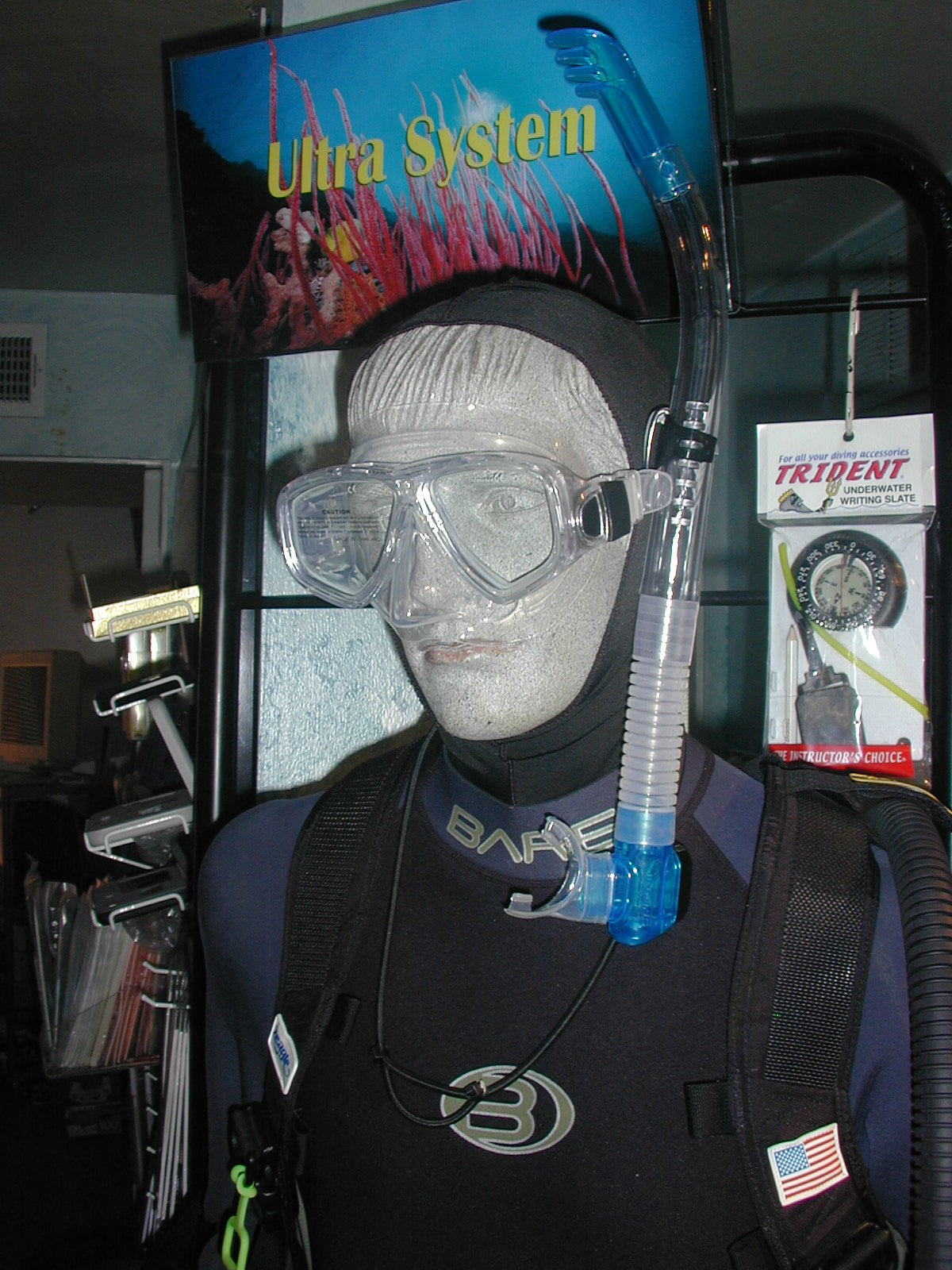
Al with his mask and snorkel
Al with his mask and snorkel.

The mask is one of the most basic, yet essential pieces of equipment for our sport and has an interesting history. Since the human eye is not adjusted for seeing clearly without air in front of it, divers realized that thy needed some sort of air pocket in front of their eyes to see well underwater. With the beginning of diving divers fashioned goggles, similar to those which swimmers use today. These only covered divers’ eyes so I can imagine that it was pretty difficult to breathe comfortably underwater! With the growth of diving in the 1930s and after the World War II technological boom round masks that covered the eyes and nose became popular. Divers realized that they could increase peripheral vision by having an oval mask instead. These masks were usually homemade, as was most dive equipment, and were made of roughly cut glass and neuprene. As the sport really took off with Cousteau’s era dive masks were changed to have more specific eyepieces, separated the eyes chamber from the nose, and traded the neuprene skirt for silicone. These changes greatly improved the mask to give divers a greater visual field and make the masks more resistant to wear and tear, and are now the modern versions we know today.

Filed Under: Open Circuit, Scuba Diving Equipment Tagged With: Scuba Dive Training, scuba equipment

  • « Go to Previous Page
  • Page 1
  • Page 2
  • Page 3
  • Page 4
  • Go to Next Page »

Footer

Contact Us

Oceanic Ventures, Inc
5808 Newcastle Dr.
Houston, TX 77401-3214
USA

Phone: 713-523-DIVE (3483)

eMail: divesafe@oceanicventures.net

Signup for our dive and scuba newsletters

Don’t miss news about the exciting happenings at Oceanic Ventures.


Map and Directions

Socialize

  • Email
  • Facebook

Why People Choose Us

People choose their friends carefully just as they should choose their adventure partners and Scuba Diving Instructors.  Oceanic Ventures is the premier scuba dive shop in Houston, Texas, and the Southwest because of our exceptional service and our sense of adventure.  In talking with our clients and friends, people choose us for a number of reasons such as: Passion – We love what we do and we want to share the beauty and excitement of the underwater world with everyone we meet. Caring- Our clients tell us they love us because we truly care about people and strive to make their scuba diving experiences safe, fun and enjoyable. Professional – Our staff members are the … [Read more …]

Copyright © 2026 all rights reserved Oceanic Ventures, Inc. · Sitemap · Log in