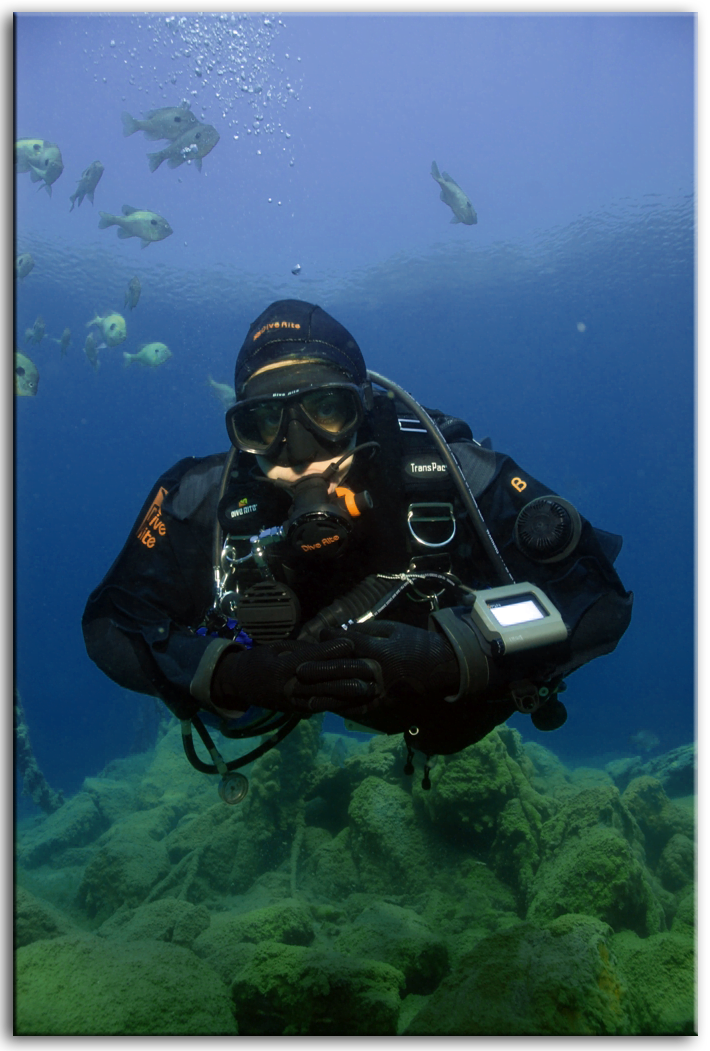
• Skip to primary navigation
  • Skip to main content
  • Skip to footer

Houston's Premier Scuba and Dive Shop Oceanic Ventures Inc.

(713) 523-3483 (dive)
5808 Newcastle Drive
Houston, TX 77401

  • Home
  • Stay Current
    • Our Blog
    • Travel and Events Calendar
    • Club Aquarius Social Club
      • Club Aquarius Social Club Upcoming Events
      • Club Aquarius Social Club – The Past
    • Special Events
    • Local Scuba Diving Events
    • Photography Contest
    • Categorized Blog Posts
  • Equipment
    • Dive Equipment
    • Rebreather Systems
    • Cruise Ship Passengers
    • Repair & Maintenance
    • Air & Mixed Gas Blending
    • Pure Fiji Spa Products
  • Training
    • Become a Scuba Diver
    • Scuba In Your Home or Ours
    • Diving Programs for Young Explorers
    • Recreational Dive Courses
      • Recreational Dive Courses overview
      • The Briar Club Scuba Program
      • West University Scuba Program
      • Houstonian Scuba Program
    • Technical Diving Courses
      • Basics
      • Nitrox
      • Trimix
      • Rebreather
      • Wreck Diving Programs
      • Cave Programs
      • Blending
    • Leadership Dive Courses
  • Travel
    • Travel Escorted Adventures
    • Travel – Other Travel Programs
    • Travel – Custom Travel Adventures
    • Local Scuba Diving Events
    • Technical Travel
    • Scuba Diving Around Texas
    • Travel Insurance
    • Travel Forms
  • Company
    • About Oceanic Ventures
    • Meet Our Team
    • Testimonials
    • Facility Hours
    • Map
    • Oceanic Ventures Foundation
    • Resources & Articles
    • Archive
  • Shop
    • Online Store
    • Cart
    • Checkout
    • My Account
    • Policies regarding Privacy and Purchases
  • Contact

Archives for April 2011

April 29, 2011 by Eric Keibler

Side Mount Open Water Course to be offered in June

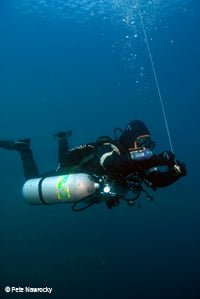
Photo by Pete Nawrocky
A number of divers have been asking about side mount diving lately.  It seems that a number of people are becoming interested in adding side mount diving to their skill-set.  You will find this style of diving different but freeing, especially when compared to diving in twins.

Eric Keibler will be offering an Open Water Side Mount course in June.  This is a 3 night class with one to two days of open waters.  It is intended for open water diving, not side mounting in caves or wrecks.  You will find it to be an easy way to extend your bottom time.
If you would like to find out more, please send Eric a note.  Or, if you are ready to sign-up just send Eric an email or sign-up now through our on-line system.
Filed Under: Open Circuit, Scuba Dive Training, Scuba Diving Equipment Tagged With: Scuba Dive Training, Sidemount, Technical Diving, Training

April 28, 2011 by Eric Keibler

Open Water Sidemount Scuba Diving

Diver in Sidemount Equipment
Diver in Sidemount Equipment Photo by Pete Nawrocky

Pete Nawrocky is on a mission.  He is interested in expanding divers options around the world by introducing them to open water side-mount diving.  When Pete is not using his rebreather, you will find him diving this way and telling everyone he meets that this is the only way to dive open circuit.
 Diving side mount is not a new concept; it was originally created by cave divers that had a need to safely penetrate narrow and confining spaces. In recent years, many open water divers have viewed side-mounting as the next step in their diving skill evolution. Much of this interest comes from the way the divers are able to divide the weight of the equipment. Preparing for a dive is different. The diver can carry the cylinders to the waters edge and leave them there. After suiting up in the appropriate thermal protection, you put on your harness/air cell combination that is independent of the cylinders. After entering the water, you attach the cylinders to the harness. 
One thing you might notice when looking at a side-mount diver is that the hose routing is completely different this is a result of the different methodology employed by these divers.  Each tank is independent and is used for different tasks.
 So why would an open water diver want to “dive side-mount?”  One reason is that as an alternative to twin cylinders, you can dive anywhere single cylinders are available.  This allows for longer bottom times where twin cylinders are not available.  Additionally, many side mount divers prefer carrying single bottles to the water rather than a set of manifolded, twin cylinders.
 Lamar Hires, President of Dive Rite discusses side mount diving in a series of videos.  You will find all of the videos on our youtube channel.  In this video, Lamar discusses why you might want to learn to sidemount diving: 

 There are some drawbacks to side-mount diving over twinset diving.  The redundancy prneuded by using manifolded twin cylinders is eliminated as is the simplicity of the system.  There are ways to manage the lack of redundancy which is taught in side-mounting programs.
 Learning to dive “side-mount” is more than just hanging two cylinders off of your BCD or harness system.  Learning how to deal with the bottles, donning and remneung them so as not to lose them in the water, and establishing a breathing regime are all part of a side-mounting training program.
 There is also some additional equipment needed to take advantage of this method of diving.  In looking at Dive Rite’s sytem, the Nomad XT sidemount rig is our “off road” model made with a super-tough exterior. The outer panels of the wing are engineered using SuperFabric® brand technology for optimum resistance to punctures and abrasions, while remaining very flexible.  It was built with the explorer in mind.  It has the added benefit of being a modular system: the harness, wing, butt-plate and crotch strap are all separate elements. This allows the traveling explorer (or any diver wishing to modify their rig) the ability to trade out wings, remove the buttplate or make any fit adjustments necessary to meet the objective of the dive mission.  Here are some divers using Pete’s preferred system.  While this video shows divers in a cave, this same system can be used while swimming on a reef or touring a wreck.

 To effectively mount the bottles on the harness you will need some bungee straps to keep the valves and bottles in position and make some other modifications to your kit.  You will also find yourself “kitting up” differently.  Because of  this, some additional training is necessary to do it correctly.  Learning to dive in a sidemount kit is not difficult, it is just different.  It takes some practice and some flexibility. 
_____________________________________________________________
 
Pete Nawrocky: Pete is the Sales Manager for Dive Rite and is best known for his willingness to share his passion for diving with others. Pete has established quite a following of divers who enjoy his affable approach to teaching and Pete can be found at least once a month in the water with a group of divers who want to learn new techniques or try new equipment. Pete makes it a point to dive with all of his clients as often as possible; believing that diving is what builds lasting relationships and after all, is what draws everyone to this unique industry in the first place.

Filed Under: Open Circuit, Scuba Dive Training, Scuba Diving Equipment Tagged With: Bungee, Dive Rite, Nawrocky, Nomad, Sidemount

April 27, 2011 by Eric Keibler

Larry Elsevier from Cochran Computers to Speak at Club Meeting

Larry Elsevier
We are pleased to welcome Larry Elsevier to our monthly Club Aquarius meeting on 28 April 2011.  The meeting is open to everyone.  This month we will be meeting at the Black Labrador, 4100 Montrose.  The meeting starts at 7:00.  We are asking for RSVP’s so we know how many people will be joining us.
Larry is currently the Sales Manager for Cochran Consulting, manufacturers of the Cochran diving computers. But Larry’s love of diving started long before his move to Texas. As a commercial urchin diver and dive store owner in the Seattle area, Larry was the first dive facility outside of Key West Florida to offer nitrox to his divers and commercial clients. He operated one of the the largest Nitrox blending facilities in the world and pioneered the use of liquid oxygen in gas production.
Larry’s love of diving took him all over the world and he simply loves talking about diving with everyone he meets. An unassuming personnality Larry is a go to guy when it comes to diving technology, especially dive compuaters. He and Mike Cochran became friends when Larry was selling the then new dive computers in his store and their friendship continued until Mike talked Larry into mneung to Texas.
Larry believes that the Cochran computer is simply the best unit on the market and he is willing to tell you why without a lot of sales speak. Come visit with Larry and find out more about these incredible dive computers and the technology behind them.

Filed Under: Presentations, Scuba Diving Equipment Tagged With: Cochran Dive Computers, Larry Elsevier

April 24, 2011 by amosnachoum

Mysteries of the Artic

polar bear 300x172 Mysteries of the ArcticThe arctic is a place of great mystery, and even more so these days, when it’s never been warmer up there. Yes, that’s right. While a lot of the US is seeing snow, ice and excessive cold, the place that we think of as being the coldest on the planet is going through a warm season. Scientists are reporting the arctic just had the least amount of sea ice on record in January. Air temperature is way above normal, too, even as “down south” people are shoveling their cars out of the snow.

A warmer Arctic

The experts are trying to understand if these two things are related. It’s well established that a warmer arctic is a fact – and it’s been going on like that steadily in recent years, but scientists don’t know yet if some of that arctic air mneung south is a trend or a blip. Just another mystery of the arctic, I think.
Here’s another arctic mystery for you: Polar bears might be facing their own population crisis. Why? Polar bears rely on sea ice when they hunt. They use it to get to the seals – their main food. Researchers have discovered that as the arctic becomes warmer, sea levels have dropped and there are fewer newborn polar bear cubs. Pregnant polar bear mothers go into hiding in a winter den and fast during part of their eight-month term. If they haven’t eaten enough before they do, they might not be able to sustain themselves. Scientists believe that having less food makes it less likely for a mother polar bear to give birth to a surviving cub. So there’s a relationship between the polar bear mom’s ability to survive and warmer weather. Since things seem to be changing in the wilds of the arctic, it seems like there’s no time like the present to have a look around there yourself.

Experience the High Arctic of Canada

I’d like you to experience some of the mystery, in mid-April. Will you join me? I’m leading an expedition to the high arctic of Canada, where we’ll see polar bear families emerging after months in their snow dens. We’ll see polar bear cubs learning to walk and play and track them when they head out to the edge of an ice floe to hunt for seals.
The days up there are 18 hours long – perfect for wildlife photography. Put your camera to your eye and you’ll capture spectacular images of baby polar bears and their mothers, the Aurora Borealis, endless white landscapes, seals and whales. We’ll have an opportunity explore Inuit camp life, too. There are only two spaces left on this trip, so I’d ask that if you would like to join us, please book today.
[If you would like to Join Amos on his Artic Adventure, please let Dive Mom know and she will help you set the whole thing up.]

Filed Under: Artic, Digital, Photography, Wild Life Tagged With: amos nachoum, artic, biganimals, expedition

April 21, 2011 by swatowich

An Encounter with Dr. Sylvia Earle

Stephanie and her family with Sylvia Earle

This year, my family and I and other members of the Oceanic Ventures team were fortunate to meet an extraordinary individual, Dr. Sylvia Earle, who has a deep commitment to protecting and conserving the marine environment. Sharing a few impressions from our encounter will, I hope, show how we can all work toward having a lasting positive impact on oceanocean conservation.

You might ask why this topic is of any importance, and how protecting the oceans will affect you or your family. Simply put, the human race depends on the oceans for life. And as divers, we rely on the oceans for our recreation and exploration.

The oceans are responsible for the production of a major portion, up to 50-70%, of atmospheric oxygen. Oceans also sequester carbon dioxide that we produce but are unable to metabolize. Billions and billions of tiny microorganisms living in the ocean use photosynthesis to produce oxygen by capturing carbon dioxide and energy from sunlight. Furthermore, oceans support the essential water cycle that brings rain and freshwater to land, allowing us ample water resources for agriculture and recreation.

The oceans are already showing the stress of human activities. If we fail to take action to further protect these vast and wonderful environments, we risk facing a world with insufficient oxygen, an altered water cycle with unknown consequences, and further buildup of toxic carbon dioxide in the atmosphere.

But the news isn’t entirely grim. Sylvia Earle emphasizes that we are living in the very best of times. We have the knowledge and resources to protect and conserve our marine environments, while also sustaining important activities for humans, including fishing, drilling for oil and oceanic shipping.

Sylvia is an oceanographer and a National Geographic Explorer-in-Residence. Many of us would know her through her diving history. Sylvia holds the record as having made the deepest untethered dive to a depth of 1000 meters (3300 feet) for men or women, an amazingly impressive feat. Sylvia has logged over 6000 hours underwater, on par with Ann and Eric! She’s been diving all over the world, but has a deep passion for the Gulf of Mexico, where she first dove and spent many hours enjoying as a child.

Sylvia spoke on April 5 at the Progressive Forum in Houston. Her message was loud and clear. We must take action to protect and conserve our marine environments, while also finding better ways to utilize the oceans for human needs. Sylvia reported that we are seriously overfishing, particularly large ocean fish such as bluefin tuna and sharks. Beyond the absolute beauty and impressive size of these creatures, they are critical for maintaining the balance of life in the oceans. As animals near at or near the top of the food chain, they keep smaller fish species in check, which is important for the health of the rest of marine ecosystems such as coral reefs. Other long-lived and slowly reproducing species such as orange roughy are also threatened by overfishing.

What you can do: become more aware of how our lifestyle might inadvertently contribute to overfishing. The Monterey Bay Aquarium in California is a great place to get started.

 Sylvia also emphasized that we must invest time and effort into finding better methods to better utilize the oceans for human activities. An obvious example was brought to light last year during the Deepwater Horizon drilling disaster. This accident took the lives of 11 people and countless numbers of marine species. We still don’t understand the ecological ramifications of the oil that was spilled, or the dispersants that were used, particularly their effect at deep depths in the Gulf. A major impact may be on the tiny photosynthetic organisms that produce oxygen for our atmosphere, as well as larger marine and bird species. As the Deepwater Horizon disaster revealed, we need to ensure that we develop cutting-edge technologies to explore and drill, and contain unanticipated oil leaks. One mile (or 161 ATM in diver terms) or more beneath the ocean surface prneudes extraordinary challenges. Sylvia pointed out that the oil industry and Houston itself were leaders in developing the needed technology.

What you can do: support investments in education and technology development that prneude the most efficient methods of extracting and using energy resources such as oil.

 A third point Sylvia discussed is to develop a system of protected marine environments, similar to the National Parks on land that prneude areas for human recreation and conservation of thousands of terrestrial species. President George W. Bush designated three Marine National Monuments within the last few weeks of his presidency that will prneude much needed protection for coral reefs in the Pacific Ocean. But more work is needed to protect areas in the Pacific as well as other oceans, and our own backyard, the Gulf of Mexico.

What you can do: become informed about conservation efforts through agencies such as the Nature Conservancy, World Wildlife Fund and Sylvia’s own Mission Blue.

 mission blue logoMission Blue is specifically aimed at conserving and protecting the oceans.  We are all capable of contributing to this effort, on large or small scales, depending on our resources, expertise and time. Protecting the oceans for our use, the vast numbers of marine species, the health of the planet, and future generations, is within our grasp. Here are a few ways to get started:

  • Learn about sustainable seafood. 
  • Let your government representatives know that you support agencies that conduct marine research.
  • Support marine conservation agencies. 
  • Support educational efforts about marine environments and their protection; let your government representatives know that you think education is vital. 
  • Help locally with beach clean-ups. 
  • Think about what you put on your lawn, and the fact that it will eventually end up in the Gulf of Mexico. 
  • Reduce waste, reuse and recycle.

Filed Under: Conservation, Marine Life, Presentations Tagged With: fish, National Geographic, ocean, sustainable fishing, Sylvia Earl

April 15, 2011 by Eric Keibler

Storage Solutions for Technical Divers – Pockets

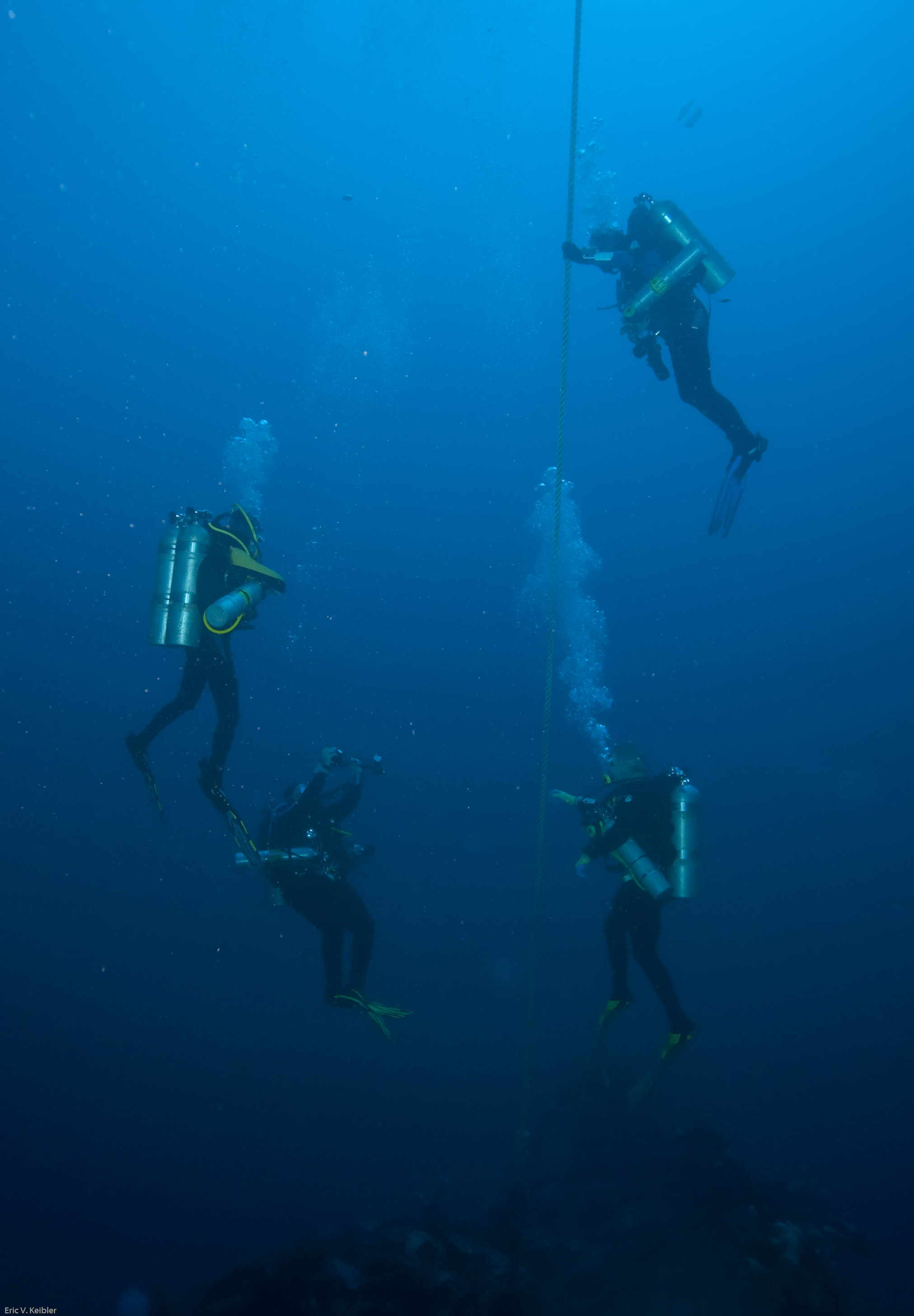
Divers on DecoPart of being a self-sufficient diver is having the necessary redundant life support equipment and safety equipment on with you on a dive.  This does not mean that you carry everything in your dive bag underwater with you, but rather, the items you need to execute the dive you have planned safely with back-up and safety equipment that you believe you will need or may need on the planned dive.  The items a technical diver might carry are:

  • Primary light
  • One or two back-up lights
  • Spare mask
  • Diver’s tool
  • Spare cutting tool (shears, knife, z-knife, etc)
  • Surface marker buoy (SMB)
  • Second SMB
  • Emergency SMB
  • Reel
  • Spool(s)
  • Whistle
  • Lifeline GPS radio
  • Strobes
  • Wet Notes
  • Slate
  • Bailout tables
  • Cable ties
  • Goodie bag
  • Lift Bag
  • Tools

 To safely carry these items underwater, you need to be able to store them out of the way.  We do this using bungee or inner tube on the straps for some things, bungee on the sides of the plate and or under the plate for others.
However, there is only so much room on the plate and straps, so adding pockets will give you more room to stow the equipment you have decided to carry.  There are a number of pocket styles that you can use with your kit.  The most widely used pockets are those that fit on the harness waist strap.  Horizontal pockets are the most traditional and are designed to carry flat items like slates, wet notes, small lights, whistles, etc.  Traditionally, they are not wide or long because of the limited “real estate” on the waist strap.  I am a fan of horizontal pockets but I do not carry too many items in a pocket. 
Another pocket style is a waist pocket with a vertical orientation.  These can either be thin like the horizontal pockets or bellows style pockets which expand to allow for more items to be placed inside.  Again, you still have the problem with limited “real estate” on the waist strap.  Some divers like vertical pockets and on some dives I have added a small spare mask pocket to the waist strap.
Dry suit divers discovered a solution to this lack of room on the waist belt years ago.  They added thigh pockets onto their suits.  You will now see wetsuit divers adding pockets to their suits as well.  Of course, if you have multiple suits you have to glue pockets on each suit.  One other thing to keep in mind is when your suit wears out, you have to cut off the pocket and re-glue it to your new suit. 

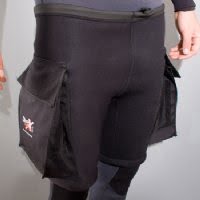
Dive X-Tras Shorts
Dive X-Tras Shorts
Another method of adding pockets to your wetsuit, is to use diving shorts with pockets included.  These shorts are basically neuprene shorts with two bellows pockets attached. 
The major problem with pockets on your thighs or hips is drag.  When these pockets are full, they add about two to four inches to your profile.  But remember, everything is a compromise and if you need the space, they are great to have but there is a trade-off.
Before deciding which system is right for you, you need to decide what items need to fit in the pockets. Do you need to carry flat items like slates and tables only or do you want to keep a spare mask and SMB handy? 
My personal choice is a horizontal pocket on the waist strap with the addition of other pockets as I need them.  While I have pockets on my drysuit, I only use them for small items like spare spools.  Your decision may be different based on your style of diving and how you want to store your equipment for a dive.

Filed Under: Open Circuit, Rebreathers, Scuba Diving Equipment Tagged With: buoyancy, Equipment, Pockets, Storage, Trim

  • Page 1
  • Page 2
  • Go to Next Page »

Footer

Contact Us

Oceanic Ventures, Inc
5808 Newcastle Dr.
Houston, TX 77401-3214
USA

Phone: 713-523-DIVE (3483)

eMail: divesafe@oceanicventures.net

Signup for our dive and scuba newsletters

Don’t miss news about the exciting happenings at Oceanic Ventures.


Map and Directions

Socialize

  • Email
  • Facebook

Why People Choose Us

People choose their friends carefully just as they should choose their adventure partners and Scuba Diving Instructors.  Oceanic Ventures is the premier scuba dive shop in Houston, Texas, and the Southwest because of our exceptional service and our sense of adventure.  In talking with our clients and friends, people choose us for a number of reasons such as: Passion – We love what we do and we want to share the beauty and excitement of the underwater world with everyone we meet. Caring- Our clients tell us they love us because we truly care about people and strive to make their scuba diving experiences safe, fun and enjoyable. Professional – Our staff members are the … [Read more …]

Copyright © 2026 all rights reserved Oceanic Ventures, Inc. · Sitemap · Log in