• Skip to primary navigation
  • Skip to main content
  • Skip to footer

Houston's Premier Scuba and Dive Shop Oceanic Ventures Inc.

(713) 523-3483 (dive)
5808 Newcastle Drive
Houston, TX 77401

  • Home
  • Stay Current
    • Our Blog
    • Travel and Events Calendar
    • Club Aquarius Social Club
      • Club Aquarius Social Club Upcoming Events
      • Club Aquarius Social Club – The Past
    • Special Events
    • Local Scuba Diving Events
    • Photography Contest
    • Categorized Blog Posts
  • Equipment
    • Dive Equipment
    • Rebreather Systems
    • Cruise Ship Passengers
    • Repair & Maintenance
    • Air & Mixed Gas Blending
    • Pure Fiji Spa Products
  • Training
    • Become a Scuba Diver
    • Scuba In Your Home or Ours
    • Diving Programs for Young Explorers
    • Recreational Dive Courses
      • Recreational Dive Courses overview
      • The Briar Club Scuba Program
      • West University Scuba Program
      • Houstonian Scuba Program
    • Technical Diving Courses
      • Basics
      • Nitrox
      • Trimix
      • Rebreather
      • Wreck Diving Programs
      • Cave Programs
      • Blending
    • Leadership Dive Courses
  • Travel
    • Travel Escorted Adventures
    • Travel – Other Travel Programs
    • Travel – Custom Travel Adventures
    • Local Scuba Diving Events
    • Technical Travel
    • Scuba Diving Around Texas
    • Travel Insurance
    • Travel Forms
  • Company
    • About Oceanic Ventures
    • Meet Our Team
    • Testimonials
    • Facility Hours
    • Map
    • Oceanic Ventures Foundation
    • Resources & Articles
    • Archive
  • Shop
    • Online Store
    • Cart
    • Checkout
    • My Account
    • Policies regarding Privacy and Purchases
  • Contact

Blog

July 27, 2020 by Carl Strange

Fiji – Saweni Bay

17o28S / 177o24E

At least I hope we have left the west coast of Viti Levu and are snuggly anchored on the tiny island of Waya in the southern portion of the Yasawa group.  No cities, no streets, and fewer day charter boats the further north we go

Communications – What we use on Enchante

REbecca Strange on the Radio
Rebecca Calling Out

Long-distance cruising boats need long-distance radios.  VHF works for harbor and anchorage communications but its line of sight and limited to 10-15 miles even with mast-mounted antennas.  Up until the mid-80s or so cruising boats had Ham radios because commercial Single Side Band Radios (SSB) were much, much too expensive.  You took the Morse code and written exam and talked around the world for free.

SSB radios got cheaper and Morse code never quit being a pain so more and more boats started using SSBs  Only commercial, frequency-controlled radios can be legally used on SSB frequencies.  Typically these radios are electronically, restricted to the SSB bands and frequencies.  Ham radios cannot legally be used on the SSB frequencies and are electronically restricted to the ham bands.  However, Ham radio operators consider themselves radio experimenters and the helpful manufacturers make it trivial to disable the frequency restriction allowing the radio to transmit on any frequency.  I would be shocked to find a Ham radio on a cruising boat that hadn’t been altered to work on both Ham and SSB frequencies.  When pressed, the ham can point to the regulation allowing any form of communication in an emergency.   In reality, the bands are poorly policed, especially internationally.  For instance, there is a legal requirement to identify the ship station by radio call sign such as WB5ABC.  The great majority of boats simply use their boat name.  I would have to dig out my license to look up my Ship’s Station License.  In the real world, I am “Enchante“.  Ham frequencies are more disciplined and there I am known by my ham call sign.

For voice communications, it hardly matters if you install an SSB or Ham radio with the band restriction disabled.  Ham does give you access to a more formal system of “nets” stateside.  For instance, the Ham-operated Pacific Seafarers Net meets nightly to track boats traveling in the Pacific.  This is a friendly net that runs a formal roll-call of boats underway.  If you declare yourself underway you are expected to check in each evening.  Should you miss a couple of evenings, the net will get seriously “interested” in finding you.  If you are within a day of your destination, they’ll let you slide a couple of days assuming you are sleeping like a log after a long trip or tied up with Customs/Immigration procedures.  However, if your last report had you well offshore or you miss more than a couple of days the net will begin to alert authorities and ultimately will initiate a full-fledged search.  Hams check into this net knowing it is a lifeline should something go wrong.  A more informal SSB net has a much more relaxed attitude about “missing” boats and the daily operator will typically shrug your absence off with something like, “Guess they forgot”.  I suppose I prefer the more formal Ham approach when traveling far offshore.  On the other hand, most of the useful information about cruising areas, island check-in procedures, problem-solving “why does my starter make this noise?“, and general boat-to-boat chat is carried out on the SSB bands.  Hence the popularity of modified Ham rigs.

A huge advance in communications for cruisers started in the mid-90s with the introduction of Email via Ham radio.  Although it was painfully slow in the beginning, the ability to send and receive email brought new life to Ham Radio.  The software and hardware were developed by Hams for Hams.  Being Ham radio the software and shore-based service are completely free.  Of course, these guys aren’t dummies and quickly recognized a commercial market was needed to service all those boats with SSB radios since it’s perfectly legal to charge for services on these frequencies.  All of a sudden boats can send and receive mail daily instead of waiting for the three-month, bulk mail delivery that contains more junk mail than letters. 

Hams get email communications for free all around the world.  SSB users pay an annual fee and are allocated something like 15 minutes daily.  For a complete description check out K4CJX’s website or search for SailMail.  This mode of communication is advancing quickly.  Last year I could download weather faxes for fixed areas of the ocean.  This year I can download animated, wind, and isobar computer models for a multi-day forecast over any area of the ocean I’m interested in.  This is a huge improvement in forecasting weather for a voyage.  While anchored in Fiji I can request a five-day forecast extending all the way to the SW corner of Australia.  By watching the winter fronts developing over the Tasmanian Seas I can pick a decent departure time and not get clobbered by a cold front during the 1000-mile voyage to New Zealand.  At least that’s my plan ;-).

There are many sources of information on radio installations.  Being a ham I sometimes like to play around with different antenna designs.  Most boats install insulators on their back stays to electrically isolate a long piece of wire.  They run an antenna feed line and use this long portion of their backstay as an antenna.  I can’t understand doing something silly like breaking up such an important piece of standing rigging with insulators and spending a bunch of money to do so.  If one of those expensive insulators breaks you lose your rigging.  I ran a separate length of 14-gauge wire from the stern of the boat to the top of my mizzen mast.  The ends of this antenna are electrically isolated from the rig with two $1 egg insulators and a couple of short lengths of string.  The lower portion of the antenna is tied off at the rear end of the solar panel mount so the antenna doesn’t run right alongside the back stay.  This antenna works great and I don’t have to worry about compromising my rigging.  My 14-gauge wire (or an insulated backstay antenna’s feed line) leads through a deck fitting and connects to an automatic antenna tuner tucked away in a back locker.  Again, lots of information is available on recommended lengths of antennas and installation.  Like everyone says it is vitally important, and a royal pain, to install a good ground system.  Karen and I spent days running 3″ copper straps.  Now we have tied together an external cast-iron keel, fuel tank, engine, solid lifelines and other odds and ends.   The more connections we made the better signal reports we received.

Icom IC-7100 multi-band radio
The Icom 706MKII is no longer available but a new alternative is the Icom IC-7100

Finally, my Ham radio is a small little Icom 706MKIIG connected to a matching Icom automatic antenna tuner.  The radio is modern enough to support digital communications and happily mates with the popular SCS PTC-IIe radio modem upgraded to PACTOR Mode III.  All of this jargon can be cleared up by visiting the mentioned K4CJX website.  Basically, my Dell laptop is connected to the radio modem which, in turn, is connected to the radio.  Dell runs a free email program (AirMail) that sports the familiar email interface.  Airmail also knows how to control the radio modem and radio to send and receive messages.  Traveling in the South Pacific we have a wide selection of Ham stations in the States, New Zealand, and Australia.   The same software and SCS modem can be used with a variety of radios – check the web.

Carl Strange Avatar
Carl and his wife Karen set-off on a journey around the world on-board their sailboat S/V Enchante. Along the way, they had a lot of adventures and in Aruba, a new member of their crew was born. Now a family of three with Rebecca’s birth, they sailed the Caribbean and the Pacific experiencing life along the way.

Filed Under: Sailing Tagged With: S/V Enchante

July 20, 2020 by Carl Strange

Fiji – Malolo Lai Lai Island

017o45S / 177o14E It’s easy for cruisers to get trapped for weeks and weeks at the Musket Cove Yacht Club, Fiji.  The first step on the slippery slope is picking up a mooring and opening a charge account.  Then you tune your VHF radio to channel 68 and start getting involved in daily activities.  Our six-year-old daughter quickly made friends with a very nice seven-year-old girl on another yacht.  The nearby family resort has a children’s activity center with games, shirt painting, a swimming pool, hermit crab races, island crafts, and on and on.  Our days were filled with shuttling the two girls between the two boats and to activities on shore.  Homeschooling was put on hold since the girls had plans from morning to early evening. 

While the kids were having fun the parents were enjoying the convenience of charging supplies and the local store, picking up wonderfully fresh bread for the bakery and arranging evening BBQs and the outdoor bar near the end of the dinghy dock.  The famous “One Dollar Bar” at Musket Cove had been a cruisers’ hangout for years.  While the name and drink price have changed to “Three Dollar”, the bar is still crowded most evenings.  Several BBQ pits are stocked with wood daily.  You bring your meat and side dishes, build a fire, grab a table with your friends, pick up plates, silverware, and condiments at the bar, order a couple of beers during dinner, and return all the dirty dishes when you are done.  Everything is free except for the $3 drinks ($1.50 US) so it’s a very cheap, enjoyable way to spend the evening meeting other cruisers and exchanging information.

After two weeks at Musket Cove, we headed over to the west coast of Viti Levu and the delightful little town of Latoka – the Sugar Capital of Fiji.  Again a resort offers free access to it’s beach as a dinghy landing and the local bus service provides cheap rides to the market.  Here we’re stocking up on fresh vegetables, and meat and filling up on diesel for an extended visit to the remote Yasawas.  The only downside to this area is the murky water and the ash settling on deck from the burning of the sugar cane fields after the harvest.  Three days here will be enough!

I’ve managed to do all of two dives here in Fiji.  Everywhere we’ve visited the water has been murky or the coral dead.  The outer reef at Astrolabe might have been beautiful but the winds blew 25 knots all the time we were in the area and dinghy rides were restricted the our island anchorage.  Other boats have said the water in the Yasawas is clear and the diving nice.  Perhaps I can get in a quick 98 dives over the next few weeks?  How’s the 100 dive challenge going?

Carl Strange Avatar
Carl and his wife Karen set-off on a journey around the world on-board their sailboat S/V Enchante. Along the way, they had a lot of adventures and in Aruba, a new member of their crew was born. Now a family of three with Rebecca’s birth, they sailed the Caribbean and the Pacific experiencing life along the way.

Filed Under: Sailing Tagged With: Fiji, The Strange Chronicles

July 13, 2020 by Stefanie

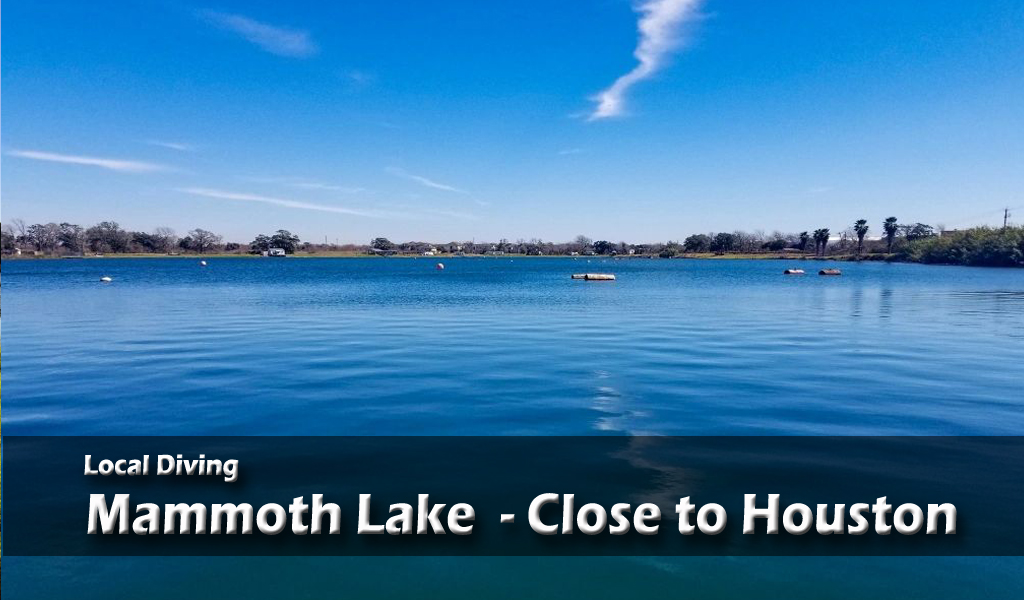
July's Local Diving Event – Mammoth Lake

Where would you like to be right now? I am guessing that it is not at home watching YouTube videos or the video from your dive trip last year. The COVID-19 world we are living in right now is making diving a little more challenging. But you can still get wet and enjoy visiting your fellow divers albeit from 6 feet away or in a mask.

On July 18th we are headed down to Mammoth Lake in Clute (Lake Jackson area). This local lake boasts the only divable C130 in shallow depths as well as fighter jets, boats, saltalite disks, a wooly mammoth, king kong and other sites that are just waiting for you to explore.

We will have a BarBQ grill there so you can cook your favorite picnic treat or maybe bring that traditional southern picnic food — cold fried chicken! If you don’t feel like cooking your favorite southern treats, Asiels is on the lake too and they offer curbside pickup and even delivery! You can find their menu here.

If you are interested in joining us here’s what you need to do...

  • Send us an email to let us know before Friday afternoon.
  • Complete the Oceanic Ventures Event Waiver and email it back to Dive Mom
  • Complete the Mammoth Lake Waiver
  • Pick-up a cylinder and any rentals you may need
  • Pack up your car (don’t forget a tarp and your mask)
  • Meet us at the Lake at 9:00 to start diving!

Do you have any questions? Cann Eric or Ann and we’ll try and make something up (ok, we will try and get the answer for you!)

Filed Under: Local Diving, Social Activities Tagged With: local diving, Texas Diving

July 13, 2020 by Stefanie

July’s Local Diving Event – Mammoth Lake

Where would you like to be right now? I am guessing that it is not at home watching YouTube videos or the video from your dive trip last year. The COVID-19 world we are living in right now is making diving a little more challenging. But you can still get wet and enjoy visiting your fellow divers albeit from 6 feet away or in a mask.

On July 18th we are headed down to Mammoth Lake in Clute (Lake Jackson area). This local lake boasts the only divable C130 in shallow depths as well as fighter jets, boats, saltalite disks, a wooly mammoth, king kong and other sites that are just waiting for you to explore.

We will have a BarBQ grill there so you can cook your favorite picnic treat or maybe bring that traditional southern picnic food — cold fried chicken! If you don’t feel like cooking your favorite southern treats, Asiels is on the lake too and they offer curbside pickup and even delivery! You can find their menu here.

If you are interested in joining us here’s what you need to do...

  • Send us an email to let us know before Friday afternoon.
  • Complete the Oceanic Ventures Event Waiver and email it back to Dive Mom
  • Complete the Mammoth Lake Waiver
  • Pick-up a cylinder and any rentals you may need
  • Pack up your car (don’t forget a tarp and your mask)
  • Meet us at the Lake at 9:00 to start diving!

Do you have any questions? Cann Eric or Ann and we’ll try and make something up (ok, we will try and get the answer for you!)

Filed Under: Local Diving, Social Activities Tagged With: local diving, Texas Diving

July 13, 2020 by Carl Strange

Fiji – Mamanuca Islands

We’re currently enjoying life at the famous Musket Cove Yacht Club.  Basically, cruisers hang out next to a nice resort.  I suppose we’re all part of the tropical scenery for the resort guests so management doesn’t mind having us around.  Besides we pay a modest mooring fee and buy beer at the bar.  This is my first “yacht club” membership.  Lifetime membership costs $1 Fiji (50 cents US) but to qualify you have to have sailed at least 1000 miles from a foreign port.  No burgee or T-shirt to buy but they do carve your name, year, and yacht name in the beams at the fancy restaurant.  Look for ours when you come through.  From here we’ll head to Vanuatu or New Caledonia before heading back down to New Zealand for the next cyclone season.

I finally gave up on my old Windbugger and replaced it with a new KISS generator built in Trinidad.  More power, brushless motor, fiberglass case and all new parts.  What a treat to have something new on the boat.

Our combined power generation is the wind generator, five solar panels (18 amps with the sun directly overhead), a shaft driven alternator (10-15 amps) while sailing, and a 190 Amp alternator for the house batteries.  In the trade wind belt, with days of continuous 15-20 knot winds and bright sun through scattered cumulus clouds, a typical output from the KISS wind generator is 8-10 amps and, during mid-day hours, solar provides 12-15 amps.  Our Grunert refrigeration and Spectra water maker are both 12 volts and we can sometimes rest at anchor for days without running the engine for charging. 

Of course, there are plenty of days with no wind and solid overcast skies when we run the engine for one and 1/2 hours.  The four liters of diesel consumed gives us a cold ice box, solidly frozen meat in the freezer, and 24 gallons or so of very fresh water.

Our water heater works by circulating engine cooling water.  I’ve seen systems with electric elements and know boats that shunt extra power from wind and solar into making hot water.  After a couple of days without running the engine we resort to a more basic solar heater – green, 2-liter soft drink bottles laid on the back deck.  They get plenty hot after a couple of hours.  The only problem is getting around to taking your cockpit shower right after your sundown gin & tonic.  If we wait too long and the heat quickly leaves the bottled water.

The Spectra water maker continues to work well.  It truly produces 16 gallons/hour drawing only 16 amps.  I definitely prefer the flexibility of a 12-volt (or 110-volt with generator) over mounting the high-pressure pump to your main engine.  The flow rate of the pump, and subsequent system pressure, depend on the RPM of your engine.  With a belt-driven system, you have to decide if the water maker is going to run at idle or motoring speeds and size the drive pulley accordingly.  With a 12-volt (or 110-volt) system you can run the system whenever you have sufficient power.
We have been relaxing in Fiji and enjoying some of the local entertainment.  shipped home a kava bowl and some carvings.  There’s also a few bundles of kava in the forward head and a bag of ground stuff somewhere on the boat.

Carl Strange Avatar
Carl and his wife Karen set-off on a journey around the world on-board their sailboat S/V Enchante. Along the way, they had a lot of adventures and in Aruba, a new member of their crew was born. Now a family of three with Rebecca’s birth, they sailed the Caribbean and the Pacific experiencing life along the way.

Filed Under: Sailing Tagged With: Musket Cove Yacht Club, S/V Enchante, Sailing, The Strange Chronicles

  • « Go to Previous Page
  • Page 1
  • Interim pages omitted …
  • Page 26
  • Page 27
  • Page 28
  • Page 29
  • Page 30
  • Interim pages omitted …
  • Page 96
  • Go to Next Page »

Footer

Contact Us

Oceanic Ventures, Inc
5808 Newcastle Dr.
Houston, TX 77401-3214
USA

Phone: 713-523-DIVE (3483)

eMail: divesafe@oceanicventures.net

Signup for our dive and scuba newsletters

Don’t miss news about the exciting happenings at Oceanic Ventures.


Map and Directions

Socialize

  • Email
  • Facebook

Why People Choose Us

People choose their friends carefully just as they should choose their adventure partners and Scuba Diving Instructors.  Oceanic Ventures is the premier scuba dive shop in Houston, Texas, and the Southwest because of our exceptional service and our sense of adventure.  In talking with our clients and friends, people choose us for a number of reasons such as: Passion – We love what we do and we want to share the beauty and excitement of the underwater world with everyone we meet. Caring- Our clients tell us they love us because we truly care about people and strive to make their scuba diving experiences safe, fun and enjoyable. Professional – Our staff members are the … [Read more …]

Copyright © 2026 all rights reserved Oceanic Ventures, Inc. · Sitemap · Log in