Topside, this was the most unimpressive dive site I’d ever seen, with docked cargo ships and unpleasant noises and smells of industrial activity. Descending to the sand at about 20 feet did not prneude much inspiration as we were greeted by some rusted cans and a baby’s diaper (used, apparently). I was left wondering why the boatload of experienced divers and divemasters was so keen on this site.
Dumaguete is on the Bohol Sea in Negros Oriental, Philippines, approximately 30 hours from Houston via Honolulu, Guam and an overnight in Manila. It is an absolutely fabulous dive location, at the northern portion of the “Coral Triangle”, the region of the greatest coral reef biodiversity in the world, and therefore well worth the arduous trip from Texas.
 The pier at Dumagute was no exception; it turned out to be the richest site of photo opportunities and encounters with weird and wonderful creatures in Negros Oriental. In this photo I was lucky to capture some very interesting behavior between 2 similar looking fish species, and equally fortunate to have Marco Inocencio from Atlantis Dive Resort interpret the activities. According to Marco, the larger fish in the hole is a false cleanerfish (Aspidontus taeniatus), while the two smaller fishes that are shown in full view are cleaner wrasses (Labroides dimidiatus). The larger fish is a mimic; it’s actually a member the blenny family who is posing as a cleanerfish in order to take bites of skin and flesh from other fishes looking for a cleaning. The false cleanerfish is distinguished from the cleaner wrasses by its head, which ends in a “nose” with its mouth slightly under and behind it while the heads of the cleaner wrasses terminate with their mouths. If you look closely enough you’ll see the characteristic pouty lips of the false cleanerfish, presumably because she isn’t much appreciated for her clever disguise and food-gathering methods!
Blog
Creating Exciting Photographic Scenics

Try and capture what you are seeing and experiencing. Digital photography makes it easy to experiment. Look at how the sun plays off the leaves, trees, bark, water droplets; see how it illuminates the spider web or causes the water to shimmer.
When the sun is hidden behind a flat white sky, look for textures and contrasts.
In his article about landscape photography (PhotoSecrets.com), Mark Fenwick encourages his readers to look for:
- Light -shadows and highlights,
- Shapes – round and angular,
- Colour – harmony and discord,
- Texture – rough and smooth,
- Composition – strong and weak,
- Tones – light and dark
- Patterns – even and odd,
- Mystery.
While you are exploring, move around your subject. Look for alternate vantage points and angles. If you can, try it at different times of the day. By mneung around and exploring a site at different times, the landscape will reveal more to you.
You can also try using different lens apertures. Ansell Adams is well known for shooting everything at f22 in order to capture all of the detail in his scenes. You can also use that depth of field to your advantage by blurring an unattractive or distracting foreground while keeping the remainder of the scene in sharp focus.
You can always start with the standard shot of an area but then start experimenting. Move around, lay on the ground, climb a tree, blur the foreground, or frame the image with a tree of bush. You can change the perspective by switching from a wide angle lens to a telephoto lens or have a little fin and try a fish eye lens.
Enjoy your photographic safaris or walks and learn to see what is happening at the moment you are there. Don’t settle for a standard shot, experiment and try something different.
Dave Talks About Rebreathers – Part 3

A: The key question that I had to answer before I began using a rebreather was, “Why do divers die on a rebreather.” The short answer is rebreather divers die when they forget or stop believing that the laws of physics apply to them.
Q: But when the above mentioned have failed for one reason or another, the next law implied should be survival. Would not the presence of a partner/buddy in close proximity of you, help?
A: Rebreathers are not complex machines but they do require one to setup them properly. Most accidents can be traced to actions or inactions on the surface. Even that, most times does not kill divers, it then takes ignoring warning signs. Generally a rebreather setup properly just works. Monitor it and you will be fine. From the accidents I have been able to research 99% have been diver error. When I use my rebreather I always tell myself the laws of physics still apply to me and complacency and stupidity kills. The definition of an accident is the lost of control. Typically there is a series of events each of itself not causing a loss of control but together causes an accident. Breaking the chain of events prevents the accident. When using a rebreather this is done by paying attention and following your training.
Q; When I dive with my partner/buddy, I have to be honest, I feel as though I am somewhat responsible for his safety, and he mine.
A: When I dive with someone I tell them that no matter what, I am coming back safely. Implied by that is I will drag their sorry butt back also, but I need to know where they are at.
In the Company of Big Animals
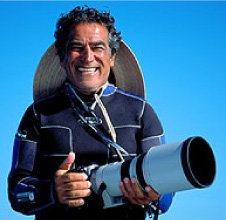 I want to introduce you to Amos Nachoum, a self-proclaimed Ambassador of the Big Animals. He is an award winning photographer who has publised photographs in magazines around the world including National Geographic. In a presentation Amos made top the Explorer’s Club in New York City, he said “to live up to that ambassador role I’ll be in the city, presenting my best stories and information about some of the most fragile regions of the underwater world. I’ll be showing and discussing photographs from my expeditions around the world and will probably include a few “classics” from the hundreds of my images that have appeared in National Geographic, Time, Life, The New York Times, Condé Nast Traveler, Le Figaro, and Der Spiegel. You can also see more of my images on my website, plus news about my latest expeditions. It’s all part of spreading my message that only through observation and interaction with these animals can people understand and respect some of the most impressive citizens of our planet. In a few words, “you have to go there and experience this firsthand.” Amos recorded a presentation for Google entitled “In the Company of Big Animals.” You will hear Amos and he talks about his expeditions and shos his photographs. Sit back, pour yourself a cocktail and be prepared to be wowed…
Dave Talks About Rebreathers – Part 2, CO2

As for a CO2 hit, the symptoms are headaches, rapid breathing then unconsciousness. When in doubt bailout.
Q: On open circuit, I breath very lightly, but it would seem to me that, that style of breathing would not lend itself to rebreather?
All rebreathers have unidirectional gas flow. This is done via flapper valves on either side of the bailout valve (BOV). Breathing type or rate is irrelevant to the movement of gas within the loop. There are some issues related to dwell time in the scubber media in extremely rapid breathing conditions. This would be a CO2 issue.
Q: Is it the outside pressure exerted on the counter lungs that forces your breath through the scrubber, and thus returning it to you?
As your lungs expand the counterlung collapses, as you exhale the counter lung expands, pressure on one cancels out the other. External pressure is not relevant, but gas density is however. Counterlungs are but one part of the loop. Work of breathing (WOB) is the resistance encountered. Commercial rebreather units have to have acceptable WOB else no one would buy them. Some units are better than others.