We will be publishing more trip information in January but you can always send Dive Mom a note to find out more before then. You don’t want to miss this opportunity!

I don’t even want to talk about how far behind the “chronicles” are. We have had some wonderfully interesting experiences since I last wrote. Honestly, I’ve been too busy to write, do boat work, or much else but play and sleep.
We just spent two weeks in the tiny, isolated Swarrow (Suvarov) lagoon in the central Cook Islands. Our time was spent learning from the remarkable 72-year-old caretaker of this park. We hunted coconut crabs, had potluck dinners with 30 lobsters, made fishing lures from black pearl oyster shells and coconut husks, went out fishing for 30 minutes, and came back with a 60-pound yellowfin tuna (tons and tons of sushi that night), and generally exhausted ourselves. Mornings started early and we never got back to the boat before 10 PM.
We finally had to leave to get some rest. We are three days into the six or so required to get to southern Tonga (17*42S / 169 59W). We blow through Tonga on our way to NZ since we’re planning to spend next year cruising in that area.
As we leave the Marquesas, here are a few family photographs…


Your Wasabe Wings sounds like something we’ll try when we reach somewhere with propane refills. We are being fairly conservative with our supply of propane since we don’t have French Poly. adaptors and don’t want to pay their outrageous prices. As a side note, it might be interesting to see just how much money the French government doles out to each individual islander. We balk at $3 for a small box of cookies – the locals walk out with handfuls. Few of them seem to have jobs – store clerks, post office employees, dump truck drivers. Lots of folks sitting, swimming, drinking, and generally enjoying life [Carl is talking about the locals and not the cruisers visiting the island].
Got to go. Another boat is due for smoked salmon and champagne in a few minutes. A celebration and thanks for the work they did to help us with the repairs. I need to be slicing limes and onions instead of typing.
We’re still in the Tuamotus anchored in tiny little Tahenea. This is a large lagoon with no distracting village and only one other boat to play with. The numerous grouper make it simple to get dinner so I should have plenty of time to write. We’ll linger here for a bit over a week then make the 250 or so miles to Tahiti. Looking forward to fresh vegetables and fruit after a steady diet of coconuts We are also looking forward to the big dance festival that happens next month.
I loaned one of my Mares Cyrano spear guns to a guy we’ve been buddy-boating with for several weeks. He is just learning to snorkel and hunt and is having a great time on the reefs. We split up for a few days to enjoy our individual islands at the lovely, unpopulated, Tahanea atoll in the Tuamotus. Today he told me, with a hang-dog expression, he had lost a spear. He’s especially embarrassed since he was doing something stupid – shooting a small shark off the back of his boat. Apparently, he hit the thing, it snapped at the line, bit it in two, and swam off with an embedded spear. He’s amazed he did something so silly since he couldn’t have dealt with the shark on board and had no idea what he was going to do with it anyway. Reminds me of hunting sparrows with my BB gun! Anyway, he has offered to buy me a new spear, once I find out the price for one.
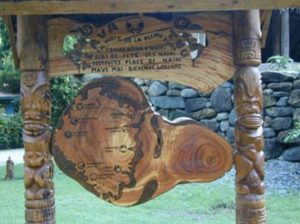
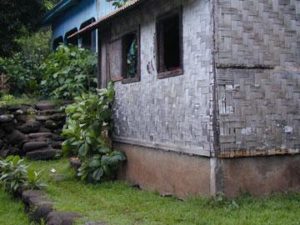
We have enjoyed walking around the island. The people here all seemed to love landscaping with flowers and plants. The whole village was lovely. We passed out several packets of Impatient and Zinnia seeds to the delight of the recipients. Got gifts of bananas, pamplemouse and limes in exchange.
Throughout the islands, we found some huts with walls woven out of coconut palms. However, they are not really used in regular housing anymore but they make useful sheds and snack bar walls. We saw a few women and older children weaving mat fronds in an assembly fashion. The kids split the fronds and lay them out. The women smoked hand-rolled cigarettes, talked, and joked as they wove. It only took a few minutes to make each section. A useful process to know when you need a quick bit of shade or something clean to sit on around a beach fire. We still need a bit of practice to make them well.
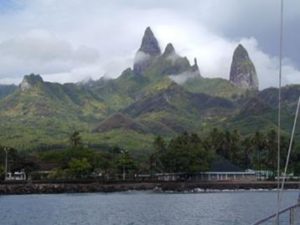
Try to find two delightful stories – the creation myth of the Marquesas and the revenge of Mataheuna. You’ll know you’ve found the right myth if the story is about a man and a woman in a tropical setting. The woman asks the man to build her a house. He asks the gods for help and the process starts. The name of each island translates into part of the structure. I only remember Ua Pou as being the two beams supporting the structure.
The Mighty Spire Mataheuna was a young rock with a spire from one of the other Marquesan islands that traveled through the island groups smashing the lesser spires to the ground. He swore revenge, grew strong, smote all the other spires, and is regarded as the mightiest to this day.
These stores were told to us by a delightful young man who runs a tiny museum on Ua Pou. Many people have donated items for him to present. He changes his exhibits every three months or so and passes the stories and traditions along especially to the school children. He’s a great storyteller and we really enjoyed our time with him.
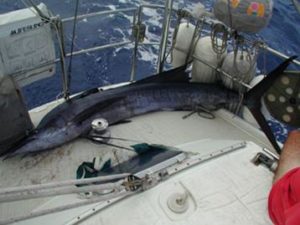
We left the peaceful harbors of Tuamotus to continue our explorations. One day out we hooked a 9-foot marlin. That is it measured 9 feet from head to tail and we didn’t include the spear shaped snout. Getting it onboard was a two-hour struggle.
I broke my favorite cleaver trying to cut steaks. Then I switched to a hack saw to cut through the spine but soon gave up on that. Finally, we spent a couple of more hours cutting it into fillets. We gave lots of fish away and I can’t count the number of ways we prepared it. Next time we’ll release anything over four feet or so.
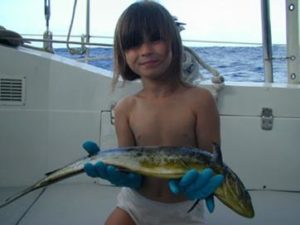
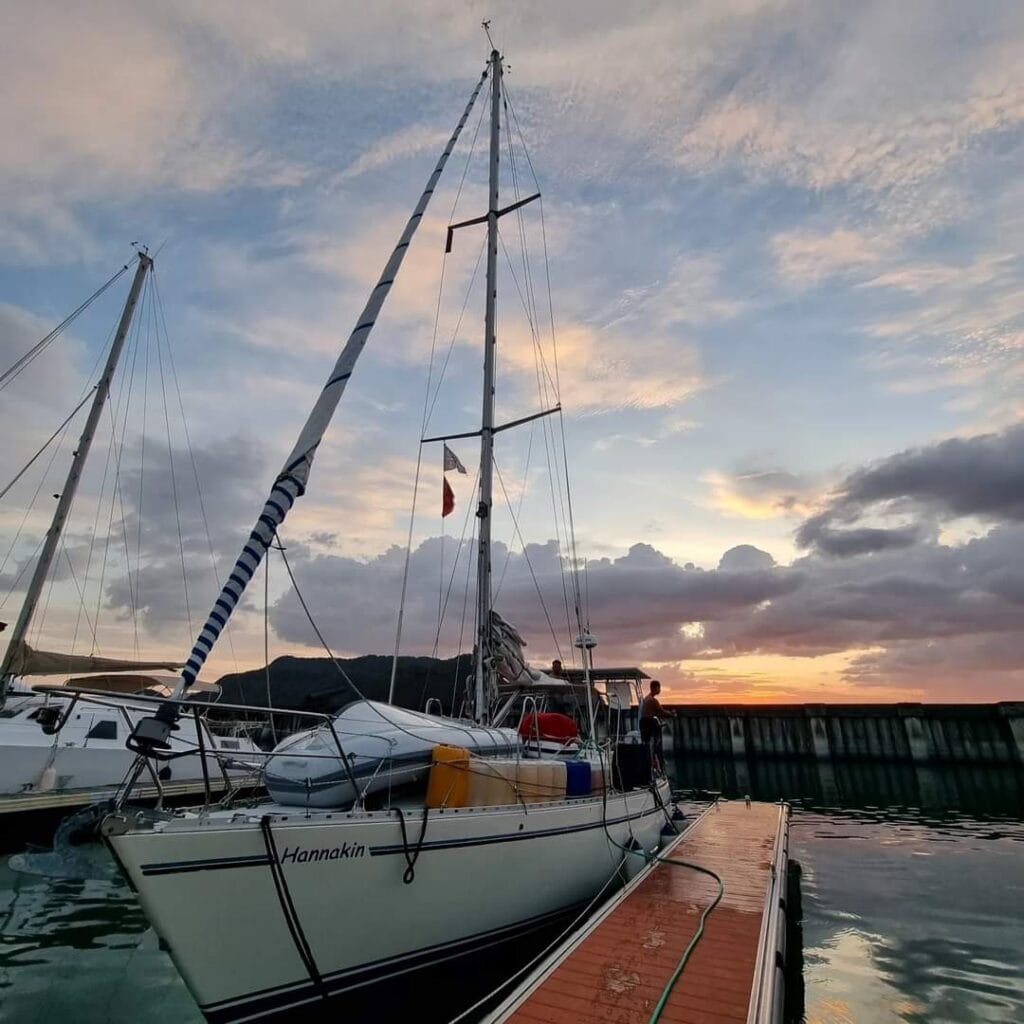
Okay, okay, okay! I just checked the running “From the Log of…” and it has been a while since our last update. Just for your information, we arrived safely in Fatu Hiva and stayed for a few days. The morning winds, that blasted down the mountains, drove us away quicker than we would have liked. Since then we’ve checked in at Atuana, Hiva Oa, and spent a few nights anchored at isolated spots on Hiva Oa and Tahuata. We’re traveling in loose company with a British couple on S/V Hannakin.
The general plan in to be drift diving in the pass of Tuamotu island in a few days.
The locals have been very friendly in the small, outlying villages. The one larger town we visited wasn’t so gracious. Everyone has fruit growing in their front yards and we’ve had no trouble trading for limes, bananas, coconuts, and Pamplemousse. French baguettes are available, hot and fresh, at $.40 per loaf. Sadly, tomatoes, potatoes, cucumbers, onions, and other vegetables are harder to come by. The locals have a few farms up in the valleys but we haven’t stayed in one place long enough to work out a trade.
The man on S/V Hannakin was PADI certified in ’92 and hasn’t been diving since. He asked for a class so we’ll work our way through a quick refresher course and head for blue water.
I have managed my first dive in the South Pacific. A short visit to a pretty reef at 40 feet then an hour of scrubbing the bottom. Our brand new Jotun paint isn’t working well at all. Our paint is black. S/V Hannakin has been in the same conditions with Red Jotun and looks great. Our theory is so much pigment is added to make the paint black that the copper/tin additives end up very diluted.
We’re still moving frequently to get to the isolation of the Tuamotus in fairly short order. Still, I’ll make time to sit down and write another installment of “From the Log…”.
I’m well aware that you haven’t received any updates lately but I have a much better excuse than “the dog ate it”.
Sailing south from Marquesas to Tuamotus we encountered a squall with 30-35 knots of wind. The seas and winds had been building slowly and we were a little slow on reducing sail. We had the headsail about halfway rolled up when we discovered a crack in the only swage fitting on the boat. I’m getting a little ahead of the story – we didn’t actually see the crack until a few days after the squall.
I was hauling away on the furling line and Karen was handling the sheets when there was a loud “Bang” forward. It took several seconds to realize the headsail was completely missing. The top head stay fitting had exploded and the partially rolled up headsail, roller furling system, and several yards of lines had gone over the side. We managed to drop the mainsail before wind pressure took the masts over the side as well. It took a couple of hours of hard work in squally weather to get the failed rigging back on deck and strapped down. Six miles of motoring into the squall took us to a protected bay in Oa Pou where we met our friends on S/V Hannakin.
We spent a couple of days licking our wounds and figuring out how to make temporary repairs. There was no chance of support from the local village since some of the women still knew how to make rope by weaving shredded coconut husks. After several days of exhausting repairs, we enjoyed sea trials on our new rig. Friday we’re stocking up with whatever fresh produce we can find in the local village and Saturday we’re heading towards the Tuamotus. More permanent repairs will be made in Tahiti and we’ll be replacing a lot of bent rigging in New Zealand. But at least we’re a sailboat again.
After the three or four-day sail to Tuamotus, we’ll rest for a day or two. Then I’ll sit down and catch up on our stories from the Marquesas.
All’s well onboard – sorta.
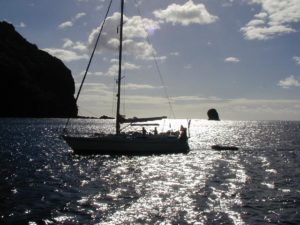
We motored the seven miles from Tahuata to Hiva Oa and anchored in Taahuku Bay. We are here to visit the town of Atuona and legally check into French Polynesia. The town has the necessary gendarme and bank so we can get our paperwork in order and pay our fees. (“Yes sir we came straight from the Galapagos.” “Oh no sir, we didn’t stop anywhere else in the Marquesas before coming to your office!”). We are required to deposit a bond to ensure there are sufficient funds to get us out of the country should the officials decide to do so. These islands have had long years of experience with cruisers arriving, losing their boat on a reef or in a cyclone or perhaps a crew member jumping ship, and the governments are tired of paying the expense to fly them home. Requiring a bond is their simple solution. Our funds will be returned when we check out of French Polynesia in a few months. Meanwhile, we lose a bit of interest and are charged on the currency exchanges – dollars converted to PolyFrancs to pay the bond – refunded in PolyFrancs then converted to dollars. We smile and pay the bond.
Friends have reported the town is wonderful complete with groceries and fresh food — if you come on the right day. It’s been a long time since we visited a place with regular air and sea freight service and the differences are staggering. The stores have much more than simple basic supplies. Of course, the prices are outrageous compared to Central and South America. Knowing this in advance, Enchante’s lockers are packed with almost a year’s worth of food. Karen has done a great job and we need little – mainly pasta, fruit and vegetables. Since these are staples with locals everywhere they are always reasonable. Of course, we splurge on ice cream, even buying some for a couple of other cruising kids Rebecca is friends with. At $7 for three cones, it’s made clear what a “rare” treat ice cream is going to be.
The anchorage is small and rolly so everyone puts out a stern anchor to hold their position in the shifting currents. Of course, this means a snarl of lines and twice as many anchors to drag in a blow. Since we’re held in one position despite the direction of the winds, we lose much of our natural ventilation. This may turn out to be a hot and buggy place. It’s a mile walk over a hill to get into town. The delightful locals are good at spotting cruisers walking on the road and frequently stop to give rides.
Rebecca and I were sitting on a bench in front of one of the little stores while we waited for Karen. We were chatting and enjoying people-watching when a nicely dressed man walked up and said, “Boy it’s great to hear English. Can I talk to you?” He was a young Mormon missionary in his second year of a two-year service in the area.
Fresh out of Utah, he spent a few weeks in Tahiti learning French and Marquesan and came to join a small program in Hiva Oh. Here he lives with a local family and is completely immersed in the language and culture. According to him, the locals are losing their native language to French and English. He can have long conversations with older people but the children spend hours watching satellite TV and can only exchange a few words. There are several churches on these tiny islands and he said we would see many on every one we visited. He is enjoying his service but is getting excited about returning home. We had a nice time chatting and learned a couple of new Marquesan words.
Okay, okay, okay! I just checked the running “From the Log of…” and it has been a while since our last update. Just for your information, we arrived safely in Fatu Hiva and stayed for a few days. The morning winds, that blasted down the mountains, drove us away quicker than we would have liked. Since then we’ve checked in at Atuana, Hiva Oa, and spent a few nights anchored at isolated spots on Hiva Oa and Tahuata. We’re traveling in loose company with a British couple on S/V Hannakin.
The general plan is to be drift diving in the pass of Tuamotu island in a few days.
The locals have been very friendly in the small, outlying villages. The one larger town we visited wasn’t so gracious. Everyone has fruit growing in their front yards and we’ve had no trouble trading for limes, bananas, coconuts, and Pamplemousse. French baguettes are available, hot and fresh, at $.40 per loaf. Sadly, tomatoes, potatoes, cucumbers, onions, and other vegetables are harder to come by. The locals have a few farms up in the valleys but we haven’t stayed in one place long enough to work out a trade.
The man on S/V Hannakin was PADI certified in ’92 and hasn’t been diving since. He asked for a class so we’ll work our way through a quick refresher course and head for blue water.
I have managed my first dive in the South Pacific. A short visit to a pretty reef at 40 feet then an hour of scrubbing the bottom. Our brand new Jotun paint isn’t working well at all. Our paint in black. S/V Hannakin has been in the same conditions with Red Jotun and looks great. Our theory is so much pigment is added to make the paint black that the copper/tin additives end up very diluted.
We’re still moving frequently to get to the isolation of the Tuamotus in fairly short order. Still, I’ll make time to sit down and write another installment of “From the Log…”.
 21 June – Fatu Hiva, Marquesas 10° 27S / 138°29W
Yesterday, we awoke to find the dinghy upside down with our small, 2HP motor in the water. The wind gusts coming down from the mountains are not to be believed. Five dinghies were flipped. Lots of flushing of outboards going on yesterday. Happily we noticed ours quickly and didn’t have any damage from saltwater. We didn’t go to shore in the morning because we simply would not have made it against the winds and chop. It was amazing. In the afternoon, the winds slacked enough that we could go to shore to pick up the bread we had ordered.
The “bakery” is a small wooden shack next to a small house. Flour and other ingredients are mixed in long wooden troughs and the lumpy, round loaves are baked in an ancient looking stone oven. Order a day in advance and pick it up the next afternoon. Unfortunately, the lady had forgotten to write down our order the day before so no bread for us.
We did have a nice time wandering around the small town and visiting with the locals. I carried a nice supply of Chiclets gum and had a great time surprising kids with a small gift. These types of treats are not generally available, word spread quickly through the town and I was constantly approached by shy, smiling children. In a few cases the parents also were delighted by the gum.
I had taken photos on our previous visit and gave a few prints to people we especially enjoyed. Several cruisers have digital cameras and color printers these days and you see prints proudly displayed on walls in houses.
Woodcarvings and tapa cloth prints are much higher priced than in years passed. Cruisers, and tourists in Tahiti, have bid up the prices over the years. We passed on the $150 carved tikis and the $180 manta rays since they looked like something you could buy at Pier One Imports. However we did get hooked on tapa art. Tapa is made by stripping tender young pieces of bark from trees – banyan and mulberry are popular. The pieces are laid on stone and pounded with a wooden mallet to form a thin, fabric looking rectangle. A black ink, made from a local plant, is used to draw very intricate art. Only a small number of ladies create this laborious art these days and now only on a couple of the Marquesan islands. We asked ladies on the street, chased rumors, approached several houses with our best Marquesan “kaoha” and finally found a lady with nice art and very reasonable prices. We bought a couple of her pieces and are delighted with our finds.
The winds died overnight and we were anxious to escape the windy anchorage so we sailed the few miles to Tahuata. It as tempting to anchor in Resolution Bay, named after Captain James Cook’s second ship, but our guide book showed a more protected bay a few miles further north. We joined a few other boats at Hana Moe Noa (Long Sleep).
Our two day stay was spent harvesting coconuts and limes from an abandoned grove, an evening fire on the pristine sand beach and diving on the boat bottom to scrape a few goose barnacles picked up crossing the Pacific.
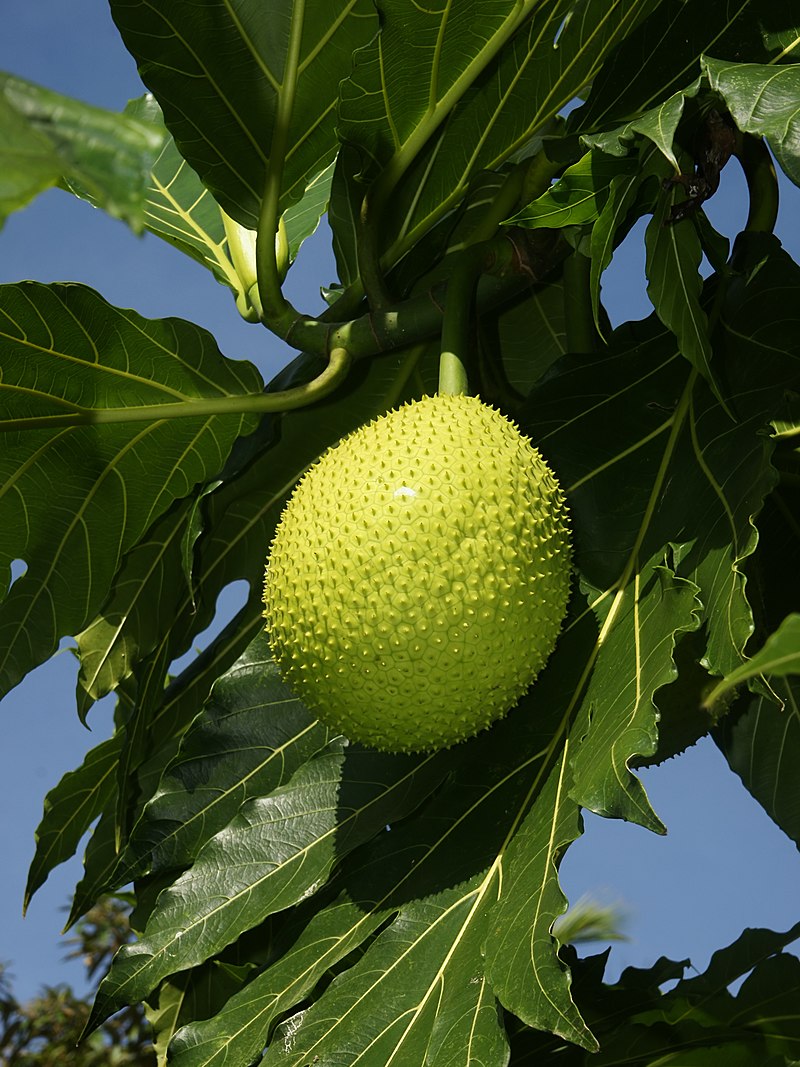

Our new culinary treats are breadfruit and pamplemousse. Breadfruit is supposed to be treated like a potato. We made thin, salted fried chips from ours. It was interesting but I would hate to live off the stuff. Pamplemousse on the other hand is wonderful. This is a very large, sweet grapefruit growing all over the Marquesas. Delightful!
Saute the garlic, onions and tomato in oil. Add breadfruit and meat. Cook until meat and breadfruit are done.
Beat eggs well and add to the breadfruit mixture. Pour into pan. When one side is cooked, turn and cook the other side until done. serve hot.
Saute onion in butter. Blend in flour and add water while stirring constantly. Cook over medium heat until thick. Add taro and mix well. Cook for 5 minutes. Pour cream into the mixture and season. Serve hot. Can substitute breadfruit for taro.