• Skip to primary navigation
  • Skip to main content
  • Skip to footer

Houston's Premier Scuba and Dive Shop Oceanic Ventures Inc.

(713) 523-3483 (dive)
5808 Newcastle Drive
Houston, TX 77401

  • Home
  • Stay Current
    • Our Blog
    • Travel and Events Calendar
    • Club Aquarius Social Club
      • Club Aquarius Social Club Upcoming Events
      • Club Aquarius Social Club – The Past
    • Special Events
    • Local Scuba Diving Events
    • Photography Contest
    • Categorized Blog Posts
  • Equipment
    • Dive Equipment
    • Rebreather Systems
    • Cruise Ship Passengers
    • Repair & Maintenance
    • Air & Mixed Gas Blending
    • Pure Fiji Spa Products
  • Training
    • Become a Scuba Diver
    • Scuba In Your Home or Ours
    • Diving Programs for Young Explorers
    • Recreational Dive Courses
      • Recreational Dive Courses overview
      • The Briar Club Scuba Program
      • West University Scuba Program
      • Houstonian Scuba Program
    • Technical Diving Courses
      • Basics
      • Nitrox
      • Trimix
      • Rebreather
      • Wreck Diving Programs
      • Cave Programs
      • Blending
    • Leadership Dive Courses
  • Travel
    • Travel Escorted Adventures
    • Travel – Other Travel Programs
    • Travel – Custom Travel Adventures
    • Local Scuba Diving Events
    • Technical Travel
    • Scuba Diving Around Texas
    • Travel Insurance
    • Travel Forms
  • Company
    • About Oceanic Ventures
    • Meet Our Team
    • Testimonials
    • Facility Hours
    • Map
    • Oceanic Ventures Foundation
    • Resources & Articles
    • Archive
  • Shop
    • Online Store
    • Cart
    • Checkout
    • My Account
    • Policies regarding Privacy and Purchases
  • Contact

Marquesias

October 17, 2019 by Carl Strange

Hiva Oa in The Marquesas (#8)

23 June Taahuku Bay, Hiva Oa, Marquesas 9 48 S / 139 02 W
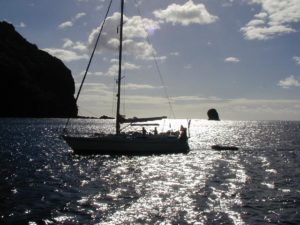
We motored the seven miles from Tahuata to Hiva Oa and anchored in Taahuku Bay. We are here to visit the town of Atuona and legally check into French Polynesia. The town has the necessary gendarme and bank so we can get our paperwork in order and pay our fees. (“Yes sir we came straight from the Galapagos.” “Oh no sir, we didn’t stop anywhere else in the Marquesas before coming to your office!”). We are required to deposit a bond to ensure there are sufficient funds to get us out of the country should the officials decide to do so. These islands have had long years of experience with cruisers arriving, losing their boat on a reef or in a cyclone or perhaps a crew member jumping ship, and the governments are tired of paying the expense to fly them home. Requiring a bond is their simple solution. Our funds will be returned when we check out of French Polynesia in a few months. Meanwhile, we lose a bit of interest and are charged on the currency exchanges – dollars converted to PolyFrancs to pay the bond – refunded in PolyFrancs then converted to dollars. We smile and pay the bond.

Friends have reported the town is wonderful complete with groceries and fresh food — if you come on the right day. It’s been a long time since we visited a place with regular air and sea freight service and the differences are staggering. The stores have much more than simple basic supplies. Of course, the prices are outrageous compared to Central and South America. Knowing this in advance, Enchante’s lockers are packed with almost a year’s worth of food. Karen has done a great job and we need little – mainly pasta, fruit and vegetables. Since these are staples with locals everywhere they are always reasonable. Of course, we splurge on ice cream, even buying some for a couple of other cruising kids Rebecca is friends with. At $7 for three cones, it’s made clear what a “rare” treat ice cream is going to be.

The anchorage is small and rolly so everyone puts out a stern anchor to hold their position in the shifting currents. Of course, this means a snarl of lines and twice as many anchors to drag in a blow. Since we’re held in one position despite the direction of the winds, we lose much of our natural ventilation. This may turn out to be a hot and buggy place. It’s a mile walk over a hill to get into town. The delightful locals are good at spotting cruisers walking on the road and frequently stop to give rides.

Rebecca and I were sitting on a bench in front of one of the little stores while we waited for Karen. We were chatting and enjoying people-watching when a nicely dressed man walked up and said, “Boy it’s great to hear English. Can I talk to you?” He was a young Mormon missionary in his second year of a two-year service in the area.

Fresh out of Utah, he spent a few weeks in Tahiti learning French and Marquesan and came to join a small program in Hiva Oh. Here he lives with a local family and is completely immersed in the language and culture. According to him, the locals are losing their native language to French and English. He can have long conversations with older people but the children spend hours watching satellite TV and can only exchange a few words. There are several churches on these tiny islands and he said we would see many on every one we visited. He is enjoying his service but is getting excited about returning home. We had a nice time chatting and learned a couple of new Marquesan words.

30 June

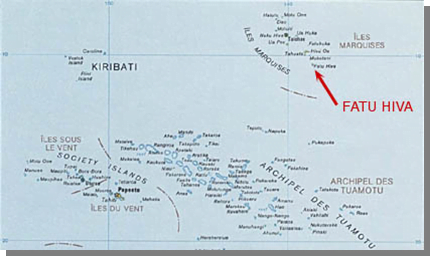
Okay, okay, okay! I just checked the running “From the Log of…” and it has been a while since our last update. Just for your information, we arrived safely in Fatu Hiva and stayed for a few days. The morning winds, that blasted down the mountains, drove us away quicker than we would have liked. Since then we’ve checked in at Atuana, Hiva Oa, and spent a few nights anchored at isolated spots on Hiva Oa and Tahuata. We’re traveling in loose company with a British couple on S/V Hannakin.

The general plan is to be drift diving in the pass of Tuamotu island in a few days.

The locals have been very friendly in the small, outlying villages. The one larger town we visited wasn’t so gracious. Everyone has fruit growing in their front yards and we’ve had no trouble trading for limes, bananas, coconuts, and Pamplemousse. French baguettes are available, hot and fresh, at $.40 per loaf. Sadly, tomatoes, potatoes, cucumbers, onions, and other vegetables are harder to come by. The locals have a few farms up in the valleys but we haven’t stayed in one place long enough to work out a trade.

The man on S/V Hannakin was PADI certified in ’92 and hasn’t been diving since. He asked for a class so we’ll work our way through a quick refresher course and head for blue water.
I have managed my first dive in the South Pacific. A short visit to a pretty reef at 40 feet then an hour of scrubbing the bottom. Our brand new Jotun paint isn’t working well at all. Our paint in black. S/V Hannakin has been in the same conditions with Red Jotun and looks great. Our theory is so much pigment is added to make the paint black that the copper/tin additives end up very diluted.

We’re still moving frequently to get to the isolation of the Tuamotus in fairly short order. Still, I’ll make time to sit down and write another installment of “From the Log…”.

Carl Strange Avatar
Carl and his wife Karen set-off on a journey around the world on-board their sailboat S/V Enchante. Along the way, they had a lot of adventures and in Aruba, a new member of their crew was born. Now a family of three with Rebecca’s birth, they sailed the Caribbean and the Pacific experiencing life along the way.

Filed Under: Pacific, Sailing, Travel Tagged With: Cruising, Enchante, Marquesias, S/V Enchante, Sailing, Strange Chronicles

October 10, 2019 by Carl Strange

Fatu Hiva in The Marquesas (#7)

21 June – Fatu Hiva, Marquesas 10° 27S / 138°29W
Yesterday, we awoke to find the dinghy upside down with our small, 2HP motor in the water. The wind gusts coming down from the mountains are not to be believed. Five dinghies were flipped. Lots of flushing of outboards going on yesterday. Happily we noticed ours quickly and didn’t have any damage from saltwater. We didn’t go to shore in the morning because we simply would not have made it against the winds and chop. It was amazing. In the afternoon, the winds slacked enough that we could go to shore to pick up the bread we had ordered.
The “bakery” is a small wooden shack next to a small house. Flour and other ingredients are mixed in long wooden troughs and the lumpy, round loaves are baked in an ancient looking stone oven. Order a day in advance and pick it up the next afternoon. Unfortunately, the lady had forgotten to write down our order the day before so no bread for us.
We did have a nice time wandering around the small town and visiting with the locals. I carried a nice supply of Chiclets gum and had a great time surprising kids with a small gift. These types of treats are not generally available, word spread quickly through the town and I was constantly approached by shy, smiling children. In a few cases the parents also were delighted by the gum.
I had taken photos on our previous visit and gave a few prints to people we especially enjoyed. Several cruisers have digital cameras and color printers these days and you see prints proudly displayed on walls in houses.
Woodcarvings and tapa cloth prints are much higher priced than in years passed. Cruisers, and tourists in Tahiti, have bid up the prices over the years. We passed on the $150 carved tikis and the $180 manta rays since they looked like something you could buy at Pier One Imports. However we did get hooked on tapa art. Tapa is made by stripping tender young pieces of bark from trees – banyan and mulberry are popular. The pieces are laid on stone and pounded with a wooden mallet to form a thin, fabric looking rectangle. A black ink, made from a local plant, is used to draw very intricate art. Only a small number of ladies create this laborious art these days and now only on a couple of the Marquesan islands. We asked ladies on the street, chased rumors, approached several houses with our best Marquesan “kaoha” and finally found a lady with nice art and very reasonable prices. We bought a couple of her pieces and are delighted with our finds.

22 June – Tahuata, Marquesas 9° 55 S / 139°06 W

The winds died overnight and we were anxious to escape the windy anchorage so we sailed the few miles to Tahuata. It as tempting to anchor in Resolution Bay, named after Captain James Cook’s second ship, but our guide book showed a more protected bay a few miles further north. We joined a few other boats at Hana Moe Noa (Long Sleep).
Our two day stay was spent harvesting coconuts and limes from an abandoned grove, an evening fire on the pristine sand beach and diving on the boat bottom to scrape a few goose barnacles picked up crossing the Pacific.

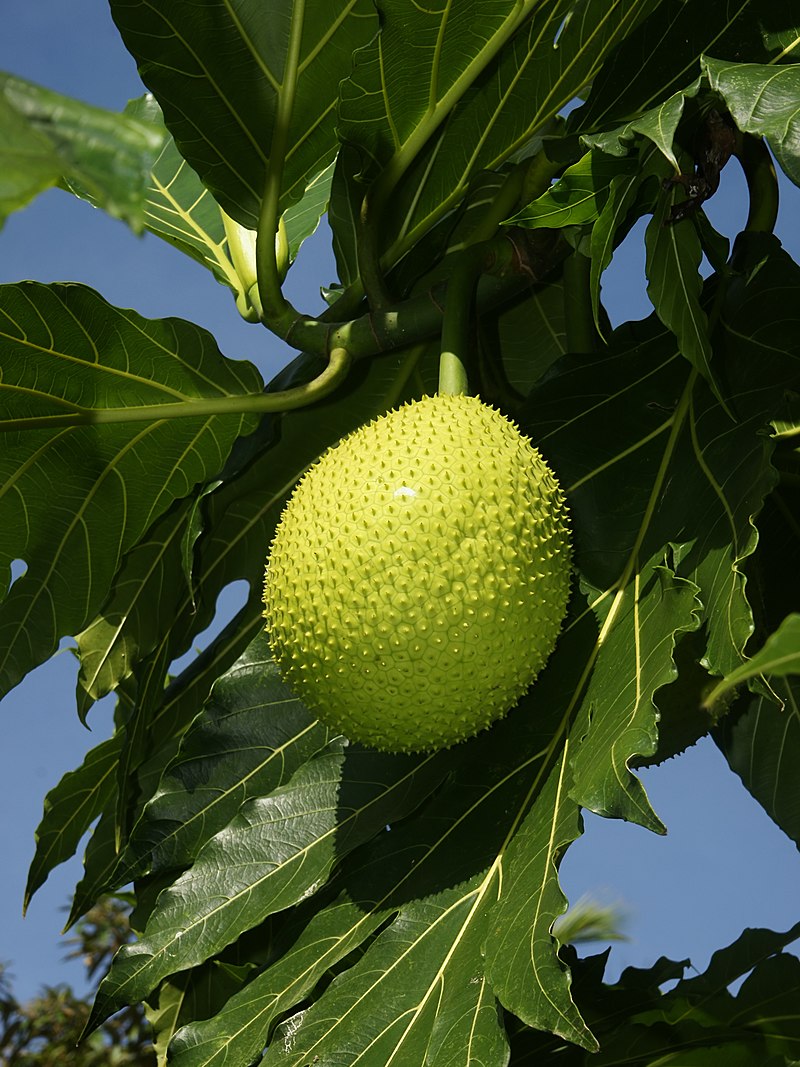
Breadfruit

Pamelo also known as pamplemousse

Our new culinary treats are breadfruit and pamplemousse. Breadfruit is supposed to be treated like a potato. We made thin, salted fried chips from ours. It was interesting but I would hate to live off the stuff. Pamplemousse on the other hand is wonderful. This is a very large, sweet grapefruit growing all over the Marquesas. Delightful!

A few Recipes from the Enchanté Galley

Breadfruit Omelet

  • 1 c ground meat, ham, or sausage 1/2 c green onion, chopped
  • 2 c breadfruit, cooked and cubed 1 tomato, chopped
  • 2 eggs salt and pepper to taste
  • 2 cloves garlic, crushed

Saute the garlic, onions and tomato in oil. Add breadfruit and meat. Cook until meat and breadfruit are done.
Beat eggs well and add to the breadfruit mixture. Pour into pan. When one side is cooked, turn and cook the other side until done. serve hot.

Cream of Taro or Breadfruit Soup

  • 1T margarine 3/4 c cream
  • 1 T flour 1/2 t salt
  • 1/2 t onion, minced 1/16 t pepper
  • 3/4 c taro, cooked and mashed 11/2 c water
  • 1/2 c celery, chopped fine

Saute onion in butter. Blend in flour and add water while stirring constantly. Cook over medium heat until thick. Add taro and mix well. Cook for 5 minutes. Pour cream into the mixture and season. Serve hot. Can substitute breadfruit for taro.

Filed Under: Food, Pacific, Travel Tagged With: Cruising, Enchante, Marquesias, Recipe, S/V Enchante, Sailing, Strange Chronicles

September 26, 2019 by Carl Strange

Underway, Journey toward the Marquesas (#5)

6 June  06 22S / 111 51W.

We’re more or less halfway there and all is well on-board. Stories to follow if I can pry Rebecca’s computer away from here during daylight hours. Don’t know if I reported mine has a keyboard problem and is useless right now.

10 June 2002 – 07 46S / 123 41W

The Galapagos are 2100 miles and thirteen days behind us. The Marquesas are 900 nautical miles and about one week ahead. We’ve seen nothing on the horizon but blue water and white clouds for days and days. Except for the occasional night squalls, our weather has been picture-perfect for the trip.
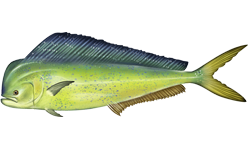
We have had great luck fishing and are enjoying Mahi Mahi (or Dolphin or Dorado) again this evening. Today’s catch was just over three feet and will keep us in fish for a couple of days. Most of the fish will be baked but a few nice pieces have been put aside to have as a sashimi (okay, thinly sliced, cold, raw fish) appetizer. Our lockers always have a good supply of Wasabi, the hot mustard that goes with sushi or sashimi.

For fishing, we had been using our only “store-bought” lures, two very nice Rapalas which over the last couple of years have helped us to catch a lot of fish. However, a few days ago, they did their job too well. Both lures were trailing behind the boat. Each had a few feet of 120-pound test, nylon-coated stainless wire for a leader. One lure was on our Penn Senator saltwater trolling rod and reel. The other was on our “meat line”. The rod and reel got the first strike. I tightened the reel break but the fish kept stripping the line (i.e. pulling more lines out). Karen released the headsail sheet to slow the boat down and I added a bit more tension to the reel. The reel never reached the smoking stage but definitely started getting hot before the fish broke the wire leader. We reeled in our empty line and wondered just how big “the one that got away” had been this time. Later in the day, I rolled up our meat line to discover the wire had been bitten or broken as well. All in all, we are lucky those two fish didn’t make it on board.

Now we are back to fishing with homemade lures. Honestly, it is a lot more fun to catch fish on our own lures. A typical lure is assembled from stainless wire and crimps, a couple of bullet weights, a serious stainless hook, a store-bought plastic squid-looking thing, and anything else that strikes our fancy and looks “fishy”. Our latest creations include the thin Mylar lining from the inside of cardboard wine boxes (only the best you know) or pretzel bags. We cut a four or five-inch square including the corner of the liner or bag. The corner is always heavily reinforced and makes a good “head” for our lure. The lure is assembled with the following steps. Loop the leader wire through the head of the hook and secure it with a crimp. Slide a bullet weight down the wire to the hook. Push the wire through the corner of the Mylar bag so the hook is hidden inside the bag. Put a second bullet weight into the head of the store-bought squid (green and orange squids have been working well lately), poke the wire through the squid, and slide it down to cover the bag. Measure a few feet of wire for a leader, make a second loop in the end, and secure with a crimp. Finally, cut the Mylar bag into strips to mimic the legs of the squid. Attach your creation to your line and troll a boat length or so behind you. Set it out in the morning and start planning your menu.

Our meat line deserves a description. This is sixty feet or so of 1/4″ three-strand nylon line. A large stainless swivel is tied to the “fishing end”. Ten feet or so of 120-pound stainless wire follows that with a second swivel and snap hook crimped on the end. The leader of a lure is attached to the snap hook and the line is trolled behind the boat. Since the 1/4 line won’t give when a fish strikes we use a four-foot piece of heavy bungee as a shock absorber. One end of the bungee is tied to a loop in the 1/4 line and the other end is tied to the aft rail of our boat. Finally, the 1/4 line, with a good bit of slack, is attached to a large cleat on our aft deck. Now when a fish strikes, the bungee will stretch giving the fish a bit of play. Should the bungee break, the 1/4 will take the load. Much like Tom Sawyer tying a fishing line around his toe, we use a clothespin to hang the slack loop of 1/4 line up in the rigging so we can keep an eye on it from the cockpit. When a fish strikes, the bungee stretches, the loop pulls out of the clothes pin and we eventually notice. It’s a crude but very effective way to fish.

16 June

We spotted Fatu Hiva at 1800 Z or 9:30 AM local. Actually, it was Revision II who called us on the VHF and pointed it out. It’s about 1:30 and we have at least an hour or 2 to go before we are anchored. I hate that it takes so long after you’ve started celebrating to actually get anchored. All in all, it has taken 19 days. Not bad. An average of 161 miles a day.

The island is gorgeous. Definitely a sight for sore eyes. Can’t wait to go on shore tomorrow and explore. They supposedly have a lovely waterfall, though it is quite a walk to get to it. We’ll only stay a few days and then go to Hiva Oa to officially check-in.
Paradise at last! YEA!

Carl Strange Avatar
Carl and his wife Karen set-off on a journey around the world on-board their sailboat S/V Enchante. Along the way, they had a lot of adventures and in Aruba, a new member of their crew was born. Now a family of three with Rebecca’s birth, they sailed the Caribbean and the Pacific experiencing life along the way.

Filed Under: Pacific, Sailing, Travel Tagged With: Crusing, Enchante, Fatu Hiva, Marquesias, S/V Enchante, Sailing Leave a Comment

Footer

Contact Us

Oceanic Ventures, Inc
5808 Newcastle Dr.
Houston, TX 77401-3214
USA

Phone: 713-523-DIVE (3483)

eMail: divesafe@oceanicventures.net

Signup for our dive and scuba newsletters

Don’t miss news about the exciting happenings at Oceanic Ventures.


Map and Directions

Socialize

  • Email
  • Facebook

Why People Choose Us

People choose their friends carefully just as they should choose their adventure partners and Scuba Diving Instructors.  Oceanic Ventures is the premier scuba dive shop in Houston, Texas, and the Southwest because of our exceptional service and our sense of adventure.  In talking with our clients and friends, people choose us for a number of reasons such as: Passion – We love what we do and we want to share the beauty and excitement of the underwater world with everyone we meet. Caring- Our clients tell us they love us because we truly care about people and strive to make their scuba diving experiences safe, fun and enjoyable. Professional – Our staff members are the … [Read more …]

Copyright © 2026 all rights reserved Oceanic Ventures, Inc. · Sitemap · Log in