Topside, this was the most unimpressive dive site I’d ever seen, with docked cargo ships and unpleasant noises and smells of industrial activity. Descending to the sand at about 20 feet did not prneude much inspiration as we were greeted by some rusted cans and a baby’s diaper (used, apparently). I was left wondering why the boatload of experienced divers and divemasters was so keen on this site.
Dumaguete is on the Bohol Sea in Negros Oriental, Philippines, approximately 30 hours from Houston via Honolulu, Guam and an overnight in Manila. It is an absolutely fabulous dive location, at the northern portion of the “Coral Triangle”, the region of the greatest coral reef biodiversity in the world, and therefore well worth the arduous trip from Texas.
 The pier at Dumagute was no exception; it turned out to be the richest site of photo opportunities and encounters with weird and wonderful creatures in Negros Oriental. In this photo I was lucky to capture some very interesting behavior between 2 similar looking fish species, and equally fortunate to have Marco Inocencio from Atlantis Dive Resort interpret the activities. According to Marco, the larger fish in the hole is a false cleanerfish (Aspidontus taeniatus), while the two smaller fishes that are shown in full view are cleaner wrasses (Labroides dimidiatus). The larger fish is a mimic; it’s actually a member the blenny family who is posing as a cleanerfish in order to take bites of skin and flesh from other fishes looking for a cleaning. The false cleanerfish is distinguished from the cleaner wrasses by its head, which ends in a “nose” with its mouth slightly under and behind it while the heads of the cleaner wrasses terminate with their mouths. If you look closely enough you’ll see the characteristic pouty lips of the false cleanerfish, presumably because she isn’t much appreciated for her clever disguise and food-gathering methods!
Travel
In the Company of Big Animals
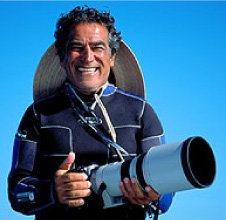 I want to introduce you to Amos Nachoum, a self-proclaimed Ambassador of the Big Animals. He is an award winning photographer who has publised photographs in magazines around the world including National Geographic. In a presentation Amos made top the Explorer’s Club in New York City, he said “to live up to that ambassador role I’ll be in the city, presenting my best stories and information about some of the most fragile regions of the underwater world. I’ll be showing and discussing photographs from my expeditions around the world and will probably include a few “classics” from the hundreds of my images that have appeared in National Geographic, Time, Life, The New York Times, Condé Nast Traveler, Le Figaro, and Der Spiegel. You can also see more of my images on my website, plus news about my latest expeditions. It’s all part of spreading my message that only through observation and interaction with these animals can people understand and respect some of the most impressive citizens of our planet. In a few words, “you have to go there and experience this firsthand.” Amos recorded a presentation for Google entitled “In the Company of Big Animals.” You will hear Amos and he talks about his expeditions and shos his photographs. Sit back, pour yourself a cocktail and be prepared to be wowed…
The Misunderstood Great White Shark
Today’s post comes from Amos Nachoum, an award winning photographer, specializig in Big Animals, like great white sharks, leopard seals, polar bears, etc. We first met Amos as we were planning for our Antartica Trip. Talking to Amos you immediately get wrapped up in his enthusiasm and his love of the sea. If you talk to him long enough, you’ll be making some incredible dives in some unusual places, think Antartica or the Artic. If you ever meet him, tell him you know Dive Mom!
Written by Amos Nachoum
Great White Sharks – Nasty Predator?
 My expeditions to encounter the Great White Shark tend to sell out fast. That’s what just happened to my last two October expeditions. My favorite spot in the world to see Great Whites is in Mexico’s Baja California. The trips sell out fast for a good reason. People are fascinated with Great Whites, even though these sharks have the undeserved reputation of being a nasty predator. They’ve got a lot of teeth, as many as 300. They’re big – 12 to 16 feet long, and they weigh a couple thousand pounds. Steven Spielberg gave a starring role to a Great White in Jaws, and that didn’t help their reputation as a ferocious man eater.
But the truth is they are one of the most fascinating animals you’ll ever encounter, and one of the most rare.
When young, they feed on small harbor seals and later go after sea lions, elephant seals and even small toothed whales. They like to ambush their prey from below – one big bite usually does the trick. They will also scavenge – eating the carcass of a whale shark. They will sometimes eat sea turtles and sea otters.
Let’s be fair, though. Scientists and others who study the Great White say that in the past 100 years more people have been killed by dogs than by Great White sharks. That’s not to say that they don’t look scary. They do, especially when you’re facing one close up. But that’s only part of what makes them so fascinating.
The Great White Shark: A Rare Species
There are only about 100 adult Great Whites in the state of California’s waters. Scientists say less than 3,500 Great Whites are left in the world’s oceans, making them rarer than tigers. They are long distance swimmers, capable of traveling 12,000 miles over a nine month period. A trip from California to Hawaii is a common trip for them. Scientists have tracked them swimming from South African to Australia and back in nine months’ time.
The Monterey Bay Aquarium has been capturing young white sharks, exhibiting them for a a short time, and then releasing them. The first time they did this, in 2004, the shark had almost a million visitors. The aquarium’s executive director Julie Packard said the shark was “the post powerful emissary for ocean conservation in our history.” The aquarium is also studying the adult Great White sharks to learn how to protect them from overfishing and the effects of bycatch – sharks that get caught in the nets of industrial fishing operations, get injured and can die because of it.
That’s what happened to one of the Monterey Bay Aquarium’s White sharks, a female. Captured on August 26, 2009 and released on November 4, the shark traveled more than 500 miles, from Monterey Bay to Baja California. There, she was accidentally caught in a gill net and died.
Baja California – One of the Best Dive Sites for Epic Shark Diving
There’s no doubt that Great White sharks are worthy of great respect. They’re found in the waters of Mexico, Australia, New Zealand and South Africa. It’s true that are amazing dives to be enjoyed in all of those locations, but my favorite place to see them is in Baja California. The water is clear and warm and the shark encounters will always be your best memories of shark diving.
Lose Weight When You Go Diving
Today, David Snyder talks about his goal of losing weight for diving.
Is this some “Biggest Losers” program? Ah, no. Lose weight when you go diving refers to you kit (equipment). As we continue to dive, over time we acquire more and more things. Very important things when we acquired them but are they still important?

The second path of my weight loss quest is to change heavier for lighter. Ounces add up to pounds. Do you really need a 12″ knife when a 6″ knife will do just fine. Lights, if your light is more than three years old you should be able to double the capacity or half the weight with a new one. I look at each piece of equipment to see if there is a lighter or more capable substitute.
My goal for this process, is one bag 40 pounds, two weeks of diving, nothing rented (except bottles) or borrowed. I am getting there.
How much do you weigh?
Eric's Cozumel Winter Get Away January 13-17 2011 Announced
 Yeah!!! Eric’s January trip details are completed!!!
We are holding air, boats and space; so, join us for an escape from the cold to Cozumel. We will be staying again at Casa Mexicana, located in town, close to shopping, dining, and activities. We have a full diving schedule starting with a boat dive the day we arrive, then one day of three dives, two days of two tank diving with lunch on the boat each day. Opportunities to add additional afternoon or night dives as desired. Recreational equipment can be rinsed and stored at the dive shop. Breakfast buffet is included each morning.
This trip is open to recreational, technical and rebreather divers. For rebreather and technical divers, the run times for each dive will be two hours.
This trip promises to be a fun trip and a great time to escape the cold in Houston or wherever you live. Dive Mom is holding space so you need book onto the trip in a hurry becasue we have to release the air seats we are holding. You can find out more details about this fun trip to Cozumel by calling Ann or reviewing the detail trip sheet.
Escape the Winter Cold, Let’s Go Scuba Diving in January!
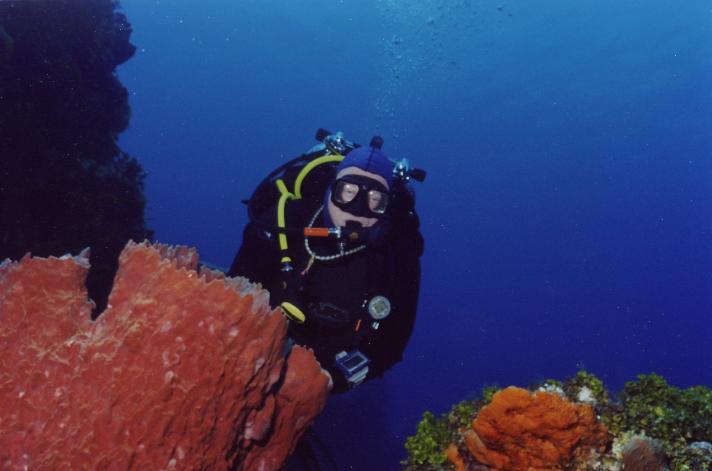 It is sometimes hard for me hard to believe that I used to be an avid skier. In college, I spent a number of weekends, a week around Christmas and Spring Break skiing. It was fun, exhilarating and challenging. My underwater camera saw more frozen moisture than liquid.
After mneung to Houston in…well let’s not go there…I changed from a skier to a sailor and a diver. White powdery slopes were replaced by soft sand beaches, boats, bikinis, dive equipment and clear blue water. Oh, and yes the warm weather.
Winters in Houston are a far cry from the cold wind-blown snow and ice of Lubbock, but I still find that winters can be cold. I guess I have just gotten used to the warmth so the mild winters here seem cold to me at times.
Despite the executives from Continental trading in their shorts and t-shirts for wool sweaters, wool pants and poly-propylene long underwear, Houston remains the gateway to the Caribbean and the soft sand and clear blue waters I discovered later in life. In the Caribbean there is plenty of warmth to go around and diving on some of the worlds most beautiful reefs. The walls stretch for miles down the coasts and in some places for miles down as well.
While Bing Crosby is singing “Let It Snow…” I am picturing a boat parked over a tropical reef, the top of the reef opening up eighty feet below me with the nearby wall plunging down 400 feet and the current guiding me along this natural aquarium. The fish are swimming, feasting in the current and the corals are gently swaying in the water.
The easiest place to go for a long weekend is Cozumel, Mexico a limestone island once home to the Mayan Oracle and a Mayan pilgrimage destination. Cortez removed the Oracle and used the island as a staging area for his conquest of Mexico.
Jacques Cousteau helped make the island a diving Mecca when he first visited the island in 1960. He found the sleepy little island a paradise above and below the water. Of course he probably would not recognize the Cozumel of today with 2 cruise ship terminals which can accommodate up to six ships. The current economic slowdown in the United States has thankfully reduced the number of ships visiting the island but unfortunately to the detriment to the local people.
Cozumel is the home of the second Marine Park founded in Mexico and is the first not to allow local fisherman to spear fish or line fish on the reefs. The primary industry in Cozumel is tourism with divers making up a large part of the tourist business, especially with the reduced cruise ship traffic.
 The reefs, which took a beating in Hurricane Gilbert are still beautiful. The southern end of the island has steep walls and beautiful corals and fish, while the North end of the island was sloping walls and fast currents with up and down currents to boot. For rebreather divers especially, the areas without the up and down currents are more enjoyable and my favorite dives are in the vicinity of Palancar Gardens and Palancar Caves. It is really special to come up from the stark limestone depths into a garden of colour and lives, swirling around you as you swim in, out and around the pillars of coral. You float along, the currents carrying you along toward the north (generally) with the scene constantly changing and renewing the colour and life.
Hmm, I think I need to go diving! Luckily for me, the travel department at Oceanic Ventures, namely Ann, has put together a long weekend in Cozumel so I can complete some training for some students who are also looking forward to warm water and wetsuits instead of the cold water and dry suits I have been making them use for training up to this point. But, despite my being involved in a training class, there are a number of people who, like me, want to escape the cold and enjoy some warm tropical breezes.
If you can get away, you are welcome to join us in Mexico 13-17 January 2011. If you cannot make it this time, keep your head warm and remember someone else is staying warm for you.