• Skip to primary navigation
  • Skip to main content
  • Skip to footer

Houston's Premier Scuba and Dive Shop Oceanic Ventures Inc.

(713) 523-3483 (dive)
5808 Newcastle Drive
Houston, TX 77401

  • Home
  • Stay Current
    • Our Blog
    • Travel and Events Calendar
    • Club Aquarius Social Club
      • Club Aquarius Social Club Upcoming Events
      • Club Aquarius Social Club – The Past
    • Special Events
    • Local Scuba Diving Events
    • Photography Contest
    • Categorized Blog Posts
  • Equipment
    • Dive Equipment
    • Rebreather Systems
    • Cruise Ship Passengers
    • Repair & Maintenance
    • Air & Mixed Gas Blending
    • Pure Fiji Spa Products
  • Training
    • Become a Scuba Diver
    • Scuba In Your Home or Ours
    • Diving Programs for Young Explorers
    • Recreational Dive Courses
      • Recreational Dive Courses overview
      • The Briar Club Scuba Program
      • West University Scuba Program
      • Houstonian Scuba Program
    • Technical Diving Courses
      • Basics
      • Nitrox
      • Trimix
      • Rebreather
      • Wreck Diving Programs
      • Cave Programs
      • Blending
    • Leadership Dive Courses
  • Travel
    • Travel Escorted Adventures
    • Travel – Other Travel Programs
    • Travel – Custom Travel Adventures
    • Local Scuba Diving Events
    • Technical Travel
    • Scuba Diving Around Texas
    • Travel Insurance
    • Travel Forms
  • Company
    • About Oceanic Ventures
    • Meet Our Team
    • Testimonials
    • Facility Hours
    • Map
    • Oceanic Ventures Foundation
    • Resources & Articles
    • Archive
  • Shop
    • Online Store
    • Cart
    • Checkout
    • My Account
    • Policies regarding Privacy and Purchases
  • Contact

Blog

June 10, 2016 by Eric Keibler

Dive Mom Is a Guest on Great Day Houston

Dive Mom, Ann Keibler, was Debra Duncan’s guest on Great Day Houston on Monday talking about scuba diving and scuba dive training. She was joined in the audience by some of Oceanic Venture’s Junior Scuba Divers including Yasmine, Andrew and Ethan as well as their diving mother Ester.
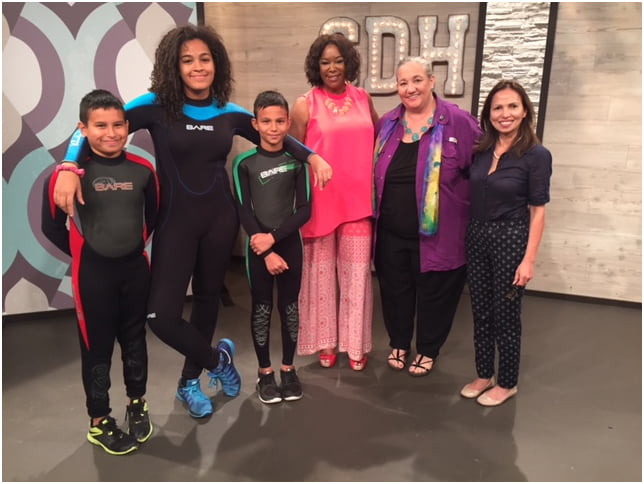
great day houston


Ann met Debra Duncan at another event, the St Luke’s Foundation’s Friends of Nursing luncheon, sponsored by Neiman Marcus. Oceanic Ventures and the Cayman Island Department of Tourism were sponsors of the raffle at the event which raised money for the nursing program at CHI St Lukes’s hospital. Debra was the Master-of-Ceremonies and introduced the really cool prize. Ann and Tina Hogson from the Cayman Islands Department of Tourism, were on hand to help her understand the prize and to answer any questions about Grand Cayman both from the MC as well as the guests.

If you missed Ann’s appearance, you can replay it here…

Filed Under: Presentations, Scuba Dive Training Tagged With: Dive Mom, diving, Great Day Houston, Texas

June 5, 2016 by Simon Pridmore

Dealing With Accidental Decompression

Divers under the boatThere is nothing to fear about accidentally going into deco as long as you know what to do when it happens.

Simon is the best-selling author of Scuba Confidential – An Insider’s Guide to Becoming a Better Diver and Scuba Professional – Insights into Scuba Diver Training & Operations. Both books are available from Oceanic Ventures. Simon has also just published a new book for divers-to-be and absolute beginners called Scuba Fundamental – Start Diving the Right Way.
There is a very good reason why instructors tell their students not to go into deco and why dive computer manuals repeat the warning time after time.
Chances are that the cylinder on your back is usually your only air source when you dive. If you run very low on air or if you suffer a rapid loss of air supply, perhaps because of a regulator free flow or a split hose, then the best option you have is to make a slow controlled ascent directly to the surface.
Yes, an alternative option is to share air with an alert, calm and capable diver around who is carrying more air than they need and is both equipped and willing to share it. But you can’t depend that someone like that will be nearby when you need them.
If you stay calm and you are not in deco, that is to say, if your computer is not showing required decompression stops, you will make it safely to the surface. You will probably not be able to make a safety stop on the way up but that is not going to be health threatening. After all, a safety stop on a no-decompression-stops dive is a luxury rather than a necessity.
On the other hand, if you do have required decompression stops, then going straight to the surface and missing those stops is definitely a health risk! That is the main reason why divers are told, “don’t go into deco!”

But Divers Do It All The Time

You may not be surprised to hear that divers accidentally go into deco every day. This is because they are only human, they have fun diving and they tend to get distracted. If it has not yet happened to you, it certainly will, so it is useful to know what to do when it does!
Because they have heard the warning so often, divers tend to panic when they find themselves accidentally in deco. There is no need for anxiety. Going into deco will not hurt you. Going to the surface when you are in deco, however, may well hurt you.
Know how your computer works and what it looks like when you go into deco. Do not be the diver who gets back into the boat moaning about a “broken” computer that is actually functioning perfectly. It is just telling the diver that they should still be underwater waiting until their deco stops clear.
The first thing you notice when you go into deco is that your computer screen suddenly looks different. A new depth reading appears, usually 10ft or 20ft, and a new time display. The depth is your new ceiling; you must not go shallower than this. The time is either your decompression stop time at the ceiling or an indicator of the minimum time it will now take you to reach the surface taking into account both your ascent time and the decompression stop time.
Every brand of computer is different. There is no industry standard. You must know how yours works. I know the manual looks boring but take the time to study it. Trust me, if you see your computer’s deco screen for the first time deep down at 100ft with your brain befuddled by narcosis, you will have no idea what it is saying to you.

Snyder01Run The Clock Down

So what do you do next? First, look at your pressure gauge. If you still have plenty of air left, relax; you have nothing to be concerned about. Start ascending gradually, keeping an eye on your computer until the deco/ascent time figure stops growing. When the figure starts to drop, continue your dive at that depth but do not go deeper again. Eventually, the deco will clear and you will see your usual no decompression screen display again with plenty of minutes remaining.
Finally, end the dive a little earlier than originally planned to make sure you have plenty of air left to do an extended safety stop of eight or ten minutes before you surface.

Remember

1. Going into deco is nothing to panic about.
2. Know what your computer screen will look like when it happens.
3. Do a long safety stop at the end of every dive where you accidentally go into deco.

Filed Under: Open Circuit, Scuba Dive Training, Skills Tagged With: diving, diving skills, Scuba Dive Training, Training

March 15, 2016 by Eric Keibler

Travel & Adventure Photography – Food

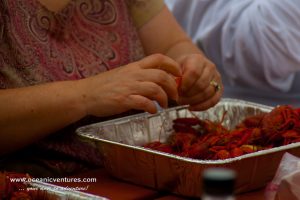
fiji-416Let’s face it, on any adventure, the food is as important as the other activities.  Most of us are not on backpacking trips where freeze-dried or dehydrated food is the standard but rather we are there to experience the small part of the world we are visiting and food is an important part of that experience.
So, if food is an important portion of your trip, do you spend time trying to document experiences?  Do you try to capture the moment and the feelings associated with you meal so you can make your friends at home jealous?
Darren Rowse, in his article Food Photography – An Introduction has a few hints for improving your photographs:

Lighting

Treat the food you’re photographing as you would any other still life subject and ensure that it is well-lit.  Natural light is an ideal way to light food, assuming you are near a window and it is not dark outside.  You may need to “fill” using your strobe to eliminate harsh shadows.  Remember you want some shadow because it gives the food height and makes it look interesting but harsh shadows may take away from the image.  You can also use your napkin to reflect some light into these dark areas.  Daylight helps to keep the food looking much more natural.

Props

Pay attention not only to the arrangement of the food itself but to the context that you put it in.  You may have to move some of the flatware or other plates to give the object more room and to put it in an interesting setting.  Pay attention to the foreground and the background.
Be Quick
Food doesn’t keep its appetizing looks for long so as a photographer you’ll need to be well prepared and able to shoot quickly after it has been cooked before it melts, collapses, wilts and/or changes color.  You are also probably eating with other hungry divers and adventurers and their patience will wear thin if you take too much time arranging the table and setting up your shot.

Style It

The way food is set out on the plate is as important as the way you photograph it.  The chef or staff have probably prepared the plate to showcase the food the way they want it.  This is called “plating” in the cooking world and presentation has become very important.  However, in moving it from the kitchen to your table, things may have moved or to improve the lighting, you may find yourself acting as a food stylist.  Some things to remember is, keep it simple, wipe away spills, and try for some height.

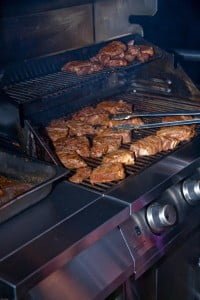
ovi-107Get Down Low

A mistake that many beginner food photographers make is taking shots that look down on a plate from directly above.  While this can work in some circumstances – in most cases you’ll get a better shot by shooting from down close to plate level (or slightly above it).  Don’t be afraid to push your chair back  and get down low.

Macro

Really focusing in on just one part of the dish can be an effective way of highlighting the different elements of it.  A mixture of shots can really add to your trip.

20090903-IMG_0535Steam

Having steam rising off your food can give it a “just cooked” feel.  This is easier said than done but it goes hand-in-hand with the “be quick” hint above.
Adding photographs of your meals can add a more rounded dimension to your travel memories so remember to take your camera to dinner.

Filed Under: Digital, Photography Tagged With: photo, photography, Surface Photography

March 14, 2016 by Simon Pridmore

Scuba Diving and Narcosis – Diving Under the Influence

Simon is the best-selling author of Scuba Confidential – An Insider’s Guide to Becoming a Better Diver and Scuba Professional – Insights into Scuba Diver Training & Operations. Both books are available now from Oceanic Ventures.

Dive Manager - Csaba

Understanding narcosis, being aware of its effects, and knowing how to manage it are important tools for divers.

When you dive deep, you often see people do strange things under the influence of narcosis. One diver will swim away from his buddy, lost in his own thoughts until he suddenly realizes he is alone in the ocean. Another will keep looking at his computer every few seconds, apparently not registering what it is telling him. A third will stop on a reef wall and stare fixedly at a branch of coral for a good five minutes. Later, he will tell you that he thought the coral was a moray eel and that he was waiting for it to move.

This sort of thing can be funny but there is a serious side to narcosis. The diver who heads off into the blue without his buddies loses the support of the team. The diver who cannot remember what his computer was showing just a few seconds after looking at it is suffering from short-term memory loss and this makes it difficult for him to follow a dive plan.

Narcosis is an integral part of scuba diving. The only way to avoid it is not to dive deep. If you want to dive to 100ft and beyond, then you are just going to have to get used to it!

What is Narcosis?

Air, even oxygen-enriched air like NITROX, is an intoxicating cocktail. Many people will tell you they enjoy the “buzz” of going deep. This “buzz” is mainly due to “anesthetic potential”, something all gases have. In the right quantity, any gas can knock you out. Nitrogen, the major constituent gas in air, has substantial anesthetic potential and, as you dive deeper, the partial pressure of the nitrogen increases, and the depressant effect on your central nervous system becomes greater.

The effects are similar to alcohol and, just as with alcohol, they are dose-related. Narcosis is progressive and increases with time and depth. At 100ft a diver will experience mild symptoms such as euphoria and slow reactions but at 150ft the diver may not be able to function intellectually at all.

There is a widespread misunderstanding of what narcosis is. Many divers claim that they do not suffer from narcosis because they feel more relaxed, comfortable, confident, and capable at depth.  However, these are actually the most common symptoms, and, although it might sound like a good thing to feel like that, in fact, this state of mind will lead a diver to take more risks, forget or throw out the dive plan, react to an emergency more slowly and lose track of time.

Managing Narcosis

The good news is that narcosis can be managed.

The first steps are to recognize that it is there and understand what it is doing to you. Then you must train yourself to focus on important issues such as time, depth, and the dive plan and not allow yourself to get distracted.

Exercise mental control over everything you do. Move slowly and deliberately when carrying out a task at depth. You are more likely to get it right if you do something in a sequence of short steps, rather than try and do it quickly.

You can also use memory cues. Technical divers wear wrist slates to remind them of complex dive plans and experienced instructors carry checklists for training dives. They also make debriefing notes as they go because they know that later they will not be able to depend on their memory for the things that happened while they were at depth.

Probably the best defense against narcosis is to rehearse team rescue and self-rescue drills and skills until they become instinctive. Then, in an emergency, you will automatically choose the correct response without thinking about it.

Contributory Factors

A number of factors can aggravate narcosis. These include fatigue, alcohol, stress, cold, and dark water. Anticipating the effect of these additional factors is the key to dealing with them. For instance, use a drysuit in cold water, minimize alcohol intake, and get a good night’s sleep before a deep diving day.

Final Word

Narcosis is something to be understood and managed, rather than feared. There is no law against diving under the influence but proceed towards deep diving gradually. Don’t just go off the deep end straight away!

Simon Pridmore Avatar
Originally from the UK, Simon has lived in the Asia-Pacific region for almost 40 years and has been involved at the sharp end of the scuba diving industry since the early 1990s, pioneering mixed-gas deep diving in the region, first in Hong Kong and later through Professional Sports Divers, his dive centre in Guam, Micronesia. He then moved to the United Kingdom to run a major technical diver training agency and work with cutting edge dive equipment manufacturers VR Technology. Today, he is one of the most prolific and well-known scuba diving and travel authors around. As well as his many books and guides, Simon writes regular columns for a variety of magazines and, under the pen name S.J. Pridmore, has recently published a highly-acclaimed first novel May the People Know I’m Here? After a decade in Indonesia, then a couple of years back in Hong Kong, these days Simon and his wife Sofie live in the south of Taiwan, still on the move as always, trying, but so far failing, to find a cure for their itchy feet.

Filed Under: Scuba Dive Training, Scuba Diver Health Tagged With: Scuba Dive Training, Training

February 16, 2016 by Eric Keibler

Travel and Adventure Photography – Nine Hints for Underwater Photographers

In reading Helen Jung’s article, Secrets to Traveling like a Local, I thought about how to apply some of her hints to diving travel photography.   We have a lot of the same issues but when you add underwater photography to the mix, it opens a whole new world in travel photography.  Here are some hints I came up with:

20090908-IMG_1109Study before you go.

You should look at what others have done so you have an idea of what iconic photographs represent the location. If you were going to Paris, you would want a photograph of the Eiffel tower.  The same applies to your underwater trip.  What creatures, people, and places did others find interesting?  Finding out where these things might be located will help you capture images that encompass your trip.

Ask Questions.

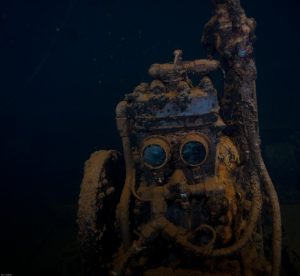
Talk to people who have been diving there and find out what they found interesting.  Keep an open mind.  You might not be interested in a Japanese Communication Bunker in Chuuk but the view from the top is wonderful.

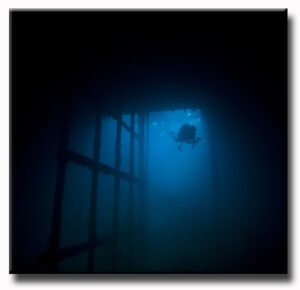
Penetration - Truk LagoonTalk to the Dive Master.

Remember, local knowledge is a big plus in photography, especially in underwater photography.  I remember one dive in Chuuk, where I went on a photography dive with Todd Emmons, the lead Master on the Odyssey.  He led me through the ship and acted as the model for a series of photographs.  I still had to interpret  each site, but he knew where others had made beautiful photographs in the past.  He also had some new places where he thought there was potential for some fun photographs.

Photography by Ann KeiblerForce yourself to push the envelope.

I am a die-hard wide-angle photographer.  I love the expansive scenics both above and below the surface.  However, many locations are really best captured using a macro or super macro lens.  So, while I can always fall back on wide-angle, I have to force myself to concentrate on Macro photography.  This was especially true in Indonesia where there are some incredible opportunities for Macro photography.

“Don’t be a Jerk.”

I cannot stress this enough!  I can write an entire article on being a good photographer underwater but I will just touch on a few things for now.  You need to be respectful of the people, places and the environment.  This is especially true underwater where the marine life is fragile and very susceptible to damage.  If you cannot get the shot without damaging the surrounding coral or other creatures (this includes hanging on) then pass on the shot or approach it a different way.  You have to be aware of your body position, fins, hands, etc so that you don’t damage the surrounding environment.  Another aspect of this is being respectful to the rest of the group.  If you are diving with a group, you owe it to them to remain a part of the group and not lag too far behind.  You may to have to pass on some shots to make up for the one you just took in order to stay with the group.  If you find this difficult, hire your own Dive Master and boat and you can then set the timing of the dive.

Talk to your taxi driver and other locals.

Remember, they know a lot about the area you are visiting.  They can be a good resource for fun things to do and entertaining things to see and do.  They can also be your pathway to understanding the local culture and customs more which will help your photography.

It is ok to be a tourist.

You are a tourist after all so it is ok to be one.  Don’t miss some of the touristy spots because some of them are really fun.  If you want a challenge, get the classic shot and then find different ways to portray the spot in your images.  Ask Ann, she loves macro photography and sometimes tree bark can be cool.

fiji-403Get up early and stay up late.

There is nothing like a sunrise or sunset right?  Well, it can really be special to be up when it goes from dark to light even before the sun starts to rise on the horizon.  Photographers call this the “Blue Hour” and it occurs twice a day – before sunrise and after sunset.  The lighting is magical so don’t miss it.  You can always take a nap or sleep when you get home.

Alex & the Girls“Give yourself permission to look and act foolish sometimes.”

“It’s OK to ask for help or not to know how to do something. You’ll get more out of a trip if you put those reservations aside.”


In both travel photography and underwater photography, we try to tell a story.  There is always a story, we just have to find the one we want to tell but that is a thought for another day…

Filed Under: Photography, Uncategorized, Underwater Tagged With: Photograph, photography, Surface Photography

  • « Go to Previous Page
  • Page 1
  • Interim pages omitted …
  • Page 48
  • Page 49
  • Page 50
  • Page 51
  • Page 52
  • Interim pages omitted …
  • Page 96
  • Go to Next Page »

Footer

Contact Us

Oceanic Ventures, Inc
5808 Newcastle Dr.
Houston, TX 77401-3214
USA

Phone: 713-523-DIVE (3483)

eMail: divesafe@oceanicventures.net

Signup for our dive and scuba newsletters

Don’t miss news about the exciting happenings at Oceanic Ventures.


Map and Directions

Socialize

  • Email
  • Facebook

Why People Choose Us

People choose their friends carefully just as they should choose their adventure partners and Scuba Diving Instructors.  Oceanic Ventures is the premier scuba dive shop in Houston, Texas, and the Southwest because of our exceptional service and our sense of adventure.  In talking with our clients and friends, people choose us for a number of reasons such as: Passion – We love what we do and we want to share the beauty and excitement of the underwater world with everyone we meet. Caring- Our clients tell us they love us because we truly care about people and strive to make their scuba diving experiences safe, fun and enjoyable. Professional – Our staff members are the … [Read more …]

Copyright © 2026 all rights reserved Oceanic Ventures, Inc. · Sitemap · Log in