• Skip to primary navigation
  • Skip to main content
  • Skip to footer

Houston's Premier Scuba and Dive Shop Oceanic Ventures Inc.

(713) 523-3483 (dive)
5808 Newcastle Drive
Houston, TX 77401

  • Home
  • Stay Current
    • Our Blog
    • Travel and Events Calendar
    • Club Aquarius Social Club
      • Club Aquarius Social Club Upcoming Events
      • Club Aquarius Social Club – The Past
    • Special Events
    • Local Scuba Diving Events
    • Photography Contest
    • Categorized Blog Posts
  • Equipment
    • Dive Equipment
    • Rebreather Systems
    • Cruise Ship Passengers
    • Repair & Maintenance
    • Air & Mixed Gas Blending
    • Pure Fiji Spa Products
  • Training
    • Become a Scuba Diver
    • Scuba In Your Home or Ours
    • Diving Programs for Young Explorers
    • Recreational Dive Courses
      • Recreational Dive Courses overview
      • The Briar Club Scuba Program
      • West University Scuba Program
      • Houstonian Scuba Program
    • Technical Diving Courses
      • Basics
      • Nitrox
      • Trimix
      • Rebreather
      • Wreck Diving Programs
      • Cave Programs
      • Blending
    • Leadership Dive Courses
  • Travel
    • Travel Escorted Adventures
    • Travel – Other Travel Programs
    • Travel – Custom Travel Adventures
    • Local Scuba Diving Events
    • Technical Travel
    • Scuba Diving Around Texas
    • Travel Insurance
    • Travel Forms
  • Company
    • About Oceanic Ventures
    • Meet Our Team
    • Testimonials
    • Facility Hours
    • Map
    • Oceanic Ventures Foundation
    • Resources & Articles
    • Archive
  • Shop
    • Online Store
    • Cart
    • Checkout
    • My Account
    • Policies regarding Privacy and Purchases
  • Contact

Marine Life

February 8, 2013 by Eric Keibler

At The Office – A Trip Report From St. Croix

St Croix

When David started diving with Oceanic Ventures, he talked a lot about the Virgin Islands and his desire to introduce us his home town, Christiansted, St. Croix. It seems that he has a lot of his Grandmother in his blood and he wants to introduce everyone to the uniqueness that is St. Croix. (David’s Grandmother, Janet Foster, was the Commissioner of Tourism for St. Croix and along with Vogue Magazine, coined the term The Island of Superlatives).

While he has taken several people to the island during the past few years, on February 1 he got one of his wishes; we took ten of our close warm personal friends to the island to discover what David already knew — there is good diving in St. Croix and a lot more.

We were fortunate to hook up with Ed and Molly Buckley from SCUBA in St Croix and Elsie from the Caravelle Hotel. They helped us coordinate everything from transfers, to Nitrox, Trimix, Sorb and rebreather bottles.

The diving in St Croix varies from steep deep walls to shallow flats with coral bommies and then spur and groove formations. Their are a lot of sharks in the area as well as other marine life from turtles to eels, snappers to butterfly fish. While it appears the large groupers have been fished out, other reef fish have survived and thrived.
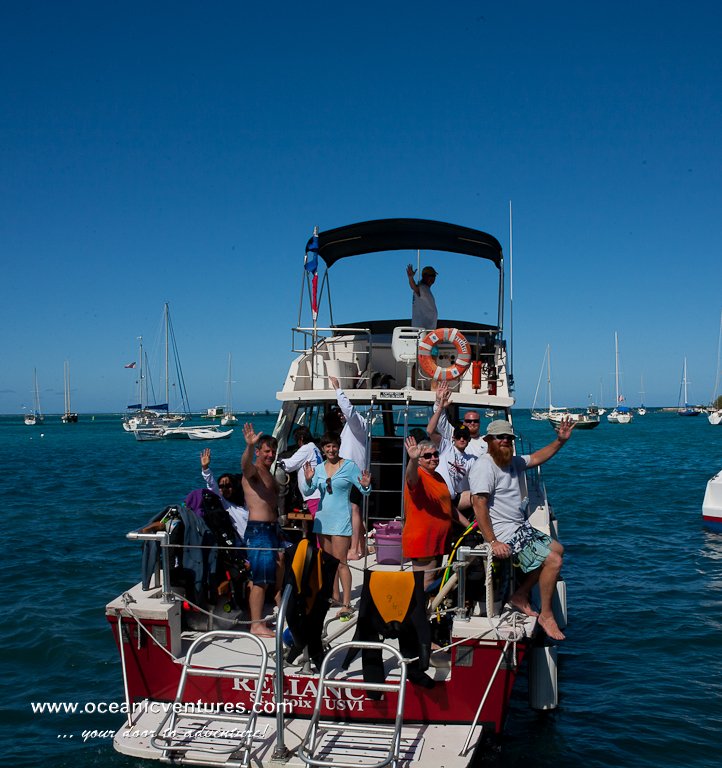
St. Croix DivingThe water temperature in this area is a little colder than the western Caribbean with temperatures ranging from 79 to 80 degrees. The waters off the island are not as protected as in some locations so there is a little more surface activity (i.e. waves) which may deter some divers from venturing out too far.

Because of the waves, winds and the relative health of our diving group, we dove mostly around the Salt River area and the channel area on the North side of St Croix. There are some other spectacular pillars and deep walls in the Cane Bay Area (I’ve seen photographs and heard stories) but the boat ride to these sites is long compared to the Salt River sites.

Despite diving solely in these areas we found the sites to be beautiful with some fun steep walls and cut-throughs in the coral formations. Because the water temperature is a little colder, there are fewer species of corals than in more temperate waters. However, the corals are healthy and plentiful.

After the dives, it seems that the national pastime in St Croix is drinking. The boardwalk is lined with bars and there are bars all around town. That is not to say that there are not restaurants serving nice meals but they tend to close early while the bars stay open until all hours of the night. Thursdays and Fridays are the big nights on the island with Saturdays being rather tame because everyone goes to the beach on Sundays (this was according to Alexandra “Alex” Morris, David’s Sister, who lives in St. Croix).
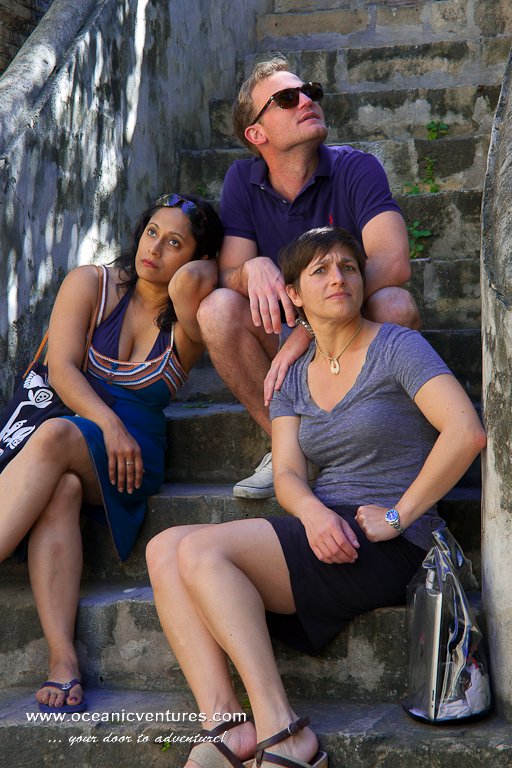
Alex & the GirlsFood ranges from fresh sea food to burgers and steaks. There is a distinct West Indian flair to much of the cooking which adds a unique flavour to the dishes. Hints of Coriander, Cumin and Tamarind can be found in many of the dishes. And, there are the lobsters. Prepared in a variety of ways, all sweet and buttery.

On the last night, David arranged for a special treat for the group — a dinner in one of the St. Croix great houses with dinner prepared by none other than Alexandra Morris, a young, up and coming chef on the island. The house was built as a town house in the late 1700’s by a pair of sugar plantation owners whose plantations were several days ride from Christiansted.

This Town House is decorated with period antiques showing that the owners are well traveled. The feel is of a traditional west indian home but with antiques from the orient and Europe. This would have showcased the wealth of the land owners who built the home.
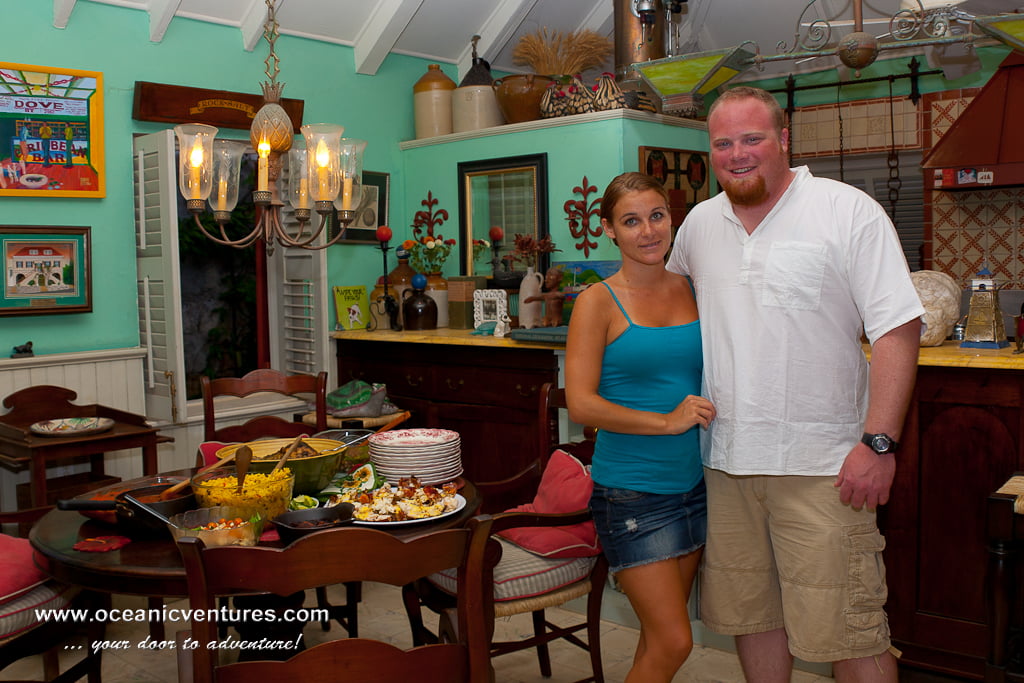
David Morris & Alexandra Morris
David Morris With His Sister Alexandra Morris

Our meal, served out in the Gazebo featured more of the local lobster, this time marinated in Cruzan Coconut Rum with toasted coconut sprinkled on top, as well as jerked chicken with a cream sauce, traditional peas and rice, local okra with mushrooms, sweet potatoes (made with spices and mashed white potatoes), a fruit salad and beans. All of this was followed by a traditional Cruzan Rum Cake (yes, it is better than the Cayman Rum Cakes) and Alexandra’s now famous passion fruit cheese cake (amazingly, there was a vine still producing passion fruit this far out of season). Fun food and fellowship, this is a way to end a trip.

Of course, David’s other goal for this trip was to finish his Principles of Technical Diving Course. Hence the reason we needed all of the logistical help from Ed and Molly. They are a tech friendly facility with Nitrox, Trimix and rebreather support available. They have granular sorb, cartridges, rebreather cylinders, twins or double cylinders, 40 cubic foot pony cylinders and other cylinders available, with or without rigging. They have a good group of gas blenders available as well as some technically trained Dive Masters to help lead the dives.

Getting to St. Croix from Houston is not as easy as the western Caribbean because this is primarily an American destination out of Miami. We went through San Juan and took an American Eagle flight over to the island. There are some other smaller carriers as well but luggage may be more of an issue with them.
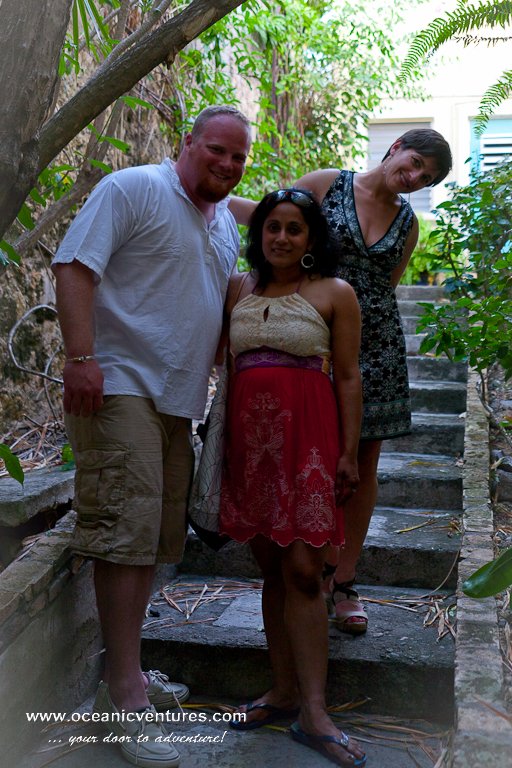
David & the Girls
David Morris with Deeba and Yuliya

One other thing to be aware of when heading to St. Croix is the island is expensive. Food, diving, technical diving supplies, etc are all expensive. Most things are imported from the states and the operating cost (water, power, fuel, etc) are expensive. This means that the prices are higher than you might expect so be prepared.

So what can I say other than traveling with David to St Croix is special and fun. He made sure everyone had a good time and for Dive Mom, he helped everyone have an exceptional shopping experience. Almost everyone came back with a St. Croix hook bracelet! Most of them purchased multiple ones — you know, it is hard to make a decision.

David loves to show off the finest points of St Croix because he is proud of the island and what it has to offer. He is truly a off-island minister of tourism. I am sure his Grandmother is smiling down on him.

Newspaper quote

Filed Under: Art, Caribbean, Marine Life, Rebreather, Rebreathers, Scuba Dive Training, Scuba Diving Activities, Travel, Trimix Tagged With: Dive Travel, diving, jewelry, Rebreather, scuba, St Croix, Technical Diving, Technical Diving.Rebreather Diving, Trimix, US Virgin Islands, Virgin Islands

December 14, 2012 by marinawatowich

Life Found in Extreme Antarctic Lake

Antarctica Mountain
Daytime in Antarctica
Copyright Eric Keibler

Most of us are familiar with Blue Lagoon in Texas, and subsequently with the excitement of seeing a fish in its vastly uninhabited waters. So imagine looking for life in a lake in Antarctica, lying 70 feet below the ice sheet, is six times saltier than sea water, has nitrous oxide levels higher than any body of water on Earth, and with an average temperature of 8 degrees Fahrenheit.  

This is the task that a team of researchers recently undertook in search of life in conditions that we did not believe could sustain life, as we know it. But when they looked in the microscope for bacteria, expecting to find none or possibly one species, they found many, an entire community living in these waters. This is an exciting discovery because it demonstrates that life can be sustained in other ways than we previously knew.  

Sunlight does not penetrate the ice to reach this lake, Lake Vida, and the bacteria do not get energy from oxygen or carbon either, as other life forms do. Although not certain, researchers believe that the organisms can harvest energy from chemical reactions between the saltwater and the rock below the lake, which is rich with iron. It is thought that the lake has been cut off from the Earth’s atmosphere for 3,000 years, which gives great clues to how life can develop especially under very extreme circumstances.

Filed Under: Antarctic, Conservation, Marine Life Tagged With: Antarctica, Lake Vida, marine life

December 5, 2012 by marinawatowich

Crustaceans Control Population With Cannibalism

Fisherman discovered long ago that lobsters practice cannibalism when many are put together in confined spaces. This is the reason that lobsters in tanks at grocery stores have rubber bands around their claws. This behavior was thought to be induced by the confining space in these tanks. But just recently this behavior has been observed in the wild as a natural behavior of lobsters. 

The lobster population on the east coast of the United States has been booming in the past few years due to overfishing of their natural predators, such as halibut. Warmer Ocean temperatures have also contributed to larger populations in the Gulf of Mexico. The lobster industry has been breaking catch records in recent years due to the unnaturally high amount of lobsters, but this imbalance is having effects on the lobster population. It seems that lobsters are being triggered to bring their population to a more balanced level and therefore prey on one another. It has been observed that at night eight of nine predatory attacks of small lobsters are from larger lobsters. This is an exceptional look at how some species adjust to overpopulation to restore balance.

Filed Under: Conservation, Marine Life Tagged With: Lobster, marine life

November 15, 2012 by marinawatowich

Corals Cry for Help from Gobies

When we think of coral reefs we usually picture the scene we are all familiar with, corals with fish swimming around, maybe hiding in or swimming amongst the coral, just like clown fish swimming protectively around their anemone. And these interactions between animals seem commonplace to us but these can be so vital to the life of a reef. One of these crucial, yet often overlooked, interactions is between the small staghorn coral, Acropora nasuta, and the gobies, G. histrio, which live in it. Due to global warming there has been an increase in toxic seaweed algae that is spreading over reefs in the Caribbean and Pacific. The toxic algae can spread over adult corals and kill larval corals as well, resulting in dying reef systems. Already, one study has show n, that there has been up to an 80% decline in living coral in the Caribbean and up to 50% in the Pacific. But the small staghorn corals have evolved a defense system against these impeding algae. Within 15 minutes of the algae coming into contact with the coral, the coral sends out chemicals to signal the fish that live around them. The chemicals have no effect on some fish but the gobies around the coral respond to the chemicals by eating the algae until it no longer touches the coral, which protects the coral. Not only is this in itself an amazing example of coevolution, but it also demonstrates mutualism because the gobies benefit from eating the toxic algae as well. The goby skin secretes toxins, which inhibit their attackers directly following an attack that many fish can hardly swim upright. This defense mechanism allows the gobies to escape. There is research that suggests that these gobies ingest the toxic algae and may sequester the toxins to then be used for their own defense. These interactions demonstrate the recycling of resources in reef systems and also the incredible ability of organisms to evolve for specific roles in their environment. Reefs rely on a balance of all the players on the reef to maintain its health and these gobies are just one small part of this delicate equilibrium.

Filed Under: Conservation, Marine Life Tagged With: Coral, Gobie, marine life

October 31, 2012 by marinawatowich

Sea Shells – Something to Think About

copyright H. Zell, from Wikipedia

The ocean has always amazed humans and it is well known that it is a crucial part of life on Earth. But one of the most fascinating aspects of the ocean is its key role in facilitating important life sustaining processes and interactions. We can experience this every time we go scuba diving, how the ocean helps balance life sustaining gases, how currents redistribute debris and animals around the world, how it prneudes a habitat for hundreds of thousands of species and many other processes. But there are many interactions that are minute and overlooked, but if you look close enough you’ll begin to realize their occurrences.  

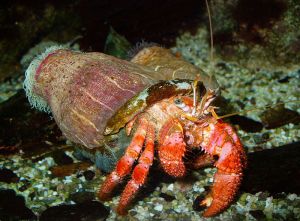
Tides prneude a vital exchange between the ocean and land, in one way that may be unexpected. Marine snails are crucial players in their ecosystems and their shells can often be seen under the waves. But as the ocean redistributes resources, empty shells can end up on land, scattered on beaches. Here, not only are they beautiful finds during a walk on the beach, they are also of ecological importance. Terrestrial hermit crabs use these shells as homes because shells large enough for a hermit crab are hard to come by on land. Hermit crabs inhabit these marine snail shells and burrow into them, thinning out the walls to make more room for themselves as they grow, and making more space to carry eggs in the shell (up to 1,000 eggs!). 

As the crab grows too large for the shell, it must find another, but modifying snail shells takes a lot of effort and crab prefers to use a shell that has been hollowed out already. The really fascinating part of this is that when crabs want to change shells they will gather with other crabs, usually groups of 3 hermit crabs will attract a congregation of dozens of others. The crabs will then form somewhat of a line from largest to smallest and wrench the larger crab from its shell, taking for themself. The largest crab is often left without a shell and must quickly find one. This is an amazing example of the sociality of crabs and the way the ocean helps facilitate this exchange. So the next time you see a marine snail while diving, just think about the long lifecycle the shell could go through!

Filed Under: Conservation, Marine Life Tagged With: marine life, photography, underwater photography

October 25, 2012 by marinawatowich

Are Beluga Whales Mimicking Human Speech?

Delphinapterus_leucas_2 beluga whale by steven snodgrass
Beluga Whale (Delphinapterus Leucas) copyright Steven Snodgrass

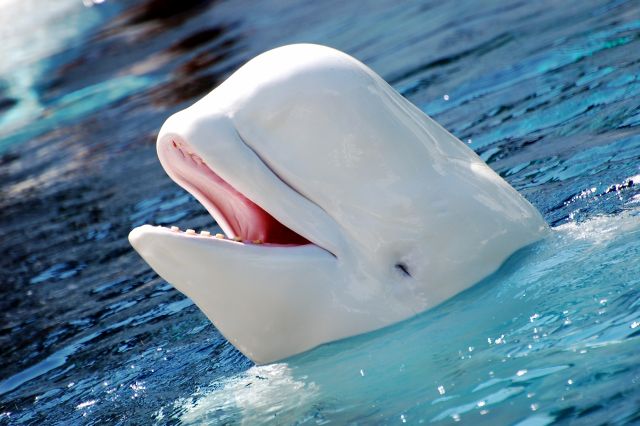
Many animals have been taught to mimic human behaviors, particularly human speech patterns but no animal has been found to do so naturally, until now. A beluga whale at the National Marine Mammal Foundation in California has been found to make sounds at lower octaves than usual and in patterns atypical for whales. While a researcher diving with the beluga heard unusual sounds the research team decided to investigate. They traced the sounds to one nine-year old male named NOC and recorded his sounds. What the discovered was that NOC was making vocal noises in bursts of about three seconds with pauses that are close to human speech patterns but not whale communication. They also found that the frequencies of NOC’s noises were varied into “harmonics” that were similar to humans but very distinct from whales. As the researchers gave NOC rewards for the human-like sounds he was taught to make them on command so they could be better studied. It was found that NOC can change the pressure in his naval cavity quickly as well as adjusted a few other body parts involved in vocalization to create lower frequency sounds in order to produce these sounds that whales have not been heard to make ever before.

This is a really exciting discovery and is one step closer to us understanding whale communication, adaptability and intelligence!

Filed Under: Conservation, Marine Life Tagged With: marine life, whales

  • « Go to Previous Page
  • Page 1
  • Page 2
  • Page 3
  • Page 4
  • Page 5
  • Go to Next Page »

Footer

Contact Us

Oceanic Ventures, Inc
5808 Newcastle Dr.
Houston, TX 77401-3214
USA

Phone: 713-523-DIVE (3483)

eMail: divesafe@oceanicventures.net

Signup for our dive and scuba newsletters

Don’t miss news about the exciting happenings at Oceanic Ventures.


Map and Directions

Socialize

  • Email
  • Facebook

Why People Choose Us

People choose their friends carefully just as they should choose their adventure partners and Scuba Diving Instructors.  Oceanic Ventures is the premier scuba dive shop in Houston, Texas, and the Southwest because of our exceptional service and our sense of adventure.  In talking with our clients and friends, people choose us for a number of reasons such as: Passion – We love what we do and we want to share the beauty and excitement of the underwater world with everyone we meet. Caring- Our clients tell us they love us because we truly care about people and strive to make their scuba diving experiences safe, fun and enjoyable. Professional – Our staff members are the … [Read more …]

Copyright © 2026 all rights reserved Oceanic Ventures, Inc. · Sitemap · Log in