• Skip to primary navigation
  • Skip to main content
  • Skip to footer

Houston's Premier Scuba and Dive Shop Oceanic Ventures Inc.

(713) 523-3483 (dive)
5808 Newcastle Drive
Houston, TX 77401

  • Home
  • Stay Current
    • Our Blog
    • Travel and Events Calendar
    • Club Aquarius Social Club
      • Club Aquarius Social Club Upcoming Events
      • Club Aquarius Social Club – The Past
    • Special Events
    • Local Scuba Diving Events
    • Photography Contest
    • Categorized Blog Posts
  • Equipment
    • Dive Equipment
    • Rebreather Systems
    • Cruise Ship Passengers
    • Repair & Maintenance
    • Air & Mixed Gas Blending
    • Pure Fiji Spa Products
  • Training
    • Become a Scuba Diver
    • Scuba In Your Home or Ours
    • Diving Programs for Young Explorers
    • Recreational Dive Courses
      • Recreational Dive Courses overview
      • The Briar Club Scuba Program
      • West University Scuba Program
      • Houstonian Scuba Program
    • Technical Diving Courses
      • Basics
      • Nitrox
      • Trimix
      • Rebreather
      • Wreck Diving Programs
      • Cave Programs
      • Blending
    • Leadership Dive Courses
  • Travel
    • Travel Escorted Adventures
    • Travel – Other Travel Programs
    • Travel – Custom Travel Adventures
    • Local Scuba Diving Events
    • Technical Travel
    • Scuba Diving Around Texas
    • Travel Insurance
    • Travel Forms
  • Company
    • About Oceanic Ventures
    • Meet Our Team
    • Testimonials
    • Facility Hours
    • Map
    • Oceanic Ventures Foundation
    • Resources & Articles
    • Archive
  • Shop
    • Online Store
    • Cart
    • Checkout
    • My Account
    • Policies regarding Privacy and Purchases
  • Contact

Marine Life

October 17, 2012 by marinawatowich

Study Indicates Some Sharks Are Color Blind

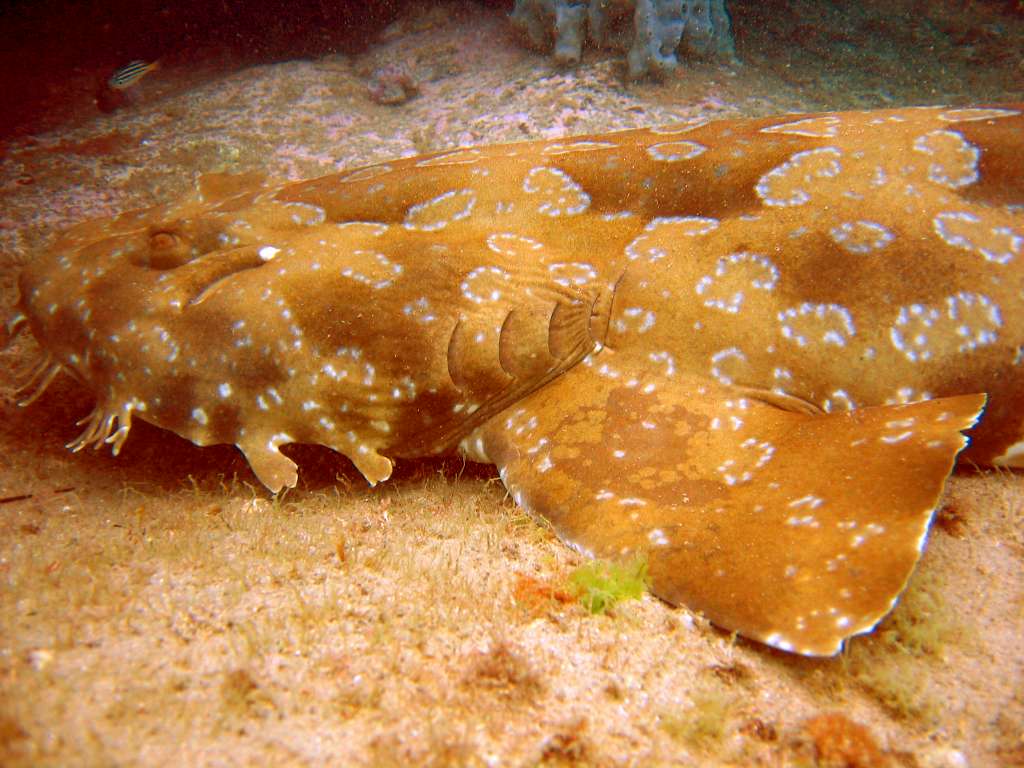
Wobblegong Shark
Spotted Wobblegong Shark.
Copyright (c) 2005 Richard Ling

A recent study by a group of Australian scientists has suggested that wobbegong sharks are color blind! Past studies that have tested color-sensing abilities in elasmobranchs (rays, skates, and sharks) have shown that some rays have color-vision, but it was believed that sharks were probably colorblind. This has now been proved in two species of wobbegong sharks and indicates the possibility of colorblindness in all sharks. But more species will have to be tested before conclusions can be drawn for more sharks.

The study looked at light-sensitive proteins in the light-sensing cells in the retina of wobbegong shark eyes. Different types of these light-sensing proteins, opsins, are used to detect various types of light and convert them into photoelectric signals. Animals usually need two types of opsins in order to have any color-vision. It was found that the two species of wobbegongs studied had only one cone opsin, concluding that their vision is colorblind. Many fish and other marine animals have color vision but this trait seems to be lost for certain types of whales, seals and dolphins, and it is unknown why large marine predators lost multiple opsins in their retina, and thus color vision. This new knowledge about wobbegong color sensitivity could have broader indications that many sharks are colorblind. This has important implications for the scuba, surfing and fishing industries, which can use this research to make their products less visible to sharks to promote diver, swimmer and surfer safety and make fishing lures that are more difficult for sharks to see in order to reduce shark by-catch!
Filed Under: Marine Life, Photography Tagged With: diving, marine life, shark

October 11, 2012 by marinawatowich

Explore the Ocean with Google Maps!

Google Map from APO IslandSome of the newest technology related to diving has come in a form strictly for surface use, as Google Maps has recently expanded their Google Street View to the ocean and gone underwater to capture panoramas and videos of reefs around the world! Google Street View is an interactive program that allows users to virtually navigate streets, museums, and famous sites world-wide but has previously stayed on land. Google has teamed up with the Caitlin Seaview Survey to create images of 360o views of reefs, which will make phenomenal images of reefs and virtual tours of popular dive sites available to billions of people who have never experienced the underwater world.  

Google hopes to make these dive sites accessible to users to promote interest and conservation of the ocean and the images will be added to an archive for marine scientists to use for studies of these marine environments. From September to December the project will travel down the coast of Australia taking thousands of images that will be continually uploaded new sites to Google Maps. Currently there are six sites available to view on Google Maps, including three sites at the Great Barrier Reef in Australia, two sites in Hawaii, and one of Apo Island in the Philippines.  

This is especially exciting for me because I have been lucky enough to dive Apo Island on an Oceanic Ventures trip and it is so cool navigate those sites via the internet! Although these images are amazing, they pale in comparison to the true underwater world of Apo Island. So, although Google cannot quite compare to really experiencing Apo Island, they’re making great strides forward and making dive sites more accessible to non-divers and divers interested in previewing sites in a sustainable way! 

You can see what I mean by going here.

Filed Under: Marine Life, Photography, Scuba Diving Activities, Travel Tagged With: diving, Google, Travel, underwater photography

August 30, 2012 by Eric Keibler

Help Save the Whales

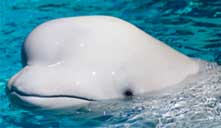
Photograph of Beluga Whale
Photo courtesy of savebiogems.org
This post is courtsey of Amos Nachoum and the staff at biganimals.com

Pierce Brosnan has narrated a video to call attention to the plight of the last 284 beluga whales of Alaska’s Cook Inlet. According to Brosnan, the actor and ocean activist, and also NRDC, the Apache Alaska Corporation is about to launch a seismic airgun attack that could push the white whales over the brink, into extinction.

The explosive noise of airguns used to explore for oil and gas can deafen, injure and even kill whales.
-Natural Resources Defense Council (NRDC)

According to NRDC, the oil exploration company is planning to launch an “acoustic onslaught in the beluga’s only home in the world” and apparently the Obama Administration has given Apache Alaska Oil the greenlight to go forward. The company, says Brosnan in the video, will use devices that create loud air blasts to explore for oil and gas – blasts that will occur every ten seconds, perhaps for months on end. At a distance, Brosnan says, the blasts can cause the whales to abandon their habitat and stop eating. At close range, they can cause deafness, even death.

“Don’t let the belugas go silent. Help protect them before time runs out.”
-Pierce Brosnan


Watch Pierce Brosnan’s video and then visit this NRDC website to tell the Obama Administration to stop the Apache Alaska Corporation from launching an airgun attack on belugas.  View the latest information from NRDC about this attack on belugas

Filed Under: Conservation, Marine Life Tagged With: environmental, marine life, whales

April 21, 2011 by swatowich

An Encounter with Dr. Sylvia Earle

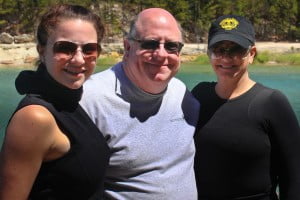
Stephanie and her family with Sylvia Earle

This year, my family and I and other members of the Oceanic Ventures team were fortunate to meet an extraordinary individual, Dr. Sylvia Earle, who has a deep commitment to protecting and conserving the marine environment. Sharing a few impressions from our encounter will, I hope, show how we can all work toward having a lasting positive impact on oceanocean conservation.

You might ask why this topic is of any importance, and how protecting the oceans will affect you or your family. Simply put, the human race depends on the oceans for life. And as divers, we rely on the oceans for our recreation and exploration.

The oceans are responsible for the production of a major portion, up to 50-70%, of atmospheric oxygen. Oceans also sequester carbon dioxide that we produce but are unable to metabolize. Billions and billions of tiny microorganisms living in the ocean use photosynthesis to produce oxygen by capturing carbon dioxide and energy from sunlight. Furthermore, oceans support the essential water cycle that brings rain and freshwater to land, allowing us ample water resources for agriculture and recreation.

The oceans are already showing the stress of human activities. If we fail to take action to further protect these vast and wonderful environments, we risk facing a world with insufficient oxygen, an altered water cycle with unknown consequences, and further buildup of toxic carbon dioxide in the atmosphere.

But the news isn’t entirely grim. Sylvia Earle emphasizes that we are living in the very best of times. We have the knowledge and resources to protect and conserve our marine environments, while also sustaining important activities for humans, including fishing, drilling for oil and oceanic shipping.

Sylvia is an oceanographer and a National Geographic Explorer-in-Residence. Many of us would know her through her diving history. Sylvia holds the record as having made the deepest untethered dive to a depth of 1000 meters (3300 feet) for men or women, an amazingly impressive feat. Sylvia has logged over 6000 hours underwater, on par with Ann and Eric! She’s been diving all over the world, but has a deep passion for the Gulf of Mexico, where she first dove and spent many hours enjoying as a child.

Sylvia spoke on April 5 at the Progressive Forum in Houston. Her message was loud and clear. We must take action to protect and conserve our marine environments, while also finding better ways to utilize the oceans for human needs. Sylvia reported that we are seriously overfishing, particularly large ocean fish such as bluefin tuna and sharks. Beyond the absolute beauty and impressive size of these creatures, they are critical for maintaining the balance of life in the oceans. As animals near at or near the top of the food chain, they keep smaller fish species in check, which is important for the health of the rest of marine ecosystems such as coral reefs. Other long-lived and slowly reproducing species such as orange roughy are also threatened by overfishing.

What you can do: become more aware of how our lifestyle might inadvertently contribute to overfishing. The Monterey Bay Aquarium in California is a great place to get started.

 Sylvia also emphasized that we must invest time and effort into finding better methods to better utilize the oceans for human activities. An obvious example was brought to light last year during the Deepwater Horizon drilling disaster. This accident took the lives of 11 people and countless numbers of marine species. We still don’t understand the ecological ramifications of the oil that was spilled, or the dispersants that were used, particularly their effect at deep depths in the Gulf. A major impact may be on the tiny photosynthetic organisms that produce oxygen for our atmosphere, as well as larger marine and bird species. As the Deepwater Horizon disaster revealed, we need to ensure that we develop cutting-edge technologies to explore and drill, and contain unanticipated oil leaks. One mile (or 161 ATM in diver terms) or more beneath the ocean surface prneudes extraordinary challenges. Sylvia pointed out that the oil industry and Houston itself were leaders in developing the needed technology.

What you can do: support investments in education and technology development that prneude the most efficient methods of extracting and using energy resources such as oil.

 A third point Sylvia discussed is to develop a system of protected marine environments, similar to the National Parks on land that prneude areas for human recreation and conservation of thousands of terrestrial species. President George W. Bush designated three Marine National Monuments within the last few weeks of his presidency that will prneude much needed protection for coral reefs in the Pacific Ocean. But more work is needed to protect areas in the Pacific as well as other oceans, and our own backyard, the Gulf of Mexico.

What you can do: become informed about conservation efforts through agencies such as the Nature Conservancy, World Wildlife Fund and Sylvia’s own Mission Blue.

 mission blue logoMission Blue is specifically aimed at conserving and protecting the oceans.  We are all capable of contributing to this effort, on large or small scales, depending on our resources, expertise and time. Protecting the oceans for our use, the vast numbers of marine species, the health of the planet, and future generations, is within our grasp. Here are a few ways to get started:

  • Learn about sustainable seafood. 
  • Let your government representatives know that you support agencies that conduct marine research.
  • Support marine conservation agencies. 
  • Support educational efforts about marine environments and their protection; let your government representatives know that you think education is vital. 
  • Help locally with beach clean-ups. 
  • Think about what you put on your lawn, and the fact that it will eventually end up in the Gulf of Mexico. 
  • Reduce waste, reuse and recycle.

Filed Under: Conservation, Marine Life, Presentations Tagged With: fish, National Geographic, ocean, sustainable fishing, Sylvia Earl

February 2, 2011 by swatowich

Scuba Diving from the Dumaguete Pier in the Philippines

Topside, this was the most unimpressive dive site I’d ever seen, with docked cargo ships and unpleasant noises and smells of industrial activity. Descending to the sand at about 20 feet did not prneude much inspiration as we were greeted by some rusted cans and a baby’s diaper (used, apparently).  I was left wondering why the boatload of experienced divers and divemasters was so keen on this site.
Dumaguete is on the Bohol Sea in Negros Oriental, Philippines, approximately 30 hours from Houston via Honolulu, Guam and an overnight in Manila. It is an absolutely fabulous dive location, at the northern portion of the “Coral Triangle”, the region of the greatest coral reef biodiversity in the world, and therefore well worth the arduous trip from Texas.
False Cleaner FishThe pier at Dumagute was no exception; it turned out to be the richest site of photo opportunities and encounters with weird and wonderful creatures in Negros Oriental. In this photo I was lucky to capture some very interesting behavior between 2 similar looking fish species, and equally fortunate to have Marco Inocencio from Atlantis Dive Resort interpret the activities. According to Marco, the larger fish in the hole is a false cleanerfish (Aspidontus taeniatus), while the two smaller fishes that are shown in full view are cleaner wrasses (Labroides dimidiatus). The larger fish is a mimic; it’s actually a member the blenny family who is posing as a cleanerfish in order to take bites of skin and flesh from other fishes looking for a cleaning. The false cleanerfish is distinguished from the cleaner wrasses by its head, which ends in a “nose” with its mouth slightly under and behind it while the heads of the cleaner wrasses terminate with their mouths. If you look closely enough you’ll see the characteristic pouty lips of the false cleanerfish, presumably because she isn’t much appreciated for her clever disguise and food-gathering methods!

Filed Under: Digital, Far East, Marine Life, Pacific, Photography, Travel Tagged With: Philippines, photography, Sealife, underwater photography

December 1, 2010 by Eric Keibler

Escape the Winter Cold, Let’s Go Scuba Diving in January!

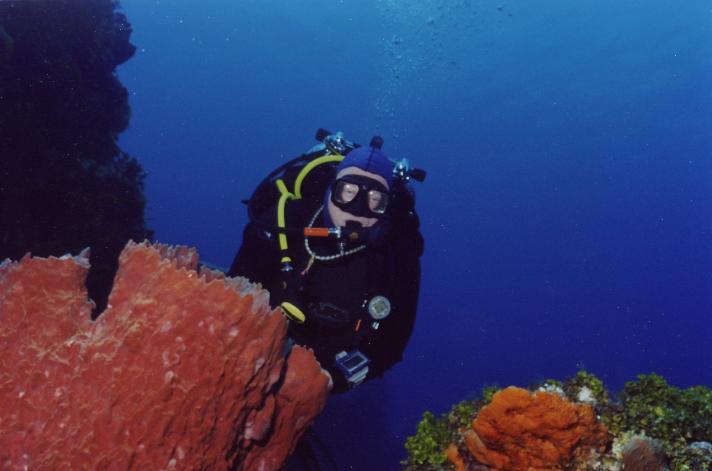
Eric Underwater in cozumelIt is sometimes hard for me hard to believe that I used to be an avid skier.  In college, I spent a number of weekends, a week around Christmas and Spring Break skiing.  It was fun, exhilarating and challenging.   My underwater camera saw more frozen moisture than liquid.
After mneung to Houston in…well let’s not go there…I changed from a skier to a sailor and a diver.  White powdery slopes were replaced by soft sand beaches, boats, bikinis, dive equipment and clear blue water.  Oh, and yes the warm weather.
Winters in Houston are a far cry from the cold wind-blown snow and ice of Lubbock, but I still find that winters can be cold.  I guess I have just gotten used to the warmth so the mild winters here seem cold to me at times. 
Despite the executives from Continental trading in their shorts and t-shirts for wool sweaters, wool pants and poly-propylene long underwear, Houston remains the gateway to the Caribbean and the soft sand and clear blue waters I discovered later in life.  In the Caribbean there is plenty of warmth to go around and diving on some of the worlds most beautiful reefs.  The walls stretch for miles down the coasts and in some places for miles down as well.
While Bing Crosby is singing “Let It Snow…” I am picturing a boat parked over a tropical reef, the top of the reef opening up eighty feet below me with the nearby wall plunging down 400 feet and the current guiding me along this natural aquarium.  The fish are swimming, feasting in the current and the corals are gently swaying in the water.
The easiest place to go for a long weekend is Cozumel, Mexico a limestone island once home to the Mayan Oracle and a Mayan pilgrimage destination.  Cortez removed the Oracle and used the island as a staging area for his conquest of Mexico.
Jacques Cousteau helped make the island a diving Mecca when he first visited the island in 1960.  He found the sleepy little island a paradise above and below the water.  Of course he probably would not recognize the Cozumel of today with 2 cruise ship terminals which can accommodate up to six ships.  The current economic slowdown in the United States has thankfully reduced the number of ships visiting the island but unfortunately to the detriment to the local people.
Cozumel is the home of the second Marine Park founded in Mexico and is the first not to allow local fisherman to spear fish or line fish on the reefs.  The primary industry in Cozumel is tourism with divers making up a large part of the tourist business, especially with the reduced cruise ship traffic.
Parrot FishThe reefs, which took a beating in Hurricane Gilbert are still beautiful.  The southern end of the island has steep walls and beautiful corals and fish, while the North end of the island was sloping walls and fast currents with up and down currents to boot.  For rebreather divers especially, the areas without the up and down currents are more enjoyable and my favorite dives are in the vicinity of Palancar Gardens and Palancar Caves.  It is really special to come up from the stark limestone depths into a garden of colour and lives, swirling around you as you swim in, out and around the pillars of coral.  You float along, the currents carrying you along toward the north (generally) with the scene constantly changing and renewing the colour and life.
Hmm, I think I need to go diving!  Luckily for me, the travel department at Oceanic Ventures, namely Ann, has put together a long weekend in Cozumel so I can complete some training for some students who are also looking forward to warm water and wetsuits instead of the cold water and dry suits I have been making them use for training up to this point.  But, despite my being involved in a training class, there are a number of people who, like me, want to escape the cold and enjoy some warm tropical breezes.
If you can get away, you are welcome to join us in Mexico 13-17 January 2011.  If you cannot make it this time, keep your head warm and remember someone else is staying warm for you.

Filed Under: Caribbean, Marine Life, Rebreather, Scuba Diving Activities, Travel, Trimix Tagged With: Continental, Cozumel, diving, Rebreather, Skiing, Trimix

  • « Go to Previous Page
  • Page 1
  • Page 2
  • Page 3
  • Page 4
  • Page 5
  • Go to Next Page »

Footer

Contact Us

Oceanic Ventures, Inc
5808 Newcastle Dr.
Houston, TX 77401-3214
USA

Phone: 713-523-DIVE (3483)

eMail: divesafe@oceanicventures.net

Signup for our dive and scuba newsletters

Don’t miss news about the exciting happenings at Oceanic Ventures.


Map and Directions

Socialize

  • Email
  • Facebook

Why People Choose Us

People choose their friends carefully just as they should choose their adventure partners and Scuba Diving Instructors.  Oceanic Ventures is the premier scuba dive shop in Houston, Texas, and the Southwest because of our exceptional service and our sense of adventure.  In talking with our clients and friends, people choose us for a number of reasons such as: Passion – We love what we do and we want to share the beauty and excitement of the underwater world with everyone we meet. Caring- Our clients tell us they love us because we truly care about people and strive to make their scuba diving experiences safe, fun and enjoyable. Professional – Our staff members are the … [Read more …]

Copyright © 2026 all rights reserved Oceanic Ventures, Inc. · Sitemap · Log in