• Skip to primary navigation
  • Skip to main content
  • Skip to footer

Houston's Premier Scuba and Dive Shop Oceanic Ventures Inc.

(713) 523-3483 (dive)
5808 Newcastle Drive
Houston, TX 77401

  • Home
  • Stay Current
    • Our Blog
    • Travel and Events Calendar
    • Club Aquarius Social Club
      • Club Aquarius Social Club Upcoming Events
      • Club Aquarius Social Club – The Past
    • Special Events
    • Local Scuba Diving Events
    • Photography Contest
    • Categorized Blog Posts
  • Equipment
    • Dive Equipment
    • Rebreather Systems
    • Cruise Ship Passengers
    • Repair & Maintenance
    • Air & Mixed Gas Blending
    • Pure Fiji Spa Products
  • Training
    • Become a Scuba Diver
    • Scuba In Your Home or Ours
    • Diving Programs for Young Explorers
    • Recreational Dive Courses
      • Recreational Dive Courses overview
      • The Briar Club Scuba Program
      • West University Scuba Program
      • Houstonian Scuba Program
    • Technical Diving Courses
      • Basics
      • Nitrox
      • Trimix
      • Rebreather
      • Wreck Diving Programs
      • Cave Programs
      • Blending
    • Leadership Dive Courses
  • Travel
    • Travel Escorted Adventures
    • Travel – Other Travel Programs
    • Travel – Custom Travel Adventures
    • Local Scuba Diving Events
    • Technical Travel
    • Scuba Diving Around Texas
    • Travel Insurance
    • Travel Forms
  • Company
    • About Oceanic Ventures
    • Meet Our Team
    • Testimonials
    • Facility Hours
    • Map
    • Oceanic Ventures Foundation
    • Resources & Articles
    • Archive
  • Shop
    • Online Store
    • Cart
    • Checkout
    • My Account
    • Policies regarding Privacy and Purchases
  • Contact

Rebreathers

February 14, 2013 by Eric Keibler

Project LifeLine

LifeLine for Valentines DayRecently, Ann and I were sitting at a table with Mike Lever, from the Nautilus Explorer and Nautilus LifeLine as well as Karen Zammitti, from Bamboo Reef in California; and, we were talking about the LifeLine units.  Karen related a story about her father and a recent experience he had with the unit.  He was diving in the Maldives and he and his dive buddy were pushed by a current in a different direction from the other divers in the group.  When they surfaced, they found the boat picking up divers and looking for them in a totally different direction from where they were.  They were not far away and eventually the boat would have found them but by using the LifeLine, he was able to tell the boat where they were so they could be picked up sooner.

Mike had a similar story to tell which drove him to develop the units.  The diver had drifted away from the shore and could see the boat but the boat was looking for him in the wrong direction so he had to just wait until they expanded their search in his direction.   It was nothing like the mneues, both divers could see the boat they were just in a different location from where the boat expected them to be.  By using the LifeLine, Karen’s father was able to reduce the time on the surface by letting the boat crew know where he was in relation to the other divers.

Divers in the Galapagos are used to carrying radio direction finders, RDF units, which will help the boat locate you if you surface too far away.  Most people never use them but everyone carries them. The advantage of the LifeLine over the RDF is that it has GPS coordinates and you can talk directly to the boat.

For a lot of trips, especially the ones in “big water” like the Pacific, carrying a LifeLine makes a lot of sense.  It is a waterproof VHF radio with a GPS function included.  It is small and fits easily onto any diving configuration.  The goal of Project LifeLine is to outfit divers doing open ocean dives with the Nautilus units.  Mike uses them on all of his boats and a number of other operators are incorporating them into their operations as well.

They are an east to use device and easy to carry.  If you would like to see them and play with them, please come by Oceanic Ventures for a demo.
Filed Under: Open Circuit, Rebreathers, Scuba Diving Equipment Tagged With: equpment, LifeLine, Technical Diving, Technical Diving.Rebreather Diving

February 8, 2013 by Eric Keibler

At The Office – A Trip Report From St. Croix

St Croix

When David started diving with Oceanic Ventures, he talked a lot about the Virgin Islands and his desire to introduce us his home town, Christiansted, St. Croix. It seems that he has a lot of his Grandmother in his blood and he wants to introduce everyone to the uniqueness that is St. Croix. (David’s Grandmother, Janet Foster, was the Commissioner of Tourism for St. Croix and along with Vogue Magazine, coined the term The Island of Superlatives).

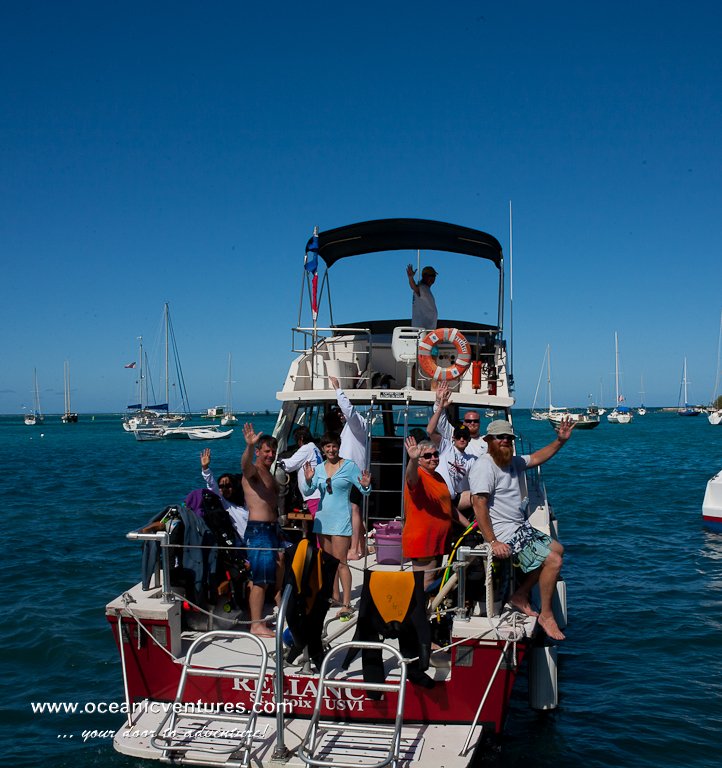
While he has taken several people to the island during the past few years, on February 1 he got one of his wishes; we took ten of our close warm personal friends to the island to discover what David already knew — there is good diving in St. Croix and a lot more.

We were fortunate to hook up with Ed and Molly Buckley from SCUBA in St Croix and Elsie from the Caravelle Hotel. They helped us coordinate everything from transfers, to Nitrox, Trimix, Sorb and rebreather bottles.

The diving in St Croix varies from steep deep walls to shallow flats with coral bommies and then spur and groove formations. Their are a lot of sharks in the area as well as other marine life from turtles to eels, snappers to butterfly fish. While it appears the large groupers have been fished out, other reef fish have survived and thrived.

St. Croix DivingThe water temperature in this area is a little colder than the western Caribbean with temperatures ranging from 79 to 80 degrees. The waters off the island are not as protected as in some locations so there is a little more surface activity (i.e. waves) which may deter some divers from venturing out too far.

Because of the waves, winds and the relative health of our diving group, we dove mostly around the Salt River area and the channel area on the North side of St Croix. There are some other spectacular pillars and deep walls in the Cane Bay Area (I’ve seen photographs and heard stories) but the boat ride to these sites is long compared to the Salt River sites.

Despite diving solely in these areas we found the sites to be beautiful with some fun steep walls and cut-throughs in the coral formations. Because the water temperature is a little colder, there are fewer species of corals than in more temperate waters. However, the corals are healthy and plentiful.

After the dives, it seems that the national pastime in St Croix is drinking. The boardwalk is lined with bars and there are bars all around town. That is not to say that there are not restaurants serving nice meals but they tend to close early while the bars stay open until all hours of the night. Thursdays and Fridays are the big nights on the island with Saturdays being rather tame because everyone goes to the beach on Sundays (this was according to Alexandra “Alex” Morris, David’s Sister, who lives in St. Croix).

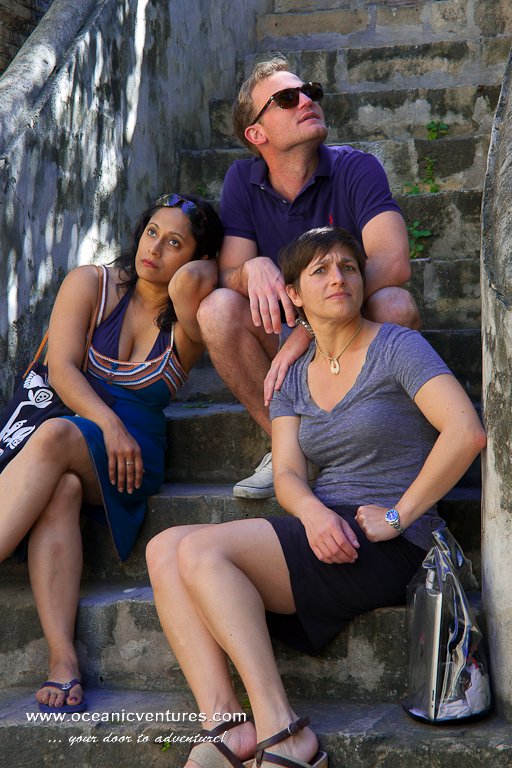
Alex & the GirlsFood ranges from fresh sea food to burgers and steaks. There is a distinct West Indian flair to much of the cooking which adds a unique flavour to the dishes. Hints of Coriander, Cumin and Tamarind can be found in many of the dishes. And, there are the lobsters. Prepared in a variety of ways, all sweet and buttery.

On the last night, David arranged for a special treat for the group — a dinner in one of the St. Croix great houses with dinner prepared by none other than Alexandra Morris, a young, up and coming chef on the island. The house was built as a town house in the late 1700’s by a pair of sugar plantation owners whose plantations were several days ride from Christiansted.

This Town House is decorated with period antiques showing that the owners are well traveled. The feel is of a traditional west indian home but with antiques from the orient and Europe. This would have showcased the wealth of the land owners who built the home.

David Morris & Alexandra Morris
David Morris With His Sister Alexandra Morris

Our meal, served out in the Gazebo featured more of the local lobster, this time marinated in Cruzan Coconut Rum with toasted coconut sprinkled on top, as well as jerked chicken with a cream sauce, traditional peas and rice, local okra with mushrooms, sweet potatoes (made with spices and mashed white potatoes), a fruit salad and beans. All of this was followed by a traditional Cruzan Rum Cake (yes, it is better than the Cayman Rum Cakes) and Alexandra’s now famous passion fruit cheese cake (amazingly, there was a vine still producing passion fruit this far out of season). Fun food and fellowship, this is a way to end a trip.

Of course, David’s other goal for this trip was to finish his Principles of Technical Diving Course. Hence the reason we needed all of the logistical help from Ed and Molly. They are a tech friendly facility with Nitrox, Trimix and rebreather support available. They have granular sorb, cartridges, rebreather cylinders, twins or double cylinders, 40 cubic foot pony cylinders and other cylinders available, with or without rigging. They have a good group of gas blenders available as well as some technically trained Dive Masters to help lead the dives.

Getting to St. Croix from Houston is not as easy as the western Caribbean because this is primarily an American destination out of Miami. We went through San Juan and took an American Eagle flight over to the island. There are some other smaller carriers as well but luggage may be more of an issue with them.

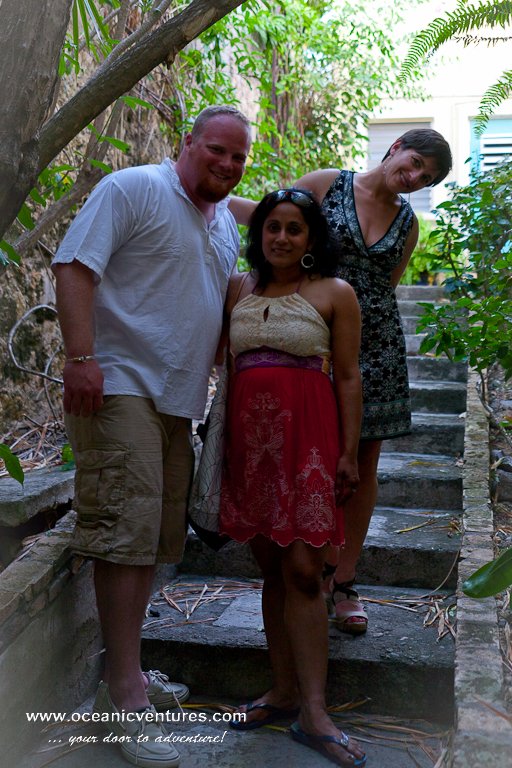
David & the Girls
David Morris with Deeba and Yuliya

One other thing to be aware of when heading to St. Croix is the island is expensive. Food, diving, technical diving supplies, etc are all expensive. Most things are imported from the states and the operating cost (water, power, fuel, etc) are expensive. This means that the prices are higher than you might expect so be prepared.

So what can I say other than traveling with David to St Croix is special and fun. He made sure everyone had a good time and for Dive Mom, he helped everyone have an exceptional shopping experience. Almost everyone came back with a St. Croix hook bracelet! Most of them purchased multiple ones — you know, it is hard to make a decision.

David loves to show off the finest points of St Croix because he is proud of the island and what it has to offer. He is truly a off-island minister of tourism. I am sure his Grandmother is smiling down on him.

Newspaper quote

Filed Under: Art, Caribbean, Marine Life, Rebreather, Rebreathers, Scuba Dive Training, Scuba Diving Activities, Travel, Trimix Tagged With: Dive Travel, diving, jewelry, Rebreather, scuba, St Croix, Technical Diving, Technical Diving.Rebreather Diving, Trimix, US Virgin Islands, Virgin Islands

December 10, 2012 by Eric Keibler

At the Office – Diving the Pathfinder Rebreather

Eric Keibler on a Pathfinder Rebreather in Grand Cayman
Just another day at the office. at least that is what I tried to convince Ann was happening the past five days in Grand Cayman. One of our friends, Pam, even said that maybe they needed to “meet in our conference room.”
But really, I was in Grand Cayman to complete a training program on the Megalodon and Pathfinder rebreathers. You can ask Emma or Nancy, I was in class each morning and diving in the afternoon…you know skills, drills and well ok, some fish, corals and steel; one dive was on the Kittywake.
While I have a lot of experience diving the Megalodon rebreather, the real treat of this trip was to dive the Pathfinder in something other than the pool. Not that I mind the pool, but there is something more interesting about a vertical wall with fish, colourful corals and vibrant sponges. Remember, part of my training was swimming in the unit.
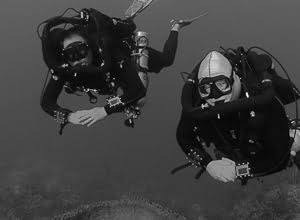
Eric Keibler and Leon Scamahorn diving Pathfinder Rebreathers in Grand Cayman
The Pathfinder is designed with a more recreational diver in mind. Underwater photographers will love this unit because it is small, easy to use and prneudes the advantage of not scaring the fish away with every breath. One of the things that appeals to me is its size and weight. The complete unit will fit in a carry on suitcase and will not require help from three of your diving buddies to put it in the overhead. For divers with camera, the unit is robust enough to go as checked luggage as well.
The unit can be configured with a standard over the shoulder set of counterlungs or with the new top of the shoulder counter lungs. One of the other configuration options is the diliuent bottle. You can configure it like a standard rebreather with the diliuent and oxygen supplies mounted to the canister or, alternatively, you can utilize the bailout cylinder as the diliuent thereby reducing the weight and simplifying the rig for the diver.
Unlike some of the other rebreather designs for more recreational divers which try to minimize any diver thought or input into the system, the Pathfinder is designed for a thinking diver. Since you can never fully factor out the human interface, Leon Scamahorn, designer of the system, believes that the diver should be included and involved in the system. This does not mean that the system is complicated but rather it needs some input from the diver during the set-up and initialization phases of the dive. Further, it offers the diver more options in dive parameters and uses.
While a purely “recreational” diver will love this unit, the Pathfinder is capable of mneung beyond what we normally consider to be recreational diving. Leon designed the unit to have enough scrubber media and system capabilities for a diver to do a typical normoxic trimix dive (using helium in the breathing mix.)
So you are probably asking what did I think about it? It was a real treat to dive a lightweight but capable rebreather. The work-of-breathing, a performance measurement, is similar to that found in the Megalodon rebreather. What this means is that it is easy to breath in the horizontal position as well as upside down and while facing up at the surface. The electronics are straight forward and easy to understand both on the surface and underwater and they do a good job of controlling the oxygen set-point or level. I found the unit trimmed well so it was easy to swim with in the water and because of its size and weight it was easy to exit the water. The scrubber packs easily and the assembly is easy and straight forward. It flushes easily and takes minimal amount of time to correct the oxygen levels.
Eric Keibler and Leon Scamahorn after Eric’ s Final Check-Out Dive for his Instructor Certification
If you are interested in rebreahers, I think this unit is a good alternative for more capable and expensive rebreathers. It prneudes a lot punch and is ideal for a photographer or any typical “recreational” diver as well a diver wanting to venture beyond the recreational limits sometime in the future. The Pathfinder is a very capable unit and may be the only unit you will need for the style of diving you have in mind.

Filed Under: Caribbean, Photography, Rebreather, Rebreathers, Scuba Dive Training, Scuba Diving Activities, Travel Tagged With: diving, Grand Cayman, Leon Scamahorn, Pathfinder, Rebreather, Training

May 6, 2012 by Eric Keibler

Travel Log – The Scuba Diving is Finished, the Journey Home Begins

20120506-173112.jpgTravel seems to contain large periods of waiting surrounded by periods of fun and adventure. We are once agin in a holding pattern here at the Blue Lagoon Resort in Chuuk Micronesia having left the boat early this morning in order to allow the crew to prepare the boat for the new group of passangers to embark later this evening.
During these waiting periods, one has time to reflect on the adventurers of the week and the fun everyone had diving here in Micronesia. There were chance encounters with sharks, swimming with turtles, and there were moments of awe watching eagle rays and marble rays swim past the submerged toe-rails.
I was fortunate to dive with the Chief Engineer, Mike, who the last time we visited, had never dove before Ann introduced him to the water. We spent hours laughing and sharing stories with old and new friends along with diving to create new memories and stories.
Diving is about moments, moments of exhileration, wonder, joy and discovery. On a trip here you can experience a wide range of emotions and thrills as you dive among the wrecks slowly being reclaimed by the sea. Once carrying instruments of war these giant steel hulls now prneude entertainment and a home to millions of organisisms and animals.
Of course, I was especially touched when I boarded the Odyssey and almost every crew member asked where Ann was and wondered why she was not here diving with us. While some may feel a little jealous about the comments, I find it a wonderful tribute to her that even after two years, the crew remember her and have such warm feelings for her.
We were fortunate to have had good weather most days and a lot of time underwater. Alex Witschey and Jim Burton completed their Advanced Wreck classes and with the extra days here, Alex was able to complete the dives for his Normoxic Trimix certification. John Rydman was able to complete his SSI Wreck Diving Specialty and Chuck Gerlneuch completed his 1,900th dive on the Nippo Maru
– a truly impressive feat.
Those of us who had been here before all noticed the deterioration that has occurred since our last trip.Some ships have faied better than others, a testament to the quality and care of her shipwrights. Some, built during the years just before the war are after the conquest of Imperial Japan began, were not so fortunate and they are showing a faster reclamation by the sea.
During our week on the Odyssey, we visited the following wreck sites:

  • Kiyosumi Maru,
  • Yamiguri Maru,
  • Fumizuki,
  • Shinkoku Maru,
  • Unkai Maru,
  • Goesai Maru,
  • Hoki Maru,
  • Fujikawa Maru,
  • Nippo Maru,
  • San Francisco Maru, and
  • Kenso Maru

Each site offered a mix of traditional wreck diving and reef diving Of course, depth played a hand in determining if one thing or another dominated the site. And of course, there are the engine rooms — tempting holes beckoning divers to explore. Be sure to ask Alex about them, I do not think he missed one of them!
Of course all of our rebreather divers wish to send a special thanks to the California Trial Lawyers Association and to the judiciary system in California. With the loss of the Teledyne cells due to frivolous lawsuits in the “great” state of California, we experienced more cell failures and issues than on any trip I have ever run. The new AP Diving cells were not very reliable with at least three failures of brand new cells requiring me to ask other divers to bring more cells with them from the states. The Max Tech R22D cells did not like moisture and the AI cells did not like doing more than 2 dives a day. Fortunately, the new Vandegraph cells performed well throughout the two weeks. The lesson learned is that until the cell manufacturers learn to make a reliable cell similar to the old teledyne cells, rebreather divers must invest in a lot of spare cells; especially when they are diving in remote locations.
Also, for the rebreather divers, I am also happy to announce that the Odyssey is now a complete rebreather friendly location with the addition of rebreather cylinders left by our divers. They now have both 2L and 3L bottles! Diving a rebreather in Chuuk is an ideal way to see and explore the wrecks. Thank you for letting us help complete the circle!
Today you will find our happy crew scouting out old Japanese military sites, catching up on email, connecting with friends or family or just trying to entertain themselves. Ann’s favorite four year old, Jess, is probably causing trouble somewhere, while others are trying to figure out how to get their luggage repacked to conform to the United Airlines baggage restrictions. Lest we forget those civilized pursuits some of the group have elected to have a massage or a pedicure and manicure. Both prneuded on site for a reasonable fee.
Drinking is also an option but with a 50% tax on liquor and beer it is an expensive one.
Of course there is breakfast, lunch and dinner. Pam and I already spent the breakfast and lunch hours together – straight with no break, in the dining room. Of course Ann and were texting via Skype and Pam was doing her best to delete all of her work emails!
Our journey home begins when we gather in front of the hotel at 11:00 for our 2:30 am flight to Guam then it is on to Honolulu continuing to various points in the US. Where is Scotty when you need him? Beam me up Scotty!
Our Journey home begins…

Filed Under: Pacific, Rebreather, Rebreathers, Scuba Diving Activities, Scuba Diving Equipment, Travel, Wreck Diving Tagged With: divin, friends, Rebreather, Travel, Truk Lagoon, Wreck Diving

April 29, 2012 by Eric Keibler

Travel Log – The Waiting Game

20120429-160928.jpg
Waiting seems to be a part of international travel. The time between check-out and leaving for e next phase of the trip do not seem to mesh. So here we sit, relaxing at the resort in anticipation of being picked up by the crew of the Odyssey for our next adventure here in Chuuk.
We have had some awesome technical scuba dives during our short stay here. Today we did one of my favorite dives here in the lagoon, the Aikoku Maru. Descending down the line the first thing you notice are the massive king posts, covered I coral growth and teaming with life. There is only half of e original ship the remainder having been blown off by a massive explosion ink the forward munition hold. But what remains is impressive. The stern gun still points to the sky as does the one remaining anti-aircraft gun on the top of the bridge structure.
The fly bridges and hallways are collapsing and some of the interior spaces are also sinking toward the bottom. There is a lot of growth all over the wreck but not so much as to obscure the features like the shallower wrecks.
Our visit to the wreck was short, 25 minutes on the bottom and 35 more minutes in the water column; and, no sharks today to entertain us.
We were also treated to a bar BQ by our dive master, Daniel, and the boat crew. A wonderful way to end our shore visit and to begin our live-aboard experience.
The diving continues…

Filed Under: Pacific, Rebreathers, Travel Tagged With: pacific, Travel

April 27, 2012 by Eric Keibler

Travel Log – Scuba Diving in Truk Lagoon Finally

20120427-205157.jpg
The weather system we avoided in Kosrae seems to have followed us to Chuuk. The basic schedule is It rain overnight, clearing slightly in the morning until just the point where we are loading the boats to go diving and then a small squall runs through kicking up the seas and making for a wet ride out to the dive site. The skies and seas remain a little disturbed while we are underwater and then just after we re-board the boat after our decompression stops, the seas lay down making the ride back to the resort a smooth affair.
We have had some great dives during the shore based portion of our trip. We started with the Fujikawa Maru, which is a spectacular wreck with lots of sea life and coral growth. The engine room and forward holds were a little murkey, probably as a result of divers who were there before us. While the zeros are still there, they show signs of deteriation. It really demostrates that things built for a terestrial environment are not as well suited to life iunderwater.
Because we were here earlier than we had origionally planned, the group decided to dive the deeper wrecks in Truk Lagoon, especially since we will not be visiting them next week. We also decided to do some of the dives using Helium. Using Helium out here is a mixed blessing. It makes for a clearer head and safer diving but there is a price to pay. First, Trimix diving generally requires longer decompression times when compared to air diving which means that we all have to get used to hanging around in shallow water and looking at one another,
Of course the biggest price to pay will come on Sunday when the Blue Lagoon Dive Shop presents us with our diving and gas bill. Helium is $4.50 per cubic foot! The rebreather divers are each using about 7 cubic feet per day while the open circuit divers are using about 38 cubic feet per day. Lest we forget, there are also the oxygen and the bottle rentals. Deep diving in the tropics can be expensive!
I have also come to realize that in order to successfully dive in remote locations, you not only have to be a compotent diver, but you also have to be part mechanic and part dreamer, with a good dose of MacGuiver tossed in. We have already had our share of equipment glitches and malfunctions. Some we have had the spare parts for and others we have not. Parts are not readily available in this remote part of the world but Pam is arriving on Sunday with some parts to make our repairs easier and more permanent. I am already compiling a list of things I need to add to my expedition kit.
So far we have dove the following wrecks:
The Fujikawa Maru,
The Hein Maru,
The Shotan Maru, twice,
The Nippo Maru, and
The Fujisan Maru.
And for all of those fish lovers we have seen a large school of Baracuda, Tuna hunting, Eagle Rays and lots of small reef fish. Alex was so popular with three little yellow stripped fish that they followed him all the way around the wreck and up to his 10 foot stop. It was like having a bunch of high school girls following him around; the only thing missing was the fish trying to flirt with him.
Great diving and good friends, what more can you want. Ok, it would be far better if Ann were here instead of manning the store at home but the world is not a perfect place.
The diving continues…

20120427-210243.jpg

Filed Under: Pacific, Rebreather, Rebreathers, Scuba Diving Activities, Travel, Trimix, Wreck Diving Tagged With: pacific, Rebreather, Truk Lagoon, Wreck Diving

  • « Go to Previous Page
  • Page 1
  • Page 2
  • Page 3
  • Page 4
  • Interim pages omitted …
  • Page 6
  • Go to Next Page »

Footer

Contact Us

Oceanic Ventures, Inc
5808 Newcastle Dr.
Houston, TX 77401-3214
USA

Phone: 713-523-DIVE (3483)

eMail: divesafe@oceanicventures.net

Signup for our dive and scuba newsletters

Don’t miss news about the exciting happenings at Oceanic Ventures.


Map and Directions

Socialize

  • Email
  • Facebook

Why People Choose Us

People choose their friends carefully just as they should choose their adventure partners and Scuba Diving Instructors.  Oceanic Ventures is the premier scuba dive shop in Houston, Texas, and the Southwest because of our exceptional service and our sense of adventure.  In talking with our clients and friends, people choose us for a number of reasons such as: Passion – We love what we do and we want to share the beauty and excitement of the underwater world with everyone we meet. Caring- Our clients tell us they love us because we truly care about people and strive to make their scuba diving experiences safe, fun and enjoyable. Professional – Our staff members are the … [Read more …]

Copyright © 2026 all rights reserved Oceanic Ventures, Inc. · Sitemap · Log in