
• Skip to primary navigation
  • Skip to main content
  • Skip to footer

Houston's Premier Scuba and Dive Shop Oceanic Ventures Inc.

(713) 523-3483 (dive)
5808 Newcastle Drive
Houston, TX 77401

  • Home
  • Stay Current
    • Our Blog
    • Travel and Events Calendar
    • Club Aquarius Social Club
      • Club Aquarius Social Club Upcoming Events
      • Club Aquarius Social Club – The Past
    • Special Events
    • Local Scuba Diving Events
    • Photography Contest
    • Categorized Blog Posts
  • Equipment
    • Dive Equipment
    • Rebreather Systems
    • Cruise Ship Passengers
    • Repair & Maintenance
    • Air & Mixed Gas Blending
    • Pure Fiji Spa Products
  • Training
    • Become a Scuba Diver
    • Scuba In Your Home or Ours
    • Diving Programs for Young Explorers
    • Recreational Dive Courses
      • Recreational Dive Courses overview
      • The Briar Club Scuba Program
      • West University Scuba Program
      • Houstonian Scuba Program
    • Technical Diving Courses
      • Basics
      • Nitrox
      • Trimix
      • Rebreather
      • Wreck Diving Programs
      • Cave Programs
      • Blending
    • Leadership Dive Courses
  • Travel
    • Travel Escorted Adventures
    • Travel – Other Travel Programs
    • Travel – Custom Travel Adventures
    • Local Scuba Diving Events
    • Technical Travel
    • Scuba Diving Around Texas
    • Travel Insurance
    • Travel Forms
  • Company
    • About Oceanic Ventures
    • Meet Our Team
    • Testimonials
    • Facility Hours
    • Map
    • Oceanic Ventures Foundation
    • Resources & Articles
    • Archive
  • Shop
    • Online Store
    • Cart
    • Checkout
    • My Account
    • Policies regarding Privacy and Purchases
  • Contact

Scuba Diving Activities

August 30, 2017 by Christian Fuss

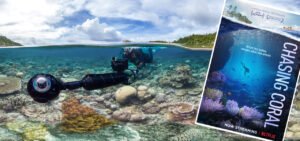
Scuba Diver's Movie Night – Chasing Corals

Photo courtesy of Ocean Agency
Chef Eric
Chef Eric
There was a lot of time to waste during sitting out a devastating storm at home. Thanks to Chef Eric we had wonderful meals and thank God we had no major power or internet outages around our neighborhood. So as Jenny and I were fed with munches by Ann and Chef Eric was preparing a delicious meal in the kitchen, we sat down at the couch and started to browse the Netflix library to find something interesting to watch. The movie, “Chasing Coral” caught my attention (“Chasing Coral” a Netflix documentary by Jeff Orlowski).  Previously, I noticed the attention it got on Social Media when it first came out a few years ago and put it on my Netflix watch list where it has lured ever since. And, what started with “hey watch this” ended in the four of us sitting in front of the TV with dropped jaws, and numerous “wow” moments.  We also found ourselves replaying many scenes and soaking up the details.
Fiji, Photo by Christian Fuss

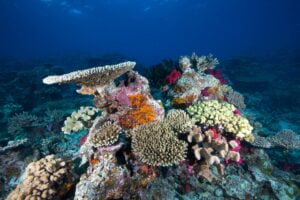
Corals are colorful and beautiful to look at

Corals are colorful and beautiful to look at but, who thought they are also amazing, small, living creatures. If your watch “Chasing Coral on Netflix” and you will get a whole new view on the world of Coral Reefs. In watching many movies and documentaries about diving and the marine environment, I have rarely seen a documentary that shows how we, as humans,  with our behavior and treatment of  our environment are destroying the oceans. Since we are all divers,  we are interested in diving, marine life and the oceans; but, little did I realize that Corals in their full beauty and diversity in colors and forms, are not just beautiful and eye candy along with being decorative, but they also provide a vital function for the reefs.
We all know they play an important role for the Marine Ecosystem.  But, it hasn’t been too long since scientists and activists have started to warn about the so-called “coral bleaching” – and about the disastrous impact this could have on the whole Earth.
The documentary “Chasing Coral”, which is offered on Netflix for streaming, tells the story about causes, the extent of the damage as well as impact this could have on the world.
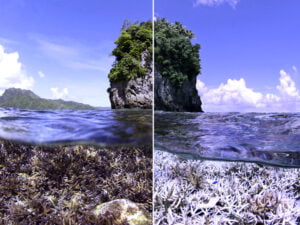
Photo Courtesy of the Ocean Agency

Coral Bleaching: Global Warming kills corals.

Coral Bleaching is a step in the process of the dying animals, yes, corals are animals. Corals live in symbiosis with various forms of algae.  In a bleaching event, the rid themselves of the algae to lessen the strain on the animal which results in the color loss or “bleaching.”What remains is a white skeleton.  While corals can recover from a short-term event, the longer it lasts or the more frequent it occurs inflicts permanent damage to the coral colony.  The main cause for is event is increased water temperature and/or strong sun radiation.
“Coral bleaching itself is a stress response, much like a fever in humans is a stress response. If the temperature spikes just a little bit above the normal range corals will start to bleach.” Dr. Ruth Gates, head of the Hawaii Institute of Marine Biology (HIMB) at the University of Hawaii explains, Coral Bleaching is a stress reaction by the corals, sort of like a fever in a human body. Just a little rise in temperature is enough for the corals to start bleaching.
Over the past two decades,  we have already seen two major coral bleaching events that were both caused by the weather phenomena El Niño. The current bleaching event however is the longest and most wide-spread so far.  According to scientists the world has lost about half of all corals within the past 30 years we are told in “Chasing Coral”
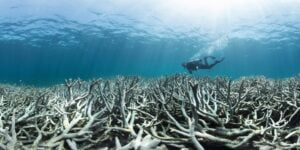
Photo Courtesy of the Ocean Agency

What does all this have to do with us?

No matter what you believe about the Global Warming argument, we are all affected by the Earth’s warming trend.  The rise of the oceans is a concern for islanders who see their land disappearing below the waves, and for others there are the severe weather disasters, hurricanes and floods.  These are all impacts of global warming.  The oceans play an important role in our lives because they absorb 93% of the heat in the atmosphere; and, because they are helping to moderate temperatures by absorbing the heat, the water temperatures in our seas have increased dramatically during the past couple of years.
Richard Vevers, founder and CEO of the NGO “The Ocean Agency” comments, “We look at climate change as if it is an issue in the air. And you go: one or two degrees Celsius, does that really matter? But when you talk about the ocean, it’s like your body temperature changing. And imagine your body temperature rises one degree centigrade or two degrees centigrade. Over a period of time that would be fatal. And that’s the seriousness of the issue when you look at it in terms of the ocean.”
In essence, the  man-made climate change is essentially heating up the oceans which then leads to the dying of corals and a whole ecosystem. Raising awareness among all people was the driving force behind the  documentary “Chasing Coral.”
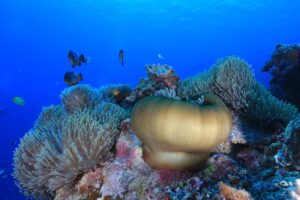
Fiji, Photo by Christian Fuss

Why we cannot afford to not to care!

Corals create reefs; these reefs are the home, food source and nursery for countless fish and other marine life. If corals die, whole habitats disappear. This does not just “mess up” the fragile balance within the oceans,  a large portion of the world population depends on fish and other marine life as source of protein. A mass dying of fish could follow a mass coral dying which would dramatically affect the lives of millions of people.
But the health of a reef does not only affect the security of food sources, they break waves, calming down the ocean before it gets to the coastline. If these fringing reef die or disappear the sea conditions will change becoming more unpredictable and dangerous for people living and working along the shores.  This is on top of the rising sea levels which we are already experiencing.
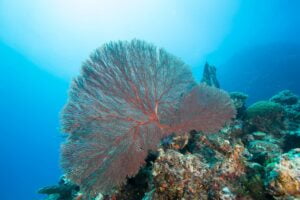
Fiji, Photo by Christian Fuss
All of the places, we as divers enjoy traveling to, like Indonesia, Philippines, Palau, Maldives, Mexico, Caribbean islands, Samoa, French Polynesia and many more these coral reefs are a major source of income from tourism – without the corals and without the fish these places would lose tourism resulting in starvation and lowering an already low standard of living.
In the documentary, divers, scientists, filmmakers and coral nerds try to document the current worldwide coral bleaching events and coral deaths for those who otherwise would never see what’s happening underneath the surface of our oceans.  The documentary took over 3 years to film and edit and included more than 500 hours under water and footage from more than thirty countries.  Despite the technical as well as whether challenges the photographers were able to catch breath-taking footage of reefs before and after they died.  Shockingly depressive are shots of whole reef ecosystems that are completely dead, where no life is left. It is incredibly disturbing to see that once the corals are dead the vibrant fish populations disappear as well.
 

There couldn’t have been a more perfect night to watch this movie!

We were watching this movie in the safety of our home with family and friends while the Hurricane Harvey flood aftermath was unfolding just right out at our doorstep. We were just experiencing one if not the most severe natural disaster the US has ever experienced, we were experiencing the sheer force of the effects of what is at least to some degree caused by the human impact on our environment. As I am writing this we are on day three of the disaster, many people have lost their homes, their belongings, their memories, some even their live or loved ones. This was day three of which they say is a five to seven-day stretch. Mother earth is teaching us a lesson those days what happens if we keep being careless.
I urge everyone to watch “Chasing Corals” unfortunately it is only available on Netflix there is no DVD. I invite everyone who does not have access to Netflix to come to Oceanic Ventures. Inc. and use our Netflix account to watch it in the classroom.
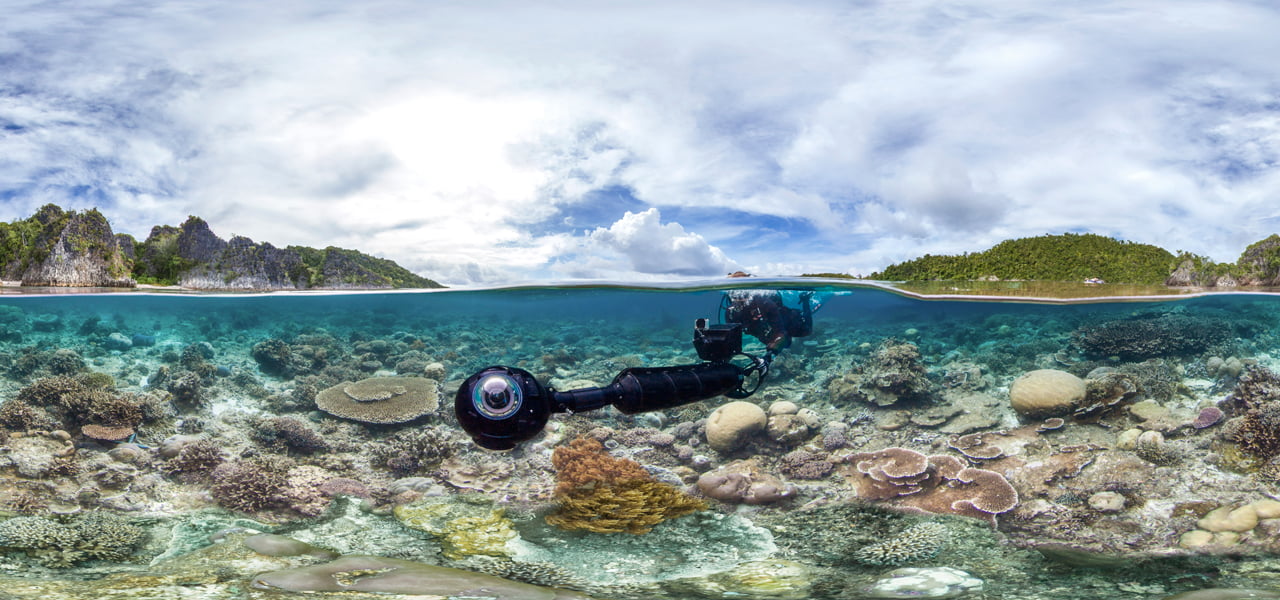
Photo Courtesy of the Ocean Agency

Filed Under: Conservation, Scuba Diving Activities Tagged With: conservation, Coral, coral bleaching, global warming

June 19, 2017 by Simon Pridmore

Scuba Diving – Life on Liveaboards

Scuba Diver in Raja Ampat Indonesia

Have you ever dreamed of living and scuba diving right on top of one of the world’s best dive sites, starting the day by pulling on your wetsuit, slipping into your dive gear, and dropping into the clear, warm ocean above a coral reef teeming with fish all waiting to wish you good morning?
This is the dream made real by liveaboard dive boats, which have been multiplying in recent years in response to demand from divers with busy lives who want to make the most of the leisure time they have.

There are options for all budgets, from dormitory accommodation to palatial private cabins, from canteen-style buffets to fine dining. You can share the deck with a couple of dozen other keen divers or scuba in style on an exclusive boutique luxury vessel with personal rinse tanks and dive valets to look after you and your gear. Some liveaboards offer weekend schedules; others extended voyages to really let you get away from it all.

What are the pros and cons of Liveaboard Scuba Diving?

The main advantages are that you get access to more remote and unspoiled places that see comparatively few divers and you can easily dive four or even five times a day.

The disadvantage is that you are living on a boat, which can be uncomfortable if sea conditions become rough. Your food options are limited and nightlife is usually non-existent. If you do not get on with your fellow travelers it is hard to escape but liveaboards are usually very convivial places full of like-minded, outgoing folk.

A Typical Liveaboard Day

You wake early, roused from your sleep by sunrise and the sound of activity. You throw on your swimsuit and a t-shirt and head for the galley for a snack to wake you up and give you energy and hydration for the first plunge of the day.

You greet your companions on the dive deck where your equipment is ready to go. You showed the crew how you like it set up on the first day and they are quick learners. During the trip, your dive gear lives permanently in the space allocated to you. Your wetsuit hangs nearby although you will be diving so frequently it will never get really dry! On some boats you gear up fully on deck and jump straight in; other liveaboards use small boats called tenders to take you back and forth to the sites.

Breakfast follows the first dive and from there the day progresses in a sequence of rest – dive – eat – rest – dive – eat until you fall into bed and are rocked to sleep by the sea.
Every boat has a sunbathing area, shaded deck space, and a communal lounge where there might be a Scrabble game going on or someone running through their photos from the last dive. If you want some privacy, you can retreat to your cabin, which on most boats is a shared twin room with bunks or single beds. If you are traveling alone you may find yourself sharing with a stranger, usually of the same sex. This is not necessarily a bad thing. You may find you have made a buddy for life!

There are fresh water showers on deck and usually in the cabins but expect hot water to be in short supply. Think of it as a wonderful surprise if you get some and use it sparingly as you may not be the most popular person on board if you are the only one that got to enjoy it!

Tips for Liveaboard Trips for Scuba Divers

Join a pool session or a local dive. Run an in-water check on your equipment before you go. If you find problems get them fixed and then go back in the water and check everything again before you leave.

Pack light: liveaboard life is very informal. Take a few T-shirts and pairs of shorts, a sarong or two, and a sweatshirt for the cool evenings at sea. Don’t bring shoes apart from those you wear to travel; you will go barefoot on board and can use your dive booties for any beach walking.
Be prepared with: –

  1. Multiple surface signaling devices such as a torch, a noisemaker, and a tall, brightly coloured safety sausage
  2. A small spares kit containing a mask strap, regulator mouthpiece, and two fin straps, (as they both tend to break at the same time!)
  3. A personal medical kit containing anti-motion-sickness pills, patches, or wristbands; eardrops; antibiotic ointment for coral cuts and hydrocortisone cream for hydroid stings.

Warning: liveaboard diving can be very addictive!

Simon is the best-selling author of Scuba Confidential – An Insider’s Guide to Becoming a Better Diver and Scuba Professional – Insights into Scuba Diver Training & Operations. Both books are available from Oceanic Ventures. Simon has also just published a new book for divers-to-be and absolute beginners called Scuba Fundamental – Start Diving the Right Way

Simon Pridmore Avatar
Originally from the UK, Simon has lived in the Asia-Pacific region for almost 40 years and has been involved at the sharp end of the scuba diving industry since the early 1990s, pioneering mixed-gas deep diving in the region, first in Hong Kong and later through Professional Sports Divers, his dive centre in Guam, Micronesia. He then moved to the United Kingdom to run a major technical diver training agency and work with cutting edge dive equipment manufacturers VR Technology. Today, he is one of the most prolific and well-known scuba diving and travel authors around. As well as his many books and guides, Simon writes regular columns for a variety of magazines and, under the pen name S.J. Pridmore, has recently published a highly-acclaimed first novel May the People Know I’m Here? After a decade in Indonesia, then a couple of years back in Hong Kong, these days Simon and his wife Sofie live in the south of Taiwan, still on the move as always, trying, but so far failing, to find a cure for their itchy feet.

Filed Under: Caribbean, Far East, Pacific, Scuba Diving Activities, Travel Tagged With: Adventure Travel, Dive Travel, liveaboard diving, Travel

February 24, 2017 by Eric Keibler

New Scuba Diver Video

The other day, I had an idea to try a new video for the website.  My idea was to have a short video to add to our website for new divers to entice them to call or come-by.  Since our program is a little different, I thought a video might be a good start along with a new page focused on becoming a scuba diver.  Below is the first video I came up with.   I have also set-up the new page for a new diver that hopefully provides a little information and will entice them to call.  You can find that page here.  Please let me know what you think.

Filed Under: New Students, Scuba Dive Training, Scuba Diving Activities Tagged With: Open Water, Recreational Training, Scuba Dive Training

September 27, 2016 by Eric Keibler

Investigation of East Flower Garden Bank coral die-off continues amid new coral bleaching event

Scientists documenting the bleaching event underway in Flower Garden Banks National Marine Sanctuary. Photo: G.P. Schmahl/NOAA.

From the NOAA Marine Sanctuaries website…
Scientists continue to explore a broad spectrum of possible causes for July’s mass mortality event at East Flower Garden Bank within Flower Garden Banks National Marine Sanctuary, including environmental conditions and human activities. Meanwhile, their efforts are now complicated by a new but unrelated coral bleaching event, which can happen this time of year when corals are stressed by warmer water temperatures.
A preliminary review of vessel traffic data revealed a lack of vessels in the vicinity just before the mortality event. This effectively rules out the possibility of an acute discharge of pollutants as the cause of the die-off. Earlier analyses indicated that no hydrocarbons were present in the area of the mortality, which further reduces the likelihood that the event was due to some sort of petroleum-based contamination.
Ongoing response efforts are now focused on additional analysis of oceanographic dynamics (see animation below) and water quality. NOAA research divers conducting additional response surveys earlier this month observed dead sponges in other locations around East Flower Garden Bank and on a nearby production platform just outside the boundary of Flower Garden Banks National Marine Sanctuary. The die-off and whatever caused it, therefore, may have been more widespread than initially thought. [READ MORE]

Filed Under: Conservation, Gulf Diving, Scuba Diving Activities Tagged With: gulf of mexico, NOAA, Texas

December 8, 2015 by Eric Keibler

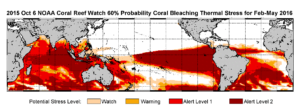
Coral Bleaching Outlook for 2016

October 2015-January 2016: NOAA's standard 4-month bleaching outlook shows a threat of bleaching continuing in the Caribbean, Hawaii and Kiribati, and potentially expanding into the Republic of the Marshall Islands. (Credit: NOAA
October 2015-January 2016: NOAA’s standard 4-month bleaching outlook shows a threat of bleaching continuing in the Caribbean, Hawaii and Kiribati, and potentially expanding into the Republic of the Marshall Islands. (Credit: NOAA)

[From Kelly Drinin, NOAA]  NOAA’s standard 4-month bleaching outlook shows a threat of bleaching continuing in the Caribbean, Hawaii and Kiribati, and potentially expanding into the Republic of the Marshall Islands. (Credit: NOAA)
As record ocean temperatures cause widespread coral bleaching across Hawaii, NOAA scientists confirm the same stressful conditions are expanding to the Caribbean and may last into the new year, prompting the declaration of the third global coral bleaching event ever on record….[READ MORE]

Filed Under: Conservation, Scuba Diving Activities Tagged With: coral bleaching

February 16, 2015 by Susan Long

The Making of a Scuba Diver

Scuba Diver Susan Long Relaxing in Fiji
Susan Long Relaxing in Fiji

I have been scuba diving for over two years – since December 2012. Not only that, I had 100 dives within 10 months, and I had another 100 dives within another 10 months. I LOVE it! I am 59 years old, a retired IT professional, not athletic or mechanical in the slightest. How did I get here?

When we got married in 1992, my husband and I made a deal. He would not buy a Harley, and I would not go scuba diving. That way, we thought we could keep each other alive for a good long time. I have always had friends who scuba dived, and I have long been intrigued by it.

I swam for exercise in college – or more precisely, struggled through maybe 10 lengths a session. It was awful and so difficult, but for some reason, I did it. I did not enjoy it at all. Fast forward 25 years, and we went with some diving friends to the Yucatan for vacation. They did some diving, and we all snorkeled one day. I was terrified! I did not understand how I was supposed to breathe underwater. But I made myself jump in and try it, and within a minute or two, I was having a great time! There were lots of glamorous fish! Who knew? And I really enjoyed being in the water – which was also a surprise, after my college swimming experiences.

Scuba Divers Susan & Larry on a motorcycle trip
Susan and her husband, Larry on their last motorcycle trip.

After I retired in 2005, I decided to go to graduate school in Spanish Linguistics at the University of Houston. The parking is horrible! (The classes were great!) I soon realized if I had a motorcycle or scooter, I could park in the designated areas much more easily. So I bought a Vespa scooter! When my husband got over the shock, he got himself a Harley! So now I had permission to scuba dive! (We now both really enjoy our motorcycle trips together!)

I had permission to scuba dive, but on the other hand, I knew it was an expensive habit. I was reluctant to get a lot more “stuff”. We already had plenty of stuff. Being overweight, I didn’t think there would be enough weight available to keep me down (seriously). I also knew myself it could be dangerous – I had looked at some books detailing scuba diving “incidents” and they are pretty scary. You wonder why anyone comes back alive!

In the fall of 2012, my friend Donna Collins (another scuba diver, and Oceanic Ventures, Inc. denizen) and I were planning to go on a cruise to Costa Rica and Panama. She suggested that we could go snorkeling, and she might try to go diving. I was enthusiastic – I had not had a chance to go snorkeling in years! She took me to Oceanic Ventures to look into getting my own mask, snorkel, fins to take on the trip.

My First Trip the the Dive Store

Ann, Alex and David Morris were in the shop, and I will never forget the warm welcome. David took me under his wing and explained everything I wanted to know about masks, snorkels, fins. I could not believe how expensive they were! But I was sold on the part of getting good equipment so I could really enjoy the experience. I left with the mask, snorkel, fins, a bag, a skin, and maybe a few other goodies. David offered to give me a snorkeling class for free, which I gladly took him up on, since I was certainly not an expert snorkeler, having only done it once.

At the snorkeling class, I learned quite a bit, especially how to “duck dive!” David offered to give me a Try Scuba session, and I was, well, OK, sure! If he’s offering, I sure will try it. Within a few days, I was trying out the scuba equipment in the West U pool, and learning the first rule of scuba. I don’t remember exactly how it happened, but the next inevitable step was signing up for Open Water Scuba classes so I could go on the Cozumel trip that December. And buying all my equipment. Oceanic Ventures made it so easy. I could not have chosen (and still can’t) between Buoyancy Compensaters, Air Delivery System’s or computers. I trusted their advice, and I really liked the idea that they had a lot of experience with the equipment they sold, and they believed in it for all levels of diving.

Open Water Scuba Training with Oceanic Ventures

I had a great time in the Open Water Scuba training with David and Alex. It was hard for me to clear my mask, but eventually I figured it out. It was hard remembering all the steps for sharing air, or the out-of-air ascent. But I did it! The Cozumel trip was fantastic. I did my open water dives there with Alex as my instructor, and it was so much fun! He was so calm, and knowledgeable, and encouraging. I could see it was going to take some time for me to get really comfortable with my buoyancy, and the breathing, but I was plenty comfortable enough to enjoy the diving, and the Oceanic Ventures group was so wonderful. All those experienced divers were so encouraging and helpful to the brand-new,” baby diver.”

Scuba Diving in the Solomon Islands Susan Long and Ann Keibler
Scuba Diving in the Solomon Islands with Susan Long and Ann Keibler

David had let me know in the  Open Water Scuba training that he was the first Oceanic Ventures student to get 100 dives in a year. That sounded like a challenge to me, and I like challenges! Also it was quite clear after the Cozumel trip that the more experience I had, the more fun I could have as a diver. So I set myself the informal goal of getting 100 dives in a year. In order to keep diving through the winter, I started drysuit training and bought a drysuit. I started Advanced Open Water Scuba training, if for no other reason that it was more diving experience! I went with Oceanic Ventures to St. Croix, Belize, Cozumel, and then to Grand Cayman in August! (Donna and I did get to do a few dives on our trip to Costa Rica.) By the time I got to Grand Cayman, I had achieved the 100 dives, between the trips, the training, and being a fun diver at Blue Lagoon and 288 Lake.

Where I Am Now…

So what about all the concerns I had, and my husband had? Well, first off, safety is obviously the first priority at Oceanic Ventures. Now that I am diving, I wonder how people got themselves into those situations in those scary dive books. Of course, mistakes can happen, but most of those incidents are inconceivable on an Oceanic Ventures trip. Yes, diving is expensive, and I have a LOT of stuff. I am still dealing with how to organize it and where it all needs to go between trips. Oh well! The experiences I have had as a diver, and the friends I have made, have been more than worth it.

Scuba Diver Susan Long Diving in Fiji
Susan in Fiji

I love being a part of the Oceanic Ventures “tribe.” It feels like home. I am very impressed with the emphasis on safety and professionalism at Oceanic Ventures. Ann and Eric Keibler run a tight ship, with little room for error, but lots of room for fun. It is easy to have fun when you have confidence in the trip leader, the dive location, the divemasters, and the choice of dive sites. And you get to go play with your dive peeps!

My husband has put up with all this graciously, taking me to the airport and kissing me goodbye as I go off on my next diving adventure. I am so happy to report that since his retirement last August he has become a certified scuba diver, and we are going on our second trip to Cozumel with Oceanic Ventures next month!

Filed Under: Caribbean, Dry Suit Diving, Local Diving, Pacific, Scuba Dive Training, Scuba Diving Activities, Scuba Diving Equipment, Skills, Travel Tagged With: buoyancy, Cozumel, Dive Travel, DiveAroundTexas.com, diving, diving skills, drysuit, Grand Cayman, Scuba Dive Training, Training, Travel

  • « Go to Previous Page
  • Page 1
  • Page 2
  • Page 3
  • Page 4
  • Interim pages omitted …
  • Page 12
  • Go to Next Page »

Footer

Contact Us

Oceanic Ventures, Inc
5808 Newcastle Dr.
Houston, TX 77401-3214
USA

Phone: 713-523-DIVE (3483)

eMail: divesafe@oceanicventures.net

Signup for our dive and scuba newsletters

Don’t miss news about the exciting happenings at Oceanic Ventures.


Map and Directions

Socialize

  • Email
  • Facebook

Why People Choose Us

People choose their friends carefully just as they should choose their adventure partners and Scuba Diving Instructors.  Oceanic Ventures is the premier scuba dive shop in Houston, Texas, and the Southwest because of our exceptional service and our sense of adventure.  In talking with our clients and friends, people choose us for a number of reasons such as: Passion – We love what we do and we want to share the beauty and excitement of the underwater world with everyone we meet. Caring- Our clients tell us they love us because we truly care about people and strive to make their scuba diving experiences safe, fun and enjoyable. Professional – Our staff members are the … [Read more …]

Copyright © 2026 all rights reserved Oceanic Ventures, Inc. · Sitemap · Log in