• Skip to primary navigation
  • Skip to main content
  • Skip to footer

Houston's Premier Scuba and Dive Shop Oceanic Ventures Inc.

(713) 523-3483 (dive)
5808 Newcastle Drive
Houston, TX 77401

  • Home
  • Stay Current
    • Our Blog
    • Travel and Events Calendar
    • Club Aquarius Social Club
      • Club Aquarius Social Club Upcoming Events
      • Club Aquarius Social Club – The Past
    • Special Events
    • Local Scuba Diving Events
    • Photography Contest
    • Categorized Blog Posts
  • Equipment
    • Dive Equipment
    • Rebreather Systems
    • Cruise Ship Passengers
    • Repair & Maintenance
    • Air & Mixed Gas Blending
    • Pure Fiji Spa Products
  • Training
    • Become a Scuba Diver
    • Scuba In Your Home or Ours
    • Diving Programs for Young Explorers
    • Recreational Dive Courses
      • Recreational Dive Courses overview
      • The Briar Club Scuba Program
      • West University Scuba Program
      • Houstonian Scuba Program
    • Technical Diving Courses
      • Basics
      • Nitrox
      • Trimix
      • Rebreather
      • Wreck Diving Programs
      • Cave Programs
      • Blending
    • Leadership Dive Courses
  • Travel
    • Travel Escorted Adventures
    • Travel – Other Travel Programs
    • Travel – Custom Travel Adventures
    • Local Scuba Diving Events
    • Technical Travel
    • Scuba Diving Around Texas
    • Travel Insurance
    • Travel Forms
  • Company
    • About Oceanic Ventures
    • Meet Our Team
    • Testimonials
    • Facility Hours
    • Map
    • Oceanic Ventures Foundation
    • Resources & Articles
    • Archive
  • Shop
    • Online Store
    • Cart
    • Checkout
    • My Account
    • Policies regarding Privacy and Purchases
  • Contact

Scuba Diving Activities

February 14, 2011 by Eric Keibler

Preplanning a Scuba Diving Silhouette Photograph

Photograph by Eric Keibler - Penetration

Penetration

© Eric V. Keibler

Here is a natural light photograph taken in a cargo hold in Truk Lagoon.  While the shot may look completely natural, it was set-up prior to getting in the water.  Todd Emons and I decided to go in the water together to take some photographs of one another in various locations on the ship.

Todd works on the Odyssey so he is very familiar with the wrecks and had some ideas of what shots might look good in this wreck. This type of local knowledge helps you to capture photographs that you might otherwise miss.  Of course, you still have to do everything to take the image but setting up the shot can make things easier.  You need to discuss the general sight and then make a plan with your dive buddy.  It is easier to discuss what you want to do on the surface rather than underwater.  Working with a model can be quite challenging underwater and having a plan before you go in makes it much simplier.

To take this shot, I swam to the lower portion of the cargo hold.  While getting in position, it was important not to kick up the bottom or dislodge too much debris from the ceiling because the debris would ruin the shot.  I set the camera on manual and set the camera to properly capture the blue light throwing everything else into shadows.  After everything was set, I signaled Todd who was perched at the lip of the hold and he began to swim toward the camera being careful not to shine his light in the direction of the camera.  You can see just a small beam coming from the light but because the hold was so large, and the backlight so strong, his light had little effect in the final image.

Also notice that while Todd is the subject of the shot, he is not in the center of the image but rather is in the top third of the picture.  In general, it is more pleasing to the eye if the subject is not centered but rather offset into another quadrant.  We call this division the rule of thirds which is a compositional tool.  Look for a better discussion of this “Rule” in another post on composition.

Remember, when taking silhouette shots, it is important to make sure that you keep the meter reading set for the backlight and not let the camera adjust to the target swimming towards you. 

Camera Specifications: Canon 5D, fitted with a 17mm-40mm lens at 20mm, f4.0 at 1/25 sec, ISO 640

Filed Under: Digital, Pacific, Photography, Scuba Diving Activities, Travel, Underwater, Wreck Diving Tagged With: photography, silhouette, underwater photography, Wreck Diving

February 9, 2011 by amosnachoum

Striped Marlin, Scuba Diving – an Underwater Photography Expedition


Half Dozen Marlins Chasing Bait Ball
Half a Dozen Marlins Chasing a Bait Ball

In the Company of Striped Marlin – an Underwater Expedition
The first year I led my Striped Marlin Expedition to Todos Santos in Mexico, it was splendid. Last year was almost a bust because we hardly saw any Striped Marlin. The reason for that was the water temperature rose to over 81 degrees, and that meant there were not many plankton and the sardines had nothing to feed on. The marlin somehow figured that out and almost totally avoided the normal pattern.
This year with support and reports from the University in La Paz and the local fisherman, I have understood that the marlin will show up, but later than last year. What you see below are images from the first two days here. The sea is placid, the wind very calm and water temperature is between 76 – 78 – just right for the plankton bloom, the sardine are feeding and … the marlin are here. Take a look:
Giant Bait Ball
Giant Bait Ball

Light Marlins Bait Ball

Malin Feeding
Malin Feeding

My TeamMy Team of Guests

Chris and Jerry were with me last year – they understood very well what was happening with the water temperature and feeding patterns. We did all that was humanly possible to show them a good time and we succeeded to a limited level. Both were so impressed by the effort they have joined me again and they are here with us and they are so happy that they counted on my research. I am so proud to be able to deliver to such loyal guests, pictured above.
Every day we leave at 6:30 am along the western cost of Baja (on the Pacific side) and stay out till 5pm – watching the Frigate birds feeding action and formation. It’s the birds who actually give us information about the marlin. When a formation of two dozen or more Frigates is tight and close over the water I know the birds are feeding on sardines below – and the marlin are in pursuit.
All day we jump in and out of the water. The encounters last from just one minute up to sometimes 20 minutes. It’s a dance among the birds and fish. The “bait ball” of sardines, the Striped Marlin below, and the birds above all work in opposite directions from each other. The sardines run for their life but they are not much of a match for the quantity and skills of the birds up above and the marlin under the water. Both the flying and swimming predators are relentless and work the bait ball till it is consumed. It’s dramatic and exciting, especially when visibility ranges from 80 to 150 feet plus … next year we will come back in December. There will be room for only four people to join in the adventure, to be in the company of the ocean giants like the Striped Marlin.
Eric Keibler is putting together one of these trips with me.  Remember, there are only 4 spaces so you need to call him quickly!

Filed Under: Pacific, Photography, Scuba Diving Activities, Travel, Underwater Tagged With: Adventure Diving, Big Animals, Marlin, underwater photography

January 18, 2011 by amosnachoum

In the Company of Big Animals

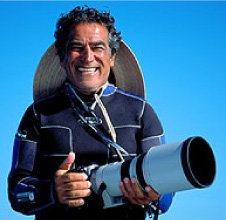
I want to introduce you to Amos Nachoum, a self-proclaimed Ambassador of the Big Animals. He is an award winning photographer who has publised photographs in magazines around the world including National Geographic. In a presentation Amos made top the Explorer’s Club in New York City, he said “to live up to that ambassador role I’ll be in the city, presenting my best stories and information about some of the most fragile regions of the underwater world. I’ll be showing and discussing photographs from my expeditions around the world and will probably include a few “classics” from the hundreds of my images that have appeared in National Geographic, Time, Life, The New York Times, Condé Nast Traveler, Le Figaro, and Der Spiegel. You can also see more of my images on my website, plus news about my latest expeditions. It’s all part of spreading my message that only through observation and interaction with these animals can people understand and respect some of the most impressive citizens of our planet. In a few words, “you have to go there and experience this firsthand.” Amos recorded a presentation for Google entitled “In the Company of Big Animals.” You will hear Amos and he talks about his expeditions and shos his photographs. Sit back, pour yourself a cocktail and be prepared to be wowed…

Filed Under: Digital, Photography, Presentations, Scuba Diving Activities, Travel, Underwater, Video

December 16, 2010 by David Snyder

Technical Diving and Commitment

Now what would possess one to want to strap over 100 pounds of stuff onto their body and jump into water over their head? When you find the answer you have found a technical diver.
My answer was that I wanted to go to places that required that commitment. It all started when I first went to Bikini Atoll. Prior to our trip, I had heard about that Nitrox thing and since I knew we were going deep I decided to take a class. Well back in 1995 Nitrox was still a voodoo gas in many eyes. So after much searching I found someone to teach it. In addition to the Nitrox class we took a Deep Air class, sort of a introduction to decompression stop diving. Didn’t think we needed it, but what the heck. After completing the classes off to Bikini we went. We knew what we were doing now!
Well, all dives in Bikini are decompression stop dives. The average dive depth is 155 feet. After a week of this diving, had a great time, but we realized we did not have a clue and that clearly was not acceptable. So after our return, back to the dive shop we went and said we wanted to finish our training. Finish our training meant hypoxic trimix and cave.
At that point I had made the commitment to become a technical diver. After completion of the trimix and cave classes I was a certified cool tech diver, or was I? In the fullness of time I have realized that to truly be a technical diver you have to do technical dives. In order to do technical dives you have to want to do technical dives. So in the end the Why is because there is something down there you want to see and technical diving is how to see it safely.

Filed Under: Cave Diving, Open Circuit, Rebreathers, Scuba Diving Activities, Scuba Diving Equipment, Trimix Tagged With: Bikini, Nitrox, Technical Diving, Training, Trimix

December 15, 2010 by amosnachoum

The Misunderstood Great White Shark

Today’s post comes from Amos Nachoum, an award winning photographer, specializig in Big Animals, like great white sharks, leopard seals, polar bears, etc. We first met Amos as we were planning for our Antartica Trip. Talking to Amos you immediately get wrapped up in his enthusiasm and his love of the sea. If you talk to him long enough, you’ll be making some incredible dives in some unusual places, think Antartica or the Artic. If you ever meet him, tell him you know Dive Mom!
Written by Amos Nachoum

Great White Sharks – Nasty Predator?

Great White Shark by Amos NachoumMy expeditions to encounter the Great White Shark tend to sell out fast. That’s what just happened to my last two October expeditions. My favorite spot in the world to see Great Whites is in Mexico’s Baja California. The trips sell out fast for a good reason. People are fascinated with Great Whites, even though these sharks have the undeserved reputation of being a nasty predator. They’ve got a lot of teeth, as many as 300. They’re big – 12 to 16 feet long, and they weigh a couple thousand pounds. Steven Spielberg gave a starring role to a Great White in Jaws, and that didn’t help their reputation as a ferocious man eater.
But the truth is they are one of the most fascinating animals you’ll ever encounter, and one of the most rare.
When young, they feed on small harbor seals and later go after sea lions, elephant seals and even small toothed whales. They like to ambush their prey from below – one big bite usually does the trick. They will also scavenge – eating the carcass of a whale shark. They will sometimes eat sea turtles and sea otters.
Let’s be fair, though. Scientists and others who study the Great White say that in the past 100 years more people have been killed by dogs than by Great White sharks. That’s not to say that they don’t look scary. They do, especially when you’re facing one close up. But that’s only part of what makes them so fascinating.

The Great White Shark: A Rare Species

There are only about 100 adult Great Whites in the state of California’s waters. Scientists say less than 3,500 Great Whites are left in the world’s oceans, making them rarer than tigers. They are long distance swimmers, capable of traveling 12,000 miles over a nine month period. A trip from California to Hawaii is a common trip for them. Scientists have tracked them swimming from South African to Australia and back in nine months’ time.
The Monterey Bay Aquarium has been capturing young white sharks, exhibiting them for a a short time, and then releasing them. The first time they did this, in 2004, the shark had almost a million visitors. The aquarium’s executive director Julie Packard said the shark was “the post powerful emissary for ocean conservation in our history.” The aquarium is also studying the adult Great White sharks to learn how to protect them from overfishing and the effects of bycatch – sharks that get caught in the nets of industrial fishing operations, get injured and can die because of it.
That’s what happened to one of the Monterey Bay Aquarium’s White sharks, a female. Captured on August 26, 2009 and released on November 4, the shark traveled more than 500 miles, from Monterey Bay to Baja California. There, she was accidentally caught in a gill net and died.

Baja California – One of the Best Dive Sites for Epic Shark Diving

There’s no doubt that Great White sharks are worthy of great respect. They’re found in the waters of Mexico, Australia, New Zealand and South Africa. It’s true that are amazing dives to be enjoyed in all of those locations, but my favorite place to see them is in Baja California. The water is clear and warm and the shark encounters will always be your best memories of shark diving.

Filed Under: Pacific, Scuba Diving Activities, Shark Diving, Travel Tagged With: great white shark, pacific, shark

December 14, 2010 by David Snyder

Lose Weight When You Go Diving

Today, David Snyder talks about his goal of losing weight for diving.

Is this some “Biggest Losers” program? Ah, no. Lose weight when you go diving refers to you kit (equipment). As we continue to dive, over time we acquire more and more things. Very important things when we acquired them but are they still important?

Stahlsac 10 lb Premium Roller Bag Great for Travel, Scuba Diving Equipment, Snorkeling, Jet Skiing, Kayaking, Swimming, Triathlon, Camping equipment. It is a Versitile Rolling Travel Case.

As the airlines have become more strict with checked luggage, I have embarked on a quest to lighten the load. This quest takes two paths. First is do I need a particular piece of equipment? Do I really need that fourth light, or that second slate, or that spare whatever? My idea now is if I am not certain that I will use something it gets left behind. I plan to enter the water carrying everything I brought and my dive bag empty.
The second path of my weight loss quest is to change heavier for lighter. Ounces add up to pounds. Do you really need a 12″ knife when a 6″ knife will do just fine. Lights, if your light is more than three years old you should be able to double the capacity or half the weight with a new one. I look at each piece of equipment to see if there is a lighter or more capable substitute.
My goal for this process, is one bag 40 pounds, two weeks of diving, nothing rented (except bottles) or borrowed. I am getting there.
How much do you weigh?

Filed Under: Photography, Scuba Diving Activities, Scuba Diving Equipment, Travel

  • « Go to Previous Page
  • Page 1
  • Interim pages omitted …
  • Page 7
  • Page 8
  • Page 9
  • Page 10
  • Page 11
  • Page 12
  • Go to Next Page »

Footer

Contact Us

Oceanic Ventures, Inc
5808 Newcastle Dr.
Houston, TX 77401-3214
USA

Phone: 713-523-DIVE (3483)

eMail: divesafe@oceanicventures.net

Signup for our dive and scuba newsletters

Don’t miss news about the exciting happenings at Oceanic Ventures.


Map and Directions

Socialize

  • Email
  • Facebook

Why People Choose Us

People choose their friends carefully just as they should choose their adventure partners and Scuba Diving Instructors.  Oceanic Ventures is the premier scuba dive shop in Houston, Texas, and the Southwest because of our exceptional service and our sense of adventure.  In talking with our clients and friends, people choose us for a number of reasons such as: Passion – We love what we do and we want to share the beauty and excitement of the underwater world with everyone we meet. Caring- Our clients tell us they love us because we truly care about people and strive to make their scuba diving experiences safe, fun and enjoyable. Professional – Our staff members are the … [Read more …]

Copyright © 2026 all rights reserved Oceanic Ventures, Inc. · Sitemap · Log in