• Skip to primary navigation
  • Skip to main content
  • Skip to footer

Houston's Premier Scuba and Dive Shop Oceanic Ventures Inc.

(713) 523-3483 (dive)
5808 Newcastle Drive
Houston, TX 77401

  • Home
  • Stay Current
    • Our Blog
    • Travel and Events Calendar
    • Club Aquarius Social Club
      • Club Aquarius Social Club Upcoming Events
      • Club Aquarius Social Club – The Past
    • Special Events
    • Local Scuba Diving Events
    • Photography Contest
    • Categorized Blog Posts
  • Equipment
    • Dive Equipment
    • Rebreather Systems
    • Cruise Ship Passengers
    • Repair & Maintenance
    • Air & Mixed Gas Blending
    • Pure Fiji Spa Products
  • Training
    • Become a Scuba Diver
    • Scuba In Your Home or Ours
    • Diving Programs for Young Explorers
    • Recreational Dive Courses
      • Recreational Dive Courses overview
      • The Briar Club Scuba Program
      • West University Scuba Program
      • Houstonian Scuba Program
    • Technical Diving Courses
      • Basics
      • Nitrox
      • Trimix
      • Rebreather
      • Wreck Diving Programs
      • Cave Programs
      • Blending
    • Leadership Dive Courses
  • Travel
    • Travel Escorted Adventures
    • Travel – Other Travel Programs
    • Travel – Custom Travel Adventures
    • Local Scuba Diving Events
    • Technical Travel
    • Scuba Diving Around Texas
    • Travel Insurance
    • Travel Forms
  • Company
    • About Oceanic Ventures
    • Meet Our Team
    • Testimonials
    • Facility Hours
    • Map
    • Oceanic Ventures Foundation
    • Resources & Articles
    • Archive
  • Shop
    • Online Store
    • Cart
    • Checkout
    • My Account
    • Policies regarding Privacy and Purchases
  • Contact

Open Circuit

September 28, 2017 by Eric Keibler

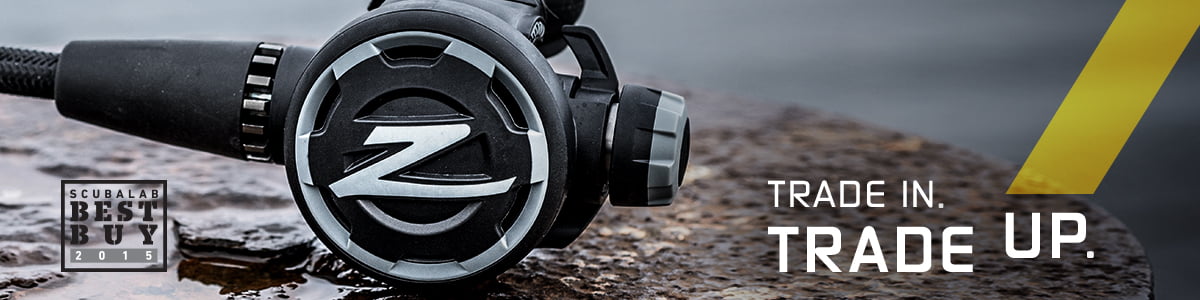
Equipment Special – Zeagle Trade-In Offer

TRADE IN ANY DIVE AIR DELIVERY SYSTEM, WORKING OR NOT, AND RECEIVE A DISCOUNT TOWARDS A ZEAGLE F8

Huish Outdoors has extended their trade-in offer for people in the flood-ravaged part of the country until October 31.  So, bring in your used Air delivery system (first and second stage) to Oceanic Ventures, Inc. and you will receive over $100 toward a new F8 Regulator (Yoke or Din style).
The best performing diaphragm regulator on the market today. In partnership with Atomic Aquatics, we engineered over 20 different improvements on everything from inner mechanisms and materials to exterior controls and aesthetics. The F8 breathes better, works harder and lasts longer than any other air delivery system Zeagle has ever made.

Filed Under: Open Circuit, Scuba Diving Equipment Tagged With: Equipment, equipment specials

February 27, 2017 by Eric Keibler

New Scuba Diving Equipment – Ocean Positive Swimwear

Oceanic Ventures now carrying the complete line of Ocean Positive swimwear for men and women from Fourth Element.  These are suits with minimal fasteners that make them comfortable under wetsuits but stylish enough to wear when you are not in your suit.
Ocean Positive swimwear and hydroskin rashguards are made using recycled nylon from fishing nets which have been abandoned by fishing vessels having snagged on reef, wrecks etc.
These “Ghost Nets” amount to over 600,000 tonnes of lost gear every year. The main hazard is to marine life – from invertebrates to large marine mammals. They continue to fish, long after they have been abandoned, and account for countless lives. The netting, very slow to degrade, scrubs coral, creating a desolate seascape where they are dragged over the reef by shifting currents.
Now, all over the world, dive teams are removing these Ghost Nets from the wrecks and reefs, often at great depths, and bringing them up to the surface where they can be recycled and spun into nylon yarn.
Fourth Element uses fabric made from ECONYLl®, the recycled yarn, combined with Lycra® to make a line of active swimwear.
“This is a fantastic idea, [one which] demonstrates what we can, and should, do for the oceans”. ‘Her Deepness’ Sylvia Earle.
Here is a video explaining the idea behind Ocean Positive.

And, If you want to see the product in action watch this video…

Filed Under: Open Circuit, Rebreathers, Scuba Diving Equipment Tagged With: Equipment, scuba equipment

December 13, 2016 by Eric Keibler

New Scuba Diving Computers

tusa-dc-solarOne of the things we looked at recently is changing some of the computers we offer in our packages and as upgrades to our packages.  Two of the new entries are the DC Solar Link and the EON Steel.

According to the website, the DC Solar Link dive computer is the next generation in TUSA’s solar-powered devices. Features include: dive log transfer to smartphone or tablet using Bluetooth® SMART technology; Solar recharging which eliminates the need to replace a battery; 4-Mix Gas support; Free-Dive Mode, and a factory-sealed and rugged design that prevents flooding.

Using Bluetooth® SMART technology, you can transfer the dive logs from the IQ1204 DC Solar Link dive computer to any smartphone or tablet with TUSA Diving LOG app. Once uploaded to your device, dive logs can be shared with your friends on social media.

This computer looks like a new Casio G-Shock watch so it can double as a sport watch.  It looks good and we believe it will be a nice addition to our line.

suunto-steelThe EON Steel is Suunto’s next generation dive computer. The intuitive Suunto EON Steel combines advanced technology with a bright color screen and customizable features and display to show clearly what you need. With heavy-duty housing, a stainless steel bezel, and user updatable software, Suunto EON Steel will dive with you for years to come. We brought one in for a client who took it on our Cozumel trip and found it easy to read especially during the dusk/night dive.  The advantage of this computer is that it can be air integrated.

shearwater-infographic-transparent-1Another computer introduced last month is the Shearwater Perdix AI.  Our technical divers are familiar with other Shearwater computers becasue they have been using them for a number of years.  The Perdix AI offers all of the same great features of the Perdix, the Perdix AI uses its large, easy-to-read screen to clearly display the tank pressure as well as your gas time remaining (GTR). The Perdix AI is capable of connecting to either one or two transmitters giving the diver the option to monitor both tanks or dive sidemount.

So, if you are in need of a new dive computer, come by and look at one of the new offerings.
 

Filed Under: Open Circuit, Rebreathers, Scuba Diving Equipment, Uncategorized Tagged With: Dive Computers, scuba equipment

June 5, 2016 by Simon Pridmore

Dealing With Accidental Decompression

Divers under the boatThere is nothing to fear about accidentally going into deco as long as you know what to do when it happens.

Simon is the best-selling author of Scuba Confidential – An Insider’s Guide to Becoming a Better Diver and Scuba Professional – Insights into Scuba Diver Training & Operations. Both books are available from Oceanic Ventures. Simon has also just published a new book for divers-to-be and absolute beginners called Scuba Fundamental – Start Diving the Right Way.
There is a very good reason why instructors tell their students not to go into deco and why dive computer manuals repeat the warning time after time.
Chances are that the cylinder on your back is usually your only air source when you dive. If you run very low on air or if you suffer a rapid loss of air supply, perhaps because of a regulator free flow or a split hose, then the best option you have is to make a slow controlled ascent directly to the surface.
Yes, an alternative option is to share air with an alert, calm and capable diver around who is carrying more air than they need and is both equipped and willing to share it. But you can’t depend that someone like that will be nearby when you need them.
If you stay calm and you are not in deco, that is to say, if your computer is not showing required decompression stops, you will make it safely to the surface. You will probably not be able to make a safety stop on the way up but that is not going to be health threatening. After all, a safety stop on a no-decompression-stops dive is a luxury rather than a necessity.
On the other hand, if you do have required decompression stops, then going straight to the surface and missing those stops is definitely a health risk! That is the main reason why divers are told, “don’t go into deco!”

But Divers Do It All The Time

You may not be surprised to hear that divers accidentally go into deco every day. This is because they are only human, they have fun diving and they tend to get distracted. If it has not yet happened to you, it certainly will, so it is useful to know what to do when it does!
Because they have heard the warning so often, divers tend to panic when they find themselves accidentally in deco. There is no need for anxiety. Going into deco will not hurt you. Going to the surface when you are in deco, however, may well hurt you.
Know how your computer works and what it looks like when you go into deco. Do not be the diver who gets back into the boat moaning about a “broken” computer that is actually functioning perfectly. It is just telling the diver that they should still be underwater waiting until their deco stops clear.
The first thing you notice when you go into deco is that your computer screen suddenly looks different. A new depth reading appears, usually 10ft or 20ft, and a new time display. The depth is your new ceiling; you must not go shallower than this. The time is either your decompression stop time at the ceiling or an indicator of the minimum time it will now take you to reach the surface taking into account both your ascent time and the decompression stop time.
Every brand of computer is different. There is no industry standard. You must know how yours works. I know the manual looks boring but take the time to study it. Trust me, if you see your computer’s deco screen for the first time deep down at 100ft with your brain befuddled by narcosis, you will have no idea what it is saying to you.

Snyder01Run The Clock Down

So what do you do next? First, look at your pressure gauge. If you still have plenty of air left, relax; you have nothing to be concerned about. Start ascending gradually, keeping an eye on your computer until the deco/ascent time figure stops growing. When the figure starts to drop, continue your dive at that depth but do not go deeper again. Eventually, the deco will clear and you will see your usual no decompression screen display again with plenty of minutes remaining.
Finally, end the dive a little earlier than originally planned to make sure you have plenty of air left to do an extended safety stop of eight or ten minutes before you surface.

Remember

1. Going into deco is nothing to panic about.
2. Know what your computer screen will look like when it happens.
3. Do a long safety stop at the end of every dive where you accidentally go into deco.

Filed Under: Open Circuit, Scuba Dive Training, Skills Tagged With: diving, diving skills, Scuba Dive Training, Training

February 9, 2016 by Simon Pridmore

Scuba Diving – Get Control of your BCD!

A note about the author – Simon is the best-selling author of Scuba Confidential – An Insider’s Guide to Becoming a Better Diver and Scuba Professional – Insights into Scuba Diver Training & Operations. Both books are available now from Oceanic Ventures.

As you discovered when you first learned to scuba dive, the letters BCD stand for Buoyancy Control Device. This implies that your BCD is an appliance that controls your buoyancy in the water. It would be nice if that were the case but sadly it is not true. No matter how technologically advanced your BCD is, you are still the one responsible for controlling your buoyancy in the water. Your BCD is just a tool that you can use to help you.

But first you need to get the BCD itself under control!

stellitoBuy the right one

Most people buy BCDs that are the wrong size because they try them on in a dive shop while standing up and wearing their normal land-based-life clothes.

Try the BCD on in the shop while wearing your wetsuit and once you have chosen a model, ask to try a sample out in the pool first. Take along the size that fitted you best in the shop and take the next size down with you also. The smaller one is probably the one you will keep.

Your BCD should fit you closely, especially around the shoulders, but not restrict normal movement nor constrict you with the bag full and the straps loosened. It must have enough buoyancy when fully inflated to float you comfortably at the surface with your head clear of the water, but no more.

It is best avoid the bulky, top of the range models. They are usually very buoyant even when not inflated and will require you to wear a lot of extra weight to compensate. An oversized BCD can start moving around on its own under water and be impossible to control!

Charlie in TrukKnow how it works

Spend plenty of time studying your new BCD. Hold it up in front of you horizontally and imagine where the air will be when you are underwater. It will always be in whichever part of your BCD is closest to the surface.

Learn where the controls are. While you are swimming, practice finding your inflator mechanism by touch alone: then, practice using it in different positions. Remember it is not a pump; it will only release air when a) it is above your left shoulder and when b) your left shoulder is the part of your body closest to the water’s surface. Otherwise the air will remain trapped inside no matter how fiercely you depress the button. See how need to turn your body while swimming so that your left shoulder is at the highest point. Usually you can manage this by dipping your right shoulder.

Notice that if you are swimming with your head down and feet up, the air will be close to your butt. Most BCDs have a “tail dump” so you can release air in this position. Make sure you know instinctively if the tail dump is on the right or left.

Learn how to empty your BCD completely. Failure to master this skill can make it difficult for you to descend, cause you to carry too much weight to compensate and, worst of all, place you at risk of an out of control ascent.

Stephanie Watowich in Truk Lagoon

Set it up properly

Control your safe second stage (octopus) and your console so that you know where to find them instinctively when you need them and also so that they do not swing around below you and damage that beautiful coral you are swimming over. This means controlling the object at the end of the hose, not just the hose. Clips that retain only the hose still allow the object on the end to swing free below you and turn your accessories into reef-wrecking balls.

Minimize the number of extra bits and pieces you carry on every dive and make sure the essential items things, such as your safety sausage and dive light, are stowed away or attached securely. The two golden rules are:

  • only one thing in each pocket because if you have several items in the same pocket and pull one thing out, everything else will come out with it: and
  • attach everything by two points so that,
    1. it does not dangle and,
    2. if one of the attaching points breaks you do not lose it.


Filed Under: Open Circuit Tagged With: buoyancy, Scuba Dive Training, scuba equipment

February 14, 2013 by Eric Keibler

Project LifeLine

LifeLine for Valentines DayRecently, Ann and I were sitting at a table with Mike Lever, from the Nautilus Explorer and Nautilus LifeLine as well as Karen Zammitti, from Bamboo Reef in California; and, we were talking about the LifeLine units.  Karen related a story about her father and a recent experience he had with the unit.  He was diving in the Maldives and he and his dive buddy were pushed by a current in a different direction from the other divers in the group.  When they surfaced, they found the boat picking up divers and looking for them in a totally different direction from where they were.  They were not far away and eventually the boat would have found them but by using the LifeLine, he was able to tell the boat where they were so they could be picked up sooner.

Mike had a similar story to tell which drove him to develop the units.  The diver had drifted away from the shore and could see the boat but the boat was looking for him in the wrong direction so he had to just wait until they expanded their search in his direction.   It was nothing like the mneues, both divers could see the boat they were just in a different location from where the boat expected them to be.  By using the LifeLine, Karen’s father was able to reduce the time on the surface by letting the boat crew know where he was in relation to the other divers.

Divers in the Galapagos are used to carrying radio direction finders, RDF units, which will help the boat locate you if you surface too far away.  Most people never use them but everyone carries them. The advantage of the LifeLine over the RDF is that it has GPS coordinates and you can talk directly to the boat.

For a lot of trips, especially the ones in “big water” like the Pacific, carrying a LifeLine makes a lot of sense.  It is a waterproof VHF radio with a GPS function included.  It is small and fits easily onto any diving configuration.  The goal of Project LifeLine is to outfit divers doing open ocean dives with the Nautilus units.  Mike uses them on all of his boats and a number of other operators are incorporating them into their operations as well.

They are an east to use device and easy to carry.  If you would like to see them and play with them, please come by Oceanic Ventures for a demo.

Filed Under: Open Circuit, Rebreathers, Scuba Diving Equipment Tagged With: equpment, LifeLine, Technical Diving, Technical Diving.Rebreather Diving

  • « Go to Previous Page
  • Page 1
  • Page 2
  • Page 3
  • Page 4
  • Page 5
  • Go to Next Page »

Footer

Contact Us

Oceanic Ventures, Inc
5808 Newcastle Dr.
Houston, TX 77401-3214
USA

Phone: 713-523-DIVE (3483)

eMail: divesafe@oceanicventures.net

Signup for our dive and scuba newsletters

Don’t miss news about the exciting happenings at Oceanic Ventures.


Map and Directions

Socialize

  • Email
  • Facebook

Why People Choose Us

People choose their friends carefully just as they should choose their adventure partners and Scuba Diving Instructors.  Oceanic Ventures is the premier scuba dive shop in Houston, Texas, and the Southwest because of our exceptional service and our sense of adventure.  In talking with our clients and friends, people choose us for a number of reasons such as: Passion – We love what we do and we want to share the beauty and excitement of the underwater world with everyone we meet. Caring- Our clients tell us they love us because we truly care about people and strive to make their scuba diving experiences safe, fun and enjoyable. Professional – Our staff members are the … [Read more …]

Copyright © 2026 all rights reserved Oceanic Ventures, Inc. · Sitemap · Log in