• Skip to primary navigation
  • Skip to main content
  • Skip to footer

Houston's Premier Scuba and Dive Shop Oceanic Ventures Inc.

(713) 523-3483 (dive)
5808 Newcastle Drive
Houston, TX 77401

  • Home
  • Stay Current
    • Our Blog
    • Travel and Events Calendar
    • Club Aquarius Social Club
      • Club Aquarius Social Club Upcoming Events
      • Club Aquarius Social Club – The Past
    • Special Events
    • Local Scuba Diving Events
    • Photography Contest
    • Categorized Blog Posts
  • Equipment
    • Dive Equipment
    • Rebreather Systems
    • Cruise Ship Passengers
    • Repair & Maintenance
    • Air & Mixed Gas Blending
    • Pure Fiji Spa Products
  • Training
    • Become a Scuba Diver
    • Scuba In Your Home or Ours
    • Diving Programs for Young Explorers
    • Recreational Dive Courses
      • Recreational Dive Courses overview
      • The Briar Club Scuba Program
      • West University Scuba Program
      • Houstonian Scuba Program
    • Technical Diving Courses
      • Basics
      • Nitrox
      • Trimix
      • Rebreather
      • Wreck Diving Programs
      • Cave Programs
      • Blending
    • Leadership Dive Courses
  • Travel
    • Travel Escorted Adventures
    • Travel – Other Travel Programs
    • Travel – Custom Travel Adventures
    • Local Scuba Diving Events
    • Technical Travel
    • Scuba Diving Around Texas
    • Travel Insurance
    • Travel Forms
  • Company
    • About Oceanic Ventures
    • Meet Our Team
    • Testimonials
    • Facility Hours
    • Map
    • Oceanic Ventures Foundation
    • Resources & Articles
    • Archive
  • Shop
    • Online Store
    • Cart
    • Checkout
    • My Account
    • Policies regarding Privacy and Purchases
  • Contact

Open Circuit

November 21, 2012 by marinawatowich

A Short History of the Scuba Diving Mask!

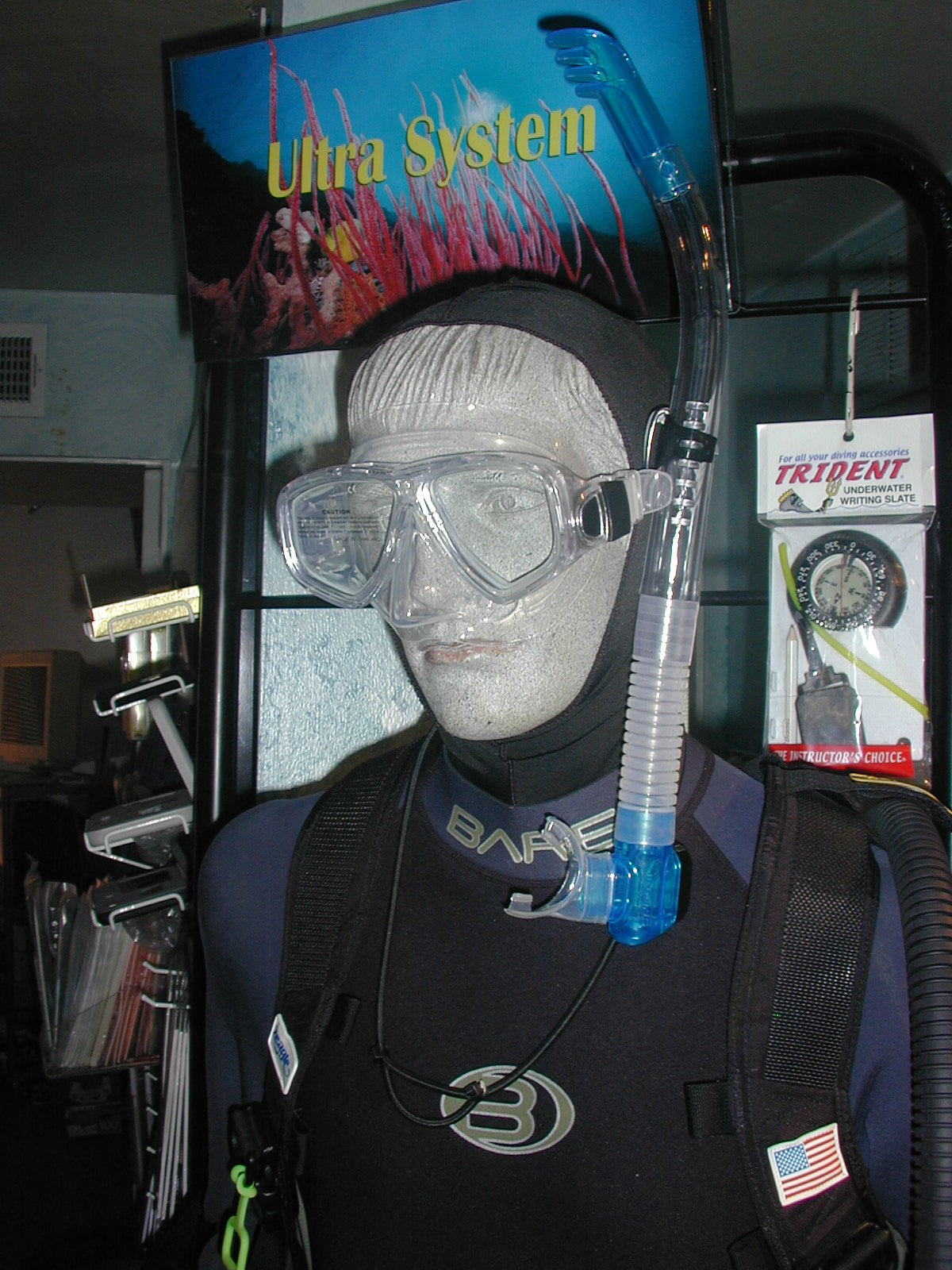
Al with his mask and snorkel
Al with his mask and snorkel.

The mask is one of the most basic, yet essential pieces of equipment for our sport and has an interesting history. Since the human eye is not adjusted for seeing clearly without air in front of it, divers realized that thy needed some sort of air pocket in front of their eyes to see well underwater. With the beginning of diving divers fashioned goggles, similar to those which swimmers use today. These only covered divers’ eyes so I can imagine that it was pretty difficult to breathe comfortably underwater! With the growth of diving in the 1930s and after the World War II technological boom round masks that covered the eyes and nose became popular. Divers realized that they could increase peripheral vision by having an oval mask instead. These masks were usually homemade, as was most dive equipment, and were made of roughly cut glass and neuprene. As the sport really took off with Cousteau’s era dive masks were changed to have more specific eyepieces, separated the eyes chamber from the nose, and traded the neuprene skirt for silicone. These changes greatly improved the mask to give divers a greater visual field and make the masks more resistant to wear and tear, and are now the modern versions we know today.
Filed Under: Open Circuit, Scuba Diving Equipment Tagged With: Scuba Dive Training, scuba equipment

September 11, 2012 by Eric Keibler

New Technical Divers

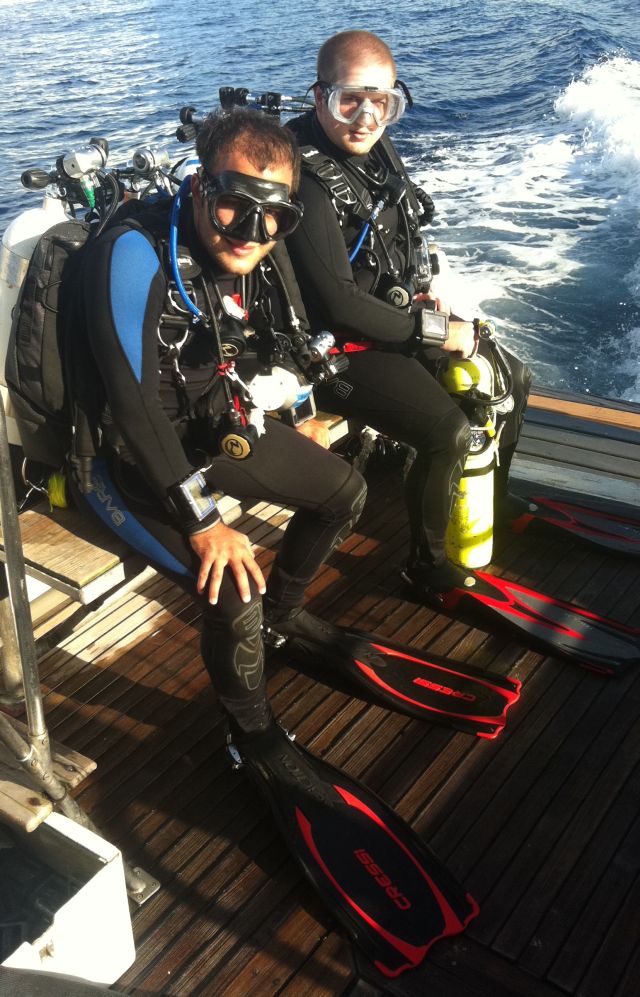
David & Steve
David & Steve Getting Ready for a Dive

Recently, I had the opportunity to teach a new group of Technical Divers.  They were excited to expand their diving knowledge and learn some new skills at the same time.  We spent the summer Side Mount diving, and learning the Principles of Technical Diving.  Needless to say, I spent a lot of time at the lake.

When it was time to go on the deeper dives required for their Advanced Recreational Trimix Class we were scheduled to go to Lake Travis.  However, they decided that it would be more fun and a better experience if we went diving in clear water.  Now, for people who know me, I don’t particularly like teaching technical diving in Lake Travis because the reduced visibility limits the swim distances and the entire diving experience is shackled.  So, when they decided that they would like a better experience, I immediately began putting something together for Cozumel.

Cozumel is an ideal choice because you can get there easily with almost daily flights direct to the island from Houston and because the diving there is spectacular.  Additionally, the infrastructure for technical diving is there with mixed gas, bottles and sorb readily available.  Additionally, the food and lodging costs are reasonable.
We arrived on Friday afternoon and were boat-diving that afternoon – a 130’ tune-up dive.  Over the next two days, we ended up doing five decompression dives to depths in excess of 145 feet and still had time to enjoy the sun and Pepe’s world famous guacamole.  Our dives were joined by turtles, large groupers, moray eels, schools of snapper, huge lobster, crabs and plenty of crystal clear blue water.
 

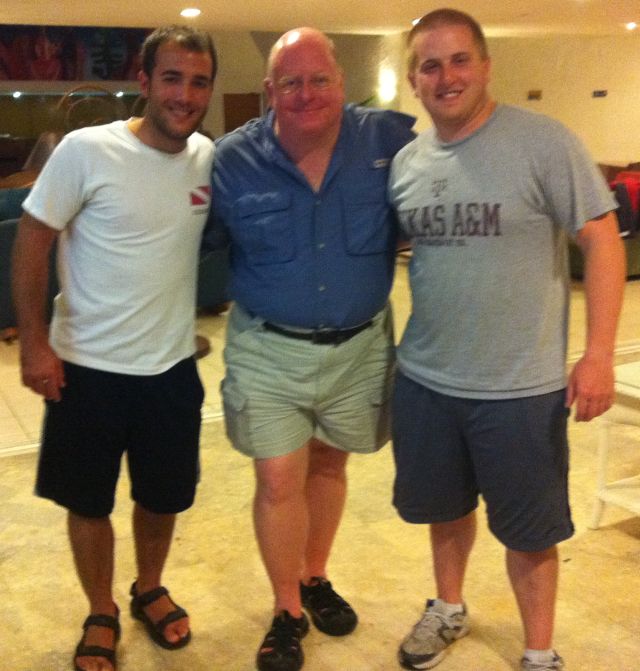
David, Eric & Steve
Finished & Celebrating!
David and Steve found out that technical diving is more than minimal visibility, slow swims and brown objects.  Here they had sunlight penetrating all the way down, enough room to swim while keeping track of the team and decompression in clear water, with a reef sliding by underneath.  They also got to experience how nice it is to have the boat pick you up at the end and deal with the equipment after the dive.  This was a whirlwind trip – arrive on Friday, Leave on Monday but it was a better experience than the dives in Lake Travis they had originally planned.
I feel they are now better equipped to deal with the diving environments most technical divers will face.  They have a lot of experience in low visibility locations but clear water is also important and these divers have experience in both environments.

Filed Under: Caribbean, New Students, Open Circuit, Scuba Dive Training, Scuba Diving Activities, Scuba Diving Equipment, Travel Tagged With: Cozumel, Principles of Technical Diving, Technical Diving

February 7, 2012 by Eric Keibler

Open Water Side Mount Scuba Diving

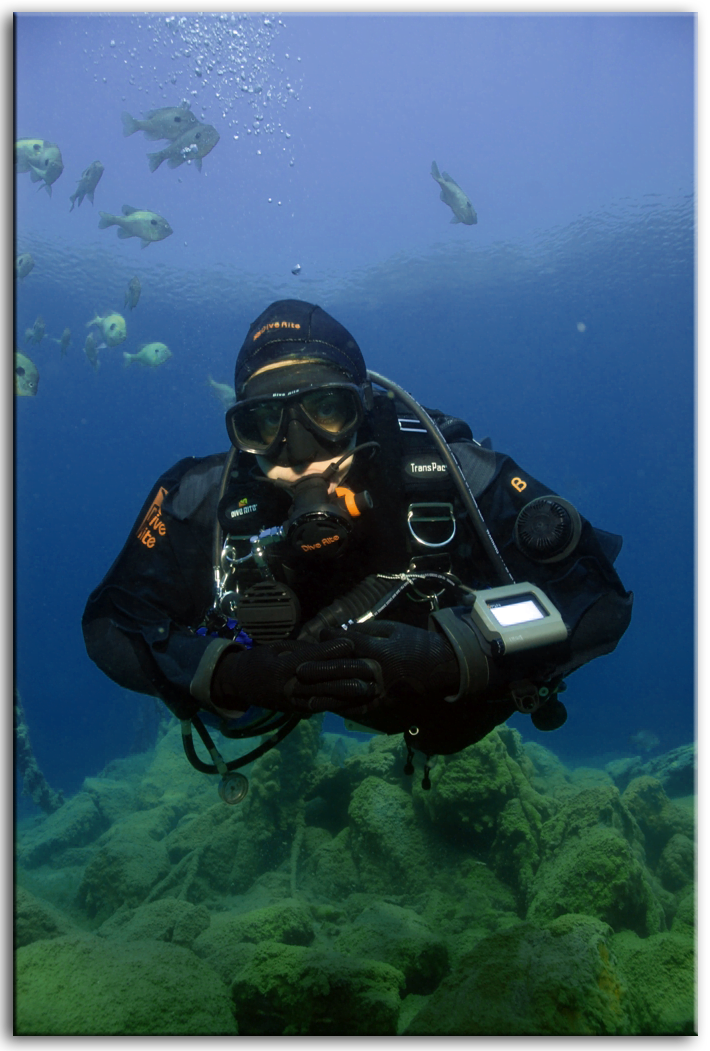
Diver Hovering
Photograph by Pete Nawrocky

If you look through the various diving publications or look at current diving trends on the internet, you will find references to side mount diving. Have you ever wondered why? In order to help answer that question we should first talk about what side mount diving is.

Like the name implies, in side mount diving, you mount the cylinders on your side instead of on your back. This is accomplished using some clips on the bottles and the d-rings on your buoyancy control device, BCD. You can see a diver in side mount gear in the photo above.

So now that you have a basic understanding of what it is, you may still be wondering why? Side mount divers have a variety of resons fro switching to this method of diving. Of course technical divers have been doing this style of diviing for a long time in order to squeeze into tighter spaces; but recreational divers are discovering new reasons to try it.

One reason given by these divers is the fact that you can carry the bottles to the water or better yet to the boat’s dive platform one at a time and then enter the water with no cylinder. This allows you to reduce the strain on your back especially when you get to hand the bottles back up to the crew and climb out of the water with no cylinders on at all.

Another reason is simply a gas supply issue. This is especially desirable if you are a heavy breather. By carrying two bottles, you have a larger gas supply and can remain underwater longer. Yes, guys, this means you can stay down as long as your wife. An additional benefit is that by changing the placement of the cylinders, side mount divers trim out better or obtain a better, horizontal posture underwater.

You may be asking that if it is simply a matter of mneung the bottles, why should I take a course to learn how to do it? That is a good question to ask. One of the things you will learn in class is how to configure your equipment to best carry the bottles. Another thing is the scheme of changing second stages as you swim underwater. In another lesson, you will learn how to deal with the bottles and the beginning and end of your dive so you don’t drop them to the bottom (a really bad thing especially when you are over a wall).

So, to put it simply, there is a lot of interest in lightinig the equipment load exiting or entering the boats for all of us. Side Mount divers also love the extra gas available! If you have not tried it, you should take a course and get started…it is a lot of fun.

To find out more about Open Water Side Mount diving, send Eric an email or leave a comment.

 The next Open Water Side Mount Course is scheduled to begin 28 February 2012. Other classes are available. Email us for more information.

Filed Under: Open Circuit, Scuba Dive Training, Scuba Diving Activities, Scuba Diving Equipment Tagged With: Sidemount, Training

May 18, 2011 by Eric Keibler

Technical Training at Local Destinations or Not?

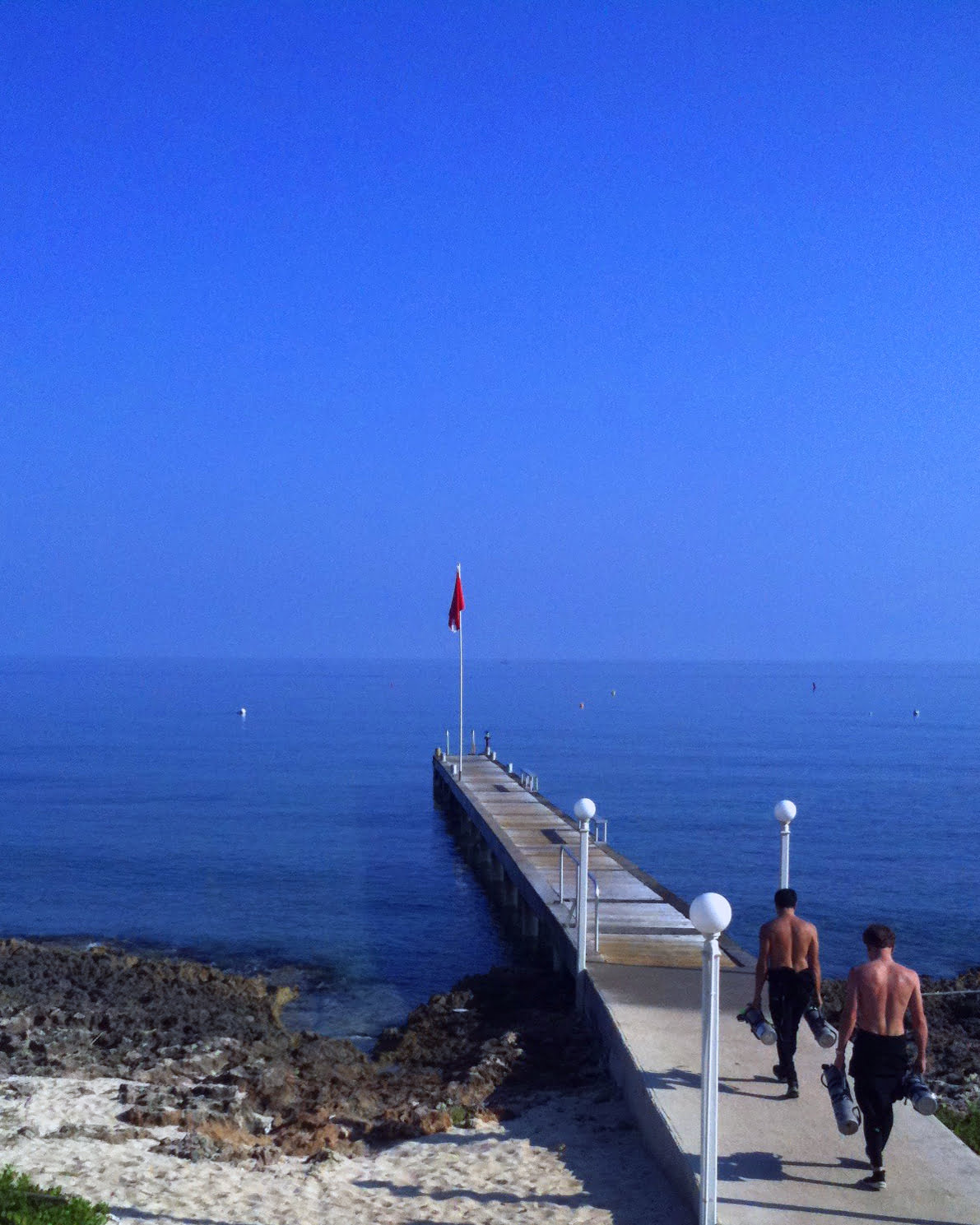
Divers walking to waterRecently I was asked why I don’t do more technical training in the deep lakes in Texas.  My reasoning has to do with both philosophy and the environment. 

First, let’s look at the environment itself.  The lakes have the advantage of being close allowing for short drives from home. To some, this helps keep the training costs lower, especially if you can camp near the lake.  They are familiar dive sites to many of the divers in the area so there is an increased comfort level which is beneficial for the student.  The problem with the lakes is that they are generally not very clear because of sediment and algae.  Because of the reduced visibility, class sizes are limited, which is not a bad thing, and students are forced to swim very close to one another or on a line.  While following a line is a good skill to learn, it inhibits the diver’s ability to fully integrate the skills and procedures into their diving.

The deeper lakes also tend to be cold at depth.  To properly train in this environment, the student needs a drysui or at a minimum a thick wetsuit.  This requires that they be comfortable with drysuit diving before the course starts because starting a technical diving program introduces more equipment and skills so adding a suit that the diver is not familiar with diving adds more complications to an already stressful situation.

This is not to say that a student cannot learn in this environment.  There are many skilled and successful divers who started their training in murky local lakes and quarries.  However, it takes more effort to become proficient in less than ideal conditions.

The second reason I prefer other locations is one of philosophy.  Beginning down the road of technical diving requires that the student develop skills, intuition, and procedures to survive and enjoy the dives.  Swimming with multiple cylinders whether manifolded or separate, as in a side mount configuration, or even on a rebreather requires that you retrain your brain to deal with different buoyancy characteristics and with mass.  I find that students master these skills faster, with more confidence, when they can see what they are doing in relation to their instructor and fellow students.  Further, by allowing them to have more room between them, they can develop better swimming and buoyancy skills in a shorter period of time.  Additionally, with clearer visibility, the stress on the instructor is reduced which I believe makes me more effective in the learning environment.

I also believe that students start this type of diving to do something or to go somewhere.  Some take it merely for the training, but moreover the student has a goal in mind when they enroll in a course.  I have yet to find someone who came to me saying they wanted to find out what the mud looked like at the bottom of Lake Travis.  Diving is about experiences and in my mind it should be predominately positive experiences.

This is not to say that these locations do not have their place in technical diving.  Before leaving for a destination, open water, I like to take the students to one of the shallow training lakes.  This allows them to refine their equipment configurations and develop some buoyancy skills in their new equipment.  You don’t need deep water to work on buoyancy; in fact, it is better to work on it in a shallow area because the trim changes are magnified.  Additionally, these locations allow me to teach some of the skills needed for this type of diving and the start helping them create procedures to deal with equipment and to start building more diving intuition.

For the final dives, I find it to be a more positive experience to go where the water is clear and there is depth and support for the type of diving you are learning.  Since we have completed the knowledge or classroom portion of the course and some basic skills dives prior to leaving for the destination, we can concentrate on the diving and planning when we arrive.

One argument against completing the open water divers in a destination rather than a local lake is the cost.  However, once you figure in the cost of fuel, lodging, meals, entry fees, etc.  The differences are not that great.  By electing to complete your training in a destination like Grand Cayman or Cozumel you will have a better experience and will enjoy the dives more.  Additionally, I believe you will learn faster and progress in this style of diving further because you have a solid foundation on which to build.

Filed Under: Caribbean, Dry Suit Diving, Open Circuit, Rebreathers, Scuba Dive Training, Scuba Diving Activities, Scuba Diving Equipment, Travel, Trimix Tagged With: Rebreather, Technical Diving, Technical Diving.Rebreather Diving, Training, Trimix

May 5, 2011 by Eric Keibler

Why should you take an Advanced Open Water Scuba Course?

Lift Bag by Chuck GerlneuchNew divers often wonder how they can start an Advanced Open Water Course so close to completing their Open Water Course; they simply do not feel like advanced divers.  While it is true they are new to the world of diving, and they need to go out diving, it is also true that having a few more underwater skills under their belts would make diving more enjoyable.  This is really what an Advanced Open Water Course is all about; it is a combination of diving specialty courses designed to give new divers a few more underwater tools.

There is no substitute for simply going out and diving.  After you complete your open water class, you and your diving buddies should plan on going diving as much as possible so you can gain some confidence and put your newly learned diving skills to work.  At our facility, we try to promote this by offering dive local weekends at other times during the month.  We also encourage new divers to return with us on the next month’s Open Water Weekend.  By participating in these other events, there is a professional dive leader on hand to give you advice and to answer your questions while learning to dive outside of the classroom setting.

But, like I said earlier, one way to make an improvement in your diving is by learning some basic underwater skills. An Advanced Open Water Course combines the following specialty classes into one package:

  • Underwater Navigation
  • Deep Diving (over 60 feet)
  • Night and Limited Visibility Diving
  • Search and Relocation

 These specialties are designed to introduce you, the new diver, to new environments and equip you with come new skills that you will use throughout your diving career.  They are also tailored to give you more confidence and help you to relax more underwater.  Why these specialties you ask?  Well, let’s look at each of them in more detail.
Underwater Navigation – You probably noticed in your Open Water Class that you had no real idea where you were.  You just followed your Instructor or a Dive Control Specialist with your Instructor following behind.  You were mostly concerned with trying to maintain buoyancy and look around at things as you glided past.  However, when you are diving without your instructor, you will have to find your way around the lake on your own.  This course introduces you to the skills needed to navigate underwater and the ability to get lost creatively.
Deep Diving – While many people do not consider diving deeper than 60 feet deep diving, you were trained and certified in 20 to 40 feet of water so 60 feet is deeper than you have been.  Assuming you do not want to repeat those out-of-air skills you were forced to endure as part of your Open Water Program, there are some things you need to consider when diving deeper, like when to start back to the surface.  So here you will learn what to do to scale the equivalent of a 6 story building and return to the surface safely and proudly.
Night & Limited Visibility Diving – Here you get more toys!  You need lights to complete this specialty so, boys get toys!  Ok, it is not all about the toys but rather how to use them as tools to safely execute a night dive.  And remember, if you are ever planning on sneaking into the cocktail party from the water, you will need this skill-set.
Search & Relocation – With the introduction of more toys comes the need to find them when you loose them.  Here we introduce you to the fine art of finding the things you lost underwater.  As part of the class you also get to use a lift bag to lift up a heavy object.  This is a useful skill if you run across an canon underwater that you think will look smashing in your front yard!
While you are learning these skills, you will be getting more comfortable underwater and may even find you do not need as much weight to sink below the surface.  You even get the opportunity to purchase some necessary toys to safely execute your dives – cool, more toys!
Taking an Advanced Open Water Course is a good way to prepare yourself for the dives that you want to do on your next vacation.  The comfort you gain in the water will make those vacation dives more enjoyable and just plain fun.  Don’t miss this opportunity to improve your diving while having fun diving in a structured program.

Filed Under: Open Circuit, Scuba Dive Training, Scuba Diving Equipment, Skills Tagged With: advanced training, diving, diving skills, Scuba Dive Training, Training

April 29, 2011 by Eric Keibler

Side Mount Open Water Course to be offered in June

Photo by Pete Nawrocky
A number of divers have been asking about side mount diving lately.  It seems that a number of people are becoming interested in adding side mount diving to their skill-set.  You will find this style of diving different but freeing, especially when compared to diving in twins.

Eric Keibler will be offering an Open Water Side Mount course in June.  This is a 3 night class with one to two days of open waters.  It is intended for open water diving, not side mounting in caves or wrecks.  You will find it to be an easy way to extend your bottom time.
If you would like to find out more, please send Eric a note.  Or, if you are ready to sign-up just send Eric an email or sign-up now through our on-line system.

Filed Under: Open Circuit, Scuba Dive Training, Scuba Diving Equipment Tagged With: Scuba Dive Training, Sidemount, Technical Diving, Training

  • « Go to Previous Page
  • Page 1
  • Page 2
  • Page 3
  • Page 4
  • Page 5
  • Go to Next Page »

Footer

Contact Us

Oceanic Ventures, Inc
5808 Newcastle Dr.
Houston, TX 77401-3214
USA

Phone: 713-523-DIVE (3483)

eMail: divesafe@oceanicventures.net

Signup for our dive and scuba newsletters

Don’t miss news about the exciting happenings at Oceanic Ventures.


Map and Directions

Socialize

  • Email
  • Facebook

Why People Choose Us

People choose their friends carefully just as they should choose their adventure partners and Scuba Diving Instructors.  Oceanic Ventures is the premier scuba dive shop in Houston, Texas, and the Southwest because of our exceptional service and our sense of adventure.  In talking with our clients and friends, people choose us for a number of reasons such as: Passion – We love what we do and we want to share the beauty and excitement of the underwater world with everyone we meet. Caring- Our clients tell us they love us because we truly care about people and strive to make their scuba diving experiences safe, fun and enjoyable. Professional – Our staff members are the … [Read more …]

Copyright © 2026 all rights reserved Oceanic Ventures, Inc. · Sitemap · Log in