• Skip to primary navigation
  • Skip to main content
  • Skip to footer

Houston's Premier Scuba and Dive Shop Oceanic Ventures Inc.

(713) 523-3483 (dive)
5808 Newcastle Drive
Houston, TX 77401

  • Home
  • Stay Current
    • Our Blog
    • Travel and Events Calendar
    • Club Aquarius Social Club
      • Club Aquarius Social Club Upcoming Events
      • Club Aquarius Social Club – The Past
    • Special Events
    • Local Scuba Diving Events
    • Photography Contest
    • Categorized Blog Posts
  • Equipment
    • Dive Equipment
    • Rebreather Systems
    • Cruise Ship Passengers
    • Repair & Maintenance
    • Air & Mixed Gas Blending
    • Pure Fiji Spa Products
  • Training
    • Become a Scuba Diver
    • Scuba In Your Home or Ours
    • Diving Programs for Young Explorers
    • Recreational Dive Courses
      • Recreational Dive Courses overview
      • The Briar Club Scuba Program
      • West University Scuba Program
      • Houstonian Scuba Program
    • Technical Diving Courses
      • Basics
      • Nitrox
      • Trimix
      • Rebreather
      • Wreck Diving Programs
      • Cave Programs
      • Blending
    • Leadership Dive Courses
  • Travel
    • Travel Escorted Adventures
    • Travel – Other Travel Programs
    • Travel – Custom Travel Adventures
    • Local Scuba Diving Events
    • Technical Travel
    • Scuba Diving Around Texas
    • Travel Insurance
    • Travel Forms
  • Company
    • About Oceanic Ventures
    • Meet Our Team
    • Testimonials
    • Facility Hours
    • Map
    • Oceanic Ventures Foundation
    • Resources & Articles
    • Archive
  • Shop
    • Online Store
    • Cart
    • Checkout
    • My Account
    • Policies regarding Privacy and Purchases
  • Contact

Open Circuit

April 28, 2011 by Eric Keibler

Open Water Sidemount Scuba Diving

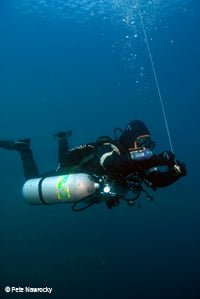
Diver in Sidemount Equipment
Diver in Sidemount Equipment Photo by Pete Nawrocky

Pete Nawrocky is on a mission.  He is interested in expanding divers options around the world by introducing them to open water side-mount diving.  When Pete is not using his rebreather, you will find him diving this way and telling everyone he meets that this is the only way to dive open circuit.
 Diving side mount is not a new concept; it was originally created by cave divers that had a need to safely penetrate narrow and confining spaces. In recent years, many open water divers have viewed side-mounting as the next step in their diving skill evolution. Much of this interest comes from the way the divers are able to divide the weight of the equipment. Preparing for a dive is different. The diver can carry the cylinders to the waters edge and leave them there. After suiting up in the appropriate thermal protection, you put on your harness/air cell combination that is independent of the cylinders. After entering the water, you attach the cylinders to the harness. 
One thing you might notice when looking at a side-mount diver is that the hose routing is completely different this is a result of the different methodology employed by these divers.  Each tank is independent and is used for different tasks.
 So why would an open water diver want to “dive side-mount?”  One reason is that as an alternative to twin cylinders, you can dive anywhere single cylinders are available.  This allows for longer bottom times where twin cylinders are not available.  Additionally, many side mount divers prefer carrying single bottles to the water rather than a set of manifolded, twin cylinders.
 Lamar Hires, President of Dive Rite discusses side mount diving in a series of videos.  You will find all of the videos on our youtube channel.  In this video, Lamar discusses why you might want to learn to sidemount diving: 

 There are some drawbacks to side-mount diving over twinset diving.  The redundancy prneuded by using manifolded twin cylinders is eliminated as is the simplicity of the system.  There are ways to manage the lack of redundancy which is taught in side-mounting programs.
 Learning to dive “side-mount” is more than just hanging two cylinders off of your BCD or harness system.  Learning how to deal with the bottles, donning and remneung them so as not to lose them in the water, and establishing a breathing regime are all part of a side-mounting training program.
 There is also some additional equipment needed to take advantage of this method of diving.  In looking at Dive Rite’s sytem, the Nomad XT sidemount rig is our “off road” model made with a super-tough exterior. The outer panels of the wing are engineered using SuperFabric® brand technology for optimum resistance to punctures and abrasions, while remaining very flexible.  It was built with the explorer in mind.  It has the added benefit of being a modular system: the harness, wing, butt-plate and crotch strap are all separate elements. This allows the traveling explorer (or any diver wishing to modify their rig) the ability to trade out wings, remove the buttplate or make any fit adjustments necessary to meet the objective of the dive mission.  Here are some divers using Pete’s preferred system.  While this video shows divers in a cave, this same system can be used while swimming on a reef or touring a wreck.

 To effectively mount the bottles on the harness you will need some bungee straps to keep the valves and bottles in position and make some other modifications to your kit.  You will also find yourself “kitting up” differently.  Because of  this, some additional training is necessary to do it correctly.  Learning to dive in a sidemount kit is not difficult, it is just different.  It takes some practice and some flexibility. 
_____________________________________________________________
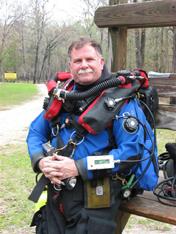
 
Pete Nawrocky: Pete is the Sales Manager for Dive Rite and is best known for his willingness to share his passion for diving with others. Pete has established quite a following of divers who enjoy his affable approach to teaching and Pete can be found at least once a month in the water with a group of divers who want to learn new techniques or try new equipment. Pete makes it a point to dive with all of his clients as often as possible; believing that diving is what builds lasting relationships and after all, is what draws everyone to this unique industry in the first place.
Filed Under: Open Circuit, Scuba Dive Training, Scuba Diving Equipment Tagged With: Bungee, Dive Rite, Nawrocky, Nomad, Sidemount

April 15, 2011 by Eric Keibler

Storage Solutions for Technical Divers – Pockets

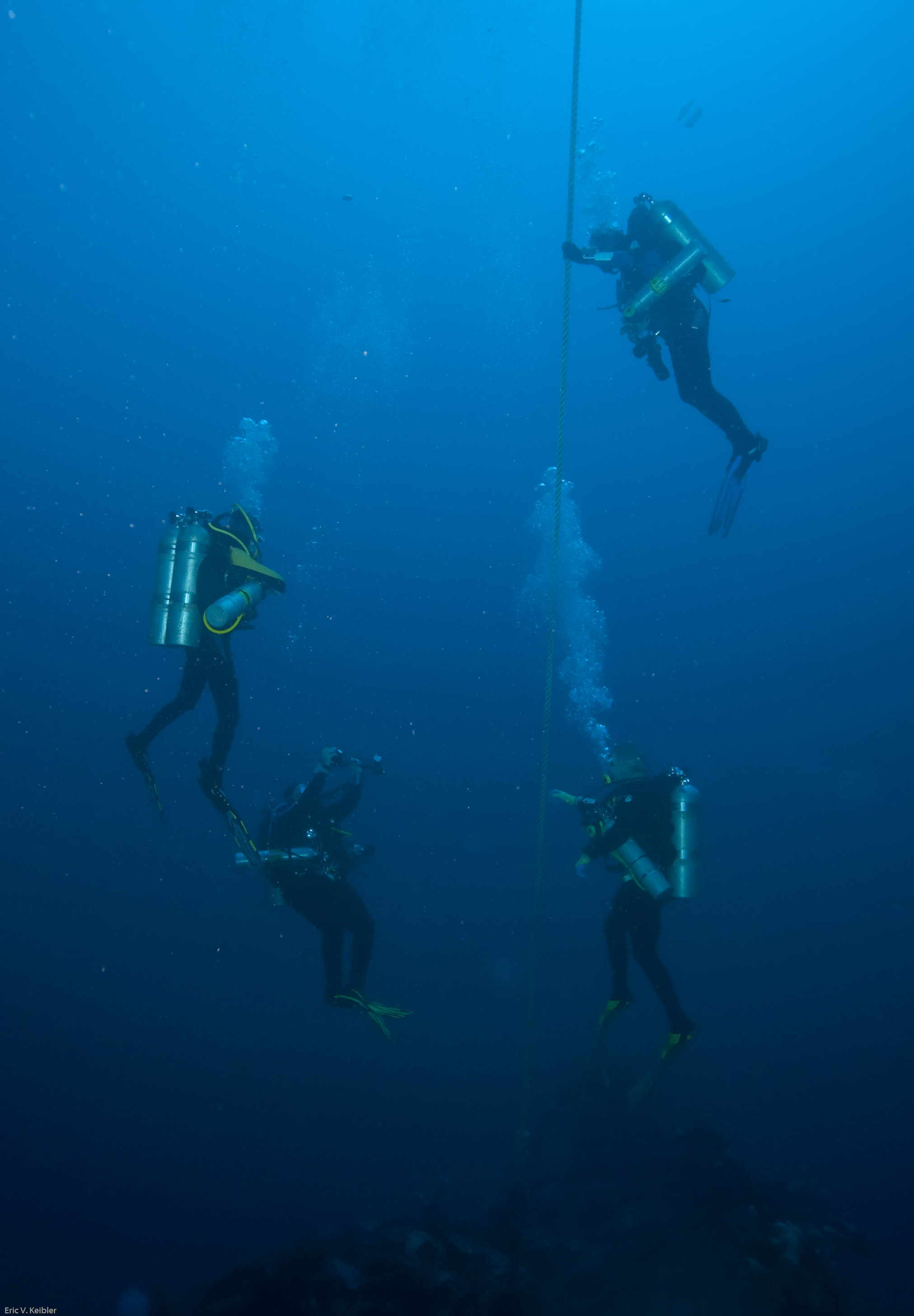
Divers on DecoPart of being a self-sufficient diver is having the necessary redundant life support equipment and safety equipment on with you on a dive.  This does not mean that you carry everything in your dive bag underwater with you, but rather, the items you need to execute the dive you have planned safely with back-up and safety equipment that you believe you will need or may need on the planned dive.  The items a technical diver might carry are:

  • Primary light
  • One or two back-up lights
  • Spare mask
  • Diver’s tool
  • Spare cutting tool (shears, knife, z-knife, etc)
  • Surface marker buoy (SMB)
  • Second SMB
  • Emergency SMB
  • Reel
  • Spool(s)
  • Whistle
  • Lifeline GPS radio
  • Strobes
  • Wet Notes
  • Slate
  • Bailout tables
  • Cable ties
  • Goodie bag
  • Lift Bag
  • Tools

 To safely carry these items underwater, you need to be able to store them out of the way.  We do this using bungee or inner tube on the straps for some things, bungee on the sides of the plate and or under the plate for others.
However, there is only so much room on the plate and straps, so adding pockets will give you more room to stow the equipment you have decided to carry.  There are a number of pocket styles that you can use with your kit.  The most widely used pockets are those that fit on the harness waist strap.  Horizontal pockets are the most traditional and are designed to carry flat items like slates, wet notes, small lights, whistles, etc.  Traditionally, they are not wide or long because of the limited “real estate” on the waist strap.  I am a fan of horizontal pockets but I do not carry too many items in a pocket. 
Another pocket style is a waist pocket with a vertical orientation.  These can either be thin like the horizontal pockets or bellows style pockets which expand to allow for more items to be placed inside.  Again, you still have the problem with limited “real estate” on the waist strap.  Some divers like vertical pockets and on some dives I have added a small spare mask pocket to the waist strap.
Dry suit divers discovered a solution to this lack of room on the waist belt years ago.  They added thigh pockets onto their suits.  You will now see wetsuit divers adding pockets to their suits as well.  Of course, if you have multiple suits you have to glue pockets on each suit.  One other thing to keep in mind is when your suit wears out, you have to cut off the pocket and re-glue it to your new suit. 

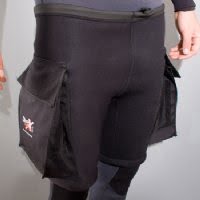
Dive X-Tras Shorts
Dive X-Tras Shorts
Another method of adding pockets to your wetsuit, is to use diving shorts with pockets included.  These shorts are basically neuprene shorts with two bellows pockets attached. 
The major problem with pockets on your thighs or hips is drag.  When these pockets are full, they add about two to four inches to your profile.  But remember, everything is a compromise and if you need the space, they are great to have but there is a trade-off.
Before deciding which system is right for you, you need to decide what items need to fit in the pockets. Do you need to carry flat items like slates and tables only or do you want to keep a spare mask and SMB handy? 
My personal choice is a horizontal pocket on the waist strap with the addition of other pockets as I need them.  While I have pockets on my drysuit, I only use them for small items like spare spools.  Your decision may be different based on your style of diving and how you want to store your equipment for a dive.

Filed Under: Open Circuit, Rebreathers, Scuba Diving Equipment Tagged With: buoyancy, Equipment, Pockets, Storage, Trim

December 16, 2010 by David Snyder

Technical Diving and Commitment

Now what would possess one to want to strap over 100 pounds of stuff onto their body and jump into water over their head? When you find the answer you have found a technical diver.
My answer was that I wanted to go to places that required that commitment. It all started when I first went to Bikini Atoll. Prior to our trip, I had heard about that Nitrox thing and since I knew we were going deep I decided to take a class. Well back in 1995 Nitrox was still a voodoo gas in many eyes. So after much searching I found someone to teach it. In addition to the Nitrox class we took a Deep Air class, sort of a introduction to decompression stop diving. Didn’t think we needed it, but what the heck. After completing the classes off to Bikini we went. We knew what we were doing now!
Well, all dives in Bikini are decompression stop dives. The average dive depth is 155 feet. After a week of this diving, had a great time, but we realized we did not have a clue and that clearly was not acceptable. So after our return, back to the dive shop we went and said we wanted to finish our training. Finish our training meant hypoxic trimix and cave.
At that point I had made the commitment to become a technical diver. After completion of the trimix and cave classes I was a certified cool tech diver, or was I? In the fullness of time I have realized that to truly be a technical diver you have to do technical dives. In order to do technical dives you have to want to do technical dives. So in the end the Why is because there is something down there you want to see and technical diving is how to see it safely.

Filed Under: Cave Diving, Open Circuit, Rebreathers, Scuba Diving Activities, Scuba Diving Equipment, Trimix Tagged With: Bikini, Nitrox, Technical Diving, Training, Trimix

September 6, 2008 by Eric Keibler

It's All Over

It is now Saturday and Tek Week 2008 has drawn to a close.  It started out a little tumultuous with Hurricane Gustov causing havoc in the Carribbean.  But as the winds moved on into the Gulf, memories were being made in Grand Cayman.


Ray Turek getting ready

My cadre of students finished their courses.  Ray Turek completed his Normoxic Trimix course and may have been convinced that CCR was the only way to dive deeper because you could stay longer.  Of course, he’ll now have to explain the need to his wife and then decide on which unit is right for him.  He certainly got to see a variety of units here this week.  Kim Smith from KISS rebreathers was here as was Peter Den Hann from Silent Diving Systems the North American distributer of the Evolution and Inspiration rebreathers.  Paul Rainmaker, designer of the rEvo rebreather was here showing off his new rebreather.  Then there were the divers themselves sporting a number of units including the Sentinel from VR technologies, several Inspirations, Evolutions, Evolution Plus’, an Optima, a Titan or two, a Megalodon, a few KISS Classics, a KISS Sport, and some rEvo’s.


While Ray was completing his Normoxic course, Madison Lee and Mark Nawman were working on their Trimix Course.  They ended their training on Friday with a 300 foot dive near Dolphin Drop-Off in the west bay.  All three of them received preliminary certificates at the closing session on Friday evening.


Madison ready to Go
Madison ready to Go

The training was a minor part of the week at least for me.  The best part was the diving.  Due to the winds from Gustov and Hanna, our diving was primarily off the West Bay portion of the island.  Of course, this is not a real problem since these walls are beautiful and the aquatic life is abundant.


Diving deep in Grand Cayman is a real treat because not only are the deep portions of the walls beautiful, but your decompression is spent on the walls as well.  This makes for a more entertaining stay and a more relaxed dive.


Coming up the coral canyons at Big tunnels treated us to more than 14 lobsters milling about and two chasing one another around the reef.  In Orange Canyon and at both Leslie’s Curl and Dolphin drop off we were treated to exhibitions by the ultimate free-divers – the turtles.  Rays and sharks greeted the divers on most dives and even the sharks made an appearance.


All in all it was a fun event and we had some great dives.  The staff at Cobalt Coast and DiveTech work hard to make these events special and they succeeded once again.

See the press release at https://www.caymannetnews.com/news-9858–1-1—.html


Tek Week Group
Tek Week Group
Ray Turek getting ready
Madison Lee
Madison Lee
Tek Week Group
Robert Hew Prebreathing
Eric with Bruce Partridge during the Rebreather Pool Demo

Filed Under: Caribbean, Open Circuit, Rebreathers, Scuba Diving Activities, Scuba Diving Equipment, Travel, Trimix

August 31, 2008 by Eric Keibler

Tek Week Update

Hurricane Gustov made the start of Tech Week in Grand Cayman a little interesting.  We spent much of the week following the hurricane tracking maps and models on Weather Underground, www.wunderground.com, and talking to people down here.


Saturday morning found us going to the airport on faith that the Cayman government would open the island to non-residents by the time our flight left.  I had spoken to Nat Robb early Saturday morning who indicated that this storm was more of a non-event for them (not true for the sister islands however).  They had some wind and little rain.


Arie, the owner of Cobalt Coast, called me at 11:15 to tell me that the government on Grand Cayman had given the “all clear” and that visitors could now return to the island.  Of course Continental had not received the message as quickly – the gate agent infomed me that “they were the airline” and it was up to them.  However, the supervisors at Continental quickly cleared the flight for visitors with confirmed reservations (of course they wanted to see a printed confirmation…).  After getting a number from Arie (just in case someone needed to confirm it with him) we were on our way.


Things were a little out of sorts and most of the windows on the island were boarded up as were some of the windows at Cobalt Coast and Dive Tech.  The benches were pushed together and the dock was a little worse for wear.  The most surprising thing was to see all of the Dive Tech cylinders in front of Cobalt Coast—lots of cylinders.


This morning the staff showed up and things were pulled out, moved swept and by lunch time you would never have known there was a storm except for the pier which by the end of the day was ¾ repaired – the only thing that stopped Jay and his crew was the fact that they ran out of wood and it was Sunday so getting more was not possible.


Nancy and the staff, pulled the boats out of the mangroves, cleaned them up, re-equipped them and toured possible dive sites by 12:00.  By 1:00 we were diving on the North wall.  The water heading out was a little green and the visibility at the dive site was not more than 60’ but we had a nice enjoyable dive, with Ray Turek completing his skills for his Normoxic Trimix course and Madison Lee learning more about free diving or breath-hold diving from Simon.


At last count 16 people canceled mostly because getting here at a different time or on a different day made it impossible.  But, 33 participants still agreed to come and at least ½ of them were here by dinner time.


The seas should continue to lay down overnight and Nancy is predicting that shore diving off Cobalt will be available by tomorrow.  Tomorrow’s dive plan calls for a 200 foot dive for Madison and Ray. 

Filed Under: Caribbean, Open Circuit, Rebreather, Rebreathers, Scuba Diving Activities, Scuba Diving Equipment, Travel, Trimix

August 24, 2008 by Eric Keibler

Coral Sex

Dive Mom, Wade and Ashton have just returned from the last Gulf Coral Spawning trip aboard the M/V Spree.  They all had a great time and got in a lot of diving.  Here’s Captain Frank’s comments:


5 folks didn’t show for the 2008 coral spawn, which made the boat a little more comfortable for the 19 who assembled at the dock on Wednesday night for a lumpy ride out to the East bank. The plan was to go to the East bank first, dive 1 or 2 there, do a rig, then wander off to the West bank to stay away from the filming that was taking place at the East bank. Alas, all good plans tend to be shot down by the rules nature dictates. The current was ripping on the West bank and would for the entire spawning time.


We arrived at the East bank and tied to Buoy 6. After 2 dives, I determined that the conditions were a little rougher than I wanted to contend with a rig, so we moved to Buoy 6 for the duration of the week. Current was noticeable in the morning, water temp was 84 degrees, waves were the biggest 1-3’s I’ve ever seen (more like 2-5’s), air temp was in the 80’s to 90’s, visibility was pretty good at 100 feet, and there was evil stinging crap in the water. Those without wetsuits are tougher than I am.


The entire week we were treated to a manta ray that kept coming back. I’m sure this is the same ray that has been here most of the summer. She seems to be curious about divers, but does not come close enough to touch She was mostly feeding, with her cephalic fins unfurled, and doing barrel rolls under the boat. The divers got lots of photographs of a marbled grouper defending his (or her) hole in the coral, since 4 days were spent on one site, the divers got to know it very well. They found the tiny nudibranchs we have here, painted alysias, as well as Ann’s favorite character from Star Wars, Jah Jah Binks (also known as a red-lipped blenny), mustached jawfish, yellow-headed jawfish, sharks of unknown varieties, and a strange blue glow from under the Fling. The Fling had a feature film crew onboard, and their lights made the ocean glow with the coolest blue color ever.


The big show was supposed to be Friday night, but only a little spawning activity was seen. Saturday night, however, was the big show. Spawning was scheduled for 9 PM, I got in at *:45 to watch for the start and signal Melanie to jump divers. At 9:05, right on schedule, the brains started. Soon after, the male cavernosa (large boulder coral) had their thing on. I came up before Franksii (small boulder coral) did their thing, but the divers were all in for that.


All in all, it was a good spawn, not the best ever, but Manuel (who has done this 5 times) said it is the best he has ever seen. Everyone saw it happen, and the guys all remarked how soft their hair was.


Sunday morning we moved to Stetson Bank. Current was coming up the wall, visibility was 100+, and all the fish were out on grand parade. The divers spotted Sailfin blennies, ubiquitous undefined sharks, rays of many descriptions, mantis shrimp,  scorpion fish, deer cowries, and “dancing” angel fish. CP was surrounded by 5-7 sandbar sharks, a spotted eagle ray, southern stingrays, and a manta. The guests continued to rave about the coral spawn.


It’s sad to see our last coral spawn in the Flower Gardens go under our belts, but we’re looking forward to two of them next year in the Dry Tortugas.


Captain Frank

M/V Spree

Freeport, Texas


See you in the Dry Tortugas!

Filed Under: Digital, Gulf Diving, Open Circuit, Photography, Scuba Diving Activities, Scuba Diving Equipment, Travel, Underwater

  • « Go to Previous Page
  • Page 1
  • Page 2
  • Page 3
  • Page 4
  • Page 5
  • Go to Next Page »

Footer

Contact Us

Oceanic Ventures, Inc
5808 Newcastle Dr.
Houston, TX 77401-3214
USA

Phone: 713-523-DIVE (3483)

eMail: divesafe@oceanicventures.net

Signup for our dive and scuba newsletters

Don’t miss news about the exciting happenings at Oceanic Ventures.


Map and Directions

Socialize

  • Email
  • Facebook

Why People Choose Us

People choose their friends carefully just as they should choose their adventure partners and Scuba Diving Instructors.  Oceanic Ventures is the premier scuba dive shop in Houston, Texas, and the Southwest because of our exceptional service and our sense of adventure.  In talking with our clients and friends, people choose us for a number of reasons such as: Passion – We love what we do and we want to share the beauty and excitement of the underwater world with everyone we meet. Caring- Our clients tell us they love us because we truly care about people and strive to make their scuba diving experiences safe, fun and enjoyable. Professional – Our staff members are the … [Read more …]

Copyright © 2026 all rights reserved Oceanic Ventures, Inc. · Sitemap · Log in